Skip to content
    • About

SOCIAL PERSPECTIVES

  • Buying Ice, Selling Power: America’s Arctic Appetite and the Quiet Logic Behind the Greenland Obsession

    January 16th, 2026

    The renewed American fixation on Greenland is neither a diplomatic curiosity nor a momentary rhetorical excess. It reflects a deeper strategic impulse—one shaped by intensifying great-power rivalry, mounting security anxiety, and a residual imperial logic recast in contemporary strategic language. When President Donald Trump asserted that the United States “needs Greenland from the standpoint of national security,” he was not merely referencing a remote Arctic landmass. He was articulating a worldview in which geography is destiny, alliances are contingent, and sovereignty becomes negotiable when power asymmetries allow it.

    Greenland, the world’s largest island, occupies a uniquely consequential position at the crossroads of North America, Europe, and the Arctic. Militarily, it anchors the northern flank of the Atlantic world, sitting astride missile trajectories, submarine routes, early-warning systems, and rapidly opening Arctic sea lanes. As climate change melts polar ice, what was once a frozen periphery is emerging as strategic core territory. From Washington’s vantage point, any possibility of Russian or Chinese influence in such a space is perceived not as a distant risk but as an unacceptable vulnerability. The Arctic, long marginal to global strategy, is now central to future contestation over surveillance, deterrence, and control of the global commons.

    Official American rhetoric frames this concern as defensive rather than acquisitive. Trump’s repeated insistence that failure to secure Greenland would invite Russian or Chinese dominance carefully distinguishes between peoples and governments, portraying the United States as a reluctant custodian of stability rather than an assertive power. This framing is strategic. It allows Washington to claim moral high ground while advancing a pre-emptive logic: action is justified not by immediate threat, but by the possibility that others might act first.

    Yet this reasoning exposes a fundamental contradiction. Greenland is not terra nullius. It is a self-governing society with elected institutions, multiple political parties, and democratic agency within the Kingdom of Denmark. Any serious security argument that marginalizes the explicit consent of Greenland’s people reveals the fragility of its moral foundation. When sovereignty is discussed in abstraction from popular will, the language of protection slips unmistakably into the logic of possession.

    The strategic calculus extends well beyond missiles and radar installations. Effective American control over Greenland would consolidate dominance over the Arctic, secure NATO’s northern gateway under Washington’s direct influence, and foreclose Chinese economic entry into critical sectors such as rare-earth mining and infrastructure. It would also constrain Russia’s strategic maneuverability in an increasingly militarized polar region. In this sense, Greenland is less an end in itself than a keystone: control it, and the balance of power across the northern hemisphere tilts decisively.

    This episode also signals a broader transformation in American statecraft. The post-war United States traditionally projected power through institutions, alliances, and shared norms. The Greenland discourse suggests a shift toward transactional geopolitics, where territory is treated as a strategic asset and alliances as potential encumbrances rather than force multipliers. Trump’s language often echoes that of commercial real estate rather than diplomatic stewardship: some locations are simply too valuable to be left in other hands, too important to entrust to mutual trust.

    Ironically, this logic undermines the very alliance system it purports to protect. Denmark is not a rival power but a NATO ally. Greenland already hosts American military facilities under mutually agreed arrangements. Even implicit threats of annexation transform partnership into coercion and cooperation into suspicion. European responses have therefore been unusually firm and unified, emphasizing that Greenland’s future belongs to its people and warning that pressure or force would fracture the Atlantic alliance itself.

    From Greenland’s own perspective, American attention often feels less like protection than erasure. While aspirations for eventual independence from Denmark exist, overwhelming majorities reject incorporation into the United States. Treating security imperatives as overriding local self-determination resurrects uncomfortable colonial precedents, in which distant powers justified decisive intervention as necessary for order and stability.

    Beyond the Arctic, a wider global audience is paying close attention. If the United States can openly contemplate acquiring territory from a democratic ally, its moral authority to oppose similar actions elsewhere is significantly weakened. The rules-based international order—already under strain—loses further credibility when its principal architect signals that consent is secondary to strategic convenience.

    Ultimately, the Greenland fixation is less about ice than about identity. It reflects an America increasingly comfortable with unilateralism, increasingly skeptical of restraint, and increasingly convinced that security requires ownership rather than cooperation. Whether or not Greenland is ever formally “taken,” the intent alone carries consequences: it accelerates European strategic autonomy, emboldens rival powers, and reinforces a global perception of American unpredictability.

    Greenland—vast, silent, and strategically pivotal—has become a mirror. In it, the world sees not only America’s Arctic ambitions, but its evolving conception of power itself: one that privileges control over consensus, possession over partnership, and security defined not by shared rules, but by who ultimately holds the map.

    Visit arjasrikanth.in for more insights

  • “Blood on the Harvest: Roosters Dying for Our Amusement Exposes the Darkest Pleasure of Civilized Society”

    January 15th, 2026

    Every Sankranti, a festival intended to celebrate harvest, renewal, and gratitude to the land, Andhra Pradesh stages a darker, largely unspoken counter-ritual beneath its festive glare. Paddy fields are repurposed as arenas, roosters are sharpened into instruments of violence, and abundance is converted into blood. Cockfighting—Kodi Pandem—no longer survives as a residual rural custom; it prospers as a meticulously organised underground economy worth an estimated ₹500 crore, compressed into three days of sanctioned excess. With nearly 400 breeding centers, over seven lakh roosters traded annually, and individual birds priced between ₹25,000 and ₹3 lakh, cruelty here is not incidental. It is systematized, priced, and professionally managed, marketed as “tradition” while functioning as a high-yield spectacle of engineered violence.

    The sheer scale dissolves any lingering romanticism. Hundreds of fighting pits operate across East and West Godavari and Krishna districts, drawing lakhs of spectators and gamblers from across the state and beyond. Single bouts routinely attract bets of ₹10 lakh, while entire venues circulate crores each day through cockfights, card games, and dice tables operating alongside. The birds are bred for aggression, isolated, protein-loaded, sometimes drugged, and forced into endurance regimens—swimming included—before razor-sharp blades are tied to their legs. Death is not an aberration but an expectation. Losing birds are often slaughtered and sold at premium prices, completing a grotesque economic loop where suffering is monetised twice over. All of this violates the Prevention of Cruelty to Animals Act, 1960, and the Andhra Pradesh Gaming Act, 1974, yet enforcement collapses annually under the combined weight of social acceptance and political protection.

    What sustains this industry is not ignorance of the law but accommodation by power. High-stake events are frequently organised by political loyalists, sometimes with elected representatives in attendance, while police presence is neutralised through bribes, selective blindness, or logistical overwhelm. Organising a major venue costs several lakhs—covering tents, bouncers, and “arrangements”—an investment recovered many times over through betting. Each year, police seize thousands of knives and register hundreds of cases, yet the ritual resumes with clockwork certainty. Even senior officers privately acknowledge that cockfighting has acquired social legitimacy, not unlike Jallikattu. When prestige, money, and electoral arithmetic converge, legality becomes negotiable and cruelty acquires immunity.

    Yet Kodi Pandem is not uniquely Telugu; it is profoundly human. From the legal Sabong arenas of the Philippines to bullfighting in Spain, camel wrestling in Turkey, dogfighting rings across continents, and bear baiting in South Asia, societies repeatedly convert animal pain into public entertainment. The architecture is remarkably consistent: ritual justification, high economic stakes, masculine pride, and the crowd’s visceral thrill when blood confirms dominance. Animals become proxy battlefields where humans rehearse power, rivalry, and control without moral cost. The suffering is not a by-product of the spectacle; it is the spectacle.

    Psychologically, such blood sports offer a socially sanctioned outlet for suppressed aggression and status anxiety. Gambling intensifies the experience by converting violence into adrenaline and profit. The rooster becomes an extension of its owner’s ego—victories mythologized, defeats avenged through higher stakes and sharper blades. Technology has only refined this cruelty. Buyers now select birds through video calls; breeders sell across states and borders; money moves digitally. What was once local and intimate has become networked, efficient, and scalable. Distance dulls empathy, making violence easier to consume.

    The tragedy is that prohibition alone has proven inadequate against a practice sustained by appetite. Annual bans, court orders, and police assurances remain performative when confronted by cultural sanction and economic gravity. Meanwhile, the collateral damage accumulates quietly: families ruined by gambling losses, spikes in alcohol abuse, public health risks from unregulated animal movement, and a broader social desensitization to cruelty. A ritual once embedded in agrarian life now carries criminal, financial, and moral costs far beyond its festive frame.

    The deeper question, then, is not whether cockfighting is illegal—it is—but why societies continue to crave such spectacles. Sankranti does not require blood to endure. Its essence—gratitude for harvest, community bonding, reverence for life—can thrive through non-violent rural sports, cultural performances, kite festivals, and breeding exhibitions without blades. Until we confront the uncomfortable truth that cruelty remains entertaining when wrapped in tradition and money, animal bloodsports will keep resurfacing in new forms. The roosters merely expose what we would rather not acknowledge: that beneath our festivals and progress, suffering still draws applause—and the crowd has not yet looked away.

    Visit arjasrikanth.in for more insights

  • Crude Alchemy and the Art of Profiting from Chaos: Jamnagar Turned War, Sanctions, and Morality into a High-Octane Business Model

    January 14th, 2026

    In the wreckage of the Russia–Ukraine war—amid moral outrage, sweeping sanctions, and choreographed condemnations—an unlikely axis of global energy power quietly consolidated itself on India’s western coast. Jamnagar, home to the world’s largest refining complex, became the crucible where geopolitics was reduced to chemistry and recomposed as profit. As Europe pledged moral separation from Russian oil and Washington weaponized sanctions, Reliance Industries confronted an uncomfortable modern reality: energy markets do not respond to ethics; they respond to price, scale, and engineering. What followed was not illegality but something far more disquieting—a flawless exploitation of a fragmented global order, where discounted Russian crude was legally transformed into premium European fuel and war became an input variable in an industrial equation.

    The logic was stark. Sanctions disrupted demand patterns, not demand itself. Russian crude, exiled from Western markets, traded at steep discounts. India, unconstrained by Western sanctions, absorbed the supply. Reliance, equipped with one of the world’s most complex refineries, became the processor of choice. Before the war, Russian oil accounted for roughly 3 percent of Jamnagar’s intake. By 2025, it approached 50 percent. Cheap Urals crude entered the system; high-value diesel, petrol, jet fuel, and blending components emerged—products stripped of national origin. Once refined, the oil carried no geopolitical DNA. It flowed legally into Europe and the United States, jurisdictions that had sanctioned Moscow in principle while continuing to consume its molecules in practice.

    This outcome was not a loophole; it was a structural exposure. Western sanctions were designed for a linear world where supply chains obey intent. Jamnagar demonstrated the fallacy. From early 2023 onward, Reliance exported close to $86 billion in refined petroleum products, with approximately 42 percent destined for countries that had formally sanctioned Russia. The European Union absorbed tens of billions in imports; the United States became the single largest buyer by volume. Europe effectively outsourced its refining dilemma to India, paid a premium for the end product, and preserved the appearance of ethical compliance. Russia sold its crude. Reliance captured the margin. The war economy adapted seamlessly.

    Washington’s response was predictably indignant. American rhetoric framed the trade as indirect financing of Russia’s war, accompanied by tariffs and political theatre. Yet the outrage revealed an uncomfortable hypocrisy. The same economies criticising India continued importing fuel refined from Russian crude because severing that flow would have triggered price spikes and domestic instability. Sanctions thus became performative—morally resonant, economically permeable.

    Reliance did not violate the rules; it mastered their internal contradictions. The deeper discomfort lay in the exposure of declining Western leverage in a multipolar energy system.

    For India, the calculus was unapologetically strategic. Discounted crude tempered inflation, strengthened the current account, and enhanced energy security amid global volatility. Non-alignment, legacy ties with Moscow, and strict legal compliance provided diplomatic cover. Reliance, meanwhile, capitalized on its scale, technology, and export-oriented design. Unlike public-sector refiners focused on domestic supply, Jamnagar was engineered for precisely this environment—high complexity, global reach, and the capacity to arbitrage geopolitics itself. What critics term “sanctions laundering,” admirers call industrial sophistication. Both interpretations are accurate.

    Yet this model rests on fragile tolerances. The European Union’s impending restrictions on refined products derived from Russian crude threaten to disrupt the equilibrium if enforced rigorously. More than half of Reliance’s jet fuel exports have flowed to Europe; a clampdown would necessitate swift strategic recalibration. Add to this volatile price caps, uncertain Russian supply contracts, and the spectre of secondary sanctions, and Jamnagar’s success appears less permanent than contingent—balanced precariously between legality, tolerance, and global inconsistency.

    Ultimately, Jamnagar is not a story of corporate cynicism or national betrayal. It is a case study in contemporary power. In today’s world, influence does not belong to those who proclaim values, but to those who understand how systems behave under stress. Reliance did not design the war, the sanctions, or Europe’s dependency. It optimized them. The refinery stands as a monument to a post-moral global economy where disorder generates value and neutrality itself becomes a profit center. The real question is not why Jamnagar thrived—but why anyone expected a system built on contradictions to produce a different outcome.

    Visit arjasrikanth.in for more insights

  • Raid, Retrieve, Revolt:  Laptops, Law and the Republic Collided in Bengal

    January 13th, 2026

    What began as a procedural enforcement action mutated, almost overnight, into one of the most intellectually disquieting political episodes of contemporary India—a moment where laptops stood in for sovereignty, raids resembled street theatre, and the Constitution seemed to pause, unsure whether it was being interpreted or openly tested. The Enforcement Directorate’s January raids on premises linked to I-PAC, a private political consultancy advising the Congress alliance in West Bengal, were remarkable not merely for targeting a non-governmental political actor, but for what followed: a Chief Minister walking into a raid location, exiting with a laptop and files, and daring the Republic to clarify where authority truly resides.

    Formally, the raids were tethered to the long-running coal smuggling case registered by the CBI in 2020, involving illegal extraction and diversion of coal from Eastern Coalfields Limited. Over time, the investigation widened to alleged hawala channels and money laundering, bringing the ED into the frame. The case was neither new nor peripheral. It had already brushed against powerful political interests in Bengal, including individuals close to the Chief Minister, making it a combustible mix of crime, capital, and influence. But until that day, it was still recognisably a legal process.

    The transformation from investigation to constitutional flashpoint occurred on the ground. ED officials attempting searches reportedly found themselves obstructed—local police present, central forces stalled, and access contested. Then came the optics that altered the narrative irreversibly: the arrival of Kolkata’s Police Commissioner, followed by Mamata Banerjee herself. A sitting Chief Minister entering a raid site, staying briefly, and leaving with a laptop and a green folder—later described as confidential political strategy documents—was not symbolic defiance alone. It was a performative assertion that political authority could physically intervene in an ongoing investigation.

    Banerjee’s defence was unapologetically political. She framed the raids as a covert attempt to access opposition election strategies ahead of impending polls, portraying the Centre as weaponizing investigative agencies to sabotage democratic competition. In her account, the seized materials were not evidence but intellectual property, essential to electoral fairness. The ED’s narrative could not be more different. It alleges that potential evidence was forcibly removed in the presence of senior state officials, irreparably compromising the probe. The agency’s unusually sharp language—describing the incident as a “showdown” and an act of obstruction—signals how seriously it views the challenge.

    The confrontation has now ascended to the Supreme Court. The ED has invoked Article 32, arguing that its right to conduct an independent investigation has been violated by a state government. This is an extraordinary claim, reflecting how far institutional conflict has travelled. Simultaneously, the West Bengal government has mounted a multi-front response: police complaints against ED officers, a state-level probe into alleged procedural violations, public protests led by the Chief Minister herself, and a caveat in the Supreme Court to ensure the State is heard before any adverse order. Parallel proceedings in the Calcutta High Court further complicate an already crowded legal battlefield.

    Stripped of personalities, the episode exposes a structural unease at the heart of India’s federal democracy. Policing is constitutionally a State subject; central agencies derive authority from special statutes that often stretch federal sensibilities. West Bengal’s withdrawal of general consent to the CBI years ago reflected a broader opposition anxiety about political misuse. While the ED does not require such consent under the Prevention of Money Laundering Act, its expanding footprint has generated similar resistance. The result is legality without legitimacy, power without consensus.

    Data intensifies the discomfort. Patterns in recent years show a disproportionate number of investigations involving opposition leaders, frequently surfacing near elections. Even if legally tenable, such timing corrodes public trust. Yet the counter-response—elected governments physically obstructing raids, intimidating officers, or removing material under scrutiny—does equal damage. In this collision, neither side emerges institutionally intact. Agencies appear partisan; governments appear lawless; citizens are left choosing between competing claims of victimhood.

    The judiciary now stands as the reluctant referee. Its eventual ruling will resonate far beyond the fate of a laptop or a folder. A verdict favouring the State may embolden resistance to central agencies across opposition-ruled states; a verdict favouring the Centre risks normalising coercive federalism. Either way, the judgment will recalibrate the grammar of Centre–State relations.

    What makes the moment genuinely unsettling is its creeping normalisation. Raids interrupted by political mobilization, investigations dismissed as electoral conspiracies, and constitutional remedies deployed as tactical weapons are no longer aberrations; they are becoming routine. When every institution is suspect and every action is politicized, governance collapses into perpetual confrontation.

    The I-PAC episode is not an outlier. It is a mirror held up to a Republic struggling to decide where law ends and power begins. If restraint, institutional respect, and democratic maturity do not return to the center of public life, today it is laptops and files. Tomorrow, it may be something far more foundational that is carried out of the room.

    visit arjasrikanth.in for for more insights

  • A Nation Goes Offline and a Currency Goes into Free Fall: Iran’s Digital Darkness Meets Economic Despair

    January 12th, 2026

    Iran today stands at a rare and dangerous intersection where economic collapse, political rigidity, and digital repression converge into a single national crisis. The country is not merely experiencing protests; it is living through a moment when the basic operating systems of modern life—currency and connectivity—are simultaneously failing. As the rial continues its relentless plunge and the internet is periodically switched off, the Iranian state appears caught in a paradox of its own making: hyper-aware of global pressures yet increasingly disconnected from its own society. What unfolds on the streets is not sudden rage but accumulated despair, finally stripped of restraint.

    At the heart of the unrest lies a brutally simple truth: economic arithmetic has become unbearable. Iran’s currency has been losing value steadily for years, eroding wages, savings, and dignity with mechanical cruelty. Inflation hovering around 40 percent, and far higher for food and essentials, has turned daily life into a calculation of survival. When citizens can no longer price tomorrow, governance itself loses credibility. Rising costs of cooking oil, rent, transport, and medicine are not abstract statistics; they are intimate violations of household stability. In this context, public acts of anger—tearing down symbols, defying authority—are less ideological statements than moral indictments. The social contract, in the public mind, has already been broken by the state’s inability to protect economic life.

    What makes this phase uniquely threatening to the system is the identity of those who first protested. Bazaar merchants, historically central to Iran’s economic and political architecture, have traditionally functioned as a stabilizing force rather than a disruptive one. When shop shutters come down in protest, it signals not peripheral unrest but internal fracture. These are not groups demanding marginal concessions; they are stakeholders questioning the competence and direction of the state itself. Once the commercial backbone withdraws confidence, the legitimacy crisis deepens. The protests thus reflect not only public anger but elite disillusionment—an erosion from within that authoritarian systems find hardest to contain.

    Economic distress has rapidly expanded into open political defiance. Protest slogans have moved beyond complaints of mismanagement to direct challenges to authority and ideology. Calls questioning the Supreme Leader’s legitimacy, expressions of nostalgia for pre-revolutionary stability, and demands for systemic change reflect a society that no longer believes reform is achievable within existing structures. This is not episodic unrest triggered by a single policy error; it is the cumulative exhaustion of a population worn down by sanctions, corruption, repression, and the repeated failure of promised relief. Hope has not merely faded—it has been discredited.

    The state’s response follows a familiar but increasingly brittle pattern: securitization and silence. Security forces dominate public spaces while information flows are choked. The internet blackout is not a technical contingency; it is a deliberate political instrument. By severing connectivity, the state aims to disrupt protest coordination, block visual evidence from reaching the world, and isolate citizens psychologically from one another. Digital darkness becomes collective punishment. Yet this tactic reveals anxiety more than strength. Confident governments communicate; insecure ones censor. In an economy already weakened, shutting down the internet inflicts additional damage—crippling commerce, banking, logistics, and livelihoods. Each hour offline compounds resentment, turning control into self-inflicted harm.

    External reactions add another combustible layer. Statements of concern and condemnation from Western capitals provide symbolic encouragement to protesters but simultaneously offer the regime a familiar narrative of foreign interference. Framing dissent as externally orchestrated subversion has historically helped consolidate internal control. But its credibility is thinning. When inflation empties kitchens and unemployment corrodes self-worth, foreign conspiracies lose explanatory power. Economic pain is too immediate, too personal, to be dismissed as imported agitation. Nationalist deflection may still mobilise security elites, but it no longer persuades ordinary citizens.

    What ultimately emerges is a state governing increasingly through coercion rather than consent, trapped in a narrowing corridor of options. Repression risks escalation; economic concessions require resources and reforms the system is structurally reluctant to provide. Meanwhile, the protest movement itself remains broad and emotionally unified yet organizationally fragmented. Leaderless movements are difficult to decapitate but also struggle to convert street energy into political outcomes—especially under communication blackouts. Still, the persistence of unrest across regions, classes, and ideologies suggests something deeper than coordination: a shared recognition that the future has been foreclose.

    Iran has survived protests before, but this moment is distinct. Currency collapse mirrors moral collapse; digital isolation reflects political isolation. Even if streets are cleared and connectivity restored, the rupture endures. A population can be forced into silence, but it cannot be compelled back into belief. When a nation is unplugged while its money turns to dust, the damage is not temporary—it is remembered. And that memory, more than any slogan, is what makes this crisis a warning rather than an episode.

    visit arjasrikanth.in for more insights

  • One Decision, One Desert, One Factory—and an Entire Region Rewired

    January 11th, 2026

    In a land where drought dictated destiny and migration became a rite of passage, the idea that global manufacturing could take root sounded almost utopian. This was a geography known more for empty bus stands than factory gates, more for seasonal despair than permanent opportunity. Yet history sometimes bends not through chance, but through vision backed by nerve. What unfolded here was not an industrial accident or a corporate gamble; it was a deliberate act of statecraft. Chandrababu Naidu, leading a newly formed and economically anxious Andhra Pradesh, chose to defy both geography and conventional wisdom by planting a world-class manufacturing ecosystem in one of the state’s most backward regions—and then ensured it succeeded.

    The audacity lay not merely in attracting a global automobile manufacturer, but in deciding where to place it. In 2015, when most policymakers chased safe coastal belts or urban peripheries, Naidu looked inward, toward a drought-scarred, migration-prone district crying for structural change. Land was allotted, credibility was pledged, and risks were absorbed long before headlines followed. This was infrastructure-first economics in its purest form—build confidence first, capital will follow. At a time when the state itself was still defining its fiscal and administrative spine, Naidu wagered that execution, not incentives, would be the real differentiator.

    Industrial revolutions are rarely triggered by factories alone; they are born from invisible enablers. Water in a dry zone is not a facility—it is faith. Power is not supply—it is assurance. Roads are not concrete—they are commitments. What separated this project from countless MoUs was speed with seriousness. A reservoir was completed to guarantee water in a region long accustomed to scarcity. Dual power lines ensured uninterrupted electricity where outages were once routine. Roads, logistics corridors, and civil works moved with a sense of urgency unheard of in backward districts. In under fourteen months, a full-scale manufacturing complex rose from scrubland. Within two years, production began—not ceremonially, but competitively, aligned with global benchmarks. The message was unmistakable: backward regions fail not due to lack of potential, but due to lack of execution.

    Today, one car rolls out every minute, and over three lakh vehicles are produced annually. Yet the true output is not measured in units, but in lives restructured. Tens of thousands of jobs—predominantly for local youth—emerged directly, many of them first-generation industrial workers who had never imagined a shop floor as a career destination. Around this core grew an ecosystem alive with motion: ancillary units, supplier parks, logistics hubs, training institutes, transport services, and small businesses feeding off continuous economic energy. Drivers became entrepreneurs, helpers became supervisors, and migration quietly reversed—not through subsidies, but through dignity.

    The transformation radiated outward. A sixty-kilometre radius that once symbolised stagnation now hums with economic confidence. Land values multiplied, rentals surged, housing layouts mushroomed, and retail followed employment. Infrastructure built for industry lifted communities wholesale—better roads improved connectivity, reliable power altered daily life, and water access expanded beyond factory gates. Hospitals, schools, restaurants, and skill centres followed people, not policies. This was not industrialisation that displaced geography; it reorganised it. A backward district became a reference point, studied by investors and planners across India.

    Social change followed economic certainty. Women entered shop floors in significant numbers, challenging inherited norms and reshaping household aspirations. Families invested more aggressively in education, especially technical skills. Exposure to global manufacturing culture altered attitudes toward punctuality, quality, safety, and teamwork. Rising incomes translated into better healthcare, improved housing, and cultural confidence. Corporate social responsibility complemented public effort—supporting education, health, water conservation, and afforestation in one of the state’s most stressed ecological zones. This was not industry as extraction; it was industry as integration.

    Critics rightly point to challenges. Growth clustered around a single anchor risks uneven development if not replicated elsewhere. Rising land prices strain affordability for those outside the ecosystem. Dependence on one major industry demands diversification into allied manufacturing and services. Agriculture faced labour shifts, and skill mismatches required correction. These are not indictments; they are predictable side effects of rapid transformation. 

    What matters is that such challenges are manageable—and worth managing—because the alternative is permanent backwardness.

    The deeper lesson transcends one factory or one district. It proves that regional inequality is not destiny, that geography is negotiable, and that political vision, when matched with administrative speed, can rewrite economic maps. Chandrababu Naidu’s approach demonstrated that manufacturing need not chase existing prosperity; it can be sent to create it. If replicated deliberately across regions, such ecosystems can become growth poles lifting entire hinterlands.

    This story is not about automobiles. It is about intent with courage. It is about believing that backward regions deserve first-class infrastructure, not leftover schemes. And it is about a leadership philosophy that understands a simple truth: when vision meets execution, even a desert can learn to assemble the future—one car at a time.

    visit arjasrikanth.in for more insights

  • From File Notes to Firestorms: Retired Babus  Finally Speak and the System Starts Listening

    January 10th, 2026

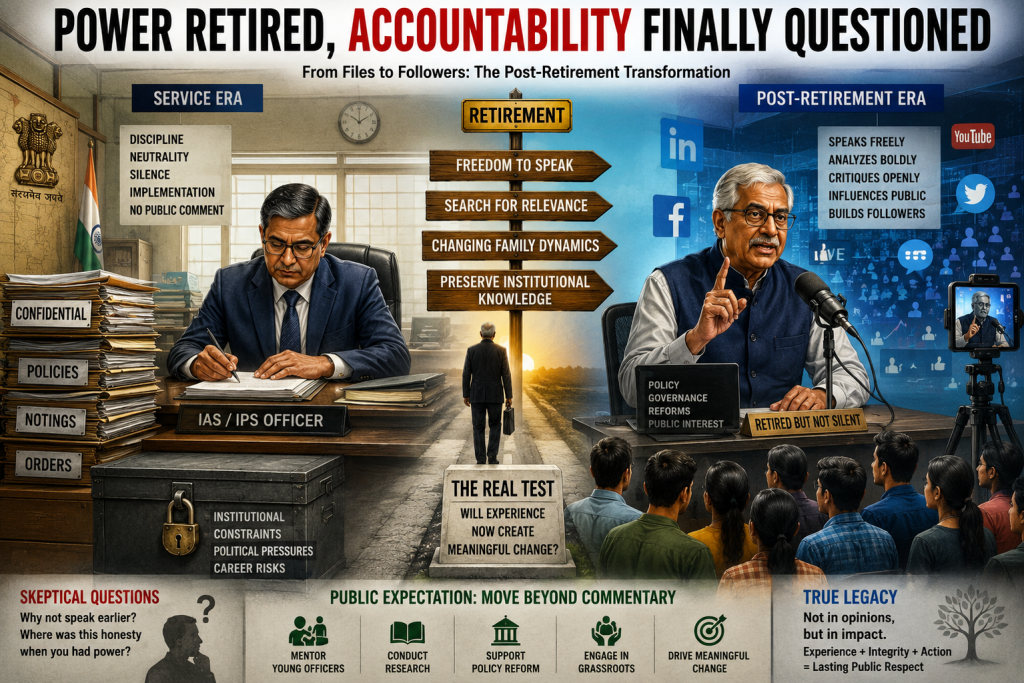
    India is living through a peculiar democratic moment where the once-invisible steel frame of the state has discovered a public voice—often sharp, impatient, and unapologetically political. Retired IAS and IPS officers, long trained in discretion and procedural restraint, are now prominent actors in social media debates, television studios, public lectures, and political commentary. Many of them speak in tones that are openly critical of governments, policies, and political leadership. To some, this feels like a moral awakening delayed by service rules; to others, it resembles activism that begins only after the security of pension and protocol is assured. What is undeniable, however, is that India’s bureaucracy is no longer retiring quietly—it is renegotiating its relevance in the public sphere.

    This transformation did not occur in a vacuum. For decades, Indian civil servants have functioned within one of the most tightly controlled professional ecosystems in a democracy. Conduct Rules prohibit public criticism of government policy. Neutrality is not merely an ethical expectation but an enforceable obligation. Transfers, stalled careers, vigilance inquiries, and reputational damage act as constant reminders of the cost of dissent. The Official Secrets Act further ensures that transparency is fraught with legal risk. Within such a structure, silence is not personal cowardice; it is institutional conditioning.

    Retirement, therefore, does not create conscience—it releases it. What surfaces afterward is often a backlog of observations, frustrations, and moral discomfort accumulated over an entire career.

    History shows that when bureaucratic authority is combined with genuine autonomy, the results can be transformational. T. N. Seshan, as Chief Election Commissioner, proved how a civil servant with constitutional backing and a free hand could reshape democratic practice without writing a single new law. Kiran Bedi demonstrated how personality and conviction could disrupt institutional inertia, eventually transitioning from policing to politics. Over time, the line between administration and politics blurred further, with former bureaucrats becoming chief ministers, Union ministers, and influential policymakers. Figures such as S. Jaishankar and Dr. Jitendra Singh illustrate how administrative expertise can be successfully repurposed within political power structures.

    At the state level—particularly in the Telugu states—this trend has taken on a more outspoken and confrontational character. Retired officers like I. Y. R. Krishna Rao, former Chief Secretary; V. V. Lakshminarayana, ex-Joint Director of the CBI; Vijay Kumar, IAS; A. B. Venkateswara Rao, IPS; Praveen Prakash, IAS; and recently Purnachandra Rao, IPS, former DGP, have become highly visible public commentators. They write columns, deliver speeches, dominate debates, and maintain active social media presences. They raise serious concerns about corruption, governance failures, institutional erosion, and democratic backsliding. In doing so, many have become what critics describe as “media tigers”—powerful in articulation, influential in narrative-building, and adept at commanding attention.

    Yet politics is not administration by another name. It is a fundamentally different craft. A successful politician is shaped by lifelong immersion among people—sharing their insecurities, negotiating their contradictions, absorbing their anger, and surviving their verdicts. Politics is brutal in ways bureaucracy rarely is: it strips comfort, destroys privacy, and offers no guaranteed tenure. Bureaucrats, by contrast, move through structured hierarchies, protected authority, and defined roles. Their experience, though deep and valuable, is often sectoral and filtered through files, procedures, and official interactions rather than sustained grassroots struggle. This difference matters. Knowing how the system works is not the same as knowing how people live under it.

    The danger today lies in mistaking visibility for impact. Social media critiques, television debates, and eloquent speeches generate awareness but not necessarily change. India’s deepest social crises—caste exclusion, informal labour exploitation, agrarian distress, urban poverty, gender violence—rarely reveal themselves fully in curated studios or intellectual forums. Unless retired civil servants engage directly with communities, institutions, and local governance, their interventions remain cerebral rather than transformative. Insight without immersion risks becoming commentary detached from consequence.

    This contrast becomes sharper when placed alongside career politicians. Politicians gain and lose everything through public life—power, comfort, reputation, and often dignity. They survive inside people’s hearts if they deliver, and are discarded mercilessly if they do not. Their authority is emotional and relational, not procedural. Bureaucratic authority, by contrast, resides inside institutions and inside the mind. When retired officers attempt to influence politics without crossing this experiential divide, public scepticism is inevitable. Many citizens quietly ask: why now, and why from a distance?

    Yet dismissing this bureaucratic upsurge would be both unfair and unwise. Retired civil servants bring rare institutional memory and practical understanding of how policies are diluted, how corruption hides behind procedure, and how welfare collapses during implementation. Their voices carry a credibility that activists and academics often lack. The real test, however, lies in intent. If post-retirement vocalism is primarily about personal relevance or political positioning, it will fade. If it evolves into grounded engagement—mentoring young leaders, strengthening institutions, working with communities, and offering constructive solutions—it can meaningfully enrich Indian democracy.

    Ultimately, this phenomenon is less an indictment of retired officers than of a governance system that suppresses ethical voice during service and tolerates it only after exit. Democracies do not decay because people speak; they decay because truth is silenced too long. Until India creates space for principled dissent within service itself, file noting’s will continue to explode into public firestorms—only after retirement, when silence is no longer compulsory but relevance still deeply contested.

    Visit arjasrikanth.in for more insights

  • India Is Not Mined—It Is Remembered: A Geological Autobiography Written in Ore and Fire

    January 9th, 2026

    Mining in India, at first glance, resembles an accountant’s nightmare and a geologist’s boredom: endless tables of coordinates, grades, depths, probabilities, and risks stacked against uncertainty. But that impression comes from starting at the wrong end of the story. India’s mineral wealth is not a catalogue; it is a biography. It is the violent autobiography of a landmass that has been melted, drowned, torn apart, stitched together, scorched, buried, and finally hurled into another continent. Every tonne of iron, coal, bauxite, gold, limestone, or lithium extracted today is not merely a commodity—it is a footnote to a four-billion-year planetary drama that began long before India existed, before continents existed, before life itself learned how to breathe.

    The story opens in a world without land. Early Earth was wrapped in a global ocean, capped by a thin, unstable crust floating on a convulsing mantle. Magma leaked constantly through this crust, cooled in seawater, sank, reheated, and was crushed again, slowly forming a crystalline basement of granite-like rock. These submerged foundations are among the oldest surviving rocks on Earth, now exposed in belts stretching from the Dharwar craton in the south to Singhbhum in the east. They became India’s first mineral vaults not by chance but by chemistry under extreme conditions. Three billion years ago, Earth’s oceans carried no oxygen. Molten iron dissolved freely in seawater—until microscopic life rewrote planetary chemistry.

    When early bacteria began releasing oxygen as waste, it reacted violently with dissolved iron. Rust precipitated out of the oceans in rhythmic pulses, settling on the seabed in layered sheets known as banded iron formations. These deposits, still visible across Jharkhand, Odisha, and Karnataka, now underpin India’s steel industry. Gold followed a different route. Superheated water deep underground dissolved metals and silica, forcing its way through fractures and cooling slowly to deposit quartz veins laced with gold. Karnataka’s ancient gold belts are not veins of luck; they are scars left by boiling fluids punching through primordial crust.

    Once land emerged, it did not rest. Between one and two billion years ago, what is now Rajasthan was ripped apart by deep rifting. Ocean water rushed into fractures, heated beyond 200°C, and leached zinc, lead, copper, and silver from surrounding rocks. These metal-rich fluids erupted back onto the seabed like submarine geysers, cooling instantly and dropping sulphide layers as metallic snow. When tectonic forces later reversed, those thin layers were folded, compressed, and thickened into ore bodies. The base metal deposits of the Aravalli belt are fossils of submarine violence, preserved by continental collision.

    As tectonic fury eased, geology entered a quieter phase. Shallow seas flooded the subcontinent’s interior, filling vast basins from the Vindhyas to the Cuddapah with sand, clay, lime, and mud. Calcium-rich seawater, periodically stirred by microbial life, deposited thick limestone blankets on the seabed. Pressure and time turned some of this limestone into marble. These unassuming sediments became India’s cement backbone and building stone, forming the literal foundations of cities long before humans imagined them. This was geology in a patient mood, storing strength for a future economy.

    Around 300 million years ago, India was welded to Africa, Antarctica, and Australia within Gondwana. Contrary to its icy name, Gondwana was lush and humid. As it fractured, rift valleys opened across eastern and central India. Rivers poured vast quantities of plant matter into these troughs, burying it under sand and clay. Over millions of years, pressure transformed this biomass into coal. But transport mixed plant material with sediment, giving Indian coal its defining weakness: extraordinarily high ash content. Nearly all of India’s coal lies in these ancient river valleys, a geological inheritance that still shapes power economics today.

    Then came catastrophe. Sixty-six million years ago, India drifted over the Réunion hotspot. Magma pooled beneath the crust until it erupted catastrophically, flooding western and central India with lava in one of Earth’s largest volcanic events. The Deccan Traps spread over half a million square kilometres, choking the atmosphere with carbon dioxide and helping end the age of dinosaurs. When the eruptions ceased, rain and heat leached the basalt, washing away soluble elements and leaving aluminium-rich residues. This chemical bleaching produced the bauxite caps that crown plateaus across Maharashtra and Gujarat today.

    India’s final act was collision. Racing northward, it slammed into Asia, crumpling its edge into the Himalayas—a process still ongoing. This collision remobilised metals, driving hot fluids through fractures and depositing copper, zinc, lead, silver, and even lithium closer to the surface. Yet the same violence destroyed many older deposits, leaving the Himalayas rich in tectonic drama but poor in large, easily mineable ores.

    Even now, the autobiography continues quietly. Rivers grind mountains into sand, waves sort minerals by weight, and black sands rich in titanium gather along southern beaches. Every challenge in Indian mining—deep ore bodies, groundwater loss, high ash coal, complex beneficiation—flows directly from this history. Mining in India is difficult because India itself was never gentle. Its minerals are not gifts; they are survivors of Earth’s most brutal experiments, waiting for us to understand the forces that made them before we dare to extract them.

    Visit arjasrikanth.in for more insights

  • Too Big to Fly, Too Few to Fail: India’s Quiet Drift from Competition to Concentration

    January 8th, 2026

    India’s economic self-image is built on velocity—fast growth, rapid scaling, and spectacular headline numbers. Airports expand, data flows surge, platforms multiply, and balance sheets swell. Yet beneath this confident narrative lies a quieter, more unsettling transformation. Across sector after sector, competition is thinning, power is concentrating, and markets increasingly resemble narrow corridors controlled by a handful of gatekeepers. Scale, once a means to efficiency, is beginning to mutate into systemic vulnerability. When dominance crosses a certain threshold, the failure or inertia of one firm does not remain a corporate problem; it spills outward, disrupting millions of lives at once. At that point, efficiency turns fragile and growth subtly becomes exclusionary.

    The aviation sector exposes this fragility with brutal clarity. IndiGo’s market share, hovering between 60 and 65 percent, does not by itself violate competition law. Indian jurisprudence is explicit: dominance is not illegal; abuse of dominance is. Yet December’s cascading flight disruptions revealed a deeper structural weakness that law often struggles to capture. When one airline stumbles operationally, the market fails to self-correct. Rival carriers lack spare capacity to step in “in a timely, likely, and sufficient manner.” Flights are cancelled en masse, prices spike, and passengers are stranded nationwide. This is not simply poor service; it is the lived experience of systemic risk created by excessive concentration. When one firm’s operational stress translates into nationwide paralysis, the issue transcends firm-level failure and enters the realm of public interest.

    This is where the celebrated idea of Joseph Schumpeter’s “creative destruction” begins to falter in contemporary India. Competition is supposed to discipline firms, reward innovation, and continuously replace the inefficient with the superior. But creative destruction presumes the existence of credible challengers. In highly concentrated markets, destruction occurs without creation. Capacity disappears faster than alternatives can emerge. Innovation stagnates, not because firms are lazy, but because dominance dulls the pressure to improve. In aviation, innovation for ordinary consumers is not about marginal algorithmic tweaks or financial engineering; it is about reliability, redundancy, and resilience. When a single disruption collapses output across the country, the core competitive parameters of quality and reliability have already eroded.

    Telecom tells a similar story, though with different origins. The sector has slid from a vibrant multi-player market into a fragile near-duopoly dominated by Reliance Jio and Bharti Airtel. Jio’s 2016 entry was disruptive in the best Schumpeterian sense: prices crashed, data consumption exploded, and digital inclusion surged. Consumers benefited enormously. But the consolidation that followed has left the market brittle. Vodafone Idea struggles to survive, BSNL lags technologically, and spectrum pricing frameworks increasingly favour deep-pocketed incumbents. The concern today is no longer cheap tariffs; it is future innovation, network resilience, and strategic dependence on a tiny set of firms controlling the nation’s digital bloodstream.

    Digital payments offer a more nuanced case. Google Pay and PhonePe dominate transaction volumes, yet their power is partially constrained by the architecture of UPI as public digital infrastructure. Switching costs are low, and alternatives like BHIM theoretically have unlimited scale potential. Yet behavioural economics explains why theory diverges from reality. Status quo bias, branding embedded into QR codes, network effects, and passive governance all tilt user behaviour toward private platforms. Dominance here is not enforced by proprietary technology alone but reinforced by psychology and the state’s reluctance to actively shape outcomes.

    Infrastructure and logistics raise even more consequential questions. Ports, airports, power, transmission, and logistics increasingly intersect within the same corporate ecosystems. Vertical integration may deliver efficiencies, but it also raises formidable entry barriers and enables leverage across markets. This is not merely a competition issue; it is a strategic one. Over-reliance on a few conglomerates heightens systemic risk and complicates questions of national resilience in sectors critical to trade, energy, and mobility.

    India’s legal framework is not oblivious to these dangers. The Competition Act deliberately avoided rigid numerical thresholds after liberalisation, adopting instead a qualitative test of dominance: the ability to act independently of competitive forces. Parliament assumed expert regulators would apply this flexible standard intelligently. That assumption is now under strain. The Competition Commission of India and sectoral regulators—DGCA, TRAI, RBI, and others—often operate in silos, react late, and communicate cautiously. Press releases substitute for reasoned orders, and crises are addressed episodically rather than diagnostically.

    The core failure is not the absence of regulation but the absence of anticipation. Competition law is meant to be preventive, not merely punitive. Price, output, and quality—the three consumer harms regulators are tasked to monitor—are often examined only after collapse occurs. When output falls sharply or quality deteriorates at scale, regulators appear compelled to “do something,” yet rarely explain clearly what structural vulnerabilities allowed the failure to propagate so widely.

    The implications for India’s growth trajectory are profound. Concentrated markets dampen innovation, magnify systemic risk, and quietly tax consumers through higher prices, fewer choices, and poorer services. More dangerously, they entrench economic power in ways that distort policymaking and weaken democratic accountability. Growth built on narrow pillars may look impressive, but it is inherently fragile.

    India does not need to fear scale; it needs to fear complacency. Strong firms are a national asset only when surrounded by credible competitors and vigilant regulators. The challenge ahead is not to dismantle success, but to restore balance—through proactive sectoral diagnostics, genuine inter-regulatory coordination, and an uncompromising focus on consumer welfare. Otherwise, India may discover too late that an economy dominated by a few powerful hands can soar for a while, but it has very few emergency exits when turbulence inevitably hits.

    Visit arjasrikanth.in for more insights

  • Empire Without Flags: The World’s Richest Nations Colonise the Future While Preaching the Past

    January 7th, 2026

    Imperialism did not end when colonial flags were lowered; it simply upgraded its operating system. In the twenty-first century, domination rarely arrives by gunboats alone. It moves through spreadsheets and sanctions, servers and standards committees, supply chains and security guarantees. Control is exercised without annexation, obedience extracted without occupation. Developed nations now practice a refined form of imperial aggression that denies its own existence, cloaking coercion in the language of rules, values, and global order even as it quietly hollows out the institutions meant to restrain power. This is empire without responsibility, influence without accountability, and authority without consent.

    The United States exemplifies this new grammar of dominance through its sanctions regime. By weaponizing the centrality of the dollar and the global financial system, Washington extends its jurisdiction far beyond its borders.

    Secondary sanctions on Iran and Venezuela do not merely target governments; they discipline banks, companies, and entire economies in third countries that have no vote in American policy. What is marketed as moral enforcement functions in practice as economic siege warfare, reshaping domestic politics, choking trade, and forcing foreign alignments under the threat of exclusion from global finance. The power of SWIFT, payment clearing, and compliance regimes turns the financial system into a tool of geopolitical obedience, transforming market access into a privilege granted by political favour.

    Russia represents a different but complementary strand of modern imperialism. Its annexation of Crimea and invasion of Ukraine are blunt violations of the UN Charter, yet they are reinforced by subtler instruments of control. Cyberattacks, energy blackmail, election interference, and disinformation campaigns fracture societies from within, eroding trust and exhausting resistance. This hybrid warfare blurs the line between peace and conflict, allowing aggression to continue below the threshold that would trigger decisive collective response. It is imperialism adapted to an era where overt conquest is costly but destabilisation is cheap.

    China’s approach is quieter, longer, and often more deniable. Despite international legal rulings, Beijing has militarised the South China Sea, transforming reefs into fortresses and law into suggestion. Simultaneously, the Belt and Road Initiative exports infrastructure finance that often creates asymmetric dependency. Ports, power plants, and highways are presented as development assistance, but the leverage lies in debt, standards, and strategic access. Control emerges not through soldiers, but through contracts and connectivity. Different styles, same outcome: hierarchies of power imposed without the consent of those subjected to them.

    This behaviour is no longer confined to superpowers. Regional actors, sensing the erosion of global norms, pursue their own imperial micro-projects. Saudi Arabia’s intervention in Yemen, sustained by advanced arms imports, and Turkey’s cross-border operations in Syria reveal how middle powers exploit geopolitical ambiguity. These actions flourish because enforcement mechanisms are selective and politicised. When great powers violate norms with impunity, smaller powers learn quickly. International law becomes advisory rather than binding, and sovereignty becomes conditional on strength rather than principle. The global system drifts toward a reality where legitimacy is determined by capability, and legality follows convenience.

    The systemic dangers of this order are profound. Decision-making over global public goods—climate stability, financial resilience, cyber security, pandemic response—is concentrated in a handful of capitals. The Global South absorbs consequences without shaping rules. The United Nations, designed as a collective security system, is paralysed by veto politics precisely when permanent members or their allies are involved. This paralysis erodes legitimacy and pushes states toward ad-hoc coalitions that answer to no universal authority. As norms weaken, aggression becomes contagious, and strategic rivalry eclipses cooperation. Existential threats are converted into bargaining chips.

    Economic decoupling and rival technology blocs further fracture the system. Competing standards in semiconductors, telecommunications, and digital infrastructure raise costs and fragment supply chains. Developing economies, least able to absorb shocks, suffer the most. The promise of globalisation—shared prosperity through interdependence—is replaced by weaponised interconnection, where vulnerability becomes leverage. Empire, once territorial, is now systemic.

    Yet this crisis is structural, not inevitable. The path forward does not lie in nostalgia for a mythical liberal order that never fully existed, but in rebuilding institutions to reflect contemporary power realities. Reforming the UN Security Council—curbing veto abuse and expanding representation—is no longer radical; it is essential for credibility. Middle-power coalitions and forums like the G20 must evolve from talk shops into coordinating engines capable of balancing superpower excesses. Global economic governance requires recalibration, updating IMF and World Bank structures to reflect present-day economic weight and voice. Redundancy in financial systems can reduce vulnerability to unilateral coercion without abandoning transparency or rule-based norms.

    The emerging world is neither Pax Americana nor Pax Sinica, but a fragile Pax Competitiva—peace maintained through rivalry, deterrence, and constant brinkmanship. Unless imperial behaviour is constrained by credible institutions, the future points toward spheres of influence, perpetual instability, and collective failure on planetary crises. The choice before humanity is stark: accept a world run by a few powerful states practicing imperialism without flags, or build a genuinely multipolar order where power is disciplined by rules and shared responsibility. History teaches that empires eventually collapse under their own contradictions. The unanswered question is how much damage they inflict before they do.

    Visit arjasrikanth.in for more insights

←Previous Page
1 … 10 11 12 13 14 … 146
Next Page→

Blog at WordPress.com.

Loading Comments...

    • Subscribe Subscribed
      • SOCIAL PERSPECTIVES
      • Join 106 other subscribers
      • Already have a WordPress.com account? Log in now.
      • SOCIAL PERSPECTIVES
      • Subscribe Subscribed
      • Sign up
      • Log in
      • Report this content
      • View site in Reader
      • Manage subscriptions
      • Collapse this bar