Skip to content
    • About

SOCIAL PERSPECTIVES
  • The Budget 2026, That Spoke in Morse Code: Andhra Pradesh Decoded Silence into Power

    February 4th, 2026

    Budgets rarely shout their politics. They whisper—through footnotes, sequencing, omissions, and the quiet discipline of numbers placed exactly where they matter. To read a budget only for its announcements is to miss its real language. Read carefully, and the Union Budget suggests that Andhra Pradesh, despite the absence of headline fireworks or theatrical “special packages,” may have secured something far more valuable than spectacle: structural advantage. This was not a concessionary, state-branded document designed to appease regional sentiment. It was a calibrated budget shaped by coalition arithmetic, fiscal realism, and long-horizon growth priorities—an ecosystem in which Andhra Pradesh is currently unusually well aligned.

    Finance Minister Nirmala Sitharaman’s ninth budget was framed as a Shakti-driven blueprint for inclusive growth, but its true architecture lay in alignment rather than allocation. The budget worked less through rhetorical flourish and more through design logic. Andhra Pradesh benefited precisely because its declared development pathway—capital formation, logistics integration, industrial corridors, energy transition, digital infrastructure, and sustainable tourism—mirrors the Centre’s growth imagination. In coalition politics, numbers matter, but narratives matter more. The Telugu Desam Party’s role as a key ally with 16 MPs certainly strengthens bargaining power, yet what converts leverage into lasting advantage is strategic convergence, not transactional extraction.

    Nowhere is this convergence clearer than in Polavaram. Budget documents continue to anchor near-total central funding for the project, with ₹5,936 crore earmarked, ₹157 crore as balance grants, and a proposed ₹3,320 crore towards revised cost completion and mitigation measures, including storage up to 41.15 metres. In a fiscal environment where states are routinely asked to share burdens and co-finance national priorities, Polavaram remains an exception. It is legally protected under the Andhra Pradesh Reorganisation Act, politically prioritised across administrations, and strategically indispensable to the state’s agrarian future. Polavaram is not merely an irrigation project; it is a signal that certain commitments, once made, are still honoured in full.

    Amaravati’s re-entry into the budgetary imagination is quieter but no less consequential. While the capital city did not feature in the speech’s dramatic arcs, budget papers propose ₹15,000 crore through multilateral development agencies in 2024–25, with assurances of structured support in subsequent years. This financing architecture—external funding with sovereign facilitation rather than direct budgetary grants—is telling. It reduces immediate fiscal strain on the Centre while restoring the project’s credibility and momentum. Amaravati may not yet dominate the podium, but it is firmly back on the balance sheet, which in infrastructure politics matters far more than applause lines.

    Industrial strategy further tilts the balance in Andhra Pradesh’s favour. The continued emphasis on the Visakhapatnam–Chennai Industrial Corridor integrates the state into India’s manufacturing spine, while renewed support for Rashtriya Ispat Nigam Limited, including ₹3,295 crore, reinforces Vizag’s role as a steel, logistics, and maritime hub. These are not isolated interventions. They align with the Centre’s push for supply-chain resilience, port-led development, and corridor-driven manufacturing—areas where Andhra Pradesh’s geography offers natural advantage. The state is not being added to the national industrial map; it is being thickened within it.

    The most potent gains, however, lie in the future-facing subtext of the budget. Tax holidays until 2047 for foreign companies procuring data centre services in India dovetail seamlessly with Andhra Pradesh’s ambition to build a giga-scale AI and digital infrastructure hub in Visakhapatnam. The announcement of Semiconductor Mission 2.0, a ₹40,000 crore push for electronics components, and deeper localisation strategies further strengthen this alignment. Andhra Pradesh’s coastal connectivity, renewable energy potential, and policy readiness position it as a natural beneficiary of these initiatives. This is where silent budgets do their real work—by shaping ecosystems rather than distributing sops.

    Tourism and ecology add another understated dividend. By highlighting Araku and Pulicat within a national framework for sustainable eco-tourism, the budget places Andhra Pradesh alongside Himalayan and Western Ghats states in a new green-growth narrative.

    This is not ornamental tourism policy. It integrates livelihoods, conservation, and regional branding, opening space for hospitality, transport, and service-sector growth without ecological overreach. In a country where tourism often oscillates between neglect and overexploitation, this calibrated approach matters.

    What distinguishes Andhra Pradesh’s gains in this budget is that they are embedded, not transactional. There was no dramatic “special package,” no headline-grabbing lump-sum announcement. Instead, there was continuity—across irrigation, capital development, industrial corridors, logistics, renewables, digital infrastructure, and sustainable tourism. In budgetary politics, predictability beats populism. Investors, multilateral lenders, and long-gestation projects value coherence far more than episodic generosity.

    Chief Minister N. Chandrababu Naidu and IT Minister Nara Lokesh were quick to frame the budget as balanced and future-ready, and that assessment holds analytical weight. Andhra Pradesh stands to benefit disproportionately from the budget’s structural priorities: electronics manufacturing, data centres, renewable energy, logistics, high-speed connectivity between growth nodes, and tourism anchored in sustainability. These are not peripheral sectors for the state; they are its declared growth engines.

    In sum, Andhra Pradesh did not receive a loud budget—but it received a listening one. In a coalition era where credibility is capital and alignment is currency, the state appears to have secured something more durable than spectacle: integration into India’s next growth cycle. The real test, as always, will lie in execution. But if intent translates into action, this quiet budget—spoken in Morse code rather than megaphones—may, in hindsight, mark Andhra Pradesh’s most consequential central backing in a decade.

    Visit arjasrikanth.in for more insights

  • Seven Percent Isn’t a Shield:  Economic Survey 2026 Sounds the Alarm Beneath the Applause

    February 3rd, 2026

    The Economic Survey 2026 reads less like a victory lap and more like a strategic warning, carefully wrapped in macroeconomic optimism. Released ahead of the Union Budget, it functions as India’s most comprehensive economic stress test—auditing growth, inflation, fiscal discipline, trade balances, and capital flows. On headline numbers, India remains the world’s fastest-growing major economy for the fourth consecutive year, expanding in the 6.3–6.8% range and brushing close to 7% despite global slowdown, trade fragmentation, and geopolitical turbulence. This sharply outpaces advanced economies growing near 2% and exceeds the global average of roughly 3%.

    Yet the Survey’s deeper message is unsettling: growth alone no longer guarantees stability. The older equation—strong fundamentals automatically translate into currency strength and investor confidence—is weakening. India is growing fast, but global finance is now pricing resilience, not just speed.

    The first engine of this growth story is domestic consumption, which has emerged as the economy’s principal shock absorber. Private final consumption expenditure now accounts for about 61.5% of GDP—the highest share in over a decade—and expanded by roughly 7.5% in the first half of FY26, comfortably exceeding pre-pandemic trends. The key driver is inflation compression. Headline household inflation has fallen dramatically, from around 6.7% earlier to near 1.7% by late FY26, easing pressure on food and fuel budgets. A strong agricultural year supported rural demand, while tax rationalisation and GST rate corrections lifted urban disposable incomes. This consumption-led resilience increasingly resembles the US growth model, where household demand stabilises economic cycles. The lesson is direct: inflation management is not merely macro prudence—it is a powerful growth stimulus when it protects purchasing power.

    The second pillar is an investment revival. Gross capital formation contributes close to 30% of GDP and is expanding faster than recent historical averages. Public infrastructure spending, manufacturing capacity expansion, and logistics investment are driving new asset creation in machinery, factories, and transport networks. On the supply side, services continue to lead, growing near 9% on the back of trade, transport, finance, and professional services. Manufacturing is strengthening as consumption demand feeds factory output, while agriculture, growing at a modest 3.1%, provides income stability and rural demand support. This three-engine structure—consumption, investment, and services—resembles the diversified growth models seen in economies such as South Korea during its structural transformation phase. The unresolved question is whether investment momentum converts into export-competitive productive capacity.

    Exports offer partial insulation but also expose structural constraints. India exported roughly $825 billion in goods and services in FY25, with momentum continuing despite tariff conflicts and supply-chain disruptions. Exports now account for about 21% of GDP and grew nearly 5.9% in the first half of FY26. Services exports—particularly IT, business services, and travel—expanded faster at around 6.5%, cushioning merchandise volatility. However, imports rose just as quickly, widening the goods trade gap. Despite remittances and services surpluses, India recorded a total trade deficit of nearly $95 billion. The Survey implicitly echoes a global lesson demonstrated by Japan, Germany, and later China and Vietnam: long-term currency and external stability rest on manufacturing export depth. Services generate income; manufacturing generates foreign-exchange scale and supply-chain leverage.

    The most revealing contradiction lies in the external and financial account. Despite fiscal discipline—with the Union fiscal deficit at about 4.8% of GDP, better than budgeted, and a glide path toward 4.4%—the rupee weakened to record lows near ₹92 per US dollar, depreciating roughly 6.5% over the year. Gross FDI inflows rose over 16%, yet net inflows softened due to outward investments and profit repatriation. Portfolio flows turned cautious: inflows fell to about $3.9 billion from over $10 billion the previous year as global capital chased AI-driven returns in the US and East Asia. India recorded a balance-of-payments deficit near $6.4 billion in the first half of FY26, financed through reserve drawdowns. Bond markets are sending a similar signal. Investors demand higher yields on India’s 10-year government bonds—around 6.7%, compared with Indonesia’s roughly 6.3% despite similar sovereign ratings—reflecting a rising resilience premium. The message is clear: in a fragmented and geopolitically tense capital market, macro discipline is necessary but no longer sufficient.

    The Survey’s prescription is blunt and structural. India must choose competitive integration over comfortable protection. Tariff walls, it argues, breed inefficiency and “zombie firms,” while exposure to global competition builds productivity and export capability. Recent trade agreements and selective tariff reductions—including in automobiles, food products, and beverages—signal a tentative pivot toward competitiveness. Global exemplars are instructive. Germany’s Industry 4.0 demonstrates how technology-driven manufacturing sustains export leadership. Vietnam shows how openness combined with supply-chain integration attracts durable FDI. Singapore’s SkillsFuture illustrates how continuous workforce upskilling anchors productivity transitions.

    The core takeaway from the Economic Survey 2026 is not that India is winning, but that it is entering a harder league. In this phase, endurance, export depth, institutional credibility, and the ability to absorb external shocks will determine whether today’s near-7% growth matures into tomorrow’s economic power—or stalls at the limits of comfort-zone success.

    Visit arjasrikanth.in for more insights

  • Taxed Because You Exist: India’s Middle Class Became the State’s Safest Revenue Source 

    February 2nd, 2026

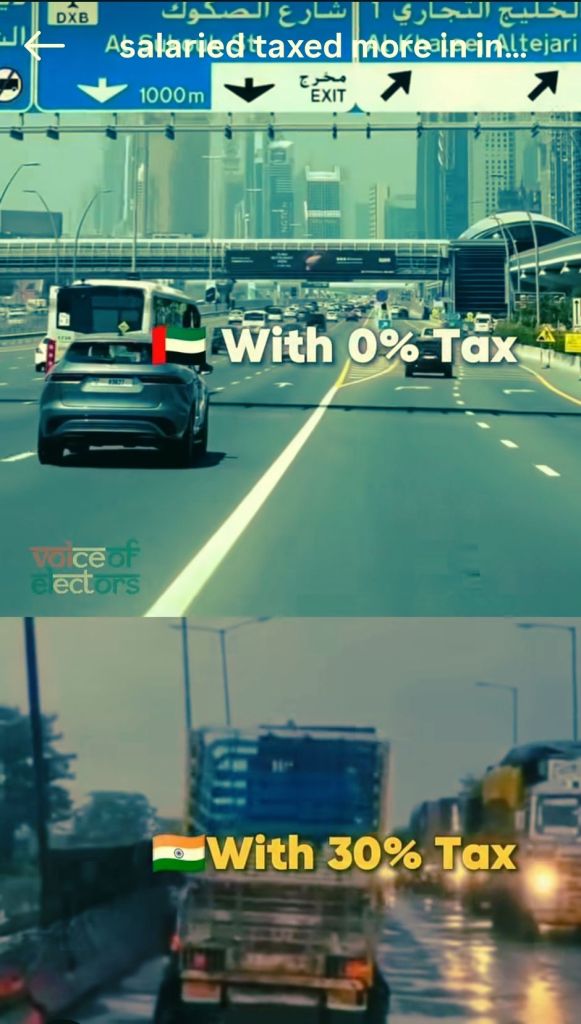
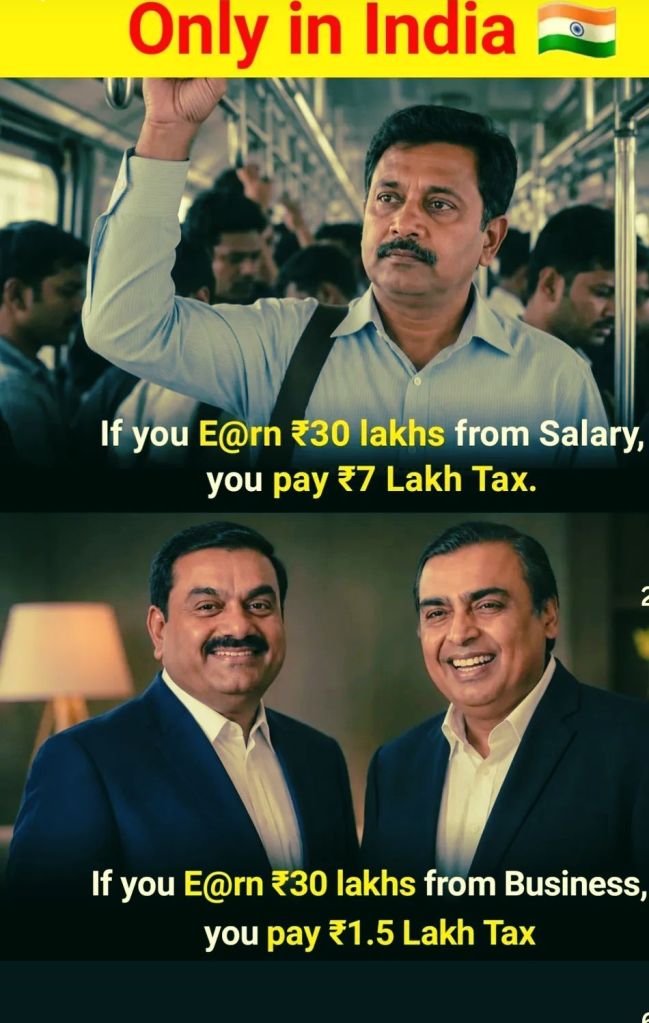
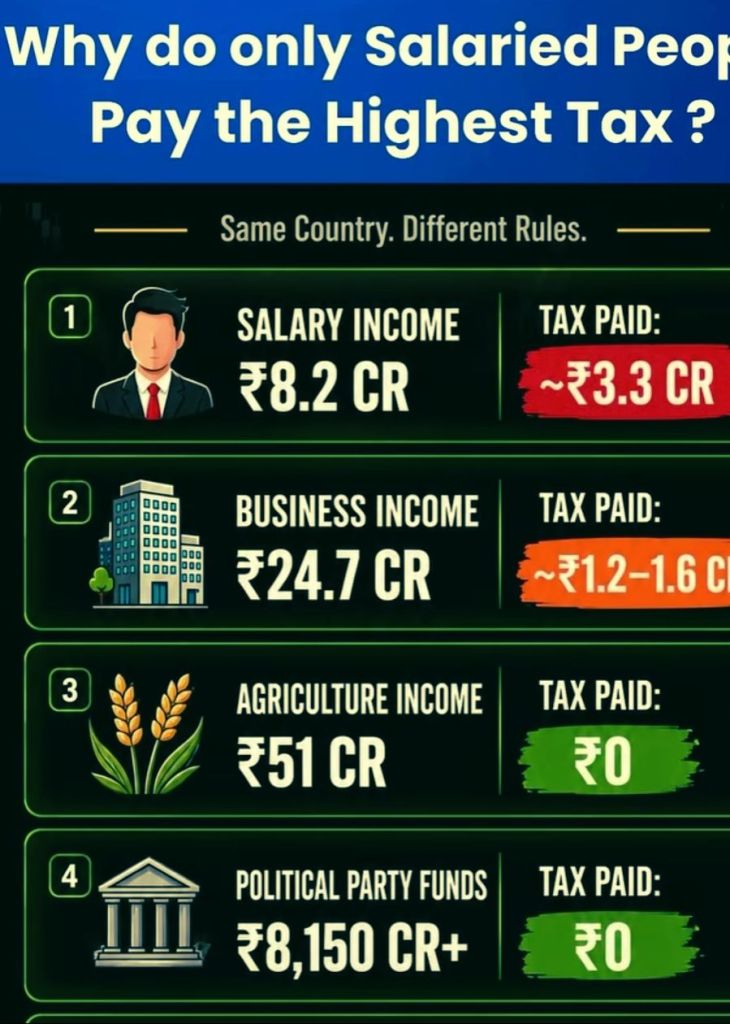
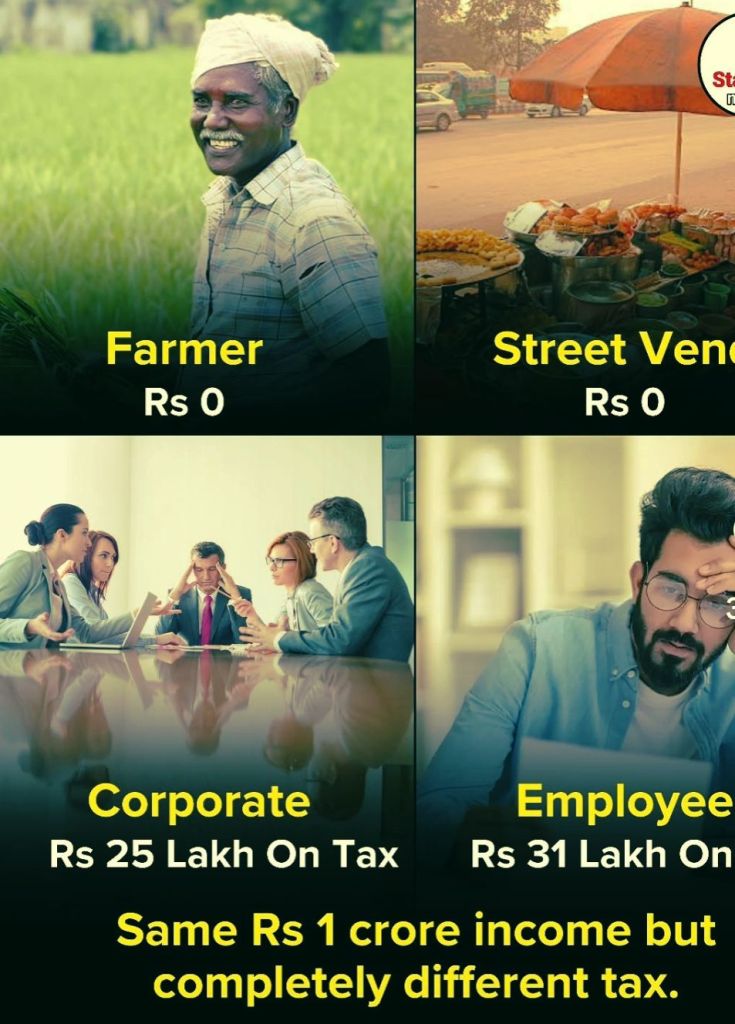
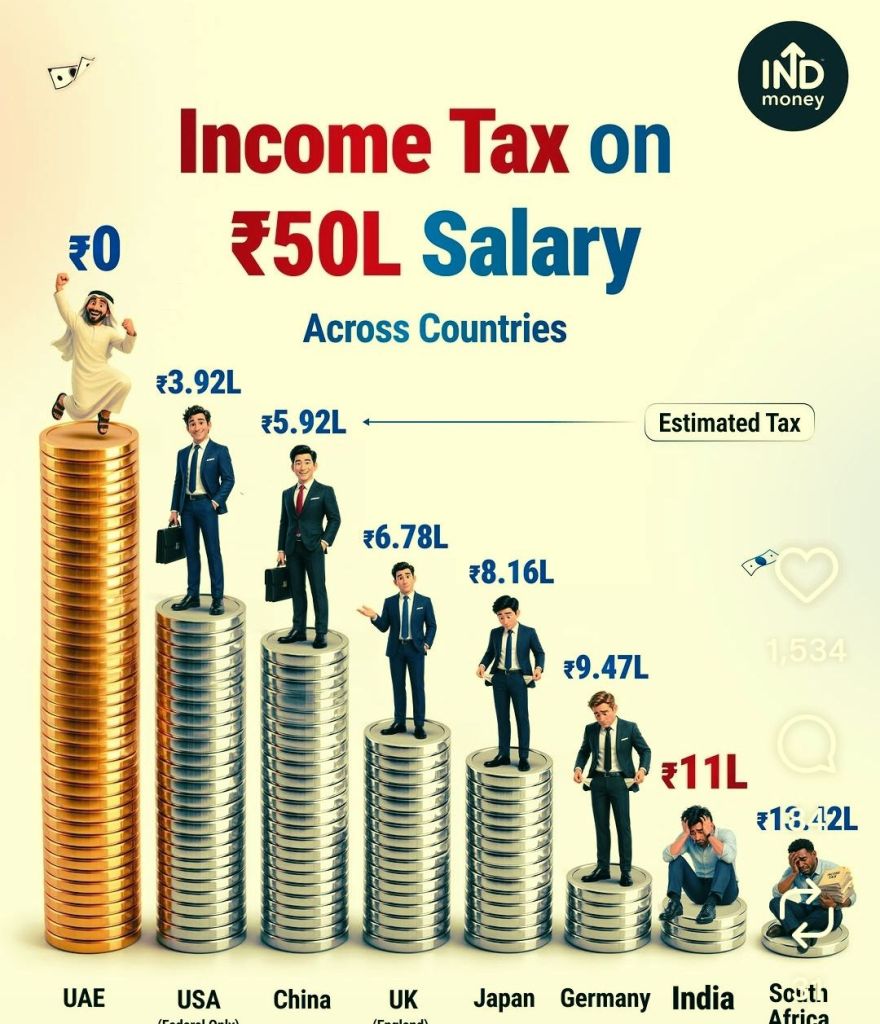
    India often presents itself as a lightly taxed economy, but this narrative collapses under scrutiny. Fewer than 10 percent of Indian households fall within the income-tax net, yet this small, highly compliant group carries a disproportionate share of the fiscal burden. Over the past decade, the composition of tax revenues has shifted decisively. Corporate tax collections have declined from roughly 3.7 percent of GDP to about 3 percent, while household contributions have climbed to nearly 3.9 percent of GDP. This is not a neutral outcome of economic change; it reflects a fiscal design that finds it administratively efficient and politically low-risk to tax salaried households while leaving large reservoirs of income and wealth structurally under-taxed.

    The result is a stark fiscal paradox. The poorest citizens are exempt by necessity, while significant segments of the wealthy—particularly those deriving income from agriculture, assets, or complex ownership structures—remain outside the effective income-tax net. What remains is a narrow but dependable base of urban professionals, salaried employees, and small entrepreneurs who are digitally visible, continuously traceable, and unable to opt out. For this group, taxation is not episodic or negotiable; it is constant, automated, and intrusive, woven into every paycheck and transaction.

    This imbalance is magnified by India’s reliance on indirect taxes, especially the Goods and Services Tax. Conceived as a neutral and efficiency-enhancing reform, GST has proven regressive in practice. Indirect taxes consume a larger share of middle-class disposable income than of wealthy households’ spending, quietly penalising everyday consumption such as fuel, transport, insurance, food services, and utilities. The burden is not only about rates but about structure. Inverted duty regimes—where taxes on inputs exceed those on final goods—are now widespread in sectors like food processing and manufacturing. Firms often pay 18 percent GST on logistics and services while collecting only 5 percent on outputs, leading to blocked input tax credits and persistent working-capital stress. These costs are rarely absorbed by businesses; they are passed on to consumers, forcing the middle class to pay twice—once as taxpayers and again as consumers underwriting systemic inefficiencies.

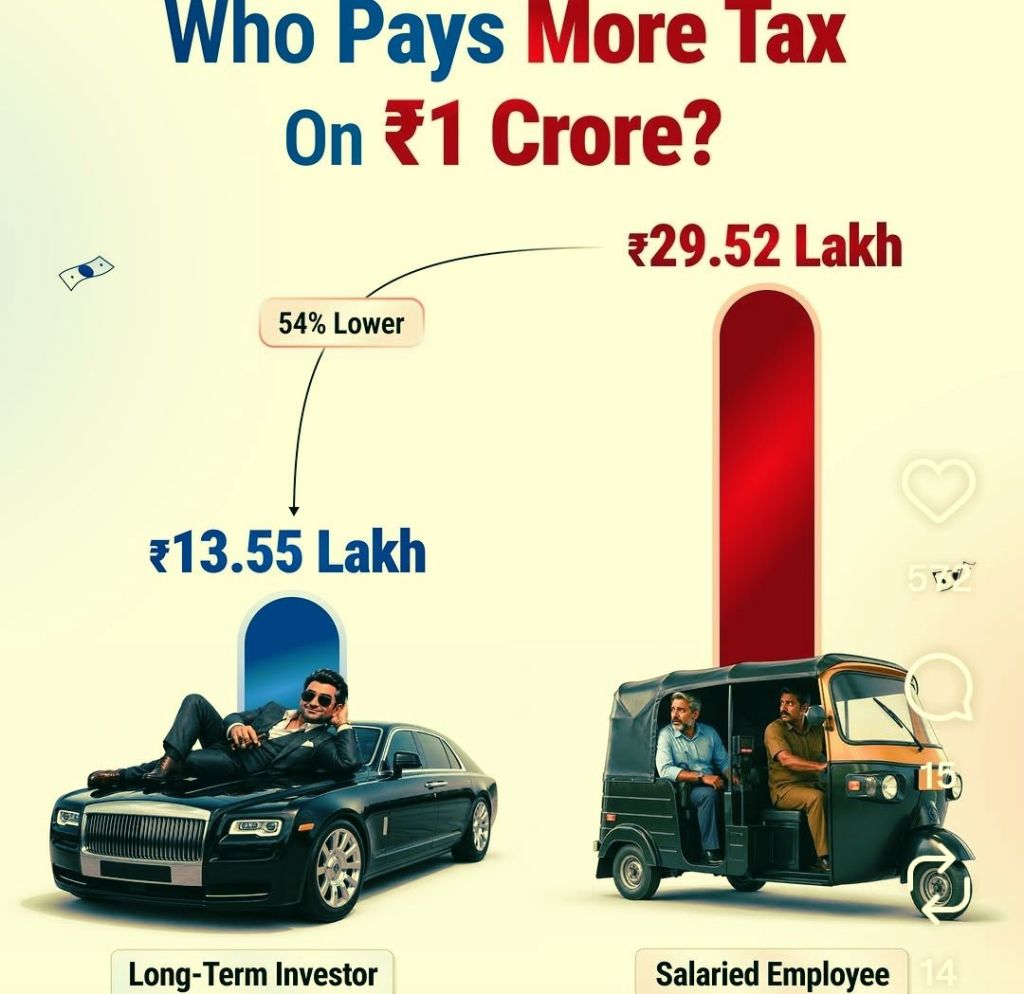
    The bias becomes even clearer in the taxation of savings and capital markets. Retail investors pay Securities Transaction Tax on every trade and then face Long-Term Capital Gains tax on profits beyond ₹1.25 lakh. For salaried individuals earning below ₹12 lakh, this LTCG is non-rebatable, creating a real tax liability even on modest, long-term savings. The incentive structure is perverse: disciplined, transparent investment is penalised, while speculative or opaque avenues often escape equivalent scrutiny. The same logic applies to newer asset classes. Virtual digital assets are taxed aggressively on gains, while losses cannot be set off, and compliance norms designed for professional traders are imposed on small retail participants. Instead of encouraging formal savings and capital formation, the system treats financial participation as a regulatory risk.

    Beyond rates and exemptions lies a deeper, more corrosive problem: complexity. India’s tax compliance burden functions as a shadow tax in its own right. Frequent filings, overlapping audits, ambiguous provisions, and discretionary enforcement raise costs for households and businesses alike. Global evidence is unambiguous—inefficient tax administration suppresses investment, discourages formalization, and erodes trust. In India, compliance anxiety has become a defining feature of middle-class economic life. The Income Tax Act, 2025, effective from April 1, 2026, captures this contradiction. While a reduction in sections and word count signals reform intent, simpler drafting does not automatically translate into a simpler lived experience. Taxpayers increasingly demand plain-language rules, reliable pre-filled returns, and predictable outcomes. In an era of advanced data analytics, approximate disclosures that trigger audits are not just inefficient; they are indefensible.

    The corporate tax experience reinforces the imbalance. India’s 2019 corporate tax cut was expected to trigger a private investment surge. It did not. Corporate savings rose, but investment rates stagnated, underscoring that tax rates alone do not drive capital formation. Regulatory uncertainty, infrastructure bottlenecks, demand constraints, and policy unpredictability matter far more. Yet instead of addressing these structural barriers, the fiscal system has compensated by intensifying extraction from households, deepening the disconnect between who earns and who pays.

    International experience points in a different direction. Estonia taxes corporate profits only when distributed, encouraging reinvestment. New Zealand operates a broad-based, single-rate GST with minimal exemptions, maximising transparency. Singapore exempts capital gains entirely and uses tax policy as a strategic growth instrument. Across advanced economies, the pattern is consistent: simplicity, neutrality, digital administration, and trust-based compliance. India, by contrast, has layered cesses, surcharges, exemptions, and procedural obligations onto a shrinking base—a strategy that is fiscally shortsighted and socially corrosive.

    The middle class is not demanding tax immunity; it is expressing exhaustion. The demand is for fairness, predictability, and proportionality. Reducing double taxation, correcting GST distortions, easing compliance, and rebalancing the direct–indirect tax mix are not populist concessions; they are prerequisites for sustainable growth and democratic legitimacy. A tax system that relentlessly targets the visible while sparing the powerful is neither equitable nor durable. India’s fiscal future depends on a philosophical shift—from squeezing compliance to rewarding participation, from extraction to empowerment. Until that shift occurs, the middle class will remain the country’s most dependable—and most overburdened—fiscal asset.

    Visit arjasrikanth.in for more insights

  • When Status Takes Wing and Safety Pays the Price: India’s Dangerous Love Affair with the Shortcut Sky

    February 1st, 2026

    India’s business aviation boom is often celebrated as a triumph of efficiency, aspiration, and elite mobility. Helicopters and private charters compress geography in a country where surface travel can be slow and unpredictable. They promise agility to governments, corporations, and high-net-worth individuals. Yet beneath this narrative of convenience lies a harder truth: rapid growth, VIP expectations, and systemic fragilities are converging into a safety dilemma India can no longer afford to treat as incidental. The sector is increasingly confusing technological sophistication with operational invulnerability — and speed with sound judgment.

    Rotary-wing aviation, by its very design, operates closer to risk margins than commercial fixed-wing airline travel. Helicopters frequently fly at lower altitudes, in variable terrain, and in dynamic weather envelopes. In India, this risk is amplified by microclimates, mountainous zones, coastal humidity, and dense fog belts across northern and central plains. Weather remains the single most underestimated killer in helicopter operations. Visibility collapse, cloud ingress, and spatial disorientation can overwhelm even experienced pilots within minutes. The crashes that killed Gen. Bipin Rawat in 2021 and Andhra Pradesh Chief Minister Y.S. Rajasekhara Reddy in 2009 are stark reminders that experience, rank, and aircraft pedigree do not neutralize atmospheric reality. The 2025 Agusta 109 crash near Pune in heavy fog further reinforced a timeless aviation truth: machines evolve, physics does not.

    The deeper problem is not merely meteorological — it is cultural. Time pressure and passenger expectation subtly reshape cockpit psychology. Business and political aviation is uniquely exposed to “schedule gravity,” where mission urgency begins to outweigh safety margins. Helicopter flights are often linked to VIP movements, election tours, emergency reviews, or high-stakes corporate schedules. Even without explicit instruction, an implicit expectation can form: the flight must go. This shifts the decision environment from safety-first to consequence-managed risk. Pilots may remain procedurally compliant yet psychologically cornered. The most dangerous phrase in aviation is rarely spoken aloud — it is felt: we cannot afford to delay.

    Growth without proportional ecosystem depth intensifies vulnerability. India’s helicopter and business charter market is expanding rapidly, with double-digit projected growth over the coming years. But fleet expansion is not matched evenly by pilot pipeline development, simulator capacity, maintenance depth, and regulatory bandwidth. When expansion outruns institutional absorption capacity, safety buffers thin out. Recent tightening of Flight Duty Time Limitations has been necessary and overdue — yet it has also exposed how stretched pilot rosters already are. Shortages lead to tighter rotations, higher fatigue risk, and operational cancellations, all of which feed commercial and political pressure loops.

    Economics quietly shapes safety outcomes as well. Aviation Turbine Fuel in India constitutes a disproportionately high share of operating costs compared to global benchmarks. When fuel accounts for nearly half of operating expenditure, operators are forced into hard trade-offs — often invisible to passengers. Investments in advanced simulation, redundancy systems, and expanded training cycles become financially harder to justify in tight-margin environments. Safety then risks becoming compliance-driven rather than resilience-driven.

    Technology is frequently presented as the sector’s shield — but it is, at best, a partial one. Terrain Awareness and Warning Systems, Ground Proximity Alerts, weather radar, and advanced autopilot modes significantly enhance situational awareness and workload management. However, accident history repeatedly shows that most fatal rotary-wing events are decision-chain failures, not equipment failures. A fully serviceable aircraft flown into deteriorating weather remains fully vulnerable. Automation reduces workload; it does not eliminate judgment error under pressure.

    A more disruptive — and under-discussed — safety intervention lies outside aviation altogether: substitution. High-fidelity virtual collaboration platforms now enable real-time governance, crisis management, and corporate decision-making without physical presence. For a large share of administrative, review, and coordination functions, digital presence is operationally sufficient. Every avoided non-essential VIP flight is not just a cost saving — it is a risk removed from the system. In safety engineering terms, elimination beats mitigation.

    This leads to an uncomfortable but necessary leadership test: restraint must become a prestige signal. Helicopter usage should be necessity-driven, not optics-driven. When aviation becomes performative — a symbol of authority arrival rather than mission requirement — risk multiplies silently across pilots, crews, and airspace systems. In a digitally connected nation, insisting on physical presence where virtual presence is effective is not efficiency — it is exposure.

    The path forward requires cultural, regulatory, and economic recalibration. Passenger protocols must explicitly empower pilots with unquestioned final authority on weather and go/no-go calls. Organizations should institutionalize “no-fault cancellation” norms for marginal conditions. Regulators and operators must scale terrain-specific simulator training, data-driven safety monitoring, and non-punitive reporting systems. Fiscal reforms — especially rationalization of fuel taxation — can directly improve safety investment capacity. Most importantly, elite users must model safety discipline rather than schedule dominance.

    India’s helicopter future can remain dynamic and productive — but only if the aircraft is treated not as a flying entitlement, but as a precision instrument operating at the edge of nature’s limits. In aviation, humility is not optional. It is aerodynamic.

    Visit arjasrikanth.in for more insights

  • Two Empires Bent a Sea:  Ambani and Adani Turned the Gulf of Kutch into India’s Greatest Wealth Machine

    January 31st, 2026

    The Gulf of Kutch is no longer a passive indentation on India’s western coastline; it is a consciously engineered theatre of capital, power, and national ambition. Once defined by salt pans, tidal creeks, and artisanal fishing, the Gulf has been refashioned into one of the most concentrated zones of industrial wealth creation in the Global South. On its opposing shores rise two corporate architectures of unprecedented scale—the Ambani and Adani empires—whose capital, technological depth, and strategic audacity have transformed an ecologically austere seascape into a cornerstone of India’s energy security, logistics supremacy, and export competitiveness.

    Geography set the stage, but intent wrote the script. The Gulf’s deep natural draft, proximity to Middle Eastern energy routes, and direct access to the Arabian Sea gave it latent strategic value for centuries. Yet potential alone does not create prosperity. Liberalisation in the 1990s unlocked private risk-taking, but it was the willingness of large Indian conglomerates to commit capital at civilisational scale that converted geography into destiny. The Gulf did not evolve organically; it was dredged, planned, connected, and embedded into global value chains with almost militaristic precision.

    On the southern shore, Reliance Industries’ Jamnagar complex represents a feat of industrial concentration rarely matched anywhere in the world. Processing nearly 1.4 million barrels of crude oil per day, it is not merely the world’s largest refining hub; it is a masterclass in integration. Crude imports, refining, petrochemicals, polymers, textiles, and downstream manufacturing are woven into a single system that converts volatility into margin. Jamnagar’s real strategic value lies not in output alone, but in insulation—India’s ability to remain energy-secure, export-capable, and geopolitically resilient amid global supply shocks. Wealth here is measured not just in balance sheets, but in strategic autonomy.

    Across the Gulf, the Adani Group built a different, equally formidable engine of accumulation. Mundra Port, now India’s largest commercial port, is less a port than a logistical ecosystem. Seamlessly connected to power plants, SEZs, rail corridors, warehousing clusters, and renewable energy installations, Mundra functions as the respiratory system of North India’s economy. Coal, containers, automobiles, food grains, and increasingly, solar modules flow through its terminals with industrial choreography. This is infrastructure capitalism at scale—where control over movement, not manufacturing alone, becomes the source of enduring advantage.

    Together, these twin poles have converted the Gulf of Kutch into India’s most potent industrial corridor. Cumulative investments exceeding $150 billion have generated over half a million direct and indirect jobs, while contributing close to a quarter of Gujarat’s GDP. The multiplier effects are unmistakable: townships emerging from scrubland, expressways slicing through salt deserts, and dense clusters of ancillary industries gravitating toward scale. Global capital followed—BP, Total, Siemens—not because of subsidies alone, but because size itself reduces risk and uncertainty.

    This transformation, however, was not frictionless. The Gulf is ecologically fragile, hosting mangroves, coral ecosystems, and India’s only marine national park. Industrialization provoked sustained environmental litigation, civil society resistance, and anxiety among traditional fishing communities facing displacement and cultural erosion. Water scarcity, hostile terrain, and the absence of pre-existing infrastructure turned every project into a high-stakes logistical gamble. Global oil price collapses threatened refinery economics; ESG scrutiny introduced reputational risk into every balance sheet.

    What distinguishes the Gulf of Kutch story is not the absence of conflict, but the capacity to absorb and re-engineer it. The Gujarat state acted less as a regulator and more as a strategic enabler—providing policy stability, aggregating land, fast-tracking infrastructure, and aligning bureaucratic incentives with long-term industrial outcomes. Technology substituted for geography: automated ports, zero-liquid-discharge plants, deep refinery integration, and world-class logistics efficiency. Environmental mitigation—mangrove regeneration, wastewater recycling, carbon-neutral commitments—evolved from compliance rituals into instruments of risk management.

    Vertical integration became the final stabiliser. Ports fed power plants; power plants energised factories; factories fuelled exports. Corporate social investments in healthcare, education, and skilling were not philanthropic afterthoughts but social shock absorbers, embedding local communities into the industrial ecosystem and reducing resistance to scale.

    The future of the Gulf of Kutch now sits at the intersection of green transition and geopolitical relevance. Massive investments in solar, wind, and green hydrogen aim to pivot the region from fossil dominance to clean-energy leadership. Port expansions and transshipment ambitions position the Gulf as a critical Indo-Pacific trade node. At the same time, climate volatility—cyclones, rising sea levels—forces sustainability to become a survival imperative, not a branding exercise.

    Ultimately, the Gulf of Kutch stands as a living laboratory of how geography, capital, and state capacity can be fused to manufacture national power. Ambani and Adani did not merely build refineries and ports; they bent a sea into an economic engine. The unresolved question is not whether wealth was created—it unquestionably was—but whether this wealth can be sustained, equitably distributed, and defended in a century defined by climate stress and geopolitical churn. On that answer rests whether the Gulf endures as an industrial miracle or becomes a cautionary monument of salt, steel, and ambition.

    Visit arjasrikanth.in for more insights

  • From Swadeshi Comfort Zones to a Global Survival Arena: When Europe Knocked, India Finally Opened the Door

    January 30th, 2026

    After more than two decades of hesitation, reversals, and strategic anxiety, India and the European Union have sealed what can justifiably be called the mother of all free trade agreements. This is not ceremonial diplomacy marketed as transformation; it is a structural reset. When the European Commission President stood beside Prime Minister Narendra Modi and invoked a combined market approaching two billion people, the statement reflected economic mass, not metaphor. Two regulatory superpowers have chosen interdependence over insulation. For India, this agreement is not merely about tariff lines and export volumes; it marks a psychological shift—an admission that defensive economics cannot power a competitive century.

    The scale of ambition distinguishes this agreement from routine trade compacts. Nearly all tariff lines on both sides move toward zero or near-zero over calibrated timelines, creating one of the deepest market-access frameworks attempted between advanced and emerging blocs. This is systemic liberalisation, not selective accommodation. Indian sectors such as marine products, pharmaceuticals, textiles, chemicals, engineering goods, and processed foods gain entry into one of the world’s most quality-sensitive consumer markets. Europe is not just large; it is exacting. It prices reliability, traceability, sustainability, and standards discipline. By accepting this gateway, India is effectively committing its producers to global-grade performance metrics rather than price-led competitiveness alone.

    The consumer-side implications are equally transformative. High-end European automobiles, precision medical devices, specialty machinery, wines, and spirits will gradually become more accessible as legacy tariff barriers are dismantled. These barriers were historically defensive—designed to incubate domestic capacity—but extended protection often mutates into structural complacency. This agreement signals a policy-level recognition that prolonged shelter distorts incentives. Indian consumers gain choice and quality; Indian producers inherit urgency. Competitive pressure will now operate as a reform engine, rewarding firms that modernise processes, upgrade technology, and optimise supply chains, while steadily marginalising those dependent on regulatory cushioning.

    At a deeper level, the agreement represents a philosophical pivot in India’s trade doctrine. The objective is shifting from security-through-protection to resilience- through-competition.

    Compliance with European norms on labour, environment, safety, digital traceability, and product integrity becomes a passport to global markets, not a bureaucratic burden. The deal thus functions as an external discipline mechanism, compelling domestic reform in logistics, certification, testing infrastructure, and production governance. It exposes chronic inefficiencies—fragmented supply networks, high transaction costs, uneven quality control—that tariff walls once concealed. Integration, in this sense, becomes an instrument of internal correction.

    The political economy of the deal is as significant as its economics. Negotiations first launched in the mid-2000s and stalled for years over automobiles, services mobility, data rules, and regulatory asymmetry. The earlier hesitation was not irrational; exposing MSMEs and labour-intensive sectors to mature European competition carried real risk. What changed was India’s strategic calculus. China’s manufacturing ascent through global value-chain integration, Vietnam’s post-2019 export surge after its EU pact, and recurring protectionist cycles in the United States collectively underscored the cost of exclusion. Diversification of markets became a strategic necessity. The EU pact emerges as the anchor of that diversification strategy.

    Sectoral opportunity, however, comes with regulatory intensity.

    Labour-intensive exports—footwear, marine products, garments, chemicals—gain tariff relief, but they also enter the world’s most compliance-heavy marketplace. European carbon border measures, chemical safety regimes, sustainability disclosures, and supply-chain due diligence rules will test exporter readiness. Pharmaceuticals and engineering goods may benefit from regulatory cooperation and recognition pathways, yet documentation and audit burdens will rise. The agreement therefore tests not only corporate adaptability but also state capacity—whether India can deliver certification ecosystems, testing labs, logistics upgrades, and financing tools fast enough to prevent compliance from becoming the new tariff.

    Trade agreements do not create competitiveness; they reveal its absence or reward its presence. India’s mixed export response to some earlier FTAs stands as a cautionary precedent. Market access is an opportunity, not an outcome. The EU–India pact is best understood as a high-stakes invitation to industrial adulthood. It withdraws comfort, expands possibility, and institutionalises competition. For Indian enterprise, the message is unambiguous: quality is mandatory, efficiency is strategic, and global standards are the new domestic baseline. The walls are lowering. Performance must rise.

    Visit arjasrikanth.in for more insights

  • “From Checkout to Call-Out: Gen Z Turned Indian Shopping into a Social Sport”

    January 29th, 2026

    If shopping in India once began at the shop counter and ended at the billing desk, Gen Z has shattered that linear ritual into a looping, participatory, always-on experience. Born between 1997 and 2012, this 68-million-strong cohort is not merely consuming differently; it is rewriting the operating system of Indian retail. For them, shopping is not an errand to be completed but a process of discovery, validation, and identity expression—often compressed into a few scrolls before breakfast and executed entirely on a smartphone.

    Gen Z is India’s first truly digital-native generation. They did not adapt to the internet; they were raised by it. With near-universal smartphone access, commerce is instinctively mobile-first and screen-led. A brand that does not load seamlessly on a phone or offer frictionless checkout is effectively invisible. This explains the rise of app-first platforms and social commerce players: for Gen Z, the phone is not a channel—it is the marketplace.

    Yet to dismiss them as impulsive scrollers would be a costly misread. Gen Z may move fast, but it researches deeply. A typical purchase journey loops through reels, comments, YouTube reviews, peer opinions, and price comparisons. Discovery is emotional and social; decision-making is analytical and crowdsourced. Trust no longer flows from celebrity endorsements or glossy ads, but from creators who feel real, accessible, and unfiltered. In this economy, a dorm-room influencer with 20,000 followers can outperform a Bollywood star in driving conversions.

    This behavioural shift has produced a distinctly Indian version of social commerce. Instagram Reels, YouTube hauls, short-video platforms, and even WhatsApp groups now function as informal storefronts. Products gain legitimacy through conversation rather than campaigns. Gen Z does not want to be sold to; it wants to be included, consulted, and validated by its community.

    Equally disruptive is the collapse of boundaries between online and offline retail. Gen Z is unapologetically “phygital.” They research online and buy offline, test products in-store and purchase online for better prices, and expect seamless options like buy-online-pickup-in-store. Physical retail is no longer about stocking shelves; it is about staging experiences. Stores are becoming content studios—interactive, Instagrammable, and designed as much for sharing as for selling.

    Values now sit at the core of consumption. Sustainability, inclusivity, and transparency are no longer niche concerns but baseline expectations. Gen Z scrutinises supply chains, representation, and environmental impact, even as it negotiates affordability constraints. The rise of local brands, gender-neutral fashion, size inclusivity, resale, and clean-label food reflects a generation that treats purchases as moral signals, not just transactions.

    Sectoral shifts underline the depth of this transformation. In fashion and beauty, ownership is giving way to rental, resale, and D2C brands that speak Gen Z’s language of authenticity over perfection. Beauty is increasingly gender-agnostic. In food, health consciousness merges with visual performance—meals must nourish the body and look good on a feed. In electronics, aspiration coexists with pragmatism, normalising refurbished devices, EMIs, and second-hand markets without stigma.

    Payments have evolved in parallel. UPI is instinctive; buy-now-pay-later tools enable controlled indulgence without the psychological burden of credit cards. Micro-transactions are normalised, mirroring fragmented attention and frequent engagement. Money moves in smaller, faster pulses—just like content.

    This new retail ecosystem is not frictionless. Choice overload causes fatigue, sustainability ideals clash with budget realities, and high return rates strain margins. Data privacy anxieties simmer. Yet these tensions reflect a broader recalibration. Gen Z is experimenting with a more participatory, values-aware form of capitalism, even as it embraces convenience.

    For businesses, the message is blunt. Selling products is no longer enough. Brands must build communities, invite co-creation, respond in real time, and accept radical transparency as the price of relevance. Speed, personalisation, and authenticity are no longer advantages—they are entry tickets.

    Gen Z is not just changing what India buys, but how, why, and with whom it buys. Shopping has become a social language, a value signal, and a shared cultural act. In reshaping Indian retail, this generation is proving that commerce now moves at the speed of a swipe—and belongs to those who understand that belonging matters more than the sale.

    Visit arjasrikanth.in for more insights

  • Reliance Industries: The Giant That Runs Fast, Lifts Heavy… and Still Trips Over Its Own Shoelaces

    January 28th, 2026

    Reliance Industries now inhabits every layer of Indian life. It carries your voice, fuels your mobility, stocks your kitchen, streams your evenings—and increasingly, promises to manufacture the future itself. Few corporations anywhere command such breadth. Yet the latest results reveal an uneasy paradox: Reliance is expanding at breath-taking scale, but with diminishing clarity of purpose. Revenues look robust, profits respectable, and capital expenditure relentless. But beneath the surface lies a conglomerate running multiple races at once—some well-paced, some overstretched, and a few with no clear finish line in sight.

    Jio illustrates both the strength and the ceiling of this model. Crossing 505 million subscribers after adding 9 million in a quarter sounds triumphant until one recalls that India’s mobile market is saturated. Growth now comes from consolidation, not creation. Jio has effectively captured nearly all net additions in the industry, a testament to market power rather than market expansion. ARPU (Average Revenue per User) has edged up to about ₹214 through higher data usage, 5G adoption, and fixed wireless broadband—not tariff hikes. Execution is competent, even impressive. But maturity brings limits. Enormous 5G investments still await decisive monetisation, and global ARPU benchmarks remain out of reach. Jio is extracting more value from a finite base, not unlocking a new frontier.

    Reliance Retail exposes the sharper contradiction. Quarterly revenues crossed ₹97,600 crore, yet profits remained stubbornly flat at around ₹6,900 crore. Scale is rising; efficiency is not. The company is aggressively expanding stores, logistics, and quick commerce, which now processes roughly 1.6 million daily orders. While contribution margins are positive, profitability remains elusive. With fewer than 30% of fulfilment points as dark stores, the hybrid physical–digital model is capital-intensive. Retail here is being engineered for dominance, not disciplined returns—growth is purchased upfront, with payoff deferred indefinitely.

    The oil-to-chemicals business, long the cash engine, delivered strong numbers—but largely thanks to global disorder rather than internal innovation. Refining margins surged amid geopolitical disruptions, supply constraints, and overseas shutdowns. Reliance benefited because of scale and efficiency, not strategic reinvention. Simultaneously, petrochemicals struggled under weak demand and Chinese oversupply. The result is a business that still throws off cash but is increasingly exposed to volatility rather than insulated by strategy.

    Then comes the grand wager: new energy. Nearly ₹8,000 crore per quarter is being invested to build an end-to-end solar, battery, and green hydrogen ecosystem. Strategically, it aligns with India’s energy security ambitions. Economically, it is a long, uncertain journey. Revenues are distant, profits further still, and much early output will be consumed internally. Green hydrogen remains speculative. This is vision at its boldest—but also capital at its most patient.

    Taken together—soft advertising markets, a nascent consumer brands portfolio, and unrelenting capex across verticals—Reliance appears less focused than formidable. Each business makes sense in isolation; together they diffuse attention and returns. The challenge is no longer ambition but allocation. Reliance has perfected the art of becoming vast. The next test is harder: becoming precise, disciplined, and consistently profitable. In today’s markets, ubiquity is easy. Earning excellence everywhere is not.

    Visit arjasrikanth.in for more insights

  • Too Big to Fail, Too Bound to Fly: Air India Reveals the Quiet Collapse of Scale in Modern Capitalism

    January 27th, 2026

    If one wishes to understand the fragility of modern capitalism, it is no longer sufficient to study obscure start-ups quietly incinerating venture capital. The real diagnostics lie in the distress of icons—institutions presumed immune because they possess pedigree, patience, and prodigious balance sheets. When a national airline bleeds over a billion dollars, when private equity stalks sports franchises like distressed steel plants, and when even the world’s most valuable corporations require tens of billions merely to stay solvent, one truth becomes unavoidable: scale no longer guarantees stability. Air India, resurrected under the Tata Group amid national emotion and international applause, is rapidly emerging as a textbook example of how privatization can inherit ownership without inheriting freedom.

    India’s flag carrier is expected to post net losses of at least $1.6 billion in FY2026—roughly ₹15,000 crore. This is not a routine cyclical setback in an industry accustomed to turbulence; it is a strategic rupture from expectation. When Tata Sons reacquired Air India in 2022, the promise was intoxicating. Bureaucratic drift would give way to professional management, political improvisation would be replaced by patient capital, and global partnerships would finally liberate the airline from decades of state-induced inertia. A rebranded identity, record-breaking aircraft orders, the Vistara integration, and confident projections of breakeven by March 2026 suggested a decisive break from the past. Today, that narrative is wobbling uncomfortably at cruising altitude.

    The June 2025 Boeing 787 Dreamliner crash near Ahmedabad was, first and foremost, a human tragedy of devastating proportions—one of the worst aviation disasters India has witnessed in decades. But it also triggered a financial and reputational shock that no balance sheet could absorb without lasting damage. More than 240 lives lost, insurance premiums expected to double, lawsuits filed in London with potential liabilities running into hundreds of millions of dollars, and a profound operational disruption erased years of fragile progress in a matter of weeks. What was meant to be a turnaround year became a reset year—if not an institutional reckoning. A revised five-year plan projecting profitability only by the third year reportedly failed to reassure the board, while Tata and Singapore Airlines were asked to inject at least another ₹10,000 crore simply to keep the airline airborne.

    Yet attributing Air India’s predicament solely to tragedy would be intellectually evasive. The deeper discomfort lies elsewhere. The airline’s struggles expose a structural truth that polite boardroom conversations often avoid: Air India may be privately owned, but it still operates inside a government-designed aviation cage. Pakistan’s prolonged closure of airspace to Indian carriers forces longer westbound routes to Europe and North America, adding hours to flight times and sharply inflating fuel costs—an unhedgeable geopolitical tax imposed on Indian airlines. Aviation turbine fuel remains among the most heavily taxed in the world. Airport charges are high, leasing norms complex, dispute resolution painfully slow, and policy predictability episodic at best.

    These are not failures of management. They are failures of the ecosystem.

    What makes Air India’s case particularly unsettling is how privatization has failed to insulate the airline from its own institutional memory. Internal surveys reportedly suggest that nearly two-thirds of employees believe “nothing meaningful has changed.” Legacy work practices endure, unions continue to influence productivity outcomes, and internal administration often feels like an extension of the state—new logos pasted onto familiar files. Aging widebody aircraft operate alongside brand-new A350s, producing wildly inconsistent passenger experiences. Spare-parts shortages persist, service standards oscillate, and the cultural friction between bureaucratic habits and corporate efficiency shows little sign of resolution. Leadership churn only compounds uncertainty, with reports that Tata is already scouting for a new CEO pending the crash investigation’s conclusions.

    The uncomfortable truth is this: Air India today resembles less a transformed private airline and more a public sector enterprise in a tailored suit. Ownership has changed, but the regulatory umbilical cord has not been cut. The airline is attempting one of the most complex integrations in global aviation—merging Air India, Vistara, Air India Express, and AIX Connect—while simultaneously flying full schedules, inducting hundreds of aircraft, retrofitting cabins, retraining staff, and rebuilding passenger trust. It is, quite literally, rebuilding the aircraft while it is still in the air.

    This story reflects a broader macroeconomic unease. India aspires to create global champions, yet continues to govern critical sectors through ad hoc rules, political sensitivities, and reactive policymaking. Aviation is treated less as core economic infrastructure and more as a regulatory experiment. Fuel taxes vary arbitrarily across states, airspace access remains hostage to geopolitics, and Indian airlines are expected to compete with Middle Eastern carriers that enjoy structural advantages policymakers are reluctant to acknowledge. In such an environment, management excellence becomes necessary—but fundamentally insufficient.

    The lesson from Air India is therefore uncomfortable but unavoidable. Privatization alone does not repair structurally distorted sectors. You can hand the cockpit to the best pilots in the world, but if the weather radar is unreliable and air traffic control keeps changing instructions mid-flight, turbulence is inevitable. Indian aviation needs standardized, transparent, and predictable regulation—rational fuel taxation, stable airspace policies, faster dispute resolution, competitive airport charges, and leasing norms aligned with global best practices.

    Rescuing Indian aviation is not about bailing out airlines. It is about repairing the ecosystem in which they operate. Without that correction, even the Tata Group—with its credibility, capital, and intent—will continue to battle headwinds that no amount of managerial discipline can overcome. If Air India struggles, it is not an anomaly. It is a warning. In modern India, even private icons can crash if the system itself is flying blind.

    Visit arjasrikanth.in for more insights

  • “From Rajpath to Responsibility: India’s Democratic Reckoning” 

    January 26th, 2026

    Republic Day is not a ritual of uniforms, gun salutes, or rehearsed grandeur; it is India’s annual audit of its own conscience. On 26 January 1950, a bruised yet unbroken nation made a decision rarer than freedom itself—to place law above impulse, institutions above individuals, and rights above rulers. It was an audacious wager in a world sceptical of post-colonial democracy. Every Republic Day since has been a recommitment to that gamble. In 2026, as the Republic enters its 76th year, remembrance matures into responsibility, and pride is tested against purpose.

    The Constitution transformed India from a civilisational entity into a modern republic without erasing its plural soul. Republic Day therefore celebrates unity without uniformity and diversity without dilution. It reminds us that democracy is not inherited like property; it is practiced like a discipline. Each generation must relearn it, renegotiate it, and defend it. In 2026, that practice is framed by a forward-looking national imagination—Viksit Bharat 2030—linking constitutional morality to developmental ambition and situating today’s governance within the longer arc toward a developed India by 2047.

    Kartavya Path, replacing Rajpath, is more than symbolic urban redesign; it is philosophical course correction. Duty replaces dominion, citizenship displaces colonial spectacle. The parade becomes narrative rather than noise. Digital India connects the remotest villages; women-led development redraws economic hierarchies; a Green Energy transition reshapes skylines and balance sheets alike. Indigenous defence platforms—from advanced fighter aircraft to autonomous drone systems—signal a republic confident in its capabilities yet disciplined in the use of power. The presence of a chief guest from the Global South reinforces India’s evolving global posture: partnership over patronage, credibility over coercion.

    What sets Republic Day 2026 apart is its insistence on participation rather than performance. Ten thousand students marching after nationwide constitutional literacy competitions is not choreography—it is civic pedagogy in motion. Augmented and virtual reality experiences turn spectators into learners, collapsing the distance between the Constitution and everyday life. A Green Republic pledge—26 lakh saplings and environmentally sensitive celebrations—ties nationalism to stewardship of nature. By honouring ASHA workers, grassroots innovators, sustainable farmers, and Olympic medalists, the Republic widens its definition of heroism. Authority is acknowledged, but endurance is celebrated.

    These celebrations reflect India’s material and institutional trajectory by 2026. A rapidly consolidating position as the world’s third-largest economy; a digital public infrastructure anchored by Aadhaar, UPI, and open networks; highways, Vande Bharat trains, ports, and metro systems stitching regions into a single economic geography; renewable capacity racing toward the 500-GW milestone; and space achievements—from Gaganyaan to deepened global collaboration—project a republic that builds at scale. This is not triumphalism; it is evidence of a system that learns, corrects, and persists.

    Yet Republic Day earns its seriousness by confronting what remains unfinished. Inequality strains the social contract; unemployment tests a young nation navigating automation and artificial intelligence; environmental stress questions the sustainability of growth; social harmony demands constant, patient stewardship; healthcare and education require deeper investment and sharper outcomes. The Constitution does not promise comfort. It promises equality before law and opportunity through the state. The Republic’s credibility depends on how honestly and effectively these gaps are closed.

    The road ahead is demanding but unmistakable. Inclusive growth must replace faith in trickle-down economics, with skilling, MSME support, and universal healthcare as central pillars. Innovation cannot remain episodic; R&D spending must approach 2% of GDP so ideas translate into livelihoods. A green transition—solar leadership, green hydrogen, climate-resilient agriculture—must reconcile prosperity with planetary limits. Democratic renewal through transparency, judicial efficiency, and active citizenship must keep institutions worthy of public trust. Globally, India’s advocacy for the Global South must combine moral voice with measurable delivery.

    To make Republic Day memorable is to make it meaningful. A nationwide constitutional oath, immersive digital access for the diaspora, heritage walks retracing freedom’s footsteps, and a documentary chronicling India’s Constitutional Journey: 1950–2026 can convert celebration into civic action. Imagine a tableau of a Net-Zero Smart Village—solar-powered, digitally literate, women-led—where tradition fuels innovation. That single image captures the Republic’s promise better than any flypast.

    Dr. B.R. Ambedkar warned that the Constitution is only as good as the people who operate it. Republic Day 2026 asks us not merely to admire the vehicle, but to drive it wisely. Celebrate the past, act in the present, and build the future—because the Republic does not survive on spectacle. It survives on citizens. Jai Hind.

    Visit arjasrikanth.in for more insights

←Previous Page
1 … 8 9 10 11 12 … 145
Next Page→

Blog at WordPress.com.

Loading Comments...

    • Subscribe Subscribed
      • SOCIAL PERSPECTIVES
      • Join 106 other subscribers
      • Already have a WordPress.com account? Log in now.
      • SOCIAL PERSPECTIVES
      • Subscribe Subscribed
      • Sign up
      • Log in
      • Report this content
      • View site in Reader
      • Manage subscriptions
      • Collapse this bar