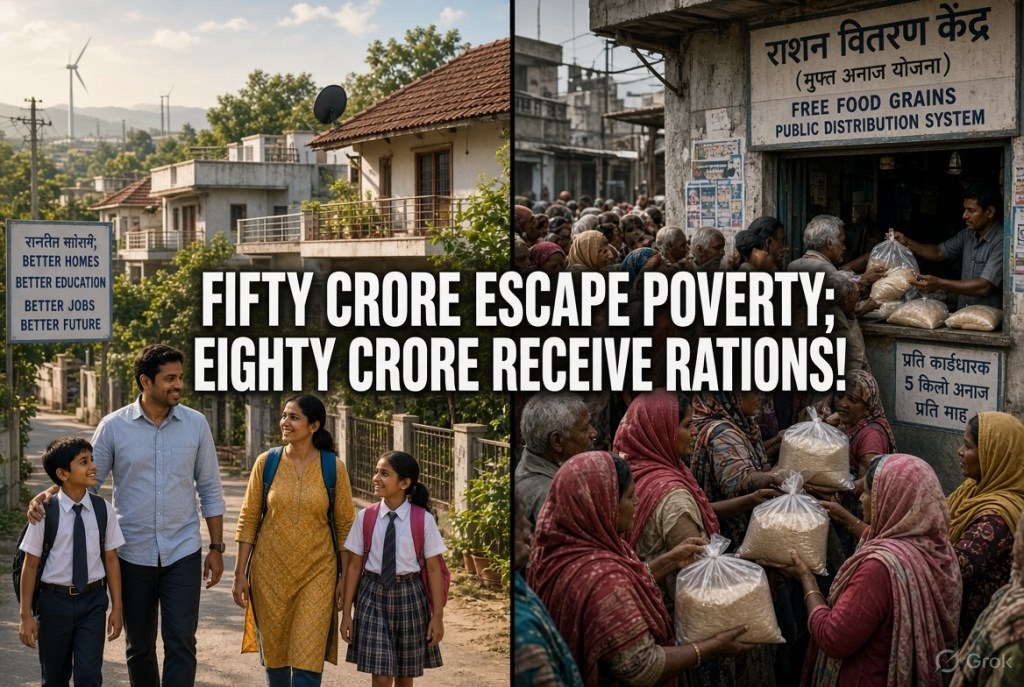
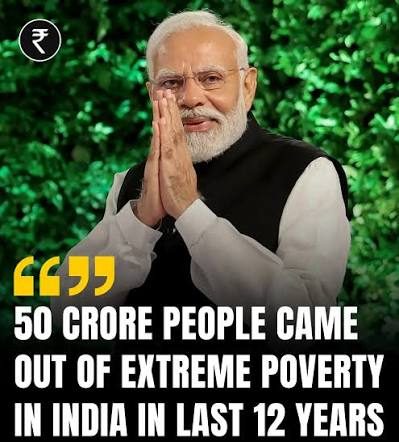
India is celebrating an extraordinary poverty-reduction narrative: nearly 50 crore people have reportedly moved above the poverty threshold over the past decade. According to the World Bank’s October 2026 Poverty and Equity Brief, poverty at the $4.20-a-day lower-middle-income benchmark declined from 57.7% in 2011–12 to 16.1% in 2023–24. At the $3-a-day extreme-poverty benchmark, it declined from 27.1% to 2.6%. These figures reflect significant improvements in consumption, infrastructure, financial inclusion, housing, sanitation, electricity and targeted welfare delivery. Yet an uncomfortable question confronts the nation: if nearly 50 crore people have escaped poverty, why does the government continue providing free food grains to approximately 80 crore beneficiaries? Is India transitioning towards economic independence, or managing a vast population through continuing state-supported consumption? This contradiction deserves serious economic examination rather than political celebration or ideological dismissal.
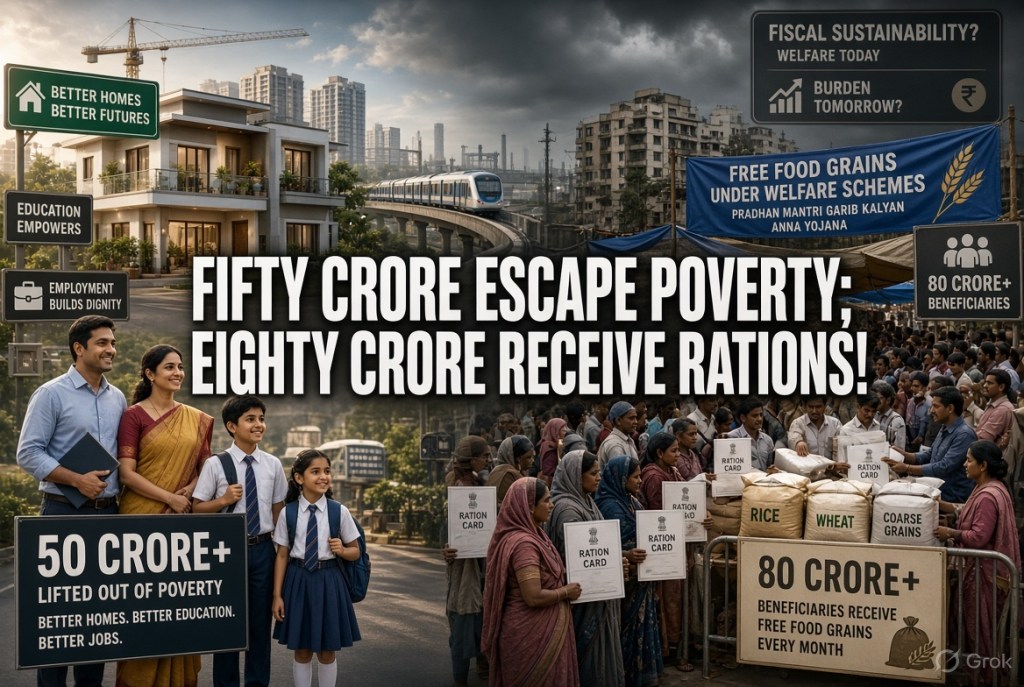
The answer begins with understanding the architecture of India’s food-security programme. Under the Pradhan Mantri Garib Kalyan Anna Yojana, approximately 81.35 crore people are entitled to free food grains, with around 80.48 crore beneficiaries identified under the National Food Security Act. Eligible priority households receive five kilograms per person monthly, while Antyodaya households receive 35 kilograms. The five-year extension from January 2024 involves an estimated food subsidy commitment of ₹11.80 lakh crore. However, an essential distinction must be recognised: these entitlements are substantially linked to population coverage ceilings based on the 2011 Census, not a contemporary assessment proving that every beneficiary remains below today’s poverty line. Therefore, 80 crore ration beneficiaries cannot automatically be described as 80 crore people living in absolute poverty. Nevertheless, the scale of coverage raises legitimate questions about beneficiary identification, income security, fiscal sustainability and the effectiveness of welfare graduation.
The statistical achievement itself deserves recognition, but intellectual honesty requires methodological scrutiny. The reported reduction of approximately 49.6 crore relates to the $4.20-a-day lower-middle-income poverty benchmark; it must not be confused with the separate $3-a-day extreme-poverty estimate. Comparisons between the 2011–12 and 2022–23/2023–24 Household Consumption Expenditure Surveys also require caution because questionnaire design, sampling arrangements and multiple household visits have evolved. India additionally lacks a recently adopted, universally accepted official monetary poverty line for contemporary policy assessment. Alternative poverty estimates consequently vary according to methodology, purchasing-power adjustments and consumption assumptions. The responsible conclusion is neither to undermine India’s progress nor to accept every headline without examination. Poverty has substantially declined, but the magnitude, durability and distribution of that progress require transparent measurement. Economic achievement must withstand statistical scrutiny to command intellectual and public credibility.
The deeper contradiction concerns the quality of employment and the sustainability of household incomes. Poverty reduction becomes durable when education leads to skills, skills lead to productive employment, employment generates rising wages, and higher earnings create savings and financial security. India’s development trajectory, however, continues to face considerable labour-market challenges. Agricultural dependence, informal employment, low-productivity occupations, uncertain daily wages and unpaid family work expose millions to economic vulnerability. Infrastructure expansion, digital connectivity and financial inclusion are important foundations, but they cannot independently guarantee economic mobility. The decisive question is whether households are moving into stable manufacturing, competitive services, modern agriculture and productive entrepreneurship. Can India claim sustainable poverty elimination when millions remain vulnerable to illness, employment disruptions, crop failures and inflation? Crossing a statistical poverty threshold is an achievement; securing the capacity to remain above it is the real measure of development.
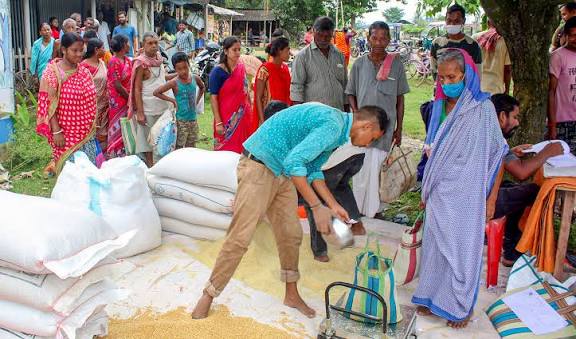
India must also distinguish between legitimate social protection and politically motivated freebies. Providing food to hungry families, nutrition to children, healthcare to vulnerable citizens and security to elderly people is neither economically irrational nor morally questionable. Welfare protects human dignity, supports consumption and prevents temporary economic shocks from becoming permanent deprivation. The pandemic demonstrated the importance of an effective public distribution system. However, social protection must evolve alongside economic progress. When welfare becomes a permanent substitute for employment, skills, enterprise and income generation, it risks institutionalising dependency. The objective should not be to withdraw food security abruptly, but to progressively connect beneficiaries with opportunities for economic independence. A welfare state must protect those who cannot support themselves while enabling those who can to become self-reliant. Compassion and competitiveness are not competing national objectives; they must reinforce each other.
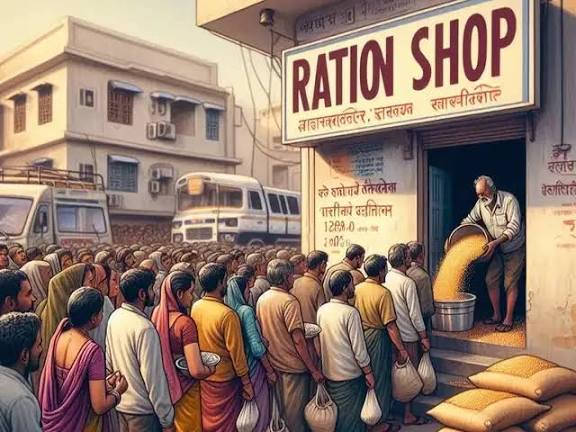
Another important dimension is the distance between escaping poverty and achieving prosperity. A household marginally above an international poverty threshold is not necessarily economically secure. A medical emergency, job loss, crop failure, education expense or unexpected liability can push such a family back into deprivation. The World Bank’s $8.30-a-day upper-middle-income poverty benchmark reportedly still places nearly 79% of India’s population below that threshold. This highlights the enormous distance between eliminating extreme poverty and building a broadly prosperous society. India’s next development challenge must therefore focus on stable household incomes, financial savings, insurance, affordable healthcare, quality education and upward economic mobility. The emerging middle class itself remains vulnerable to inflation, housing costs, healthcare expenditure and employment uncertainty. Escaping poverty is a statistical milestone; escaping vulnerability is genuine development. India must measure both.
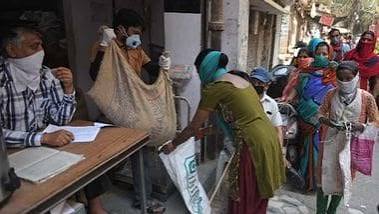
The country now needs a second-generation welfare revolution, moving from entitlement economics towards empowerment economics. The first generation established essential foundations through food security, housing, sanitation, electricity, cooking fuel, financial inclusion and direct benefit transfers. The next generation must prioritise employability, vocational education, manufacturing jobs, entrepreneurship, agricultural productivity, women’s workforce participation and small-business expansion. Beneficiary databases should be periodically updated, leakages eliminated and sustained economic progress recognised through carefully designed graduation mechanisms. However, no vulnerable household should lose essential protection merely because its income temporarily crosses an arbitrary threshold. Every major welfare programme should incorporate measurable pathways towards education, skills, employment and financial independence. Public expenditure must be evaluated not only by the number of beneficiaries covered, but also by the number of households that become economically self-sufficient. India’s demographic dividend will become a liability if millions remain trapped outside productive economic opportunities.
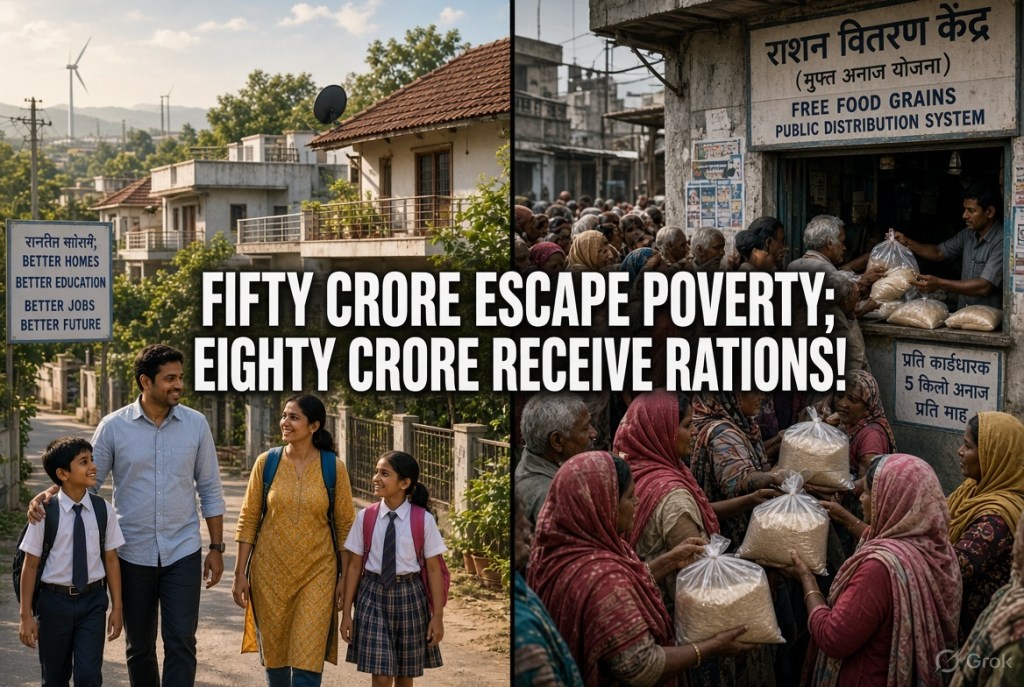
Ultimately, the 50-crore poverty-reduction narrative deserves celebration, while the 80-crore food-security coverage demands equally serious reflection. Neither number independently captures the complete reality of India’s economic transformation. The government should establish a credible contemporary poverty benchmark, reconcile consumption-survey methodologies and publish transparent indicators covering household incomes, employment quality, wages and economic vulnerability. More importantly, India needs measurable graduation indicators: how many families have moved from free rations to secure employment, from daily survival to savings, from informal labour to productive enterprise and from welfare dependence to financial independence? Viksit Bharat cannot be built by distributing entitlements indefinitely, nor by withdrawing essential protection prematurely. The ultimate test of development is not how many citizens receive free food today, but how many possess the income, dignity and economic confidence to purchase their own food tomorrow. India must graduate from poverty management to prosperity creation, transforming welfare beneficiaries into economically empowered citizens.
VST ARJASRIKANTH.IN FOR MORE INSIGHTS

