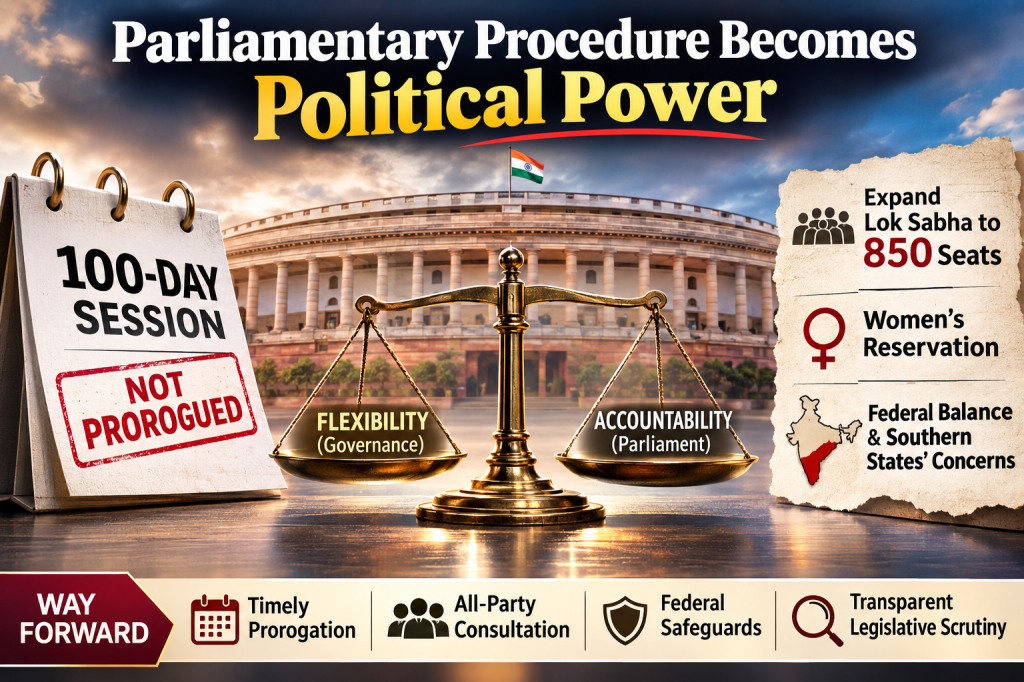
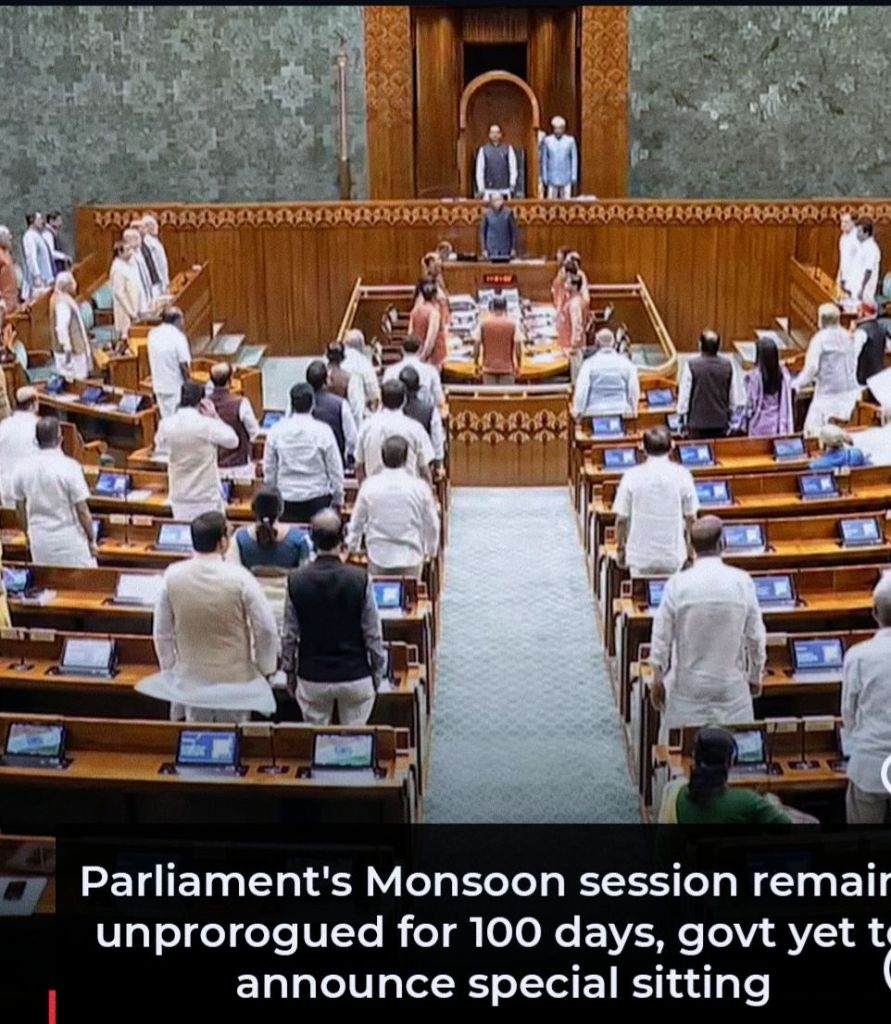
India’s democracy faces a paradox: flexibility meant to facilitate governance can become a tool for controlling legislative outcomes. The 100-day unprorogued Monsoon Session of 2026 has sharpened that concern. Both Houses adjourned sine die on August 13, yet the President had not prorogued the session by late November. The delay, exceeding the previous 87-day record in 2008, has prompted allegations that Parliament may be reconvened at short notice to consider expanding the Lok Sabha to 850 seats alongside women’s reservation. This tests whether discretion serves democracy or weakens it.
The distinction between adjournment sine die and prorogation is central. Adjournment ends a sitting, not the session; prorogation, exercised by the President under Article 85(2)(a), formally ends it. An existing session can reportedly be reconvened on roughly two days’ notice, while a fresh session requires a presidential summons and fourteen days’ notice. Article 85(1) limits the gap between sittings to six months but sets no deadline for prorogation. The Government’s textual argument therefore has force. Yet constitutional silence is not a blank cheque: discretion should accommodate exceptional circumstances and convention.
Keeping a session alive offers the Executive procedural advantages: a focused sitting could be called without the preparation and scrutiny of a Winter Session. Opposition parties may have little time to coordinate or examine legislation. Question Hour and Private Members’ Business could be sidelined. The Government gains time for coalition negotiations and the two-thirds majority required for constitutional amendment. But constitutional change demands deliberation, not tactical surprise. Compressed proceedings risk reducing Parliament from a forum of reasoned debate to an arena of numerical management. Procedure must enable parliamentary government, not convert advantage into dominance.
The substantive dispute links women’s representation with territorial reapportionment. The Nari Shakti Vandan Adhiniyam, 2023, provides 33 per cent reservation for women, contingent on a subsequent census and delimitation. The 2026 initiative reportedly seeks to accelerate implementation by expanding the Lok Sabha from 543 to 850 seats and using the 2011 Census. An amendment introduced in April failed to secure a two-thirds majority. A revised proposal reportedly preserves States’ relative representation. Yet assurances cannot replace binding guarantees. Implementing reservation within existing constituencies could separate gender justice from a contested restructuring of representation.
Delimitation redistributes federal power; it is not merely electoral administration. The freeze on inter-State seat redistribution, rooted in the 1971 Census and later extended, sought to protect States that controlled population growth from losing relative representation. A population-based exercise could increase northern States’ political weight while reducing southern States’ relative influence. Southern States argue their voice should not diminish. Federalism, recognised as part of the Constitution’s Basic Structure in S.R. Bommai v. Union of India, requires consideration. Yet representation cannot be insulated permanently from demographic change. Population and equitable federal participation must be reconciled through negotiation.
The Opposition’s counterproposal—to retain 543 seats, preserve State-wise allocations, implement reservation within the existing framework and continue the arrangement for a defined period—offers a path. Its strength is separating women’s representation from territorial redistribution. The Government, meanwhile, must address population growth’s representational consequences. Neither position can prevail through arithmetic alone. The April defeat showed that amendments affecting federal representation require agreement beyond the ruling coalition. The United Kingdom’s 2019 Miller judgment, limiting prorogation that frustrates Parliament’s functions, offers a relevant principle, though India’s framework differs: executive discretion must serve, not disable, Parliament.
The remedy is to restore predictability and deliberative legitimacy. Parliament should adopt a convention requiring prorogation within fifteen days of adjournment sine die, except in narrowly defined emergencies. An all-party mechanism should examine delimitation with every State represented. Women’s reservation should proceed through a workable arrangement that does not unnecessarily hold gender justice hostage to territorial redistribution. Amendment bills should be circulated early, not rushed through reconvened sittings without consultation. Judicial review should remain a safeguard, not the first response; courts should intervene where executive action demonstrably frustrates accountability or breaches constitutional limits. Conventions remain indispensable to constitutional government.
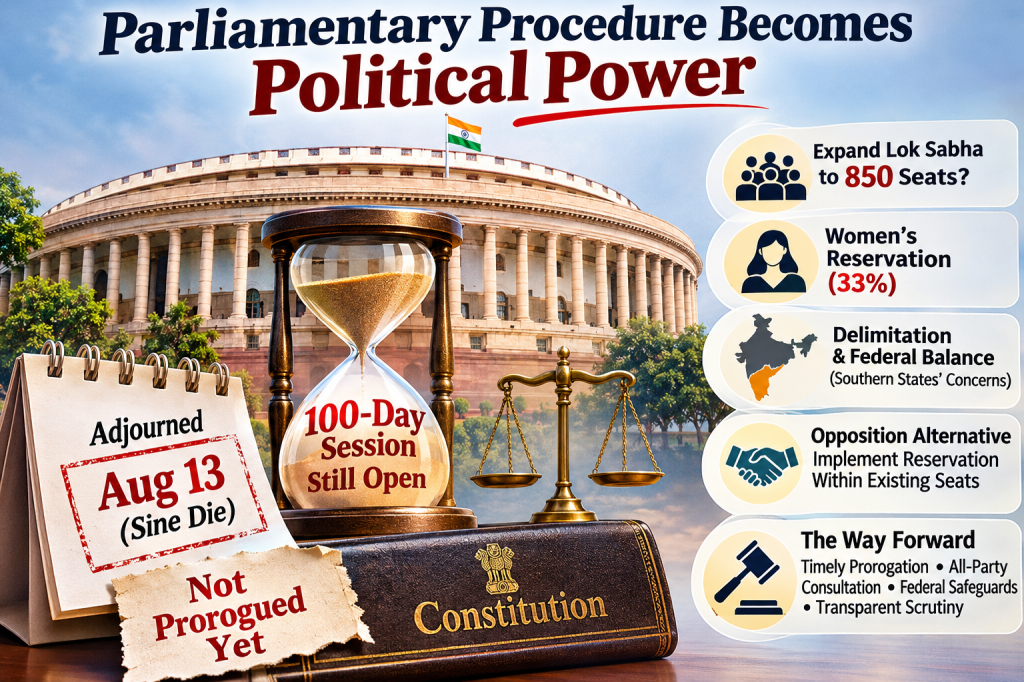
The 100-day session thus presents a crisis of convention, not necessarily an established constitutional violation. The Executive may have legal authority to defer prorogation, but must exercise it consistently with Parliament’s democratic purpose. The approaching six-month limit makes resolution urgent, through reconvening or a Winter Session. Neither procedural manoeuvring nor oppositional obstruction can replace a durable settlement. Parliament’s size, federal representation and women’s reservation will shape democracy. Such choices demand transparency, consultation and broad agreement. Constitutional statesmanship is not exploiting procedural silence; it is converting discretion into democratic legitimacy in a diverse constitutional democracy.
VST ARJASRIKANTH.IN FOR MORE INSIGHTS

