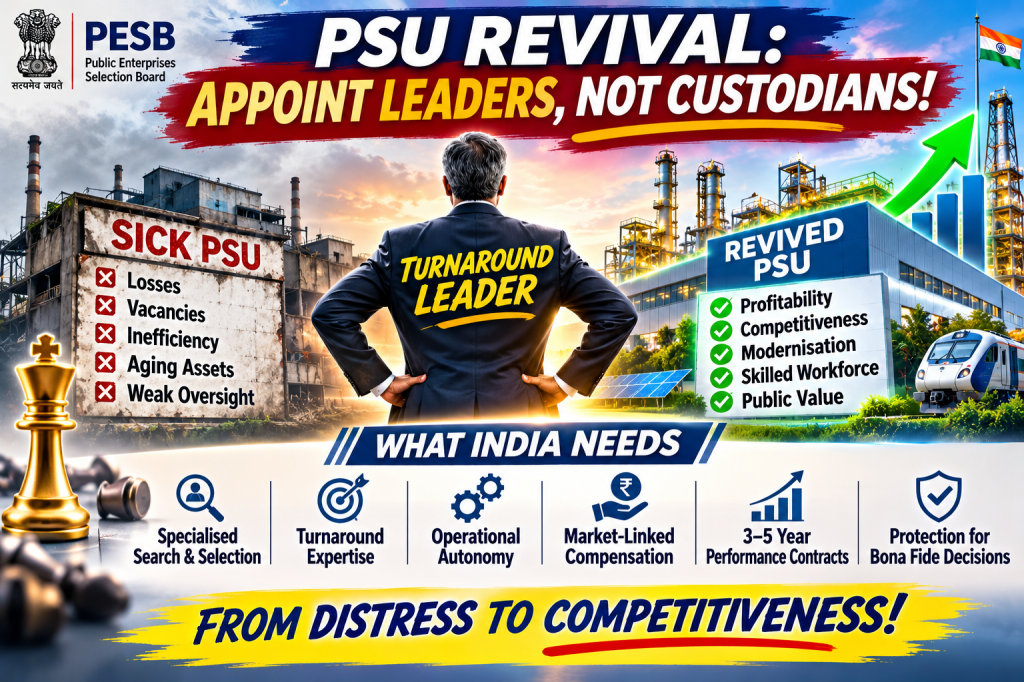
India’s public sector enterprises are confronting a paradox that exposes a deeper weakness in the country’s economic governance: despite having an institutional mechanism for selecting senior corporate leadership, several public sector undertakings (PSUs) continue to struggle with financial distress, operational inefficiencies, leadership vacancies and declining competitiveness. The Public Enterprises Selection Board (PESB), established through a Government of India resolution in 1987, was intended to professionalise appointments to senior positions in Central Public Sector Enterprises (CPSEs). Yet the central question today is not simply whether India can identify experienced executives, but whether it can identify leaders capable of rescuing failing enterprises. The distinction is crucial. Managing a profitable organisation requires strategic continuity; reviving a sick enterprise demands institutional courage, commercial imagination, financial discipline and the ability to dismantle entrenched inefficiencies. India’s PSU challenge is therefore no longer merely about filling vacancies. It is about matching leadership capabilities to the scale of institutional distress.
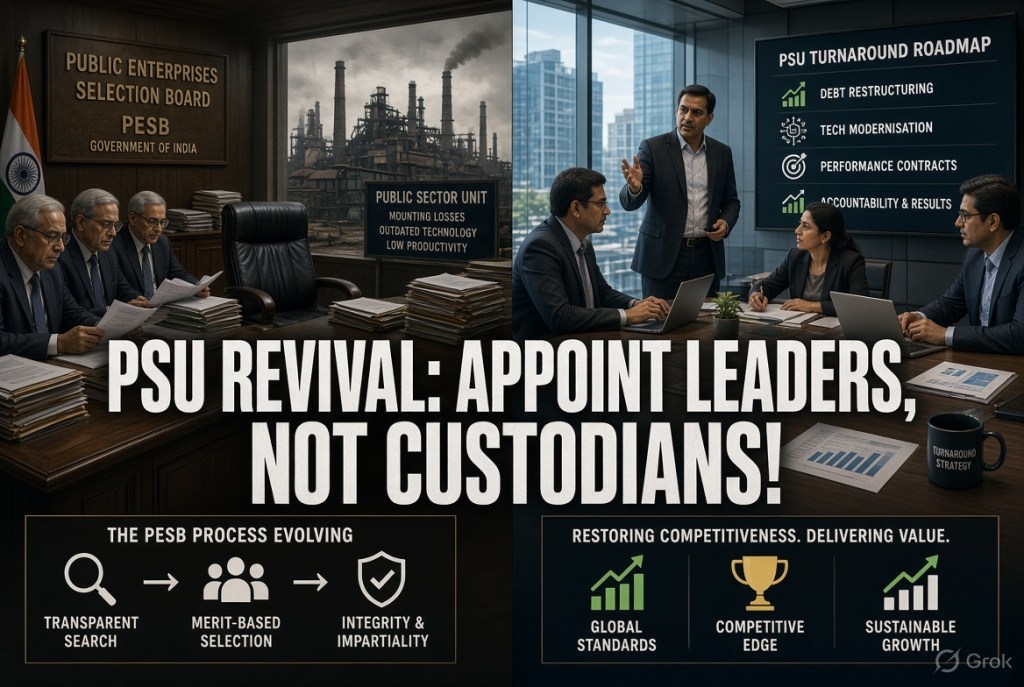
PESB performs an important function in the government’s ownership framework by defining eligibility criteria, scrutinising applications, evaluating candidates and recommending appointments to positions such as Chairman and Managing Director (CMD) and Functional Director. The process involves administrative ministries, vigilance clearances and, ultimately, the Appointments Committee of the Cabinet. Its emphasis on professional experience, integrity and administrative accountability provides an essential institutional foundation. However, procedural rigour cannot automatically guarantee strategic suitability. Conventional recruitment often places considerable weight on career progression, years of service and functional experience. A distressed enterprise, by contrast, may require a leader who can restructure debt, modernise technology, rationalise costs, negotiate with lenders, restore market confidence and challenge institutional inertia. An impressive résumé is not necessarily evidence of turnaround capability. The ability to administer an established organisation and the ability to transform a failing one are fundamentally different competencies. Selection systems must recognise this distinction rather than assume that seniority and experience alone can produce organisational revival.

The financial position of CPSEs also requires a more differentiated assessment. Aggregate performance has reportedly improved, with gross turnover rising from ₹24.62 lakh crore to ₹37.01 lakh crore and net profits from ₹0.93 lakh crore to ₹2.91 lakh crore. These improvements demonstrate that public enterprises are not universally inefficient or financially unviable. Nevertheless, aggregate profitability can conceal serious weaknesses within individual companies. Sixty-three loss-making CPSEs reportedly account for combined losses of approximately ₹21,000 crore. MTNL’s reported default of ₹8,585 crore in principal and interest obligations to seven public sector banks illustrates the magnitude of distress confronting certain enterprises. Equally concerning are reported leadership vacancies: as of February 2026, 53 CPSEs lacked full-time CMDs, while 533 of 758 sanctioned independent director positions remained vacant. Such gaps can weaken strategic supervision, delay decisions and diffuse accountability. The real policy challenge is to distinguish commercially viable enterprises requiring professional consolidation from structurally distressed entities needing fundamental restructuring.

One limitation of the existing recruitment architecture is its inadequate recognition of specialised turnaround experience. Eligibility frameworks that emphasise finance, production, operations, marketing and project management may overlook accomplished professionals in human resources, industrial relations, organisational transformation and workforce restructuring. Yet reviving a distressed PSU is not merely a balance-sheet exercise. It requires rebuilding employee confidence, addressing industrial relations, reskilling workers, redesigning organisational structures and creating a performance-oriented culture. A technically qualified executive who cannot mobilise the workforce may struggle to deliver sustainable transformation. Similarly, repeated instances of PESB finding no suitable candidate for senior positions, including in enterprises such as NTPC and BPCL, raise questions about the adequacy of conventional recruitment channels. Search-cum-Selection Committees should therefore become a transparent, specialised mechanism for identifying exceptional talent when enterprise-specific requirements demand a wider search. Candidates must be evaluated on demonstrable achievements, restructuring experience, leadership temperament and a credible commitment to institutional revival—not merely previous designations or years of service.

Attracting outstanding private-sector professionals, however, will remain difficult unless the operating environment changes. The scrutiny associated with the CVC, CAG, CBI and courts—the often-cited four Cs—can create apprehension among executives taking difficult commercial decisions. Vigilance and audit accountability are indispensable, but genuine commercial judgement must be distinguished from corruption, negligence or deliberate misconduct. A turnaround leader cannot be expected to restructure an enterprise if every commercially defensible decision carries the prospect of prolonged investigation. Compensation presents another obstacle: experienced restructuring specialists command market-linked salaries and performance incentives that conventional PSU structures may not accommodate. More importantly, operational autonomy is frequently constrained by prolonged approvals, rigid procurement procedures, ministerial intervention and resistance to organisational change. Appointing a private-sector executive without granting meaningful decision-making authority is not reform; it is merely importing responsibility without transferring power. The principle must be clear: autonomy should be accompanied by measurable accountability, while bona fide decisions taken within approved mandates should receive appropriate institutional protection.

International experience offers useful lessons in separating public ownership from day-to-day commercial management. Singapore’s Temasek model demonstrates how professional boards, clear ownership objectives and commercially accountable management can coexist with state ownership. India’s own experience also indicates that public enterprises can respond to focused restructuring, financial support and operational reform. Improvements achieved by enterprises such as SAIL and BHEL during earlier restructuring phases underline the importance of cost discipline, investment and management decisions. Developments involving Yantra India Limited, Rashtriya Ispat Nigam Limited and Hindustan Shipyard Limited provide further contexts for examining enterprise-specific revival strategies. Air India’s transfer to private ownership offers a different lesson: where accumulated structural weaknesses become difficult to address within existing governance arrangements, ownership restructuring may be considered. These examples should not be treated as interchangeable success stories. Rather, they demonstrate that different enterprises require different solutions—professional management, financial restructuring, technological modernisation, strategic partnerships or, where justified, disinvestment.

India should consequently develop a dedicated turnaround leadership architecture for distressed CPSEs. Specialised Search-cum-Selection Committees could attract proven restructuring professionals, insolvency experts, entrepreneurs, industrial managers and accomplished human-resource leaders. Each appointment should be supported by an enterprise-specific turnaround blueprint, with a fixed three-to-five-year performance contract, market-aligned compensation and clearly delegated operational authority. Performance should be assessed against measurable indicators: cash-flow improvement, debt reduction, capacity utilisation, productivity, market competitiveness, technological modernisation and employee reskilling. Professional boards with adequate independent representation must supervise these commitments, while administrative ministries should concentrate on strategic ownership objectives rather than routine commercial decisions. A transparent framework for protecting bona fide decisions, without weakening vigilance standards, is equally essential. Simultaneously, internal talent must not be neglected. Structured succession planning, leadership development and exposure to modern management practices can create a sustainable pipeline of capable executives from within the public sector itself.
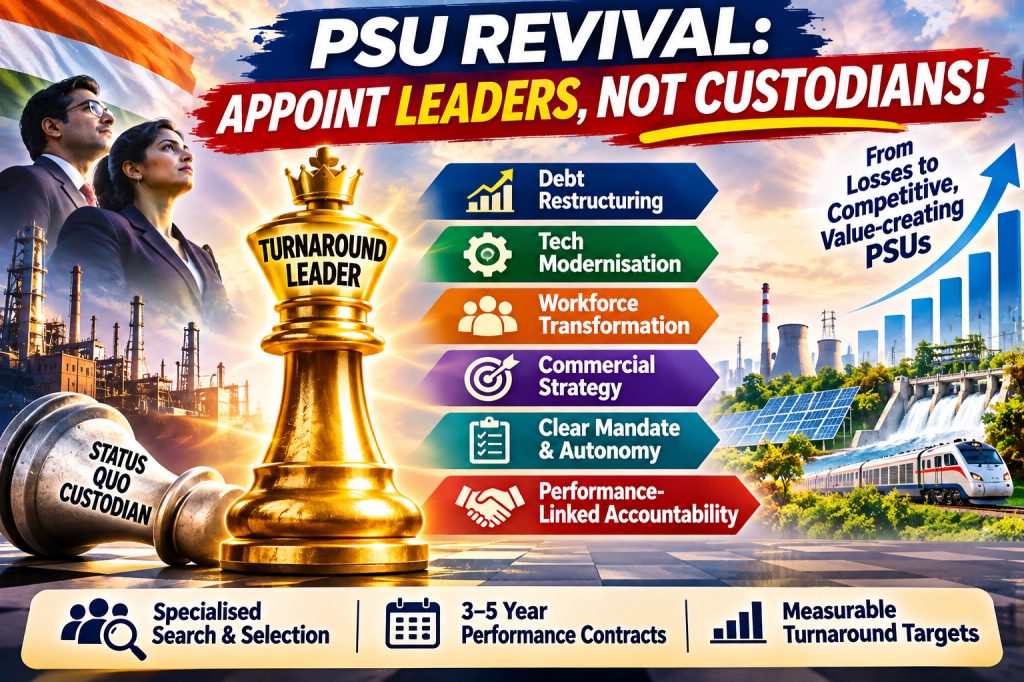
Ultimately, India’s PSU challenge is not simply a shortage of capital, technology or talented individuals. It is a mismatch between the responsibilities imposed on enterprise leaders and the authority, incentives and institutional protection available to fulfil them. PESB must evolve beyond a predominantly appointment-oriented mechanism into a strategic instrument for identifying leadership suited to different categories of enterprise. This does not require indiscriminately replacing public-sector executives with private-sector professionals. It requires placing the right leader in the right institutional context, with the freedom and accountability necessary to deliver results. Some enterprises need consolidation; others require technological reinvention, organisational restructuring or strategic disinvestment. A uniform recruitment philosophy cannot address such diverse realities. India cannot expect twenty-first-century commercial performance from twentieth-century administrative reflexes. The ultimate measure of reform will not be the number of CMDs appointed or committees constituted, but whether public enterprises regain financial health, technological relevance and public value. A sick PSU does not need another custodian of decline; it needs a turnaround architect with the authority to transform its future.
VST ARJASRIKANTH.IN FOR MORE INSIGHTS

