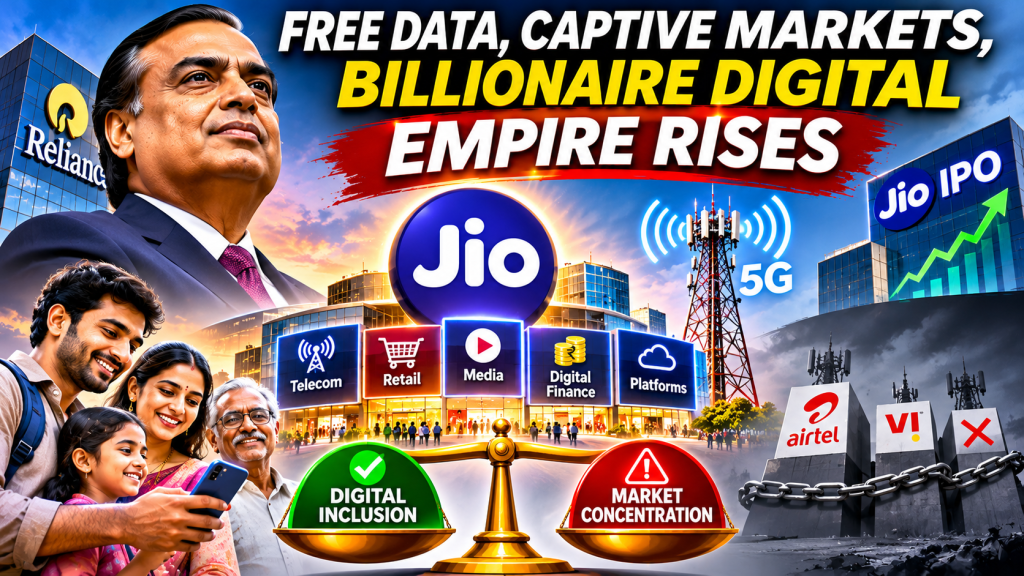
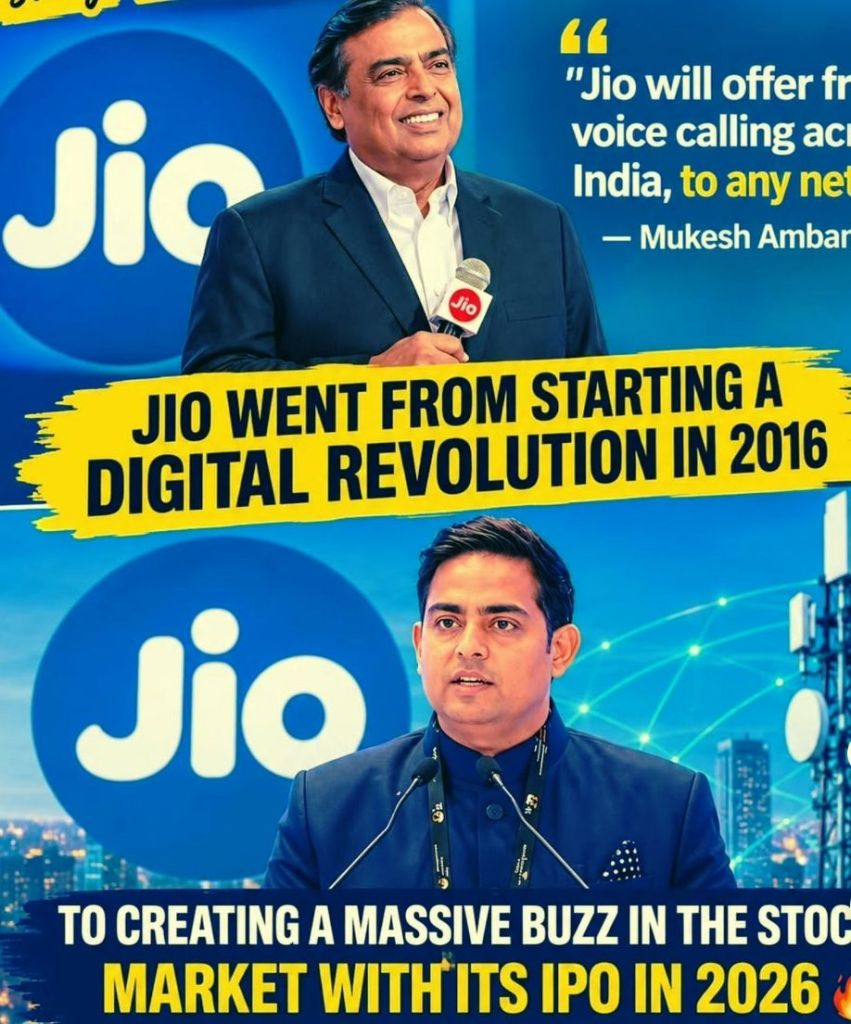
Reliance Jio’s journey from its commercial launch in September 2016 to its landmark stock market debut in October 2026 represents one of the most consequential episodes in Indian capitalism. Celebrated for democratising internet access, disrupting established telecommunications operators and accelerating India’s digital transformation, Jio has fundamentally altered the country’s economic landscape. Yet beneath this remarkable success story lies a more complicated question: did Jio merely revolutionise connectivity, or did it transform an essential public-facing service into an extraordinarily powerful commercial ecosystem? Its trajectory raises important questions about regulatory neutrality, aggressive pricing, market consolidation, consumer dependence and corporate concentration. Millions initially welcomed free voice calls and inexpensive data. A decade later, however, India’s telecommunications market offers considerably fewer meaningful competitors. The central economic paradox is whether a revolution that initially expanded consumer choice has inadvertently created conditions in which competitive choice becomes increasingly constrained.
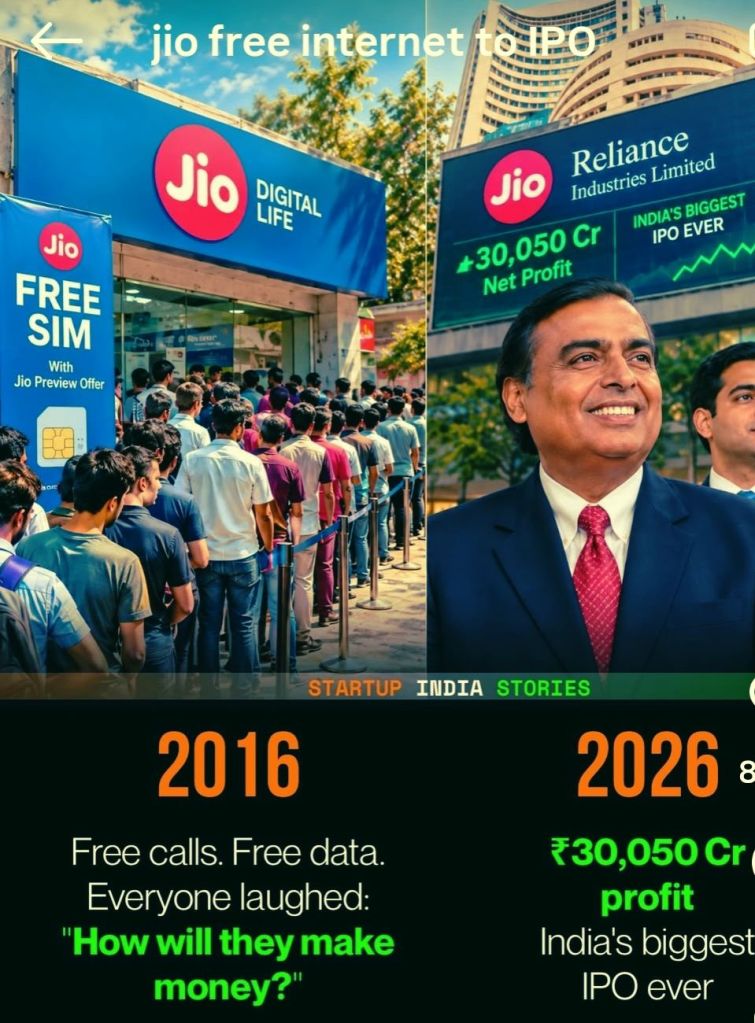
The foundations of Jio’s expansion deserve closer institutional examination. In 2010, Reliance Industries acquired Infotel Broadband Services shortly after the latter secured nationwide broadband wireless spectrum. Subsequent migration of its data-oriented licence towards a unified voice-and-data framework, under the applicable migration-fee arrangements, generated allegations of regulatory advantage. Critics questioned whether the terms provided an economic benefit unavailable through an equivalent competitive process. Jio’s extended pre-commercial testing phase, involving millions of users before its September 2016 launch, also raised questions about the competitive implications of its entry strategy. Subsequent reductions in Interconnect Usage Charges by TRAI altered the economics of voice telecommunications and benefited Jio’s free-calling model. These developments do not independently establish regulatory wrongdoing. Nevertheless, they warrant examination of whether spectrum allocation, licensing conditions and regulatory decisions consistently upheld competitive neutrality. In a market dependent on public spectrum, regulatory fairness is not merely an administrative consideration; it is fundamental to maintaining investor confidence and protecting competition.

Jio’s most consequential intervention was its aggressive pricing strategy. Its Welcome and Happy New Year promotional offers, combining free voice calls with exceptionally inexpensive data, attracted an unprecedented subscriber base and triggered a nationwide telecommunications price war. Mobile data prices reportedly declined by approximately 96 per cent, transforming internet access from an expensive privilege into an everyday necessity. Students, rural households, small businesses and first-generation digital entrepreneurs benefited enormously. However, the competitive consequences were equally significant. Operators already burdened by spectrum expenditure, debt and infrastructure investments struggled to sustain the resulting price pressure. Aircel, Telenor, Tata Docomo and Reliance Communications exited or transferred operations, while Vodafone and Idea merged. Although the Competition Commission of India rejected predatory-pricing complaints, the subsequent consolidation deserves attention. By 2026, Jio and Airtel together reportedly controlled approximately 77 per cent of India’s mobile subscriber market. The economic question is whether aggressive competition, initially celebrated for lowering prices, ultimately contributed to a market structure with fewer meaningful alternatives.
The consumer experience illustrates the economics of customer acquisition, dependency and monetisation. Initially, inexpensive connectivity attracted hundreds of millions of subscribers. Subsequently, mobile connectivity became indispensable to banking, UPI transactions, Aadhaar-linked services, employment, education and government communication. Switching operators increasingly involved more than replacing a SIM card because consumers had become integrated into interconnected digital services. Jio simultaneously expanded into broadband, devices, entertainment and digital applications, strengthening its presence across everyday consumption. As the market matured, the commercial model evolved towards monetisation through recurring subscriptions. Successive industry-wide tariff increases, particularly in July 2024, raised household expenditure. Critics interpret this transition as a hook-and-hike strategy: acquire customers through exceptionally low introductory prices and monetise their dependence once alternatives become limited. However, tariff increases must also be considered against infrastructure investment and operating costs. The legitimate public-policy concern is ensuring that essential digital connectivity remains affordable and that consumers retain genuine freedom of choice.
Jio’s financial performance illustrates the extraordinary commercial value generated by its scale. Its average revenue per user reportedly reached ₹218.8 in the second quarter of FY2026-27, supported by a subscriber base exceeding 542 million. Its reported quarterly profit of ₹8,387 crore and EBITDA margin of approximately 54 per cent demonstrate the strength of its operating economics. Even marginal increases in monthly tariffs across such an enormous subscriber base can generate substantial incremental revenue. However, investors must examine not merely profitability but also the transparency and independence of the underlying commercial arrangements. Its relationship with Reliance Retail is particularly relevant. According to the supplied figures, Reliance Retail’s distribution of prepaid services accounted for 77.08 per cent of Jio Platforms’ consolidated operating revenue in FY2025-26, while advances from Reliance Retail reached approximately ₹1.13 lakh crore. Such arrangements may generate distribution efficiencies and working-capital advantages, but they also create significant related-party dependencies. Their commercial terms, pricing methodologies, governance safeguards and shareholder implications deserve rigorous independent scrutiny, particularly where long-term approvals extend to FY2032.
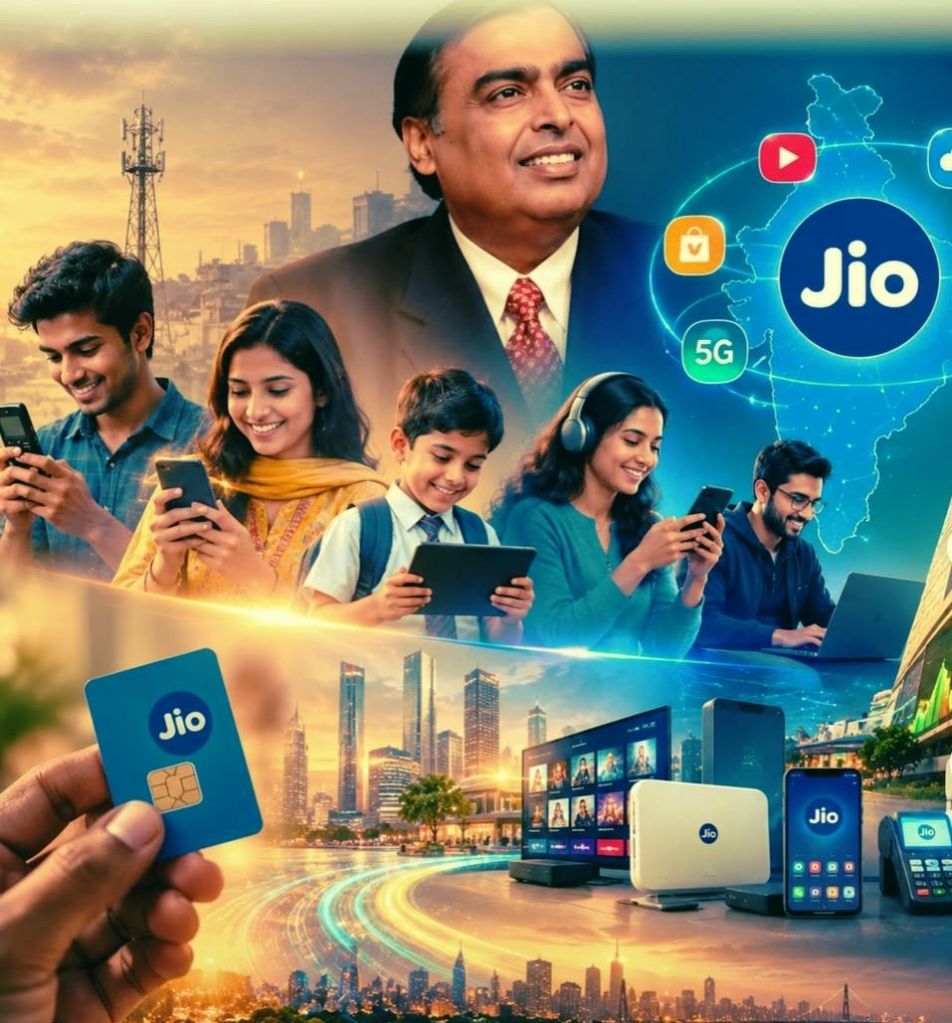
Jio’s evolution into a vertically integrated digital enterprise presents an even more complex competition-policy challenge. Its presence across telecommunications, 5G infrastructure, fibre networks, devices, entertainment, digital commerce and financial services creates substantial economies of scale. Strategic partnerships with global technology companies, including Meta and Google, have strengthened its technological and financial capabilities. Its October 2026 IPO, involving a reported fresh issue of ₹30,213 crore, represents a significant milestone in the evolution of India’s digital economy. Yet vertical integration can also generate structural advantages unavailable to independent competitors.
When a corporate ecosystem operates connectivity networks, distribution channels, content platforms and consumer-facing services simultaneously, questions arise about preferential access, data advantages and the competitive treatment of unaffiliated businesses. Its ambitions in artificial intelligence and satellite connectivity make these questions increasingly consequential. India’s digital future must encourage innovation without allowing control over essential infrastructure, consumer information and commercial platforms to become excessively concentrated.
An objective assessment must nevertheless recognise Jio’s substantial contribution to India’s digital transformation. Its network investments, cited in the supplied analysis at more than $22 billion, accelerated the country’s transition towards 4G and 5G connectivity.
Affordable data strengthened UPI adoption, digital payments, online education, entertainment, entrepreneurship and rural inclusion. Jio invested heavily in network infrastructure and forced the telecommunications industry to modernise. Low prices are not inherently anti-competitive, and commercial success cannot automatically be characterised as exploitation. The distinction lies in examining market conduct, regulatory compliance and competitive outcomes across the entire business cycle. TRAI’s reported April 2026 intervention concerning discriminatory and non-transparent entry-level tariff practices further highlights the importance of consumer protection. Going forward, data privacy, transparent pricing, related-party transactions, infrastructure access and fair competition must receive greater regulatory attention. India’s digital transformation requires both private investment and credible institutional safeguards.
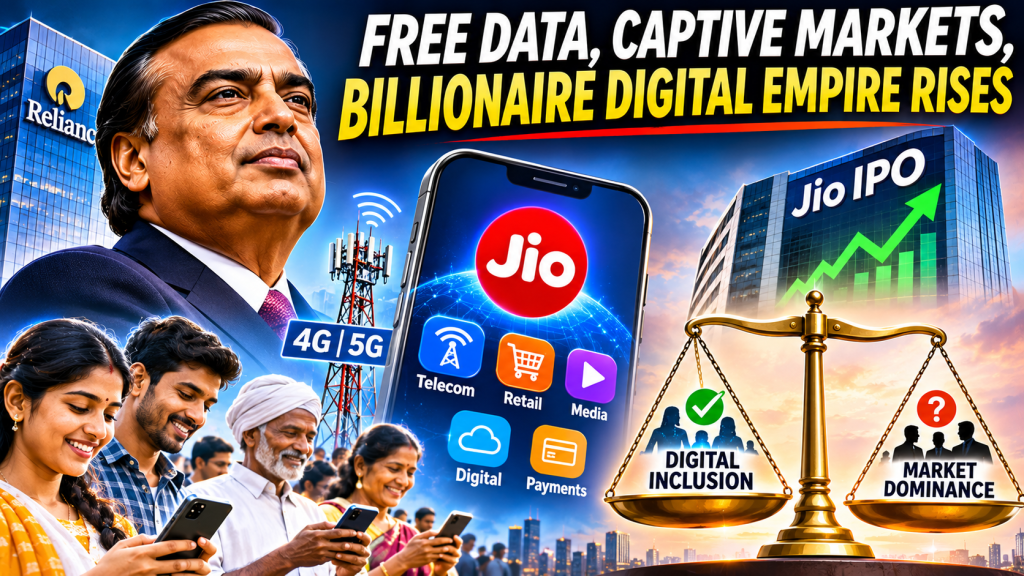
Ultimately, Jio’s journey raises a fundamental question about the future of Indian capitalism: who benefits from the economic opportunities created by digital transformation? The ordinary citizen cannot remain merely a subscriber whose dependence guarantees recurring corporate revenue. Smaller digital enterprises, independent distributors and competing innovators must retain fair access to markets and infrastructure. Government must ensure competitive neutrality, transparent spectrum allocation, effective antitrust enforcement, consumer choice and independent oversight of related-party transactions. Regulators must address emerging market concentration before it becomes structurally irreversible. Jio’s IPO should represent not merely the celebration of corporate valuation but the beginning of greater public-market accountability. India needs powerful digital enterprises, but it must never confuse corporate dominance with national digital progress. The ultimate measure of this revolution is not the wealth accumulated by its architects, but the affordability, freedom and economic opportunities secured for the millions who made it possible.
VST ARJASRIKANTH.IN FOR MORE INSIGHTS

