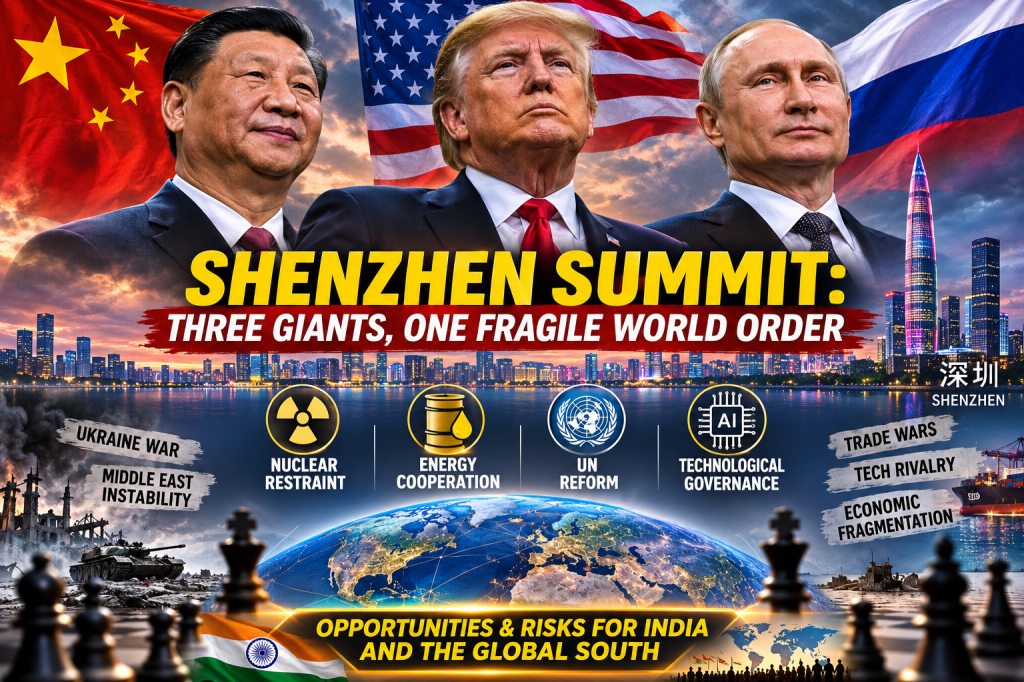
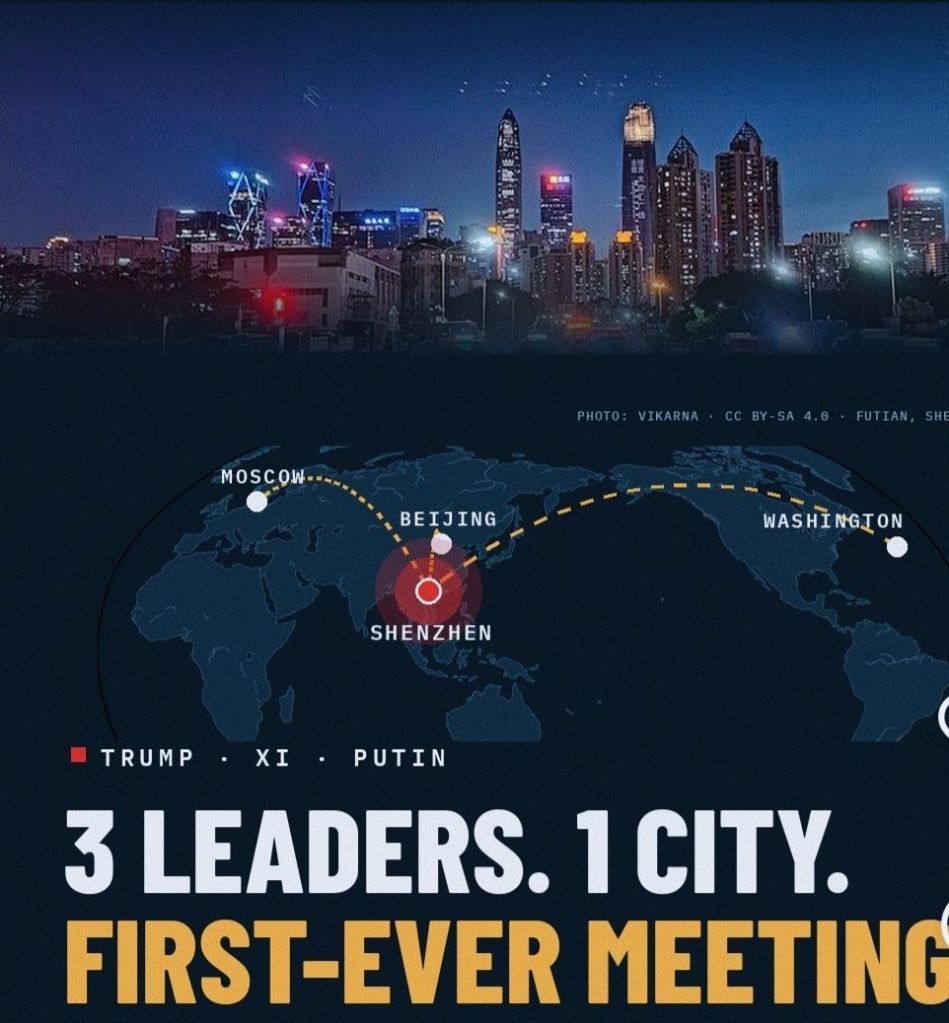
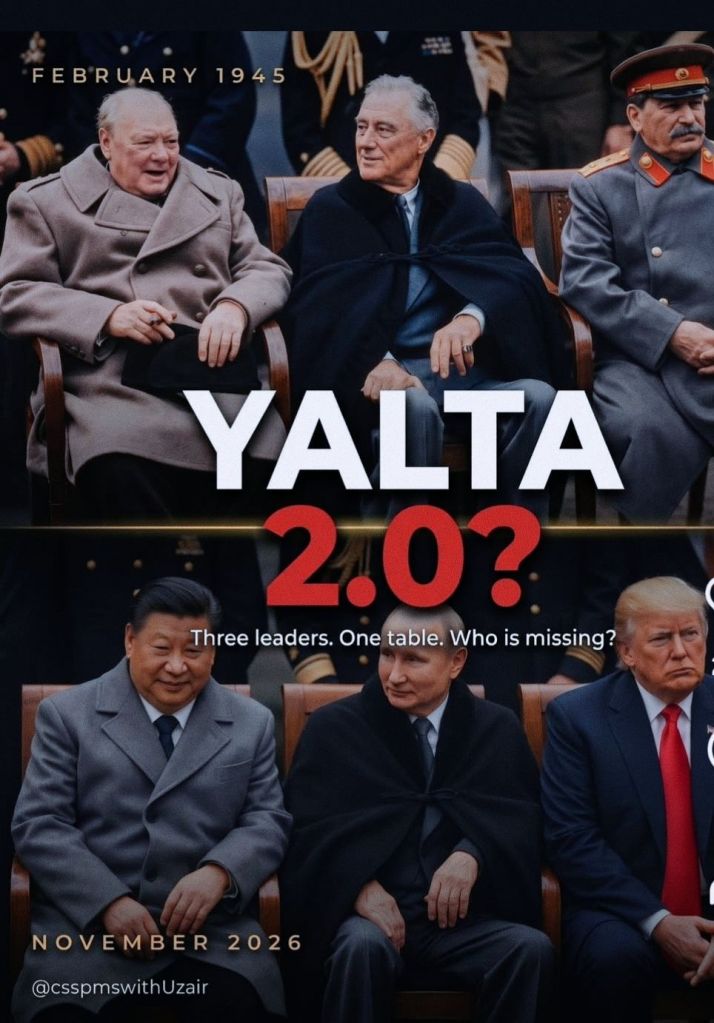
The historic trilateral summit involving Chinese President Xi Jinping, US President Donald Trump and Russian President Vladimir Putin in Shenzhen on November 19, 2026, could mark a defining moment in the evolution of twenty-first-century geopolitics. Against the backdrop of protracted wars, economic fragmentation, technological rivalry and the erosion of confidence in multilateral institutions, the convergence of three consequential nuclear powers carries extraordinary strategic significance. Their four-point declaration evokes comparisons with the Yalta Conference of 1945, when victorious powers negotiated the contours of the post-war international order. Yet Shenzhen is fundamentally different. There is no common victory, ideological consensus or agreed territorial settlement. Instead, it represents an emerging experiment in great-power accommodation: competing nations attempting to manage strategic contradictions without surrendering their ambitions. The central question is whether this encounter signals the emergence of a more stable multipolar order or the institutionalisation of a geopolitical condominium in which powerful states increasingly determine the choices available to weaker nations.
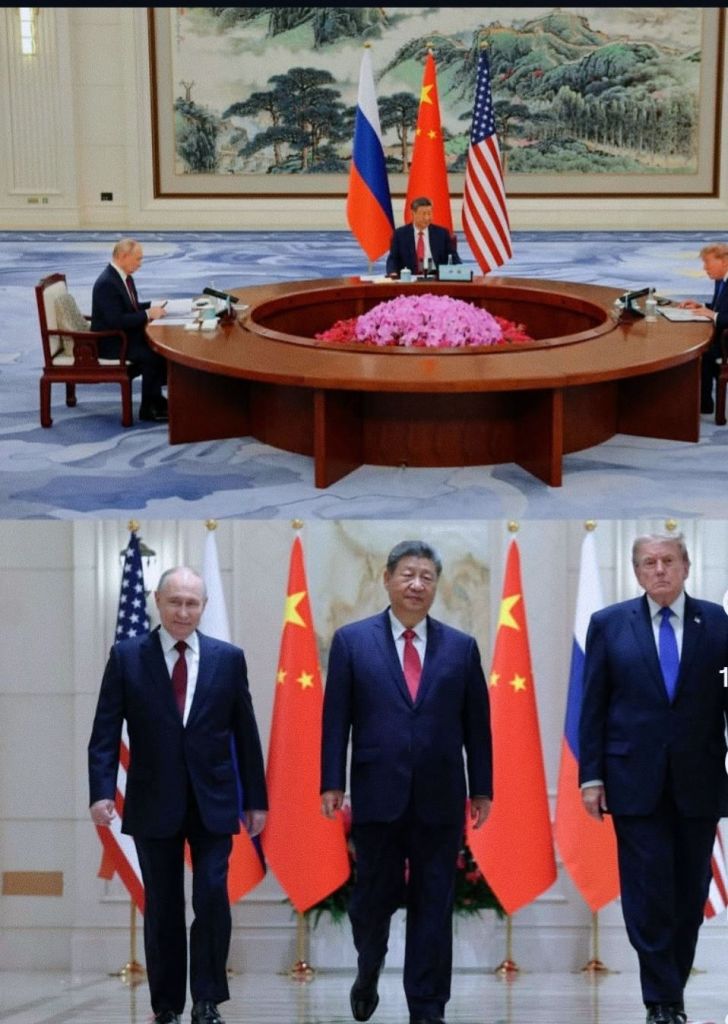
For Xi, hosting the summit reinforces Beijing’s ambition to establish China as an indispensable centre of global diplomacy. Its manufacturing supremacy, economic influence, technological capabilities and strategic trade networks provide leverage extending far beyond conventional military power. Putin’s participation offers Moscow an opportunity to challenge the narrative of international isolation, reaffirming Russia’s relevance through its nuclear arsenal, energy resources and strategic position. For Trump, the encounter reflects his preference for personalised, transactional diplomacy and direct negotiations with competing leaders. Nevertheless, diplomatic optics must not be confused with strategic convergence. Washington, Beijing and Moscow remain divided by fundamentally different security doctrines, economic interests and geopolitical ambitions. Their engagement is therefore neither an alliance nor a reconciliation of competing worldviews. It is a calculated arrangement designed to preserve strategic manoeuvrability while reducing the risks of uncontrolled confrontation. The emerging triangle is consequently defined less by friendship than by mutual recognition of the potentially catastrophic costs of strategic miscalculation.
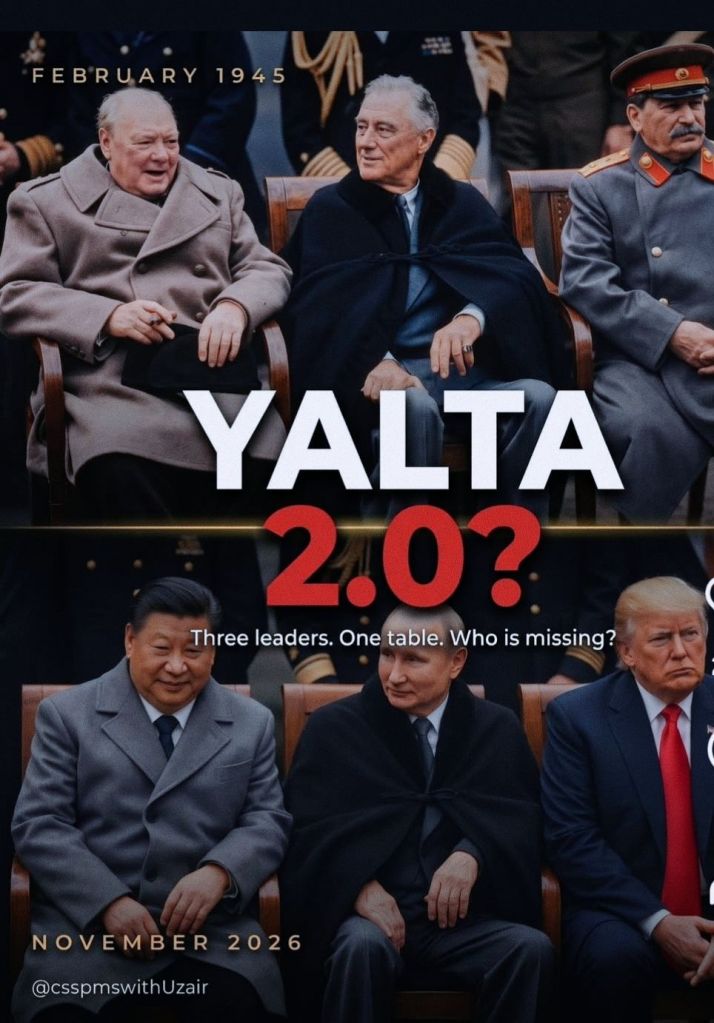
Nuclear security constitutes the summit’s most consequential strategic dimension. The reaffirmation that nuclear war must never be fought assumes particular urgency amid expanding arsenals, hypersonic capabilities, cyber vulnerabilities and artificial intelligence-enabled military systems. The expiry of the New START framework in February 2026 has further exposed weaknesses in the existing architecture of strategic arms control. Moreover, China’s expanding nuclear capabilities make the traditional bilateral Washington-Moscow framework increasingly inadequate. A credible trilateral arrangement must address asymmetries in nuclear stockpiles while establishing mechanisms for transparency, verification and crisis prevention. Military-to-military communication channels, nuclear hotlines, advance notifications of strategic exercises and mutually accepted escalation-management protocols are essential. Without institutional continuity and measurable commitments, presidential assurances risk becoming temporary diplomatic symbolism. The world does not need another declaration celebrating nuclear restraint; it needs an enforceable architecture capable of preventing a technological accident, miscalculation or regional confrontation from becoming a civilisation-threatening catastrophe.
Energy diplomacy represents another powerful instrument of strategic bargaining. The proposed expansion of refined petroleum supplies carries implications for international markets, sanctions regimes, maritime security and inflationary pressures. Collectively, the three powers possess considerable influence across energy production, refining, consumption and supply-chain networks. However, declarations without production targets, export commitments or transparent implementation mechanisms offer limited economic certainty. For India, the stakes are particularly significant. As a major energy-importing economy, New Delhi remains vulnerable to international price volatility, geopolitical disruptions and transportation costs. Greater petroleum availability and sustained price moderation could reduce the import burden, contain inflation, strengthen industrial competitiveness and improve macroeconomic stability. Nevertheless, India must resist excessive dependence on arrangements negotiated exclusively by major powers. Diversified suppliers, strategic petroleum reserves, renewable energy investments and resilient maritime supply chains remain essential pillars of national energy security.
The summit also raises fundamental questions about the legitimacy of the international institutional architecture. Its endorsement of United Nations reform acknowledges that institutions designed in 1945 increasingly struggle to accommodate the economic and geopolitical realities of 2026. Yet meaningful reform requires more than diplomatic language. Security Council expansion, equitable representation, limitations on veto-based paralysis and greater participation by emerging economies must become substantive priorities. Equally contentious is the emphasis on state sovereignty, immunities and constraints on international criminal jurisdiction. Sovereignty is indispensable to international stability, but it cannot become a convenient shield against accountability for grave violations of international law. The challenge is to reconcile sovereign equality with universal responsibility. For India and the Global South, genuine multilateral reform must dismantle the democratic deficit in global governance rather than merely redistribute influence among established powers.
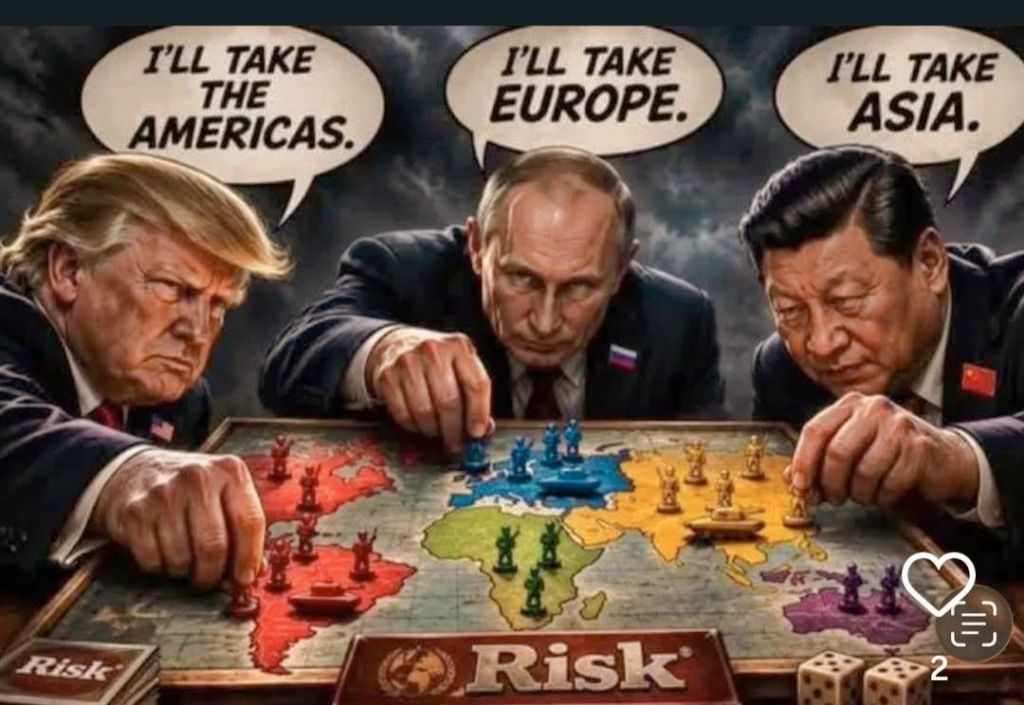
Perhaps the summit’s greatest geopolitical contradiction lies in its omissions. The absence of a concrete roadmap for resolving the Russia-Ukraine conflict and continuing Middle Eastern instability exposes the limitations of high-level accommodation. Ukraine and European stakeholders cannot be treated as peripheral considerations in negotiations determining European security. Nor can the political future of directly affected populations be decided exclusively through arrangements among external powers. The Yalta analogy is therefore instructive as a warning rather than a historical parallel. In 1945, victorious powers shaped the post-war settlement; in 2026, competing powers are attempting to manage conflicts they have not collectively resolved. A world governed through exclusive spheres of influence risks legitimising strategic coercion, weakening territorial sovereignty and undermining international law. Great-power diplomacy can create opportunities for peace, but sustainable settlements require the meaningful participation and consent of those whose territories, security and futures are directly at stake.
Beyond conventional security, the unresolved US-China technological and economic confrontation will determine the character of the emerging international order. Tariffs, semiconductor restrictions, artificial intelligence, critical minerals, industrial policy and strategic supply chains have transformed economic interdependence into an instrument of geopolitical competition. China’s manufacturing ecosystem and critical-mineral processing capabilities intersect with America’s advantages in advanced computing, semiconductor design and technological innovation. Neither economy can disengage without substantial costs. Artificial intelligence further complicates the equation by introducing unprecedented questions concerning autonomous weapons, surveillance, cyber warfare and military decision-making. Any commitment to maintaining meaningful human control over AI must translate into credible international standards and governance mechanisms. For the Global South, multipolarity creates opportunities to diversify partnerships, attract investment and strengthen bargaining power. However, it also threatens technological fragmentation, competing regulatory standards and economic coercion.
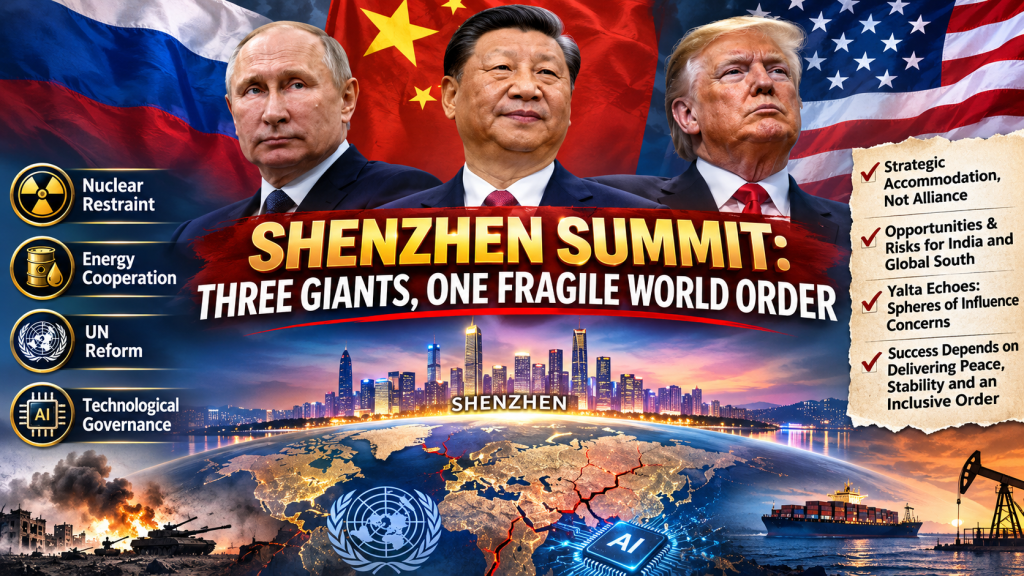
For India, Shenzhen should be interpreted neither as a diplomatic setback nor as an invitation to geopolitical complacency. New Delhi’s strategic relationships with Washington and Moscow, alongside its complicated engagement with Beijing, demand sophisticated diplomacy rather than rigid bloc politics. Its absence from the trilateral negotiating table reinforces the importance of economic resilience, military preparedness, diplomatic initiative and institutional leadership. India’s response must rest on strategic autonomy, not strategic isolation. Strengthening the Indo-Pacific partnership, pursuing constructive engagement with all three powers, advocating permanent representation in a reformed UN Security Council and championing Global South priorities are essential. Ultimately, the Shenzhen declaration must be judged not by presidential handshakes or carefully choreographed diplomatic photographs, but by measurable progress in nuclear risk reduction, energy stability, technological governance and inclusive conflict resolution. Its greatest achievement is reopening communication among competing powers; its greatest weakness is the absence of enforceable commitments. The twenty-first century cannot become the private boardroom of three powerful presidents. The real measure of leadership is not whether Xi, Trump and Putin can negotiate a world according to their ambitions, but whether they can build an international order in which every nation retains the right to shape its own destiny.
VST ARJASRIKANTH.IN FOR MORE INSIGHTS

