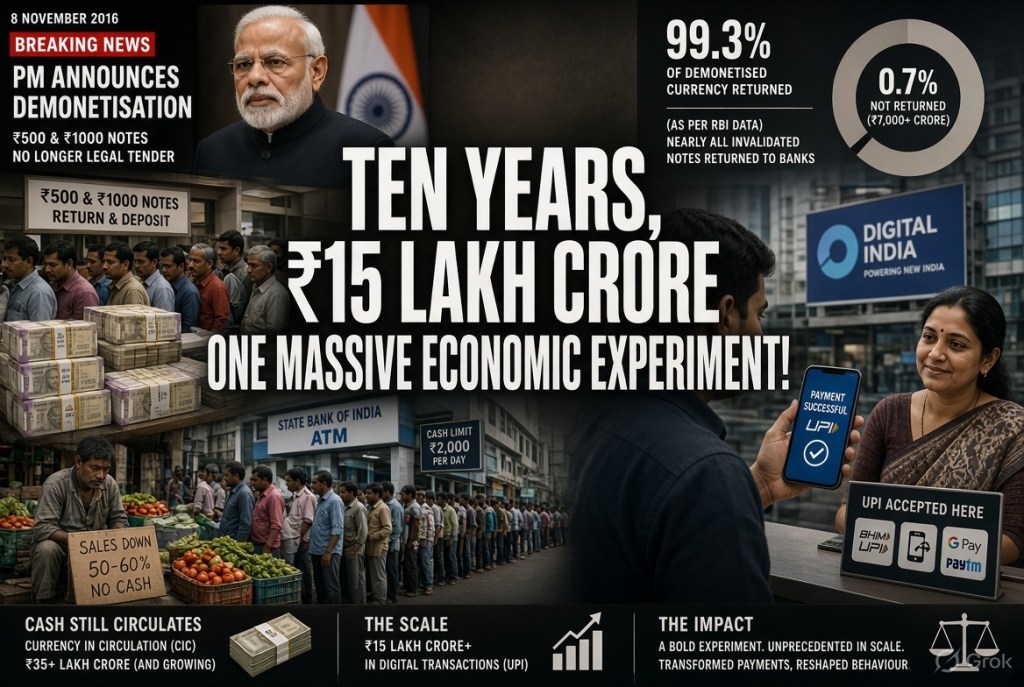
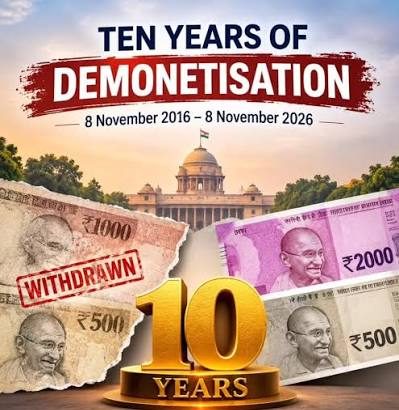
On November 8, 2016, India embarked on one of the most audacious monetary experiments in its economic history. Through a televised announcement, the government invalidated ₹500 and ₹1,000 currency notes, withdrawing approximately 86 per cent of the currency in circulation by value. The political promise was transformative: black money would disappear, counterfeit currency would be eliminated, terrorism financing disrupted and India propelled towards a transparent, cashless economy. Ten years later, demonetisation deserves neither uncritical celebration nor reflexive condemnation, but a rigorous empirical audit. Its legacy must be assessed against the objectives declared, the economic outcomes delivered and the human costs imposed. The central question is no longer whether the announcement was dramatic, but whether the disruption produced commensurate national value. When an entire economy is subjected to an extraordinary monetary shock, the burden of proof must rest on the policy itself.
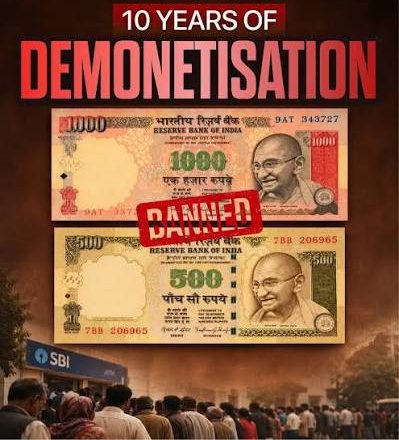
The most conspicuous failure concerns the objective that gave demonetisation its moral and political legitimacy: the elimination of black money. Of approximately ₹15.41 lakh crore in invalidated currency, nearly 99.3 per cent returned to the banking system, leaving only about ₹10,720 crore unreturned. This outcome exposed a fundamental misconception: illicit wealth is not synonymous with physical cash. It is accumulated and concealed through benami properties, undervalued real estate, gold, shell companies, manipulated accounts, offshore structures and opaque financial transactions. Currency represents only one possible repository of unaccounted wealth, often the least sophisticated. By targeting cash rather than the institutional architecture that facilitates illicit wealth creation, the intervention attacked a visible symptom instead of the underlying disease. The return of almost all invalidated currency did not establish that every rupee was legitimate; equally, it did not demonstrate that black money had been extinguished. The distinction between depositing cash and identifying its beneficial ownership was crucial, yet frequently obscured in public discourse.
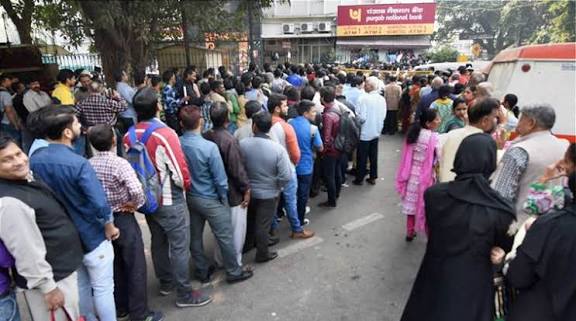
The immediate economic consequences were borne disproportionately by those least equipped to withstand them. India’s informal economy, which sustains millions of workers and small enterprises, depends heavily on cash for wages, procurement, transportation and daily transactions. Overnight liquidity deprivation disrupted agricultural markets, construction activity, small manufacturing, retail trade and household consumption. Farmers faced difficulties purchasing agricultural inputs and selling produce during a critical cropping period. Daily-wage workers lost employment as cash-dependent businesses curtailed operations. Street vendors, transport operators and neighbourhood retailers experienced collapsing transactions and working-capital shortages. For ordinary citizens, including senior citizens, women and people requiring medical assistance, accessing their own legitimate money became an exhausting exercise in standing in queues and navigating withdrawal restrictions. The economic injury extended beyond inconvenience: lost wages, interrupted supply chains, depleted savings and damaged commercial relationships cannot be reversed merely by replenishing currency. A policy ostensibly directed at economic dishonesty imposed its most immediate costs on predominantly legitimate cash-dependent livelihoods.
The macroeconomic disruption further exposed the unequal capacity of India’s economic sectors to absorb policy shocks. Organised corporations possessed banking relationships, financial reserves, digital systems and access to formal credit. Small enterprises and informal workers had none of these advantages at comparable scale. Research on the demonetisation episode identified contractions in economic activity, employment and credit, particularly in districts more exposed to the currency withdrawal. Estimates of output losses vary according to methodology, but the broader evidence points to a substantial short-term disruption. The underlying problem was structural: India attempted to transform monetary behaviour before ensuring that alternative payment infrastructure, banking access and digital acceptance were sufficiently universal. Liquidity is the bloodstream of an economy, especially for enterprises operating on narrow margins. When it is abruptly interrupted, the consequences travel from individual workers to suppliers, consumers and entire local markets. The experience demonstrated that macroeconomic resilience cannot be measured merely through aggregate GDP; the distribution of adjustment costs matters equally.
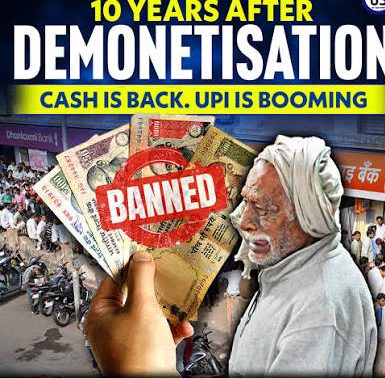
The promise of a permanently cashless economy has encountered another inconvenient reality. Currency in circulation, which stood at approximately ₹17.97 lakh crore before demonetisation, subsequently expanded to more than ₹42 lakh crore by October 2026. Cash has not disappeared; it has returned with considerable force. Its continued relevance reflects the structure of India’s economy, including agriculture, rural commerce, small businesses, informal employment and transactions where digital infrastructure or acceptance remains uneven. This is not necessarily evidence of economic backwardness. Cash offers immediacy, universal familiarity and transaction independence, while digital payments offer speed, traceability and convenience. A modern economy can accommodate both. India’s digital payments revolution, particularly through UPI, is undoubtedly transformative, but its success cannot be attributed exclusively to demonetisation. Smartphone penetration, affordable mobile data, interoperable payment architecture, merchant adoption, financial inclusion and the pandemic accelerated digital adoption. Demonetisation may have stimulated initial experimentation, but it was technological innovation and network effects that made digital payments sustainable.
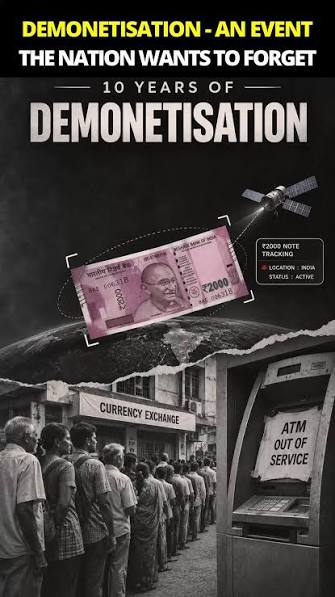
The claims concerning counterfeit currency and terror financing also require careful differentiation between temporary disruption and lasting institutional success. The withdrawal of existing notes undoubtedly interrupted counterfeit networks, which had to reproduce new currency designs and denominations. However, counterfeit notes subsequently appeared in the new currency series, demonstrating that the threat was not permanently eliminated. Counterfeiting remains a relatively small component of the overall currency stock, but its implications for national security cannot be dismissed. More importantly, illicit financial networks adapt. Their disruption requires intelligence-led enforcement, border security, financial surveillance, technological safeguards and effective prosecution. A temporary interruption in the circulation of counterfeit notes cannot be equated with the dismantling of organised criminal networks. Similarly, subsequent increases in tax collections and formal financial transactions must be evaluated against multiple intervening reforms, including GST, improved information systems and wider digital adoption. Sound policy evaluation must distinguish between outcomes that followed demonetisation and outcomes demonstrably caused by it. Chronology is not causality, and political attribution is not empirical proof.
The more consequential lesson is that economic formalisation cannot be achieved through monetary coercion alone. It requires a sustained institutional framework that makes transparency easier, compliance affordable and concealment increasingly difficult. Stronger enforcement against benami property holdings, transparent real-estate transactions, beneficial ownership disclosure, shell-company surveillance, accountable political financing and effective tax administration address the structural sources of illicit wealth far more directly. Digital infrastructure must expand through accessibility, trust and incentives rather than temporary scarcity. Small businesses need affordable working capital, simplified taxation, predictable regulation and reliable payment systems. Agricultural markets require better banking connectivity and efficient digital settlement mechanisms. Equally important, extraordinary economic interventions must be preceded by credible impact assessments, realistic implementation planning and transparent communication. Governments must establish measurable objectives, publish baseline data and permit independent evaluation. The capacity to announce a dramatic policy is not the same as the capacity to execute a successful economic reform.
Ten years later, demonetisation stands as a defining case study in the difference between political spectacle and economic transformation. It demonstrated the state’s ability to impose an unprecedented monetary intervention, but the evidence raises serious questions about whether its principal objectives justified its scale and social costs. Its digital-payment legacy deserves recognition, yet that achievement belongs to a wider technological and institutional transformation. Its temporary disruption of counterfeit networks cannot be confused with their permanent elimination, while the return of almost all invalidated currency fundamentally challenges the original black-money proposition. India’s next phase of reform must focus on institutions rather than announcements, enforcement rather than symbolism, and measurable outcomes rather than political narratives. Ultimately, the legitimacy of economic governance rests not on the magnitude of disruption imposed upon citizens, but on the durable improvements delivered to them. In 2016, ordinary Indians stood in queues to establish the legitimacy of their money. Ten years later, it is the policy itself that must stand in the queue of public accountability.
VST ARJASRIKANTH.IN FOR MORE INSIGHTS

