
The Supreme Court’s November 5, 2026 judgment in Sujit Das v. Union of India marks a significant moment in India’s constitutional jurisprudence, reaffirming that individual liberty cannot be subordinated to administrative convenience or investigative expediency. A Bench comprising Justices Ujjal Bhuyan and Atul S. Chandurkar delivered a powerful message: the constitutional clock governing production before a magistrate begins when a person’s freedom is actually curtailed, not when the investigating agency chooses to formally record an arrest. Interpreting Article 22(2) of the Constitution, the Court rejected the artificial distinction between detention and formal arrest. The judgment reinforces a fundamental democratic proposition: the State may investigate an individual, but it cannot create an unofficial zone of custody outside constitutional supervision. It is an important assertion that constitutional rights operate continuously, including during the most vulnerable moments of police investigation.
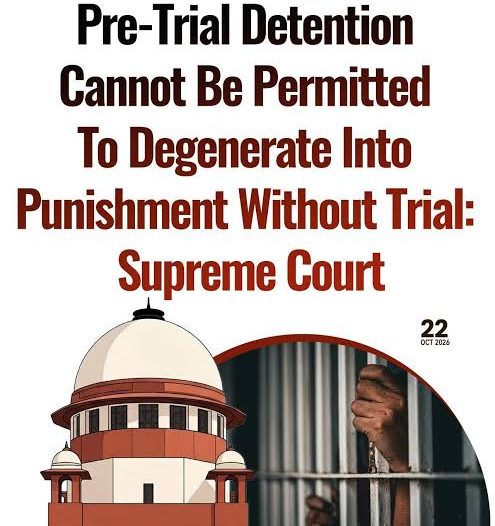
Article 22(2) mandates that every arrested and detained person must be produced before the nearest magistrate within 24 hours, excluding the time necessary for the journey. The Court interpreted the expressions ‘arrested’ and ‘detained in custody’ conjunctively, holding that the period begins from the moment personal liberty is effectively restricted. Time spent in interrogation, inquiry, search or investigation cannot be converted into an unofficial extension before formal arrest. The judgment also clarified that Section 58 of the Bharatiya Nagarik Suraksha Sanhita (BNSS) imposes an additional requirement: detention must remain reasonable even within the constitutional 24-hour ceiling. Thus, 24 hours is an outer limit, not an automatic entitlement for investigating agencies to detain individuals. The distinction is crucial because constitutional protection must govern both the duration and the justification of custody.

The facts underlying the judgment reveal the practical importance of this interpretation. The appellants in the NDPS case were detained during search and seizure operations at approximately 2 PM on September 29, 2025, but their formal arrest was recorded only at 11 AM the following day. This gap effectively placed them under police control without immediate judicial oversight. The Court held that the constitutional deadline had to be calculated from the original detention, not the subsequently documented arrest. Its intervention is particularly significant for vulnerable citizens who may be interrogated, isolated or physically restrained before an arrest memorandum is prepared. Such periods of undocumented custody can facilitate coercion, intimidation and custodial abuse, while making it difficult for families and legal representatives to establish a detainee’s whereabouts. By recognizing actual restraint as the decisive constitutional trigger, the Court strengthens the practical enforceability of personal liberty and the remedy of habeas corpus.
Equally consequential is the judgment’s emphasis on the independent constitutional responsibility of magistrates. Judicial remand must never become a mechanical endorsement of police requests. A magistrate is expected to examine the legality, duration and circumstances of detention rather than merely verify the formal arrest memorandum. The Court directed that the precise date and time at which liberty was first curtailed must be recorded and independently scrutinized. Magistrates must also determine whether detention, even within 24 hours, was reasonable under Section 58 BNSS and may decline remand when it was excessive in the circumstances. This reinforces the judiciary’s role as an institutional counterweight to executive power. The Court also rejected contrary approaches adopted in earlier High Court decisions concerning the computation of the constitutional period. The larger message is unmistakable: judicial oversight must begin when liberty is taken away, not after procedural formalities are completed.

The judgment carries particular significance for cases involving stringent special legislation, especially the Narcotic Drugs and Psychotropic Substances Act. Section 37 imposes exceptionally restrictive conditions for granting bail in specified NDPS offences involving commercial quantities. However, statutory severity cannot legitimize unconstitutional detention. The Supreme Court made clear that the protections under Article 22(2) cannot be neutralized by invoking the stringent bail framework. It also expressed reservations about the reasoning in State of Punjab v. Sukhwinder Singh @ Gora, concerning the relationship between fundamental rights and restrictive bail conditions, while recognising the implications of the larger Bench ruling in Union of India v. K.A. Najeeb. The significance lies in preserving the hierarchy of constitutional values: special statutes may strengthen the State’s investigative powers, but they cannot displace fundamental rights. The pursuit of justice cannot become an excuse for disregarding the constitutional limitations governing the State itself.

Nevertheless, a progressive judicial pronouncement does not automatically transform police behaviour or custodial practices. The critical implementation challenge is determining what constitutes a reasonable period of detention within the 24-hour ceiling. If magistrates routinely accept the entire period as reasonable, the additional protection under Section 58 could become largely symbolic. A six-hour presumptive benchmark for initial judicial scrutiny, subject to documented operational justification, could be considered as a policy proposal, although it is not a direction issued by the Supreme Court. Equally challenging is the evidentiary burden of establishing the actual commencement of detention. Individuals held in unofficial custody rarely possess the documents needed to prove when their liberty was first curtailed. The system must therefore prevent investigative agencies from controlling both the detention and the documentary evidence of its commencement. The journey-time exception must also remain confined to genuine transportation requirements rather than administrative delays or procedural convenience.
The way forward lies in converting constitutional principles into verifiable institutional systems. Every police station and investigating agency should maintain a mandatory, digitally timestamped detention register recording the first instance of physical restraint or effective police control. Such records should be accessible to the supervising authorities and available for judicial verification during remand proceedings. CCTV coverage, preservation of interrogation records and independent inspection mechanisms should reinforce transparency. The Supreme Court’s earlier directions in Paramvir Singh Saini v. Baljit Singh concerning CCTV surveillance in police stations provide an important institutional foundation. High Courts should issue consistent procedural guidance, while judicial academies, police training institutions and legal services authorities should incorporate the judgment into regular training. Every remand hearing should involve meaningful legal representation, direct interaction between the magistrate and detainee, and verification of the custody timeline. Digital accountability must become an operational safeguard rather than another compliance formality.

Ultimately, the effectiveness of Sujit Das must be measured not by the strength of its judicial observations but by the unlawful detention practices it prevents. Parliament should consider expressly incorporating the actual-curtailment principle into the BNSS to eliminate interpretative ambiguity. State police leadership must establish enforceable protocols, while National and State Legal Services Authorities should ensure timely legal assistance to detainees. Independent audits of remand proceedings, systematic monitoring of custodial complaints and accountability for falsified records can strengthen implementation. Equally, police officers must receive clear operational guidance so that legitimate investigations are not obstructed, but are conducted within constitutional boundaries. The objective is not to weaken law enforcement; it is to ensure that investigative effectiveness and constitutional discipline reinforce each other. A professional police institution gains legitimacy not by exercising unrestricted authority, but by demonstrating restraint, transparency and respect for the law.
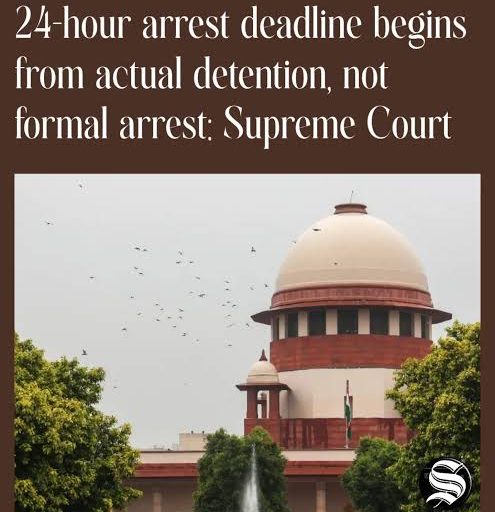
The larger constitutional lesson is that democracy is tested not merely by how effectively the State investigates crime, but by how faithfully it protects the rights of those accused. The Supreme Court has drawn a clear boundary: the police may control an investigation, but they do not own an individual’s freedom. Liberty cannot be postponed until paperwork is completed, nor can fundamental rights be suspended in the name of investigative efficiency. Sujit Das therefore represents more than an interpretation of a 24-hour procedural requirement; it is a reaffirmation of constitutional morality, judicial vigilance and human dignity. The true strength of a democracy is not the power to detain its citizens, but the discipline to respect their liberty even when they are accused of crime.
VST ARJASRIKANTH.IN FOR MORE INSIGHTS

