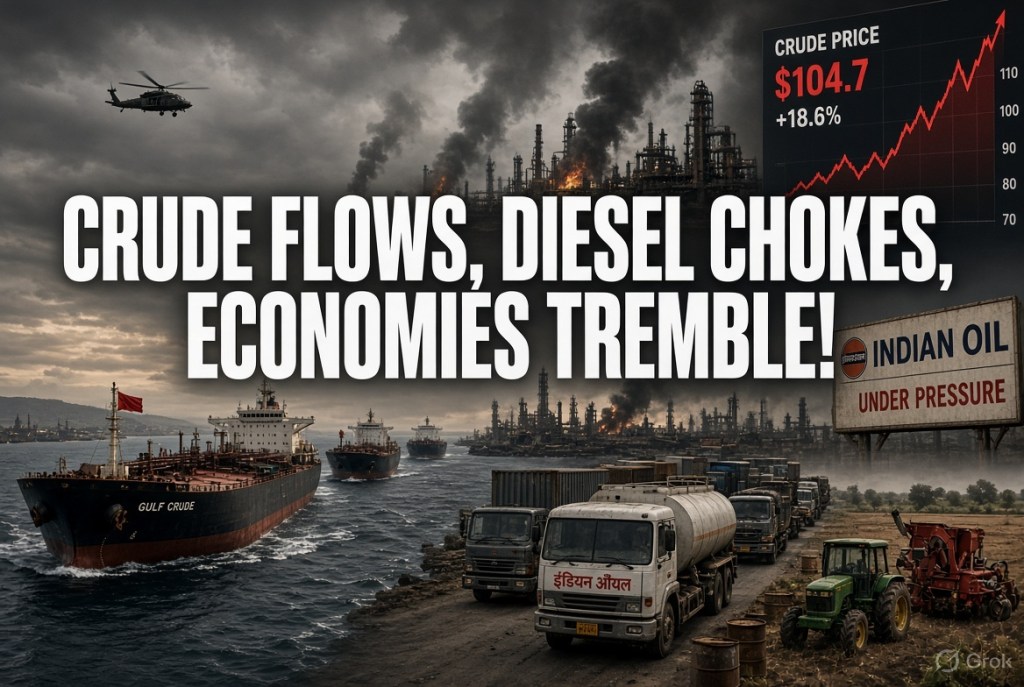
The Gulf oil crisis exposes a defining paradox of modern energy security: crude can be rerouted, but refined fuels cannot; strategic reserves can release barrels, but cannot neutralise geopolitical fear; and global supply chains can preserve volumes while accumulating hidden vulnerabilities. The disruption following the February war with Iran is therefore far more than a conventional oil-supply shock. It is a three-dimensional crisis of disrupted logistics, damaged refining infrastructure and escalating geopolitical risk premiums. Its most consequential manifestation is the emerging diesel shortage, threatening global inflation, industrial production and India’s energy economics. The central lesson is that oil security cannot be measured merely by the availability of crude; it must be measured by the uninterrupted delivery of usable fuels.
The first paradox is the resilience of crude exports despite disruption in the Strait of Hormuz. Saudi Arabia and the UAE reportedly moved approximately 5.6 million barrels per day (mb/d) through bypass pipelines by September, while smaller tankers, ship-to-ship transfers and alternative maritime routes sustained Hormuz-related flows at around 10.9 mb/d. Yet logistical continuity is not strategic security. These alternatives are expensive, capacity-constrained and exposed to further attacks. The September 11 drone strikes, which reportedly forced Saudi Arabia’s East-West pipeline to shut for 11 days, exposed this vulnerability. Shipping costs rose by approximately $20 per barrel over the year, nearly 75% attributable to Gulf rerouting. Regional production remained around 75% of pre-war levels, with recovery beyond 85% considered difficult without a durable settlement. The world is therefore paying a substantial economic and security premium merely to keep the oil moving.
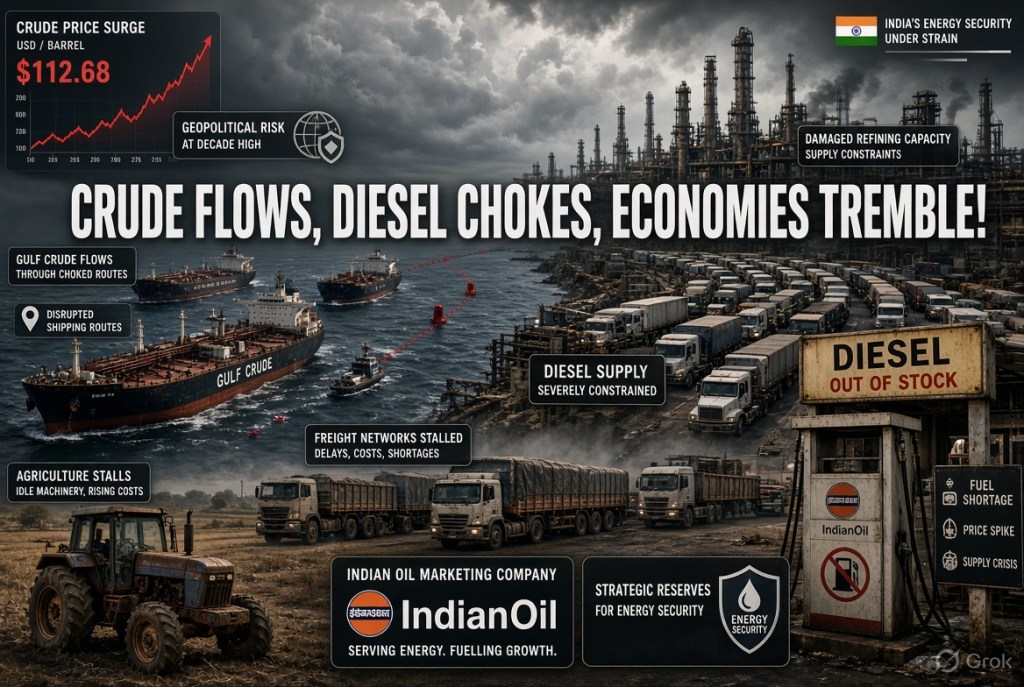
The second dimension is the widening gap between physical scarcity and financial pricing. Global inventories reportedly declined by 509 million barrels between February and September, taking onshore stocks to their lowest levels since at least 2016. Extreme backwardation, with near-term crude trading around $5 per barrel above delivery a month later, reflected immediate physical tightness and anxiety about future supply. Prices reportedly touched $116.72 per barrel, against India’s pre-war crude basket average of approximately $69. Markets are pricing not only barrels already lost, but the possibility of a much larger disruption. Houthi attacks, threats to Ras Tanura, shipping casualties and fears of further US-Israeli escalation have embedded geopolitical uncertainty directly into energy prices. In a depleted market, even an unverified threat can trigger disproportionate volatility. Fear has become an economic variable, not merely a political sentiment.
The third weakness is the diminishing power of conventional policy buffers. The G7 reportedly released 100 million barrels from strategic reserves over four months, but the intervention had limited influence on prices. Emergency stocks can bridge temporary shortages; they cannot eliminate the risk premium created by continuing conflict. China, meanwhile, emerged as an important market stabiliser by reducing seaborne crude imports by approximately 5.4 mb/d through June and drawing down domestic stocks. Its reported September inventory drawdown of 1.6 mb/d supported refining without equivalent fresh imports. However, China’s estimated 1.2 billion barrels of reserves are primarily a national security asset, not an international stabilisation facility. The subsequent October import rebound above 10 mb/d suggests that reduced purchasing cannot be treated as a permanent source of relief. The crisis demonstrates that strategic reserves buy time; they do not manufacture lasting energy security.
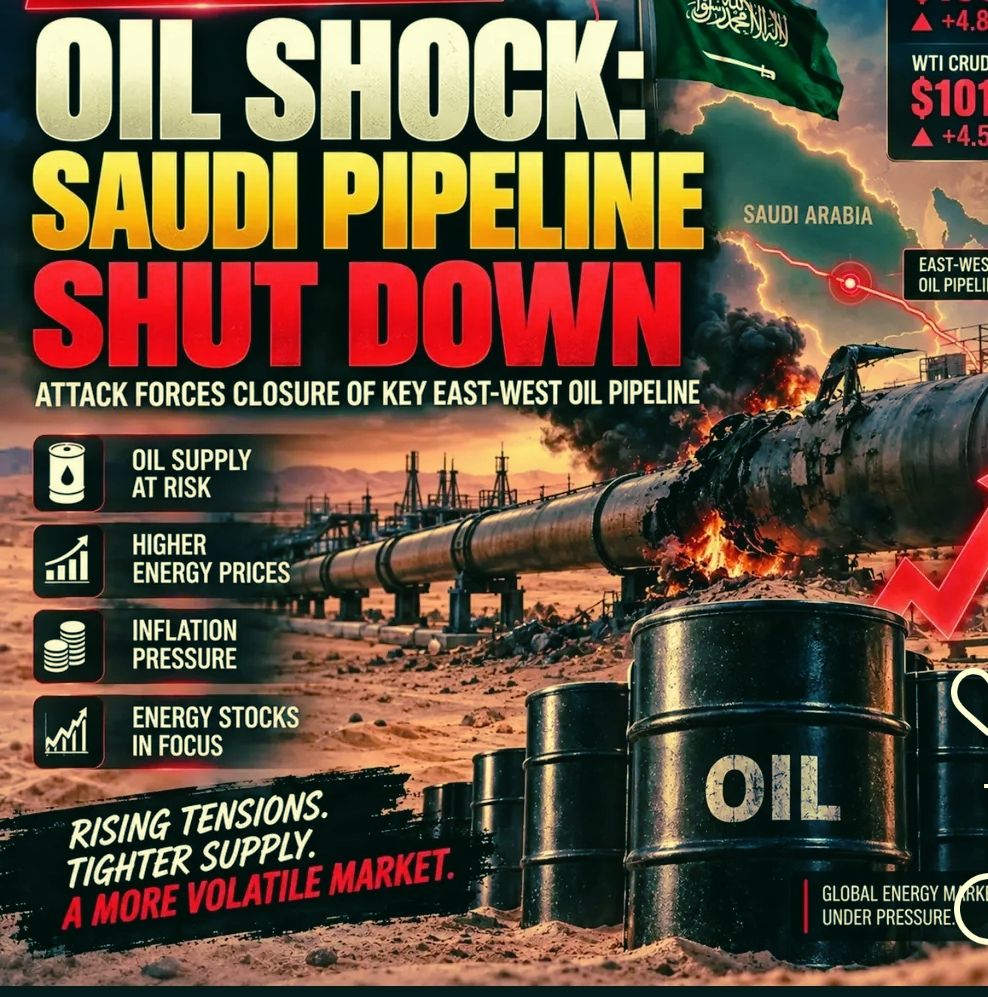
The deeper structural vulnerability, however, lies downstream—in refining capacity and finished petroleum products. Middle Eastern refinery throughput reportedly fell from 9.9 mb/d in February to 7.3 mb/d by August. Damaged facilities, restricted shipping and storage constraints have reduced supplies of diesel, jet fuel and heating oil. Unlike crude, finished fuels cannot be redirected through cross-country crude pipelines. Their handling and transfer also involve additional safety and logistical constraints. The repeated targeting and shutdown of Saudi Arabia’s Ras Tanura refinery complex, with capacity of approximately 400,000 barrels per day, illustrates how damage to a limited number of strategically important facilities can disrupt supply chains across continents. The vulnerability is not simply where oil is produced, but where it is converted into the fuels that economies actually consume.
Diesel has consequently emerged as the crisis’s most revealing economic indicator. It powers freight, agriculture, shipping, construction, mining and backup electricity generation. Demand is relatively inelastic because essential economic activity cannot quickly function without it. While US petrol prices reportedly declined for five consecutive weeks, diesel prices continued rising. Damage to Russian and Middle Eastern refineries has compounded the shortage, while Ukrainian attacks on Russian facilities, Moscow’s diesel export restrictions and China’s prioritisation of domestic fuel security have tightened international markets. Even proposed additional Russian exports of 7.5 million barrels would represent less than half a day of global diesel consumption, estimated at 28.7 mb/d. This is fundamentally a refining and product-availability crisis: crude may exist in the market, but the capacity to convert and deliver it is constrained.
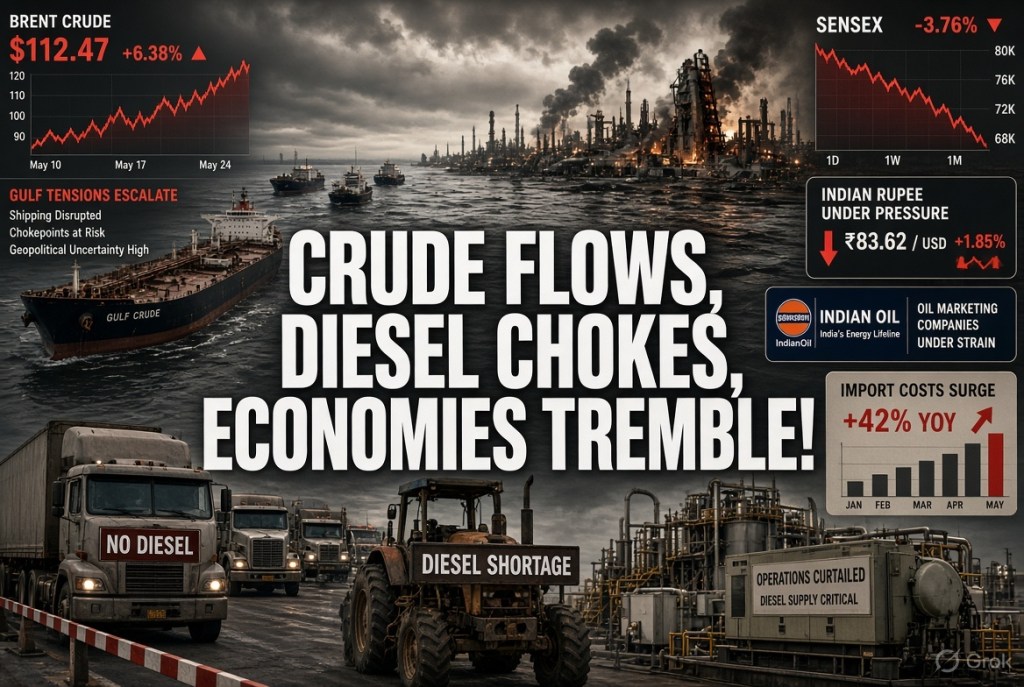
For India, the consequences are particularly asymmetric. The reported crude import cost rose 46.4% to approximately $117.4 per barrel. ICRA estimated that public-sector oil marketing companies were absorbing losses of around ₹9 per litre on diesel and ₹8 on petrol amid constrained domestic retail prices. Some outlets reportedly turned to cheaper biodiesel blending to manage costs. In contrast, private refiners such as Reliance and Nayara benefited from attractive international diesel margins and export opportunities. Adjustments to diesel export windfall taxation further complicated the distribution of gains and losses. India, therefore, cannot be described as a single economic winner or loser: consumers, taxpayers, public-sector oil retailers and private refiners face different exposures. The policy challenge is to balance affordability, fiscal sustainability, commercial incentives and uninterrupted domestic supply without allowing the burden to fall disproportionately on any one segment.
The medium-term outlook points towards a prolonged but potentially temporary supply crunch rather than permanently expensive oil. Futures markets reportedly indicate eventual Brent moderation towards $63–70, while the World Bank’s projected 2.6 mb/d contraction in global oil demand during 2026 raises the possibility of demand destruction rather than a healthy supply-side correction. Gulf refining capacity may not return to pre-war levels until mid-2027. For India, the strategic response must extend beyond crude procurement: strengthen strategic petroleum reserves, diversify crude and finished-product imports, expand domestic refining flexibility, secure shipping arrangements, accelerate alternative fuels and improve coordination between public-sector retailers and private refiners. ENERGY SECURITY IS NOT ABOUT COUNTING BARRELS; IT IS ABOUT DELIVERING THE RIGHT FUEL TO THE RIGHT ECONOMY AT THE RIGHT TIME. The next energy shock may not arrive through an empty oil tanker. It may arrive when trucks, tractors, factories and power generators discover that crude is available—but diesel is not.
VST ARJASRIAKNTH.IN FOR MORE INSIGHTS

