
India’s emergence as a global refining powerhouse illustrates how entrepreneurial ambition, technological sophistication and strategic investment can transform national vulnerabilities into industrial advantages. The Jamnagar refinery complex exemplifies the capacity of Indian enterprise to convert dependence on imported crude oil into a position of international industrial significance. Yet, this achievement raises a larger question about India’s economic future: can a nation aspiring to developed-economy status rely predominantly on a handful of corporate giants, or must it cultivate a far broader constellation of globally competitive enterprises? India possesses the human capital, domestic market, technological potential and entrepreneurial energy to expand its industrial champions across sectors. The challenge is not simply to create more billionaires, but to build an economic architecture in which enterprise, innovation and prosperity become widely distributed sources of national strength.

Jamnagar demonstrates why industrial scale matters in an era of geopolitical competition and uncertain energy markets. Sophisticated refining infrastructure enables the processing of diverse crude grades, supports exports, generates economic value and strengthens India’s strategic flexibility. Such facilities are more than commercial assets: they contribute to technological capability, industrial employment and national resilience. Successful private enterprises can complement public institutions by mobilising capital, executing complex projects and integrating India into global supply chains. However, celebrating corporate achievement must not obscure the distinction between the prosperity of individual companies and the economic advancement of society as a whole. A strong industrial champion is an asset to the nation; a strong industrial ecosystem is a much greater one. The objective should be to encourage successful enterprise while ensuring that market access, investment opportunities and economic influence remain open to qualified competitors.

India’s industrial ambition must therefore extend beyond producing additional conglomerates resembling its established corporate houses. The country needs a diversified portfolio of enterprises across renewable energy, semiconductors, defence manufacturing, artificial intelligence, biotechnology, pharmaceuticals, electronics, agricultural processing, tourism, logistics and green hydrogen. Equally important are labour-intensive industries such as textiles, footwear, food processing and light engineering, which can generate employment at a scale that capital-intensive industries alone cannot achieve. Different sectors require different combinations of technology, finance, infrastructure and skills; no single corporate model can meet every national requirement. Large conglomerates can deliver capital-intensive infrastructure and complex industrial projects, while specialised firms can drive innovation, serve niche markets and build competitive supply chains. The strategic objective must be industrial multiplication rather than corporate substitution: more capable enterprises, operating across more sectors and regions, competing to deliver better products, services and employment.

The central challenge is institutional. Public policy must create an environment in which entrepreneurial success depends primarily on productivity, innovation, managerial competence and legitimate competitive advantage. This does not require hostility towards large corporations, nor does the concentration of market share automatically establish wrongdoing. It requires a distinction between supporting investment and protecting incumbency. Predictable regulations, transparent approvals, fair access to infrastructure, efficient contract enforcement and accessible finance can enable new businesses to enter sectors traditionally dominated by established players. Competition must remain meaningful, and public resources must be allocated through transparent, defensible processes. The performance of economic governance should consequently be measured not only by the investment attracted from major companies, but also by the number of new enterprises that successfully scale, enter export markets, create productive jobs and challenge established business models. The true test of an enabling state is whether it continually expands the field of opportunity.
A broader enterprise base would strengthen inclusive growth through multiple channels. Geographically dispersed investment can bring industrial activity to smaller cities, emerging manufacturing corridors and aspirational districts. Greater competition can improve productivity, encourage innovation and reduce excessive dependence on a limited number of suppliers. Enterprise creation can also widen access to wealth generation for first-generation entrepreneurs, women-led businesses, skilled professionals and young innovators. Most importantly, a diverse network of large firms, medium-sized manufacturers, technology businesses and specialised suppliers can create employment across different skill levels. Economic inclusion should not depend exclusively on transferring a share of wealth after it has been generated; it must also expand the number of people and communities capable of creating that wealth. This requires stronger vocational education, technology adoption, credit access, reliable infrastructure and institutional support for businesses moving from local operations to national and international markets.
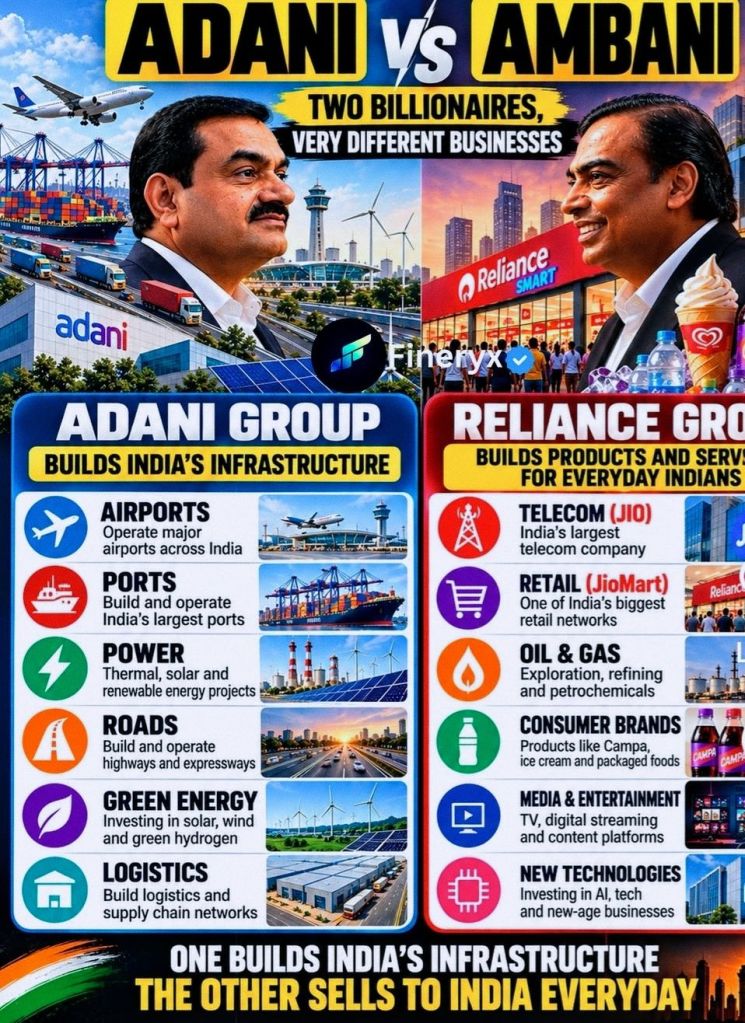
The relationship between industrial diversity and Comprehensive National Power is equally significant. A country may possess impressive industrial capabilities yet remain vulnerable if critical infrastructure, energy supplies, telecommunications, logistics or strategic manufacturing depend excessively on a narrow group of firms. Concentration can deliver economies of scale, but excessive dependence may magnify the consequences of corporate distress, supply-chain disruption or geopolitical shocks. A diversified industrial ecosystem offers alternative suppliers, regional production networks, specialised capabilities and greater economic resilience. In energy, India can build upon existing refining strengths while encouraging competitive investment in petrochemicals, cleaner industrial processes, renewable power and emerging energy technologies. Eastern-coast industrial hubs, supported by ports, logistics, skills and dependable low-carbon energy, could complement established western-coast centres. Strategic concentration may be justified where efficiency demands it; systemic dependence across essential sectors deserves careful scrutiny. National resilience emerges from combining globally competitive scale with credible alternatives and distributed capabilities.
Realising this vision requires a durable compact between government, industry, financial institutions and educational establishments. Governments must identify strategic priorities, develop common infrastructure, simplify compliance and maintain predictable taxation and regulation. Competition policy should address abusive market conduct without penalising legitimate scale, while public procurement should enable qualified new entrants to compete without compromising quality, security or accountability. Banks and development-finance institutions must improve access to patient capital, particularly for technology-intensive ventures and manufacturing businesses with long investment cycles. Universities, research institutions and industry should collaborate on commercialising innovation, strengthening technical skills and developing domestic technologies. States must compete through reliable power, efficient logistics, skilled workforces and transparent administration rather than discretionary concessions alone. Above all, industrial policy must remain consistent across electoral cycles. Building globally competitive enterprises is a generational undertaking, requiring institutional credibility, disciplined implementation and equal application of the rules.

India’s next economic leap will ultimately be measured not by the wealth of its richest entrepreneurs alone, but by the breadth of its entrepreneurial class, the productivity of its workforce and the resilience of its industrial foundations. Established business houses—including the Ambanis, Adanis, Tatas, Birlas and Jindals—can continue to serve as important engines of investment, exports and technological advancement. The national ambition must be to multiply successful enterprises, strengthen smaller businesses and enable talent from every region and social background to participate in industrial transformation. India does not need to diminish its corporate champions; it needs to create the conditions in which many more can emerge and compete fairly. A genuine economic superpower is not merely a country with a few exceptionally large companies, but one with a deep reservoir of capable enterprises, skilled workers, innovative institutions and productive citizens. The ultimate measure of industrial strength is not how high the tallest corporate giants rise, but how many others can rise alongside them.
VISIT ARJASRIKANTH.IN FOR MORE INSIGHTS !!!

