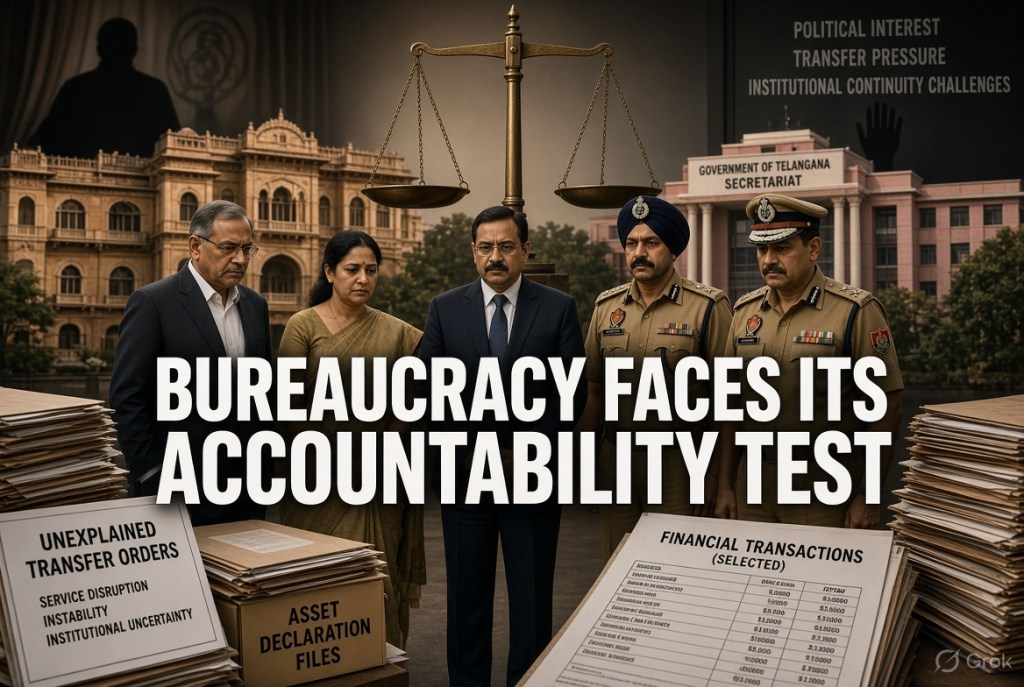
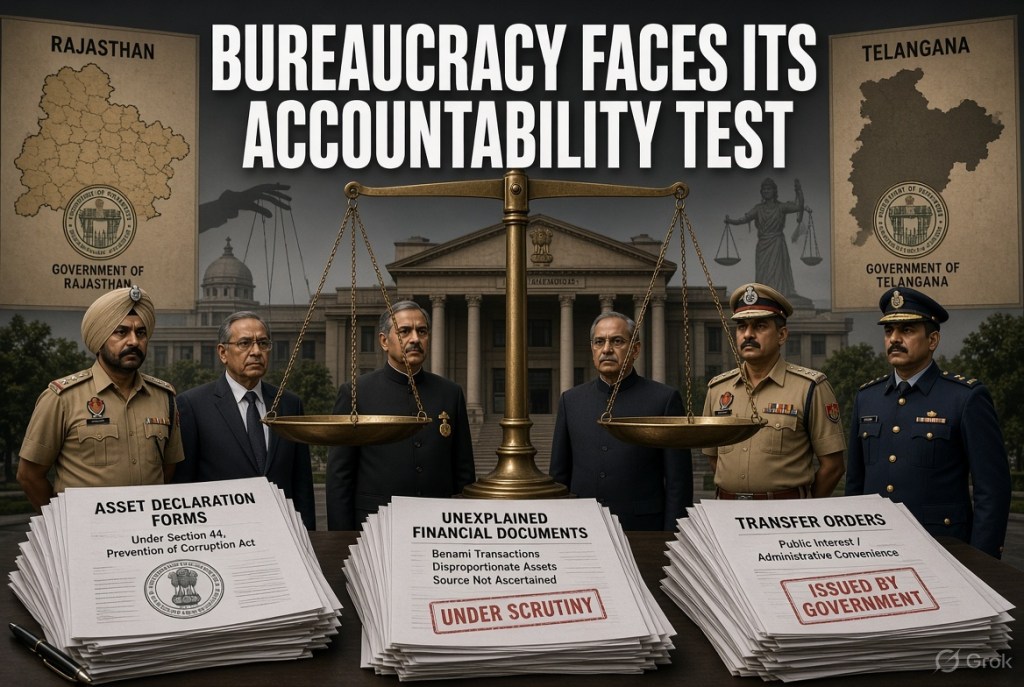
India’s higher civil services derive their legitimacy from three interdependent foundations: integrity, political neutrality and professional conduct. Recent developments in Rajasthan and Telangana, alongside matrimonial disputes involving senior police officers, expose the institutional tensions surrounding these principles. Property transactions attracting scrutiny, administrative reshuffles following political transitions, criminal investigations and personal disputes entering public institutions may appear unrelated. Legally, they must be examined independently, with allegations distinguished from established findings. Institutionally, however, they raise a common question: are India’s accountability systems sufficiently robust to protect professional independence while ensuring that public authority is exercised responsibly? The credibility of the All India Services cannot depend merely on individual reputations; it must rest on transparent rules, impartial investigations and consistent standards of conduct.
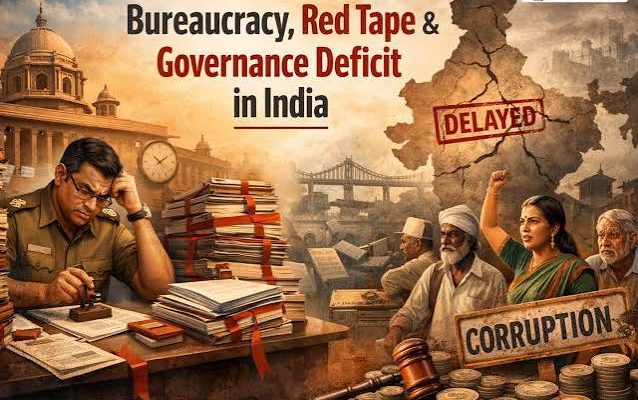
The Rajasthan controversy brings financial integrity and conflict-of-interest safeguards into sharp focus. A senior IAS officer was reportedly placed under Awaiting Posting Orders on 28 October 2026 following questions surrounding the acquisition of 40 resort properties by family members from a single corporate entity over approximately two-and-a-half years. The reported portfolio comprised 20 cottages in Udaipur and 20 villas in Alwar, acquired for an aggregate ₹6.165 crore and subsequently leased back to the same company for annual rentals of approximately ₹1.80 crore. This represents a reported gross rental yield of nearly 29.2%. Questions have also arisen about a customised investment-incentive package reportedly approved for the company, with a document dated 27 March 2026, coinciding with the registration of the villas. The officer has reportedly stated that the transactions were disclosed in property returns and tax filings. The government order cited administrative reasons and did not establish misconduct or announce disciplinary proceedings. Nevertheless, the economic structure, timing and possible overlap with official responsibilities warrant independent examination. Property disclosure is an essential safeguard, but formal disclosure cannot replace scrutiny of valuations, funding sources, commercial arrangements and potential conflicts of interest.
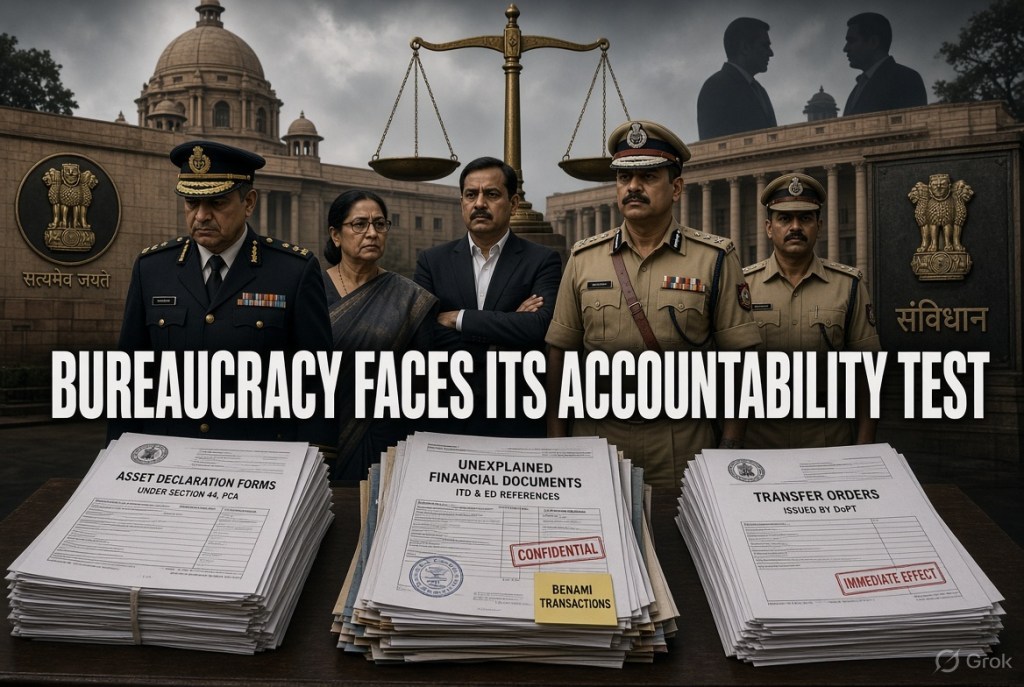
Telangana illustrates a different institutional challenge: maintaining administrative neutrality and continuity during political transitions. Following the change of government, senior IAS officers experienced investigations, transfers, portfolio changes and voluntary retirement. One officer became an accused in the Anti-Corruption Bureau’s Formula E investigation, for which prosecution sanction was reportedly granted and a chargesheet subsequently filed; the allegations remain subject to judicial determination. Another was transferred after publicly expressing criticism concerning environmental issues at Kancha Gachibowli and was subsequently assigned to the Finance Commission. A third opted for voluntary retirement in October 2025, reportedly following repeated transfers and differences concerning administrative decisions in the Excise Department. A fourth announced an intention to seek voluntary retirement ahead of superannuation and was reassigned from significant administrative responsibilities.
Governments are entitled to reorganise their administrative machinery, investigate decisions of previous regimes and select officers for positions of responsibility. Equally, civil servants must answer for decisions taken in public office. The institutional concern arises when transfers, investigations and career disruptions create uncertainty about whether administrative decisions are being assessed through evidence-based accountability or political considerations.
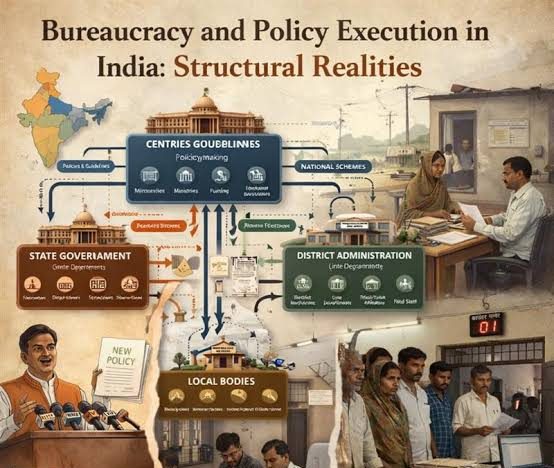
The larger consequence is the erosion of institutional memory and professional confidence. Senior civil servants accumulate decades of specialised experience in infrastructure, industrial development, taxation, urban governance, investment promotion and public finance. Repeated transfers between unrelated portfolios or premature departures can weaken institutional capacity, delay projects and disrupt policy continuity. Voluntary retirement is a legitimate service entitlement and must not automatically be interpreted as evidence of political victimisation. Yet recurring patterns deserve examination. Administrative transfers should reflect competence, tenure, public interest and recorded reasons rather than unexplained discretion. Investigations into decisions of previous governments must be evidence-driven and follow due process. The civil service must remain responsive to the elected government while retaining the professional independence necessary to provide objective advice. Its ultimate allegiance is to the Constitution, the law and the citizen—not to an individual political dispensation.
The personal conduct of IPS officers presents another dimension of institutional accountability. In one case, an FIR was reportedly registered in Noida in October 2025 following allegations by a doctor against her IPS husband and his family concerning dowry harassment, domestic violence, mental cruelty and intimidation. The officer reportedly denied the allegations and presented a contrary account. In another matter, the Bihar State Women’s Commission issued a summons to an IPS officer following his wife’s allegations of mental harassment and denial of access to their six-year-old daughter, while seeking an official report concerning her safety. These matters must be investigated impartially; allegations cannot be treated as findings of guilt. Nevertheless, public office does not confer immunity from laws governing marriage, domestic violence, dowry or family responsibilities. Officers entrusted with enforcing the law must remain accountable under the same legal framework as every other citizen. At the same time, complainants deserve protection, confidentiality and access to justice without prejudgment of the accused.

A separate Supreme Court decision in July 2025 highlighted the opposite institutional danger: the potential misuse of official influence and criminal proceedings in matrimonial conflicts. Invoking Article 142 of the Constitution, the Court dissolved a marriage involving a woman IPS officer and directed her and her parents to tender unconditional public apologies to her former husband and his family. The judgment took note of the incarceration of the husband and his father for 109 and 103 days respectively and the resulting physical and mental trauma. It also directed that the officer should not use her official position to prejudice the interests of her former husband and his family. The decision underscores that institutional authority must never become an instrument of private retaliation. However, it must not be generalised into a presumption that complaints against public servants are false. Genuine domestic abuse requires protection and prosecution; fabricated or malicious proceedings require appropriate legal scrutiny. The justice system must protect victims while safeguarding due process and preventing abuse of authority.
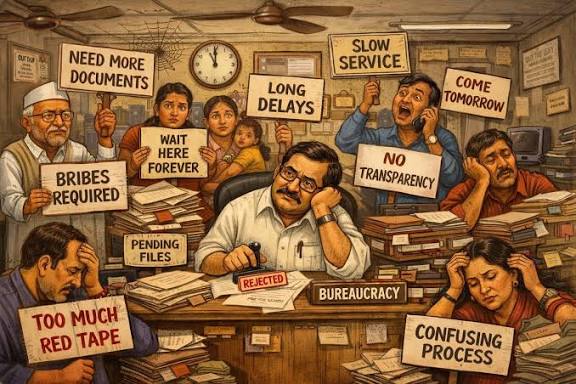
These developments expose a common governance deficit: substantial discretion exists, but safeguards are not always sufficiently transparent, predictable or consistently applied. Asset disclosures should be supplemented by risk-based verification of unusual transactions and potential conflicts of interest. Officers involved in investment, regulatory or procurement decisions should disclose relevant personal interests and recuse themselves where necessary. Transfers and APO orders should be supported by recorded administrative reasons, with reasonable timelines and clear procedures. APO must not become an informal substitute for disciplinary proceedings. Matrimonial complaints involving officers should receive confidential, time-bound departmental attention, while criminal investigations remain independent and victim-protection measures are enforced. These reforms should strengthen accountability without creating special privileges or weakening legitimate executive authority.
Ultimately, the credibility of India’s civil services will be determined not by how many officers are transferred, investigated or retired, but by whether the institutions governing them command public confidence. Political executives must respect professional independence; civil servants must uphold financial transparency, impartiality and personal integrity. Conduct rules, property disclosures, criminal law and judicial oversight must operate as a coherent accountability framework. India needs a civil service where integrity is verifiable, transfers are principled, investigations are impartial and public authority is exercised with restraint. The real test of bureaucratic power is not the authority an officer commands, but the accountability that governs its exercise. Public office is a constitutional trust—not a private privilege, political entitlement or licence to escape personal responsibility.
VST ARJASRIKANTH.IN FOR MORE INSIGHTS

