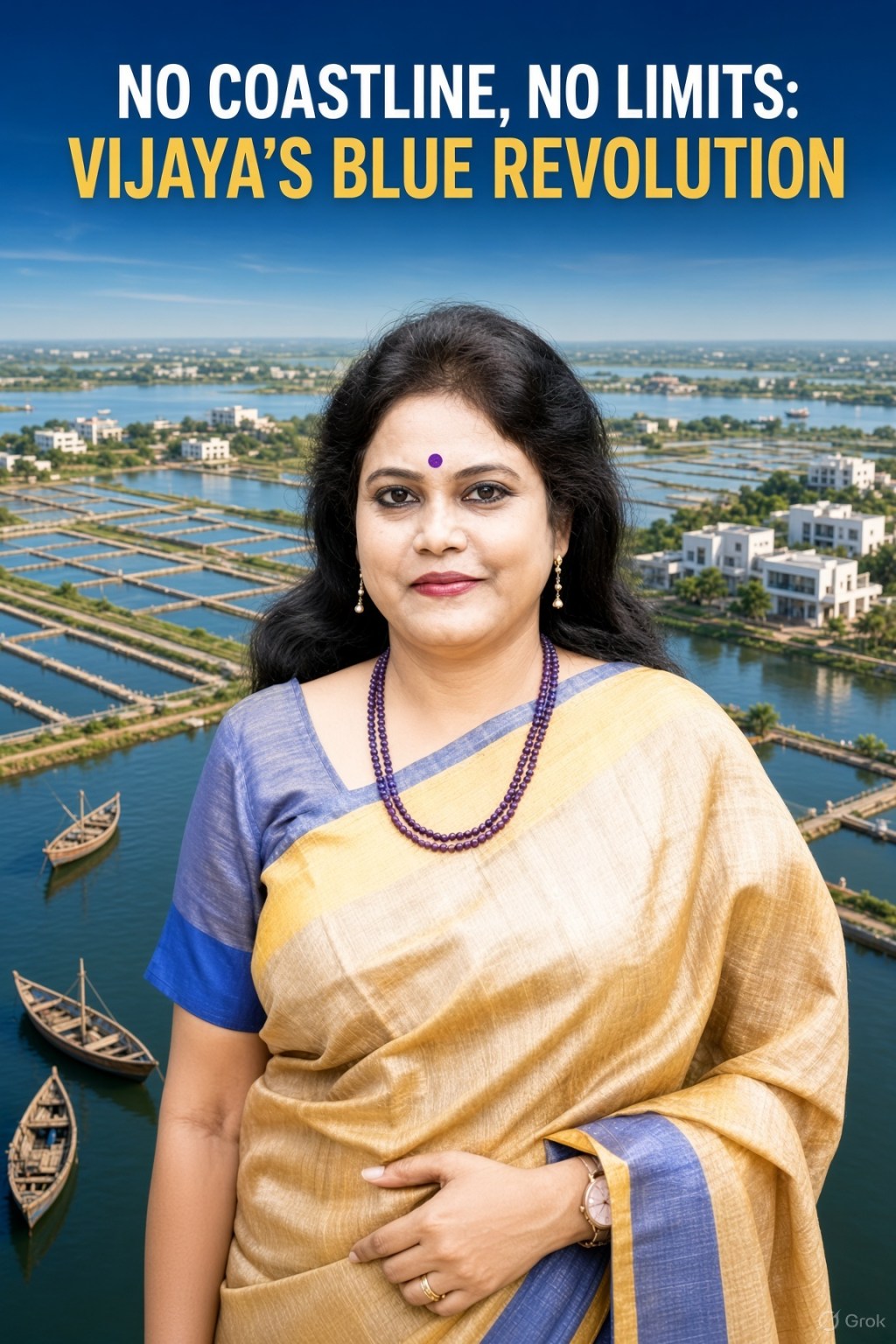
Bihar’s fisheries transformation is among India’s most compelling yet insufficiently celebrated stories of economic reinvention. A landlocked state, once dependent on Andhra Pradesh and West Bengal for fish supplies, has emerged as the country’s fourth-largest fish producer, increasing annual production from approximately 2.40 lakh tonnes to over 10.28 lakh tonnes in 25 years—a phenomenal growth of nearly 328 per cent. Today, fisheries contribute over ₹20,000 crore to Bihar’s economy, while approximately 89,600 tonnes of fish are supplied annually to neighbouring markets. Behind this transformation lies a powerful combination of political commitment, administrative innovation, scientific intervention and grassroots participation. Among the administrators who contributed to shaping this journey, Dr. N. Vijaya Lakshmi, IAS, deserves special recognition. Her contribution was not defined by publicity or personal projection, but by strengthening institutional foundations, removing administrative barriers and advancing a development-oriented approach to fisheries. The real Vijay is not merely in the numbers of fish produced; it is in the economic possibilities unlocked for millions of people.
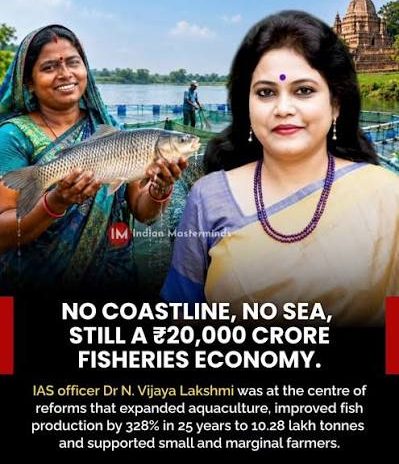
The most extraordinary lesson from Bihar is that a coastline is not essential to building a thriving fisheries economy. The state possesses approximately 1.22 lakh hectares of ponds and tanks, 9.5 lakh hectares of floodplain wetlands and derelict water bodies, 0.64 lakh hectares of reservoirs and over 21,354 kilometres of rivers and canals. These resources existed for generations, yet their productive potential remained substantially underutilised. The transformation began when fisheries were increasingly viewed not as an isolated traditional occupation but as an integrated economic ecosystem connecting agriculture, water management, technology, nutrition, employment and entrepreneurship. During her tenure as Principal Secretary, Dairy, Fisheries and Animal Husbandry, Vijaya Lakshmi contributed to advancing this broader developmental vision. Her approach reflected an important principle of public administration: natural resources do not automatically create prosperity; institutions, technology and purposeful governance convert potential into wealth.
A particularly significant intervention was the Bihar State Reservoir Fisheries Policy, 2022. Previously, reservoir fishing rights rested with the Water Resources Department, while fisheries expertise and development responsibilities belonged to the Fisheries Department. This institutional fragmentation constrained scientific management and investment. Bringing reservoir fishing rights under the Fisheries Department created a more specialised framework for resource utilisation and aquaculture development. Subsequently, more than 630 cages and 88 pens received support. The Mukhya Mantri Integrated Wetland Development Programme, popularly known as the Chaur Vikas Programme, extended this philosophy to floodplain wetlands. Solar pump sets, mechanical aerators, systematic fingerling stocking and improved pond management helped transform underutilised water bodies into productive economic assets. These interventions demonstrate how administrative coordination can generate tangible economic opportunities. Vijaya Lakshmi’s contribution was significant in helping translate policy intentions into institutional action, connecting departmental responsibilities with the practical requirements of fisheries development.
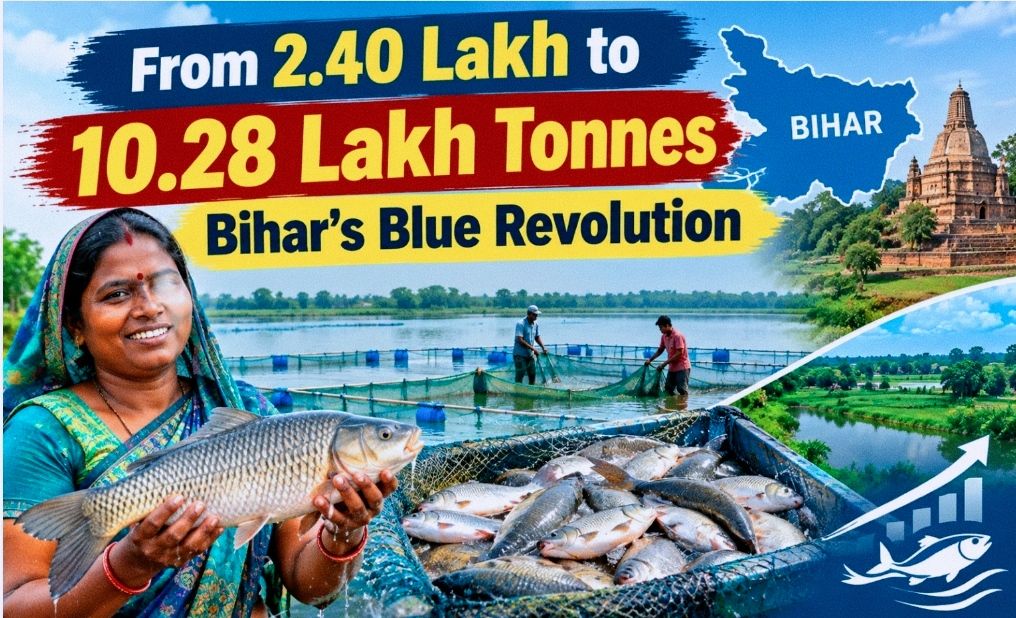
Equally consequential was the emphasis on strengthening fish-seed production and scientific aquaculture. Bihar’s expansion had historically been constrained by inadequate hatchery capacity and dependence on external sources of quality seed. The development of approximately 200 functional hatcheries and 121 fish farms, together with improved varieties such as Jayanti Rohu and improved Catla, strengthened the scientific foundations of production. Better pond productivity, improved growth rates, reduced mortality and enhanced fisherfolk incomes became important objectives of this transition. The Fish Brood Bank at Raghopur Bakhri in Sitamarhi represents another institutional step towards strengthening local breeding capacity. The larger economic lesson is that fisheries productivity cannot be sustained simply by increasing water availability or expanding cultivation. It requires quality biological inputs, scientific research, disease management, technical extension and reliable supply chains. The next priority must be genuine seed sovereignty through genetic quality assurance and affordable access to improved varieties.
Perhaps the most socially meaningful dimension of Vijaya Lakshmi’s administrative contribution was the simplification of procedures governing access to government assistance. Small and marginal fish farmers frequently encountered difficulties in securing Land Possession Certificates and other documentation required to access institutional support. Permitting alternative documents, including short-term lease agreements and land-tax receipts, helped reduce these procedural barriers. Such an intervention may appear administrative in nature, but its implications are deeply economic and social. A subsidy or development programme has little value if its intended beneficiary cannot satisfy complicated eligibility requirements. Simplifying access is therefore not merely procedural reform; it is an instrument of distributive justice. This approach reflects an important distinction between administration that simply implements rules and governance that understands citizens’ difficulties. The latter recognizes that the success of public policy must ultimately be measured by how effectively it reaches the last beneficiary.
However, Bihar’s Blue Revolution cannot be considered complete merely because production has increased. The next challenge is to convert higher output into higher and more stable incomes. This requires investments in cold-chain infrastructure, refrigerated transportation, ice plants, district-level fish markets, processing facilities and organized marketing networks. Ready-to-Cook and Ready-to-Eat products can create substantial value addition, while Fish Waste to Wealth initiatives can generate commercially useful products such as fish silage, fish scales and isinglass. Technology-intensive systems, including biofloc and Recirculatory Aquaculture Systems, offer further opportunities, provided small producers can access affordable credit, shared infrastructure and technical support. Farmer-producer organisations and cooperatives must become stronger instruments of collective bargaining and market access. The strategic transition must therefore be from the economics of producing more fish to the economics of earning more from every kilogram produced. Production creates volume; processing, branding and market intelligence create wealth.
The social foundations of this transformation are equally important. Bihar has approximately 534 block-level fishermen cooperative societies, with nearly 4.12 lakh associated fishermen, including around one lakh women. More than ₹902 crore in central assistance has reportedly been invested in the fisheries sector over the past decade, apart from state expenditure. Institutions such as the NFDB Regional Centre at Patna, Vanasur Integrated Aqua Park in Bhojpur and the Fish Brood Bank at Sitamarhi are strengthening the sector’s long-term capabilities. Yet future growth must be accompanied by ecological safeguards, transparent water-body leasing, protection of traditional fishing rights and meaningful participation of women in ownership and decision-making. Climate-resilient aquaculture, integrated makhana-cum-fish cultivation and scientific water-quality management deserve greater attention. The ultimate test of the Blue Revolution is not whether large entrepreneurs become wealthier, but whether traditional fishing communities, marginal farmers and rural women secure sustainable livelihoods and a larger share of the economic value they create.
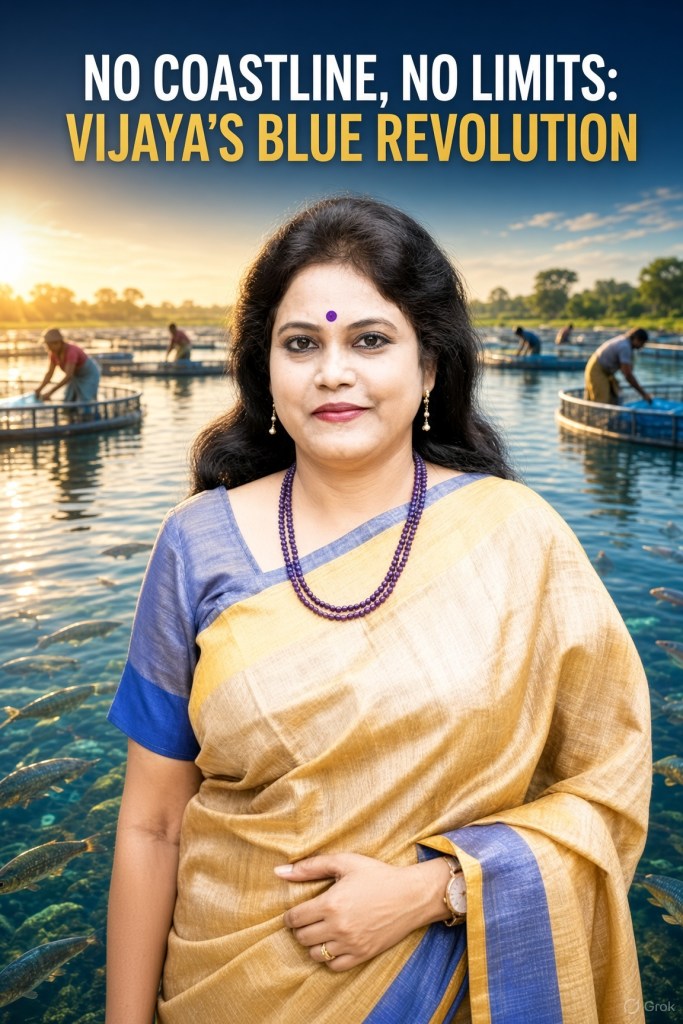
The larger significance of Bihar’s fisheries transformation extends far beyond its geographical boundaries. It offers an important development model for states possessing rivers, reservoirs, wetlands and inland water resources. Andhra Pradesh, with its extensive aquaculture experience, and other inland states can draw valuable lessons from Bihar’s institutional innovations and resource-based planning. Dr. N. Vijaya Lakshmi, IAS, represents an important dimension of this achievement—the quiet but consequential contribution of an administrator who helped connect policy reform, institutional coordination, scientific innovation and grassroots empowerment. The transformation is necessarily collective, involving political leadership, successive administrations, technical institutions, cooperatives, farmers and fisherfolk. Nevertheless, effective administrative leadership provides the coherence and continuity that enable these forces to work together. Her contribution deserves recognition not simply for the increase in fish production, but for helping unlock the developmental potential of an overlooked sector. Bihar has demonstrated that even without a coastline, water can become wealth, traditional occupations can become modern enterprises and inland resources can power economic growth. The biggest catch of Vijaya Lakshmi’s administrative journey is not fish—it is the transformation of water into opportunity, livelihoods into enterprise and governance into an instrument of prosperity.
VST ARJASRIKANTH.IN FOR MORE INSIGHTS

