
India’s instant home-help industry is attempting to transform domestic labour from an informal, relationship-driven occupation into a digitally organised, on-demand service economy. Platforms such as Snabbit, Pronto and Urban Company’s InstaHelp promise household cleaning, dishwashing and routine assistance within minutes. The proposition is compelling: urban households increasingly value convenience, reliability and verified workers. Yet the reported $60-billion domestic-work market presents a fundamental economic question: can a labour-intensive service be delivered instantly, affordably and consistently without perpetual investor subsidies? The industry’s success will depend not merely on downloads and bookings, but on whether technology can improve productivity, protect workers and create sustainable commercial returns.
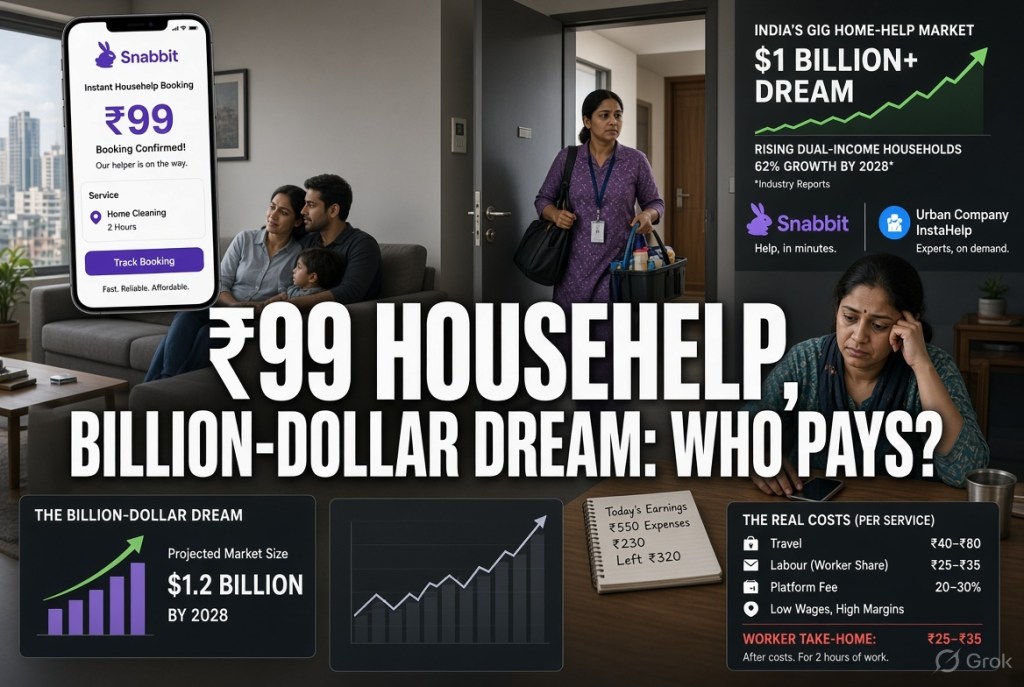
The demand surge reflects structural changes in metropolitan India. Dual-income households, nuclear families, demanding professional schedules and frequent residential mobility have weakened traditional networks for finding dependable domestic help. Consumers accustomed to instant groceries and food deliveries increasingly expect similar convenience in household services. Digital payments, identity verification, standardised checklists and flexible bookings reduce the friction of conventional hiring. Platforms also provide backup assistance when regular domestic workers are unavailable. However, rising bookings demonstrate consumer interest rather than financial viability. Subsidised prices can accelerate adoption while concealing the true cost of delivering each service. The distinction between a popular application and a profitable enterprise is therefore central to evaluating this emerging market.

The industry’s biggest contradiction lies in its pricing architecture. Promotional offers such as three visits for ₹198, individual bookings at ₹99 or hourly prices beginning around ₹49–₹99 lower the psychological barrier to trial. Yet reported consumer resistance to paying more than ₹200 per hour places a ceiling on revenue. Urban Company’s reported average InstaHelp order value of ₹172 further illustrates the challenge of financing a service involving actual human labour. Every booking requires worker availability, travel, household access, task execution, coordination and customer support. When customer payments fall below the full delivery cost, the deficit must be financed by investors, offset elsewhere or transferred to workers. Discounts can acquire customers, but they cannot permanently substitute for sound unit economics.

The comparison with quick commerce is attractive but incomplete. Grocery platforms aggregate inventory and optimise deliveries across dense neighbourhoods; domestic services must deploy a person to a particular residence for work whose duration and difficulty vary. A 10-to-15-minute arrival promise requires workers to remain close to potential customers even when demand is uncertain. Excess supply increases idle time and costs, while insufficient supply produces cancellations and delays. Greater booking density can improve utilisation, but each additional hour of cleaning still requires human effort. The sustainable model must therefore prioritise neighbourhood concentration, recurring demand, efficient scheduling and realistic service windows. Speed should be a competitive advantage, not an expensive promise that compromises service quality or worker safety.

Competition is intensifying as startups build local networks and established platforms leverage training, technology and residential-community relationships. Snabbit and Pronto are expanding their reach, while Urban Company brings an existing service ecosystem and customer base. Reported workforce numbers and investment commitments indicate the scale of the race, but expansion alone does not establish superior economics. Multiyear break-even expectations suggest that substantial capital may be needed before mature operating models emerge. Listed-company valuations also reflect the tension between aggressive growth and financial discipline. The eventual winner may not be the platform recording the most bookings; it may be the one that converts repeat demand into positive contribution margins without sacrificing reliability, affordability or fair working conditions.

The workforce dimension is equally important. These platforms can widen employment access, facilitate digital payments, provide training and create additional earning opportunities, particularly for women. However, advertised monthly earnings must be distinguished from actual take-home income after travel, cancellations, unpaid waiting time and other expenses. Algorithmic allocation, customer ratings and account suspensions can expose workers to decisions that are difficult to challenge. Strict deadlines and inadequate intervals between bookings may intensify physical strain. Traditional domestic arrangements sometimes provided informal assistance during illness or financial emergencies; purely transactional platforms may weaken such safety nets. Transparent contracts, fair grievance mechanisms, accident protection, portable social security and recognised training credentials must therefore become essential components of responsible platform design.

The decisive test begins when subsidies decline. Customers attracted by inexpensive bookings may accept higher prices for reliable, verified assistance, but others may reduce usage or return to traditional arrangements. Companies cannot assume that subsidised demand will automatically survive full-cost pricing. Scheduled services, recurring subscriptions and differentiated pricing for urgent bookings could improve predictability, provided they do not conceal unviable economics or impose unreasonable obligations on workers. Platforms should measure neighbourhood-level willingness to pay, utilisation rates, cancellations, customer retention and worker earnings. Regulators, meanwhile, should encourage transparent pricing, enforce applicable labour protections and examine algorithmic practices without undermining legitimate innovation. Commercial performance must be evaluated alongside the quality and security of employment created.
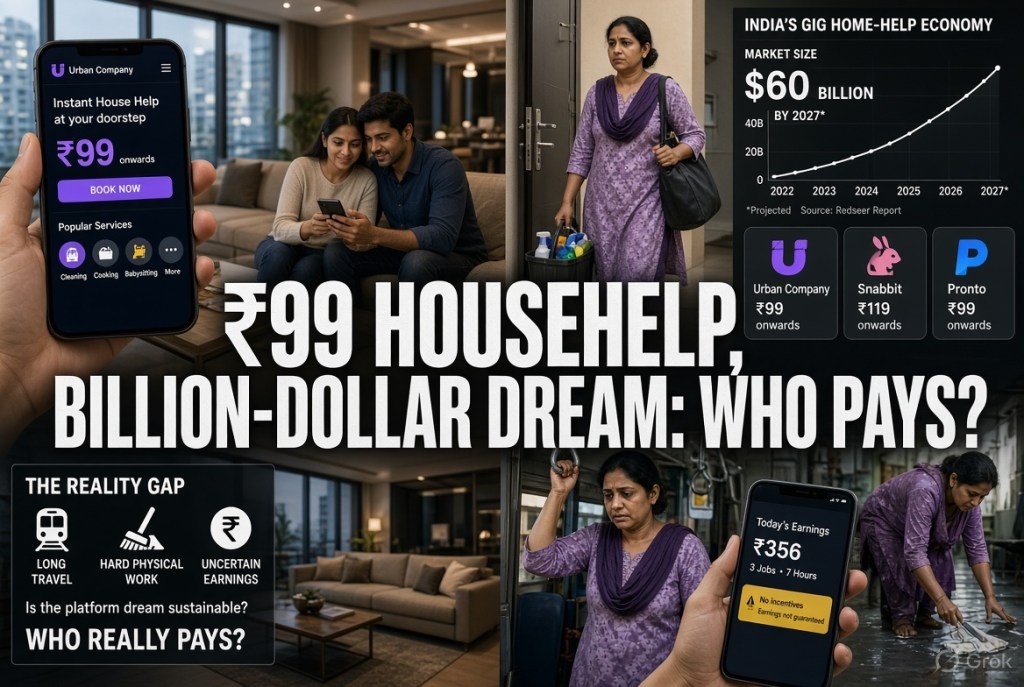
India’s instant home-help revolution could professionalise domestic work, improve convenience and create meaningful livelihoods. But the sector must move beyond venture-funded experimentation towards disciplined, socially responsible operations. Investors must distinguish growth from value creation, companies must demonstrate credible unit economics, and policymakers must ensure that technological efficiency does not become a euphemism for labour insecurity. The objective should not be to deliver human labour at the lowest imaginable price, but to organise it more efficiently, fairly and reliably. India’s domestic-work revolution will become a genuine economic breakthrough only when affordability for households, dignity for workers and profitability for platforms can coexist.
VISIT ARJASRIKANTH.IN FOR MORE INSIGHTS

