
On the evening of 18 October 2026, reported gunfire in Mumbai’s Juhu area targeting Bollywood actor Tiger Shroff brought into sharp focus an emerging security paradox of the digital age. The reported escape of the assailants, the subsequent interstate pursuit and the arrests at Kota railway station illustrate how contemporary criminal operations may combine physical violence, digital intelligence, encrypted communications and geographically dispersed intermediaries. The incident, subject to the outcome of the ongoing investigation and judicial proceedings, raises a question far larger than celebrity security: has the information society, in its relentless celebration of visibility and connectivity, inadvertently created an intelligence ecosystem that criminal networks can exploit? When information travels faster than institutions can interpret it, the boundary between technological convenience and security vulnerability becomes dangerously thin.

The most disturbing dimension is the reported possibility that publicly available information helped suspects identify movements, routines or opportunities associated with their intended target. Paparazzi footage, social media updates, fitness videos and public appearances may individually appear innocuous. Aggregated over time, however, such fragments can reveal patterns that were never consciously disclosed by the person concerned. This is the paradox of hypervisibility: an individual may voluntarily share isolated moments without realising that their cumulative digital footprint can become a map of their habits. The vulnerability extends well beyond celebrities to industrialists, political leaders, senior civil servants, journalists, entrepreneurs and ordinary citizens. In a society where personal exposure has become a currency of popularity, the distinction between being visible to an audience and being observable by a potential adversary is increasingly difficult to maintain.
This emerging threat demands a fundamental expansion of conventional security thinking. Physical protection cannot remain confined to bodyguards, access controls, surveillance cameras and secure premises when digital traces can potentially reveal the circumstances in which those safeguards are weakest. Public figures and institutions require periodic digital-risk assessments, delayed publication of sensitive location information, stronger account security and carefully designed communication protocols. Event organisers, media professionals and social platforms must also recognise the security consequences of real-time disclosures. Yet preventive responsibility must not become an excuse for censorship or the suppression of legitimate journalism. The objective is not to make public life invisible but to prevent information intended for public engagement from being converted into an operational advantage for those contemplating violence.

The reported investigation of encrypted communications and possible links to overseas intermediaries introduces another dimension of contemporary organised crime: the separation of planning, recruitment and execution across geographical boundaries. Secure messaging applications can facilitate communication between individuals who may never meet physically, potentially complicating conventional investigative methods. Nevertheless, encryption is not itself evidence of criminality. The same technology protects vulnerable citizens, journalists, businesses and democratic institutions from unlawful intrusion. Investigators must establish the authenticity, context and relevance of communications rather than treating technological sophistication as proof of conspiracy. Where foreign-based handlers or financial intermediaries are suspected, lawful international cooperation, credible digital forensics and verifiable evidence become indispensable. The challenge is to overcome the advantages that technology may provide criminal networks without dismantling the privacy protections on which legitimate digital life depends.
The reported interstate pursuit and interception of suspects at Kota railway station offer a contrasting illustration of the state’s investigative potential. Correlating CCTV footage, tracing vehicles, examining transport records and exchanging intelligence across jurisdictions can transform scattered clues into actionable leads. Such operations demonstrate the importance of coordination between state police forces, specialised investigative units and technical experts. However, the efficiency of surveillance must be accompanied by institutional discipline. Data must be collected lawfully, electronic records preserved with a demonstrable chain of custody, and investigative conclusions tested against independent evidence. Technological capability without accountability can become an instrument of arbitrary power; accountability without operational competence can leave citizens exposed. A mature security architecture must therefore combine speed, accuracy, proportionality and judicial oversight rather than treating them as competing objectives.

The reported recruitment of young individuals, including a minor, raises an equally important sociological concern. Organised criminal enterprises can operate through a hierarchy in which those who conceive and finance violence remain distant from those who physically execute it. Money, coercion, manufactured loyalty and the promise of status may draw vulnerable recruits into operations whose consequences they scarcely understand. If the allegations are substantiated, the investigation must extend beyond the immediate perpetrators to the financial channels, recruitment networks and intermediaries that sustain the enterprise. At the same time, juvenile justice protections must be respected wherever minors are involved. Arresting replaceable operatives while leaving the directing network intact offers only temporary reassurance. Durable crime prevention requires both effective prosecution and a deeper understanding of the social conditions that make vulnerable individuals available for exploitation.
The reported threats invoking other prominent film personalities and historical community grievances introduce the dangerous possibility that criminal intimidation may be packaged as an ideological or cultural campaign. Such messaging can magnify fear, attract publicity and create the misleading impression that individual criminal conduct represents an entire community. Unverified recordings, purported affiliations and sensational narratives must therefore be examined with particular care. No community should be collectively blamed for the alleged actions of individuals claiming to speak in its name. Nor should media coverage inadvertently become a distribution channel for intimidation, amplifying threats far beyond their original audience. The distinction between established facts, investigative hypotheses and deliberate propaganda is essential to preventing criminal enterprises from acquiring influence through manufactured notoriety.
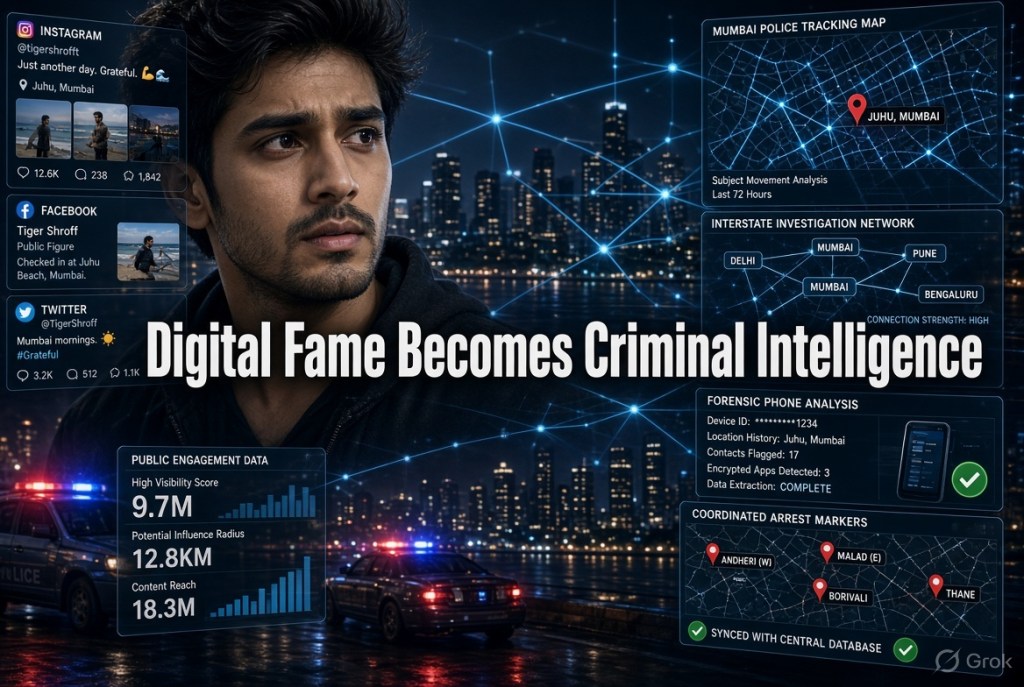
Ultimately, the decisive test will not be the speed of arrests but the strength of the case established in court. Investigators and prosecutors must demonstrate individual responsibility, authenticate electronic evidence, establish admissibility, examine financial and physical records, protect witnesses and satisfy the legal requirements of the charges invoked. Suspected international connections must be supported by verifiable evidence, while allegations must remain distinct from proven guilt. The broader lesson is unmistakable: India needs a security framework that integrates digital forensics, preventive risk management, interstate coordination, lawful international cooperation and rigorous due process. When a photograph can potentially become an intelligence asset and a digital message can precede physical violence, the modern state faces a defining responsibility—to make technology serve public safety without allowing surveillance to overwhelm liberty, publicity to empower intimidation or investigative speed to outrun justice.
VISIT ARJASRIKANTH.IN FOR MORE INSIGHTS

