
India’s infrastructure revolution faces an uncomfortable paradox: a procurement system designed to protect public money can sometimes destroy public value. The Least Cost Selection (L1) model, under which the lowest-priced technically qualified bidder generally wins, was conceived to promote transparency, curb discretion and minimise corruption. Yet, when price becomes the overriding measure of competence, the system risks rewarding aggressive underquoting rather than credible execution. Projects become delayed, assets deteriorate, costs escalate and capable entrepreneurs struggle to compete. The central question is not whether the government should pursue economy, but whether the lowest initial quotation should outweigh engineering quality, financial viability, execution capacity and lifecycle performance. When the cheapest contract becomes the most expensive outcome, procurement has mistaken price for value.
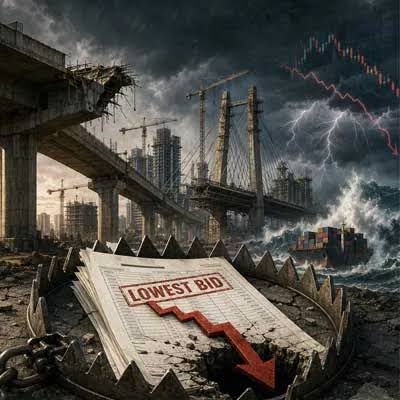
L1 is not inherently defective. For standardised supplies, routine maintenance and clearly specified, low-risk works, it offers simplicity, auditability and a defensible basis for selection. Its institutional appeal is understandable: objective price comparisons reduce the scope for arbitrary decisions and make public expenditure easier to scrutinise. The structural failure begins when this approach is applied indiscriminately to complex highways, ports, airports and urban transport systems. Such assets demand specialised engineering, reliable materials, safety systems, climate resilience and sustained maintenance. These attributes cannot always be captured by a single financial figure. Transparency should eliminate arbitrary discretion, not eliminate intelligent evaluation. The challenge is to make quality measurable and auditable rather than treating it as an inconvenient variable.
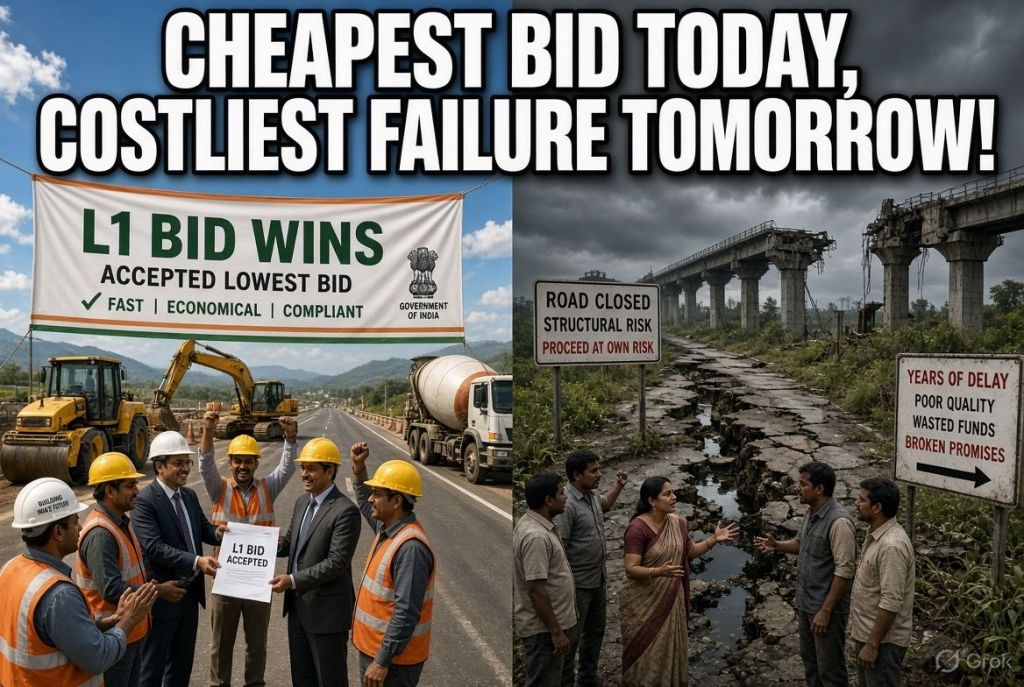
The most dangerous distortion emerges when bids fall dramatically below realistic project costs. Consider the reported Delhi rigid-pavement project estimated at ₹76.76 crore that attracted a lowest bid of ₹41.91 crore—a reduction of approximately 45.4 per cent. Such a deviation may reflect genuine efficiencies, but it can also signal unrealistic assumptions, inadequate cost estimation or a financially unsustainable offer. The appropriate response is rigorous scrutiny, not automatic applause for apparent savings. If the contractor cannot deliver at the quoted price, financial stress may lead to delayed payments, material substitution, workforce reductions, disputes over variations and prolonged arbitration. In extreme cases, projects stall or are abandoned, forcing re-tendering and further expenditure. A low bid is a promise on paper; a completed, durable asset is the actual public return.
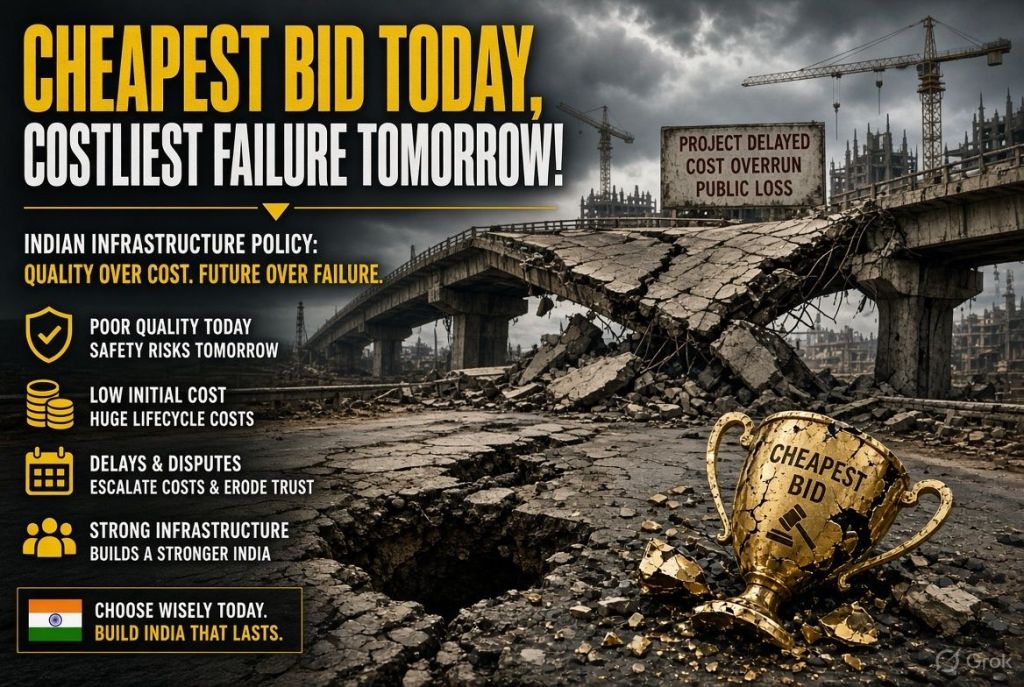
India’s wider infrastructure record reinforces the need to examine outcomes alongside procurement prices. Government monitoring data published in March 2024 reportedly recorded cost overruns in 440 of 1,873 major projects, amounting to approximately ₹5.01 lakh crore, while more than 41 per cent of monitored projects were delayed. These figures cannot be attributed to L1 bidding alone. Land acquisition, statutory approvals, utility shifting, financing constraints and defective project preparation also contribute. Nevertheless, they expose the limitations of judging procurement success at the moment a contract is awarded. The real fiscal cost includes delays, supervision, financing, litigation, maintenance and premature reconstruction. A project that appears economical at tender stage may become expensive over its operational life. The taxpayer does not consume tender documents; the taxpayer lives with the infrastructure they produce.

A parallel concern is the concentration of market opportunities. High turnover thresholds, substantial bank guarantees and narrowly defined experience requirements are intended to ensure financial and technical capability. However, when disproportionate to a project’s actual complexity, they can exclude competent mid-sized enterprises and specialised engineering firms. Large conglomerates may possess the financial capacity to qualify, while smaller innovators remain confined to subcontracting, often with limited margins and considerable execution risk. Scale undoubtedly offers advantages in financing and complex project delivery; size alone is not evidence of market abuse. The concern is excessive dependence on a narrow pool of providers, which can weaken competitive pressure, constrain entrepreneurial growth and expose supply chains and lenders to concentrated risks. A competitive economy cannot flourish if its procurement architecture systematically reserves the starting line for the biggest balance sheets.

India therefore needs a differentiated procurement architecture, not the wholesale abolition of L1. For standardised, low-risk works, L1 should remain a practical option. For complex, design-intensive and long-gestation projects, Quality and Cost-Based Selection (QCBS) can balance technical merit with financial competitiveness. Published scoring criteria, independent technical evaluation, disclosed weightings and documented decisions are essential to prevent quality-based selection from becoming a vehicle for favouritism. Lifecycle costing must also become central to evaluation, incorporating maintenance, rehabilitation, energy consumption and operating costs over an appropriate period. Performance-linked contracts should reward measurable outcomes, including durability, safety, service availability and timely completion. Project unbundling, proportionate qualification requirements and consortium arrangements can widen participation without compromising standards. The objective is not to spend more for quality; it is to stop paying repeatedly for poor value.
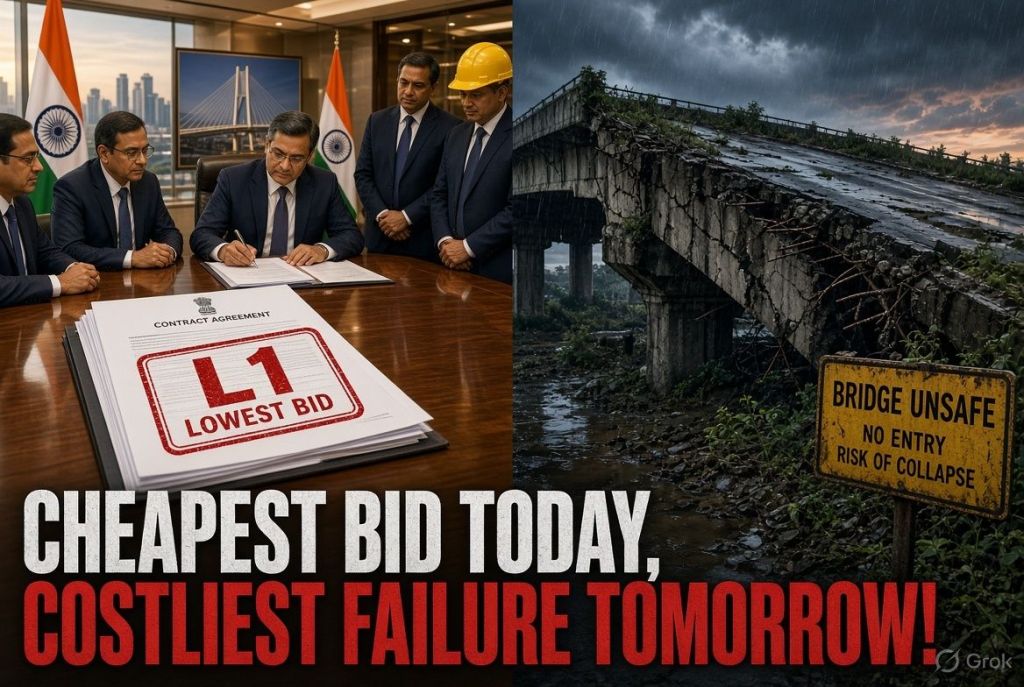
Reform must begin before tenders are issued. Inadequate Detailed Project Reports, insufficient geotechnical investigations, inaccurate utility mapping and unresolved land constraints create uncertainty that even the best procurement formula cannot eliminate. Field-based surveys, independent design reviews and greater accountability for consultants are therefore indispensable. Additional performance security for abnormally low bids can deter reckless pricing, but excessive security requirements may further disadvantage medium-sized firms. Safeguards must be proportionate to risk. Procurement agencies also need stronger technical expertise, digital monitoring, credible contractor-performance records and faster dispute resolution. Equally, audit and vigilance frameworks must recognise that a properly documented, transparent value-based decision is not inherently suspect merely because another bidder quoted less. Accountability should test the integrity and justification of the decision, not mechanically reward the lowest number.
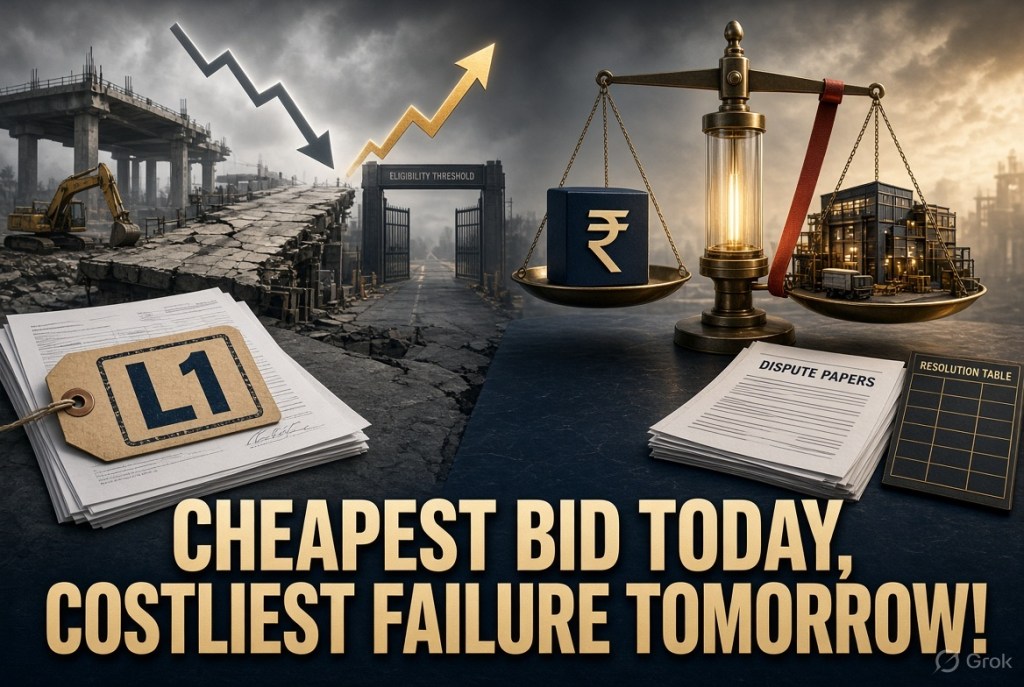
Ultimately, India must move from price-minimisation to value-maximisation. The L1 mechanism should remain where it works, but it must not become an unquestionable doctrine governing every public investment. Competition must reward credible pricing, engineering capability, timely delivery and long-term performance. Eligibility rules should protect project quality without unnecessarily excluding capable enterprises, while competition safeguards should address demonstrable market concentration through evidence-based regulation rather than arbitrary restrictions on successful businesses. India’s infrastructure ambitions demand more than contracts awarded at attractive prices; they demand assets that endure, markets that remain contestable and public expenditure that produces measurable outcomes. The decisive question is no longer simply, “Who quoted the least?” It is: “Who can deliver the greatest public value, at a sustainable cost, with verifiable accountability?”
VISIT ARJASRIKANTH.IN FOR MORE INSIGHTS

