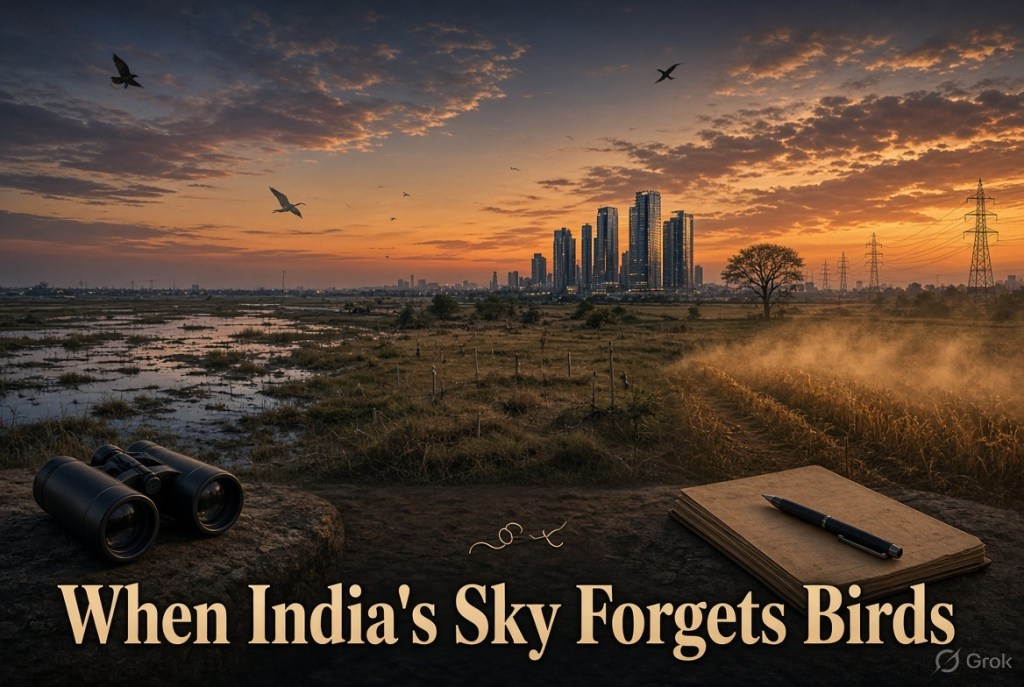
India’s bird crisis is unfolding in a strange ecological paradox: the disappearance is occurring not only in remote forests but precisely where human civilisation is expanding fastest—in backyards, farms, wetlands, grasslands and urban skylines. The State of India’s Birds 2023 assessment, based on more than 30 million observations contributed by over 30,000 birdwatchers through eBird, assessed 942 species and revealed a deeply unsettling pattern: a substantial share of India’s birds is declining, including species once regarded as ordinary and ubiquitous. This changes the conservation question fundamentally. The issue is no longer simply how to save rare birds from extinction; it is whether India can maintain the ecological systems that allow common birds to remain common. The disappearance of birds is therefore less a wildlife story than an early-warning signal of a wider deterioration in the country’s ecological infrastructure.

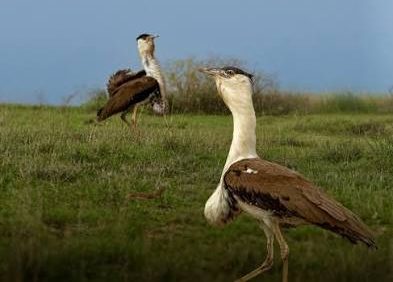
The geography of decline exposes one of India’s most persistent planning failures: we have repeatedly mistaken ecological importance for economic emptiness. Grasslands, scrublands, semi-arid landscapes and deserts have often been classified as “wastelands”, despite supporting highly specialised ecological communities. The Great Indian Bustard is an extreme illustration of this vulnerability, while species such as the Indian Courser and Indian Roller also reflect deterioration in open-natural ecosystems. These landscapes are not vacant land awaiting conversion. They regulate water, support pollinators, sustain grazing systems and provide habitat for birds, reptiles, insects and small mammals. When an ecological system is labelled “wasteland”, its destruction can proceed without triggering the same institutional resistance generated by the clearing of a forest. The vocabulary of development can therefore become an instrument of ecological erasure.

Bird decline also reveals something deeper about food chains. Species that feed on insects, small vertebrates or carrion are connected to ecological processes far beyond their immediate habitats. Pesticides can reduce insect populations; removal of hedgerows and native vegetation eliminates feeding and nesting sites; contaminated livestock carcasses can poison scavengers. India’s catastrophic vulture decline following exposure to toxic veterinary drugs remains one of the clearest demonstrations of how a decision made in agriculture or animal medicine can cascade through an ecosystem. The bird is often only the visible endpoint of an invisible chain of disturbance. When insectivorous birds disappear, the question should not simply be “Where did the birds go?” but “What happened to the insects, vegetation, water and agricultural practices on which they depended?” Avifaunal decline is therefore ecological accounting written in feathers.

The urban story is equally paradoxical. Indian cities increasingly advertise themselves as green, smart and sustainable while simultaneously becoming biologically hostile. Soil becomes concrete, native vegetation becomes ornamental landscaping, ponds become construction sites, glass façades become collision hazards and traditional roofs, eaves and cavities disappear. Small birds that once nested around human habitation lose the micro-habitats that made coexistence possible. Extreme heat intensifies the problem: asphalt, concrete, air-conditioning exhaust and declining tree cover create increasingly severe thermal environments, particularly for small birds. The modern city can therefore become technologically sophisticated while becoming biologically simple. A city may have more towers, roads and sensors—and fewer species. Urban biodiversity should consequently be treated not as decoration but as an essential component of resilient city planning.

Wetlands present another dangerous contradiction. India’s Ramsar network provides important international recognition, but designation alone cannot guarantee ecological security. Thousands of smaller lakes, ponds, irrigation tanks, marshes and seasonal wetlands remain outside major conservation narratives. Encroachment, sewage, invasive species, altered water flows and infrastructure development gradually destroy these ecological stepping-stones. For migratory birds, the consequences can be continental. Migration is a chain of habitats, and the destruction of one critical stopover can compromise an entire journey. Climate change introduces another uncertainty by altering rainfall patterns, winter temperatures and insect emergence. Birds may arrive according to evolutionary calendars while food availability shifts according to a changing climate. Timing itself becomes an ecological resource.
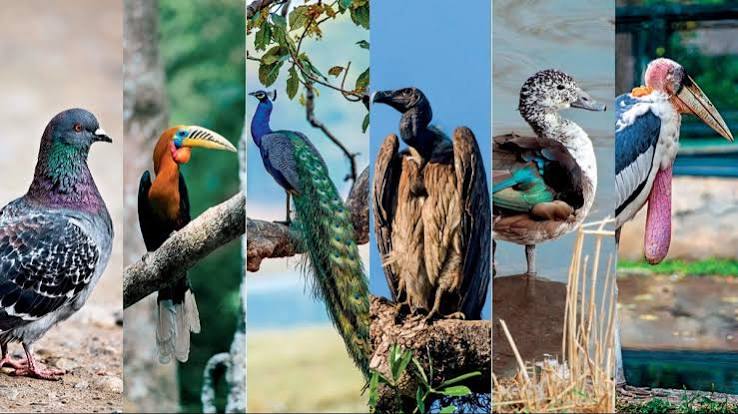
The governance problem is therefore larger than the traditional wildlife-protection model. India has historically protected what appears visibly valuable—forests, charismatic mammals and designated sanctuaries—while giving less institutional weight to agricultural mosaics, scrublands, grasslands and urban wetlands. Infrastructure introduces additional risks: power lines can cause collisions and electrocution; poorly sited renewable-energy infrastructure can fragment important habitats; highways and urban expansion can sever ecological corridors. Yet birds do not recognise administrative boundaries. A wetland does not become less important because it lies outside a notified sanctuary, and a bird flying across a revenue village does not know where a protected-area boundary ends. Conservation must therefore move from protected-area management to landscape management.
There is, however, a powerful counter-story: conservation becomes significantly stronger when citizens become participants rather than spectators. Nest-box initiatives, school bird clubs, village conservation groups, community wetland monitoring and local biodiversity mapping can transform ordinary landscapes into ecological assets. Citizen science platforms such as eBird demonstrate how millions of individual observations can collectively reveal national patterns that conventional monitoring alone could struggle to capture. The emerging lesson from different parts of India is that communities do not need to become professional conservationists to become ecological custodians. A child recording a neighbourhood bird, a farmer retaining a nesting tree or a village protecting a wetland may appear to be performing a small act; collectively, such acts create an additional layer of ecological governance that government agencies cannot manufacture by notification alone.
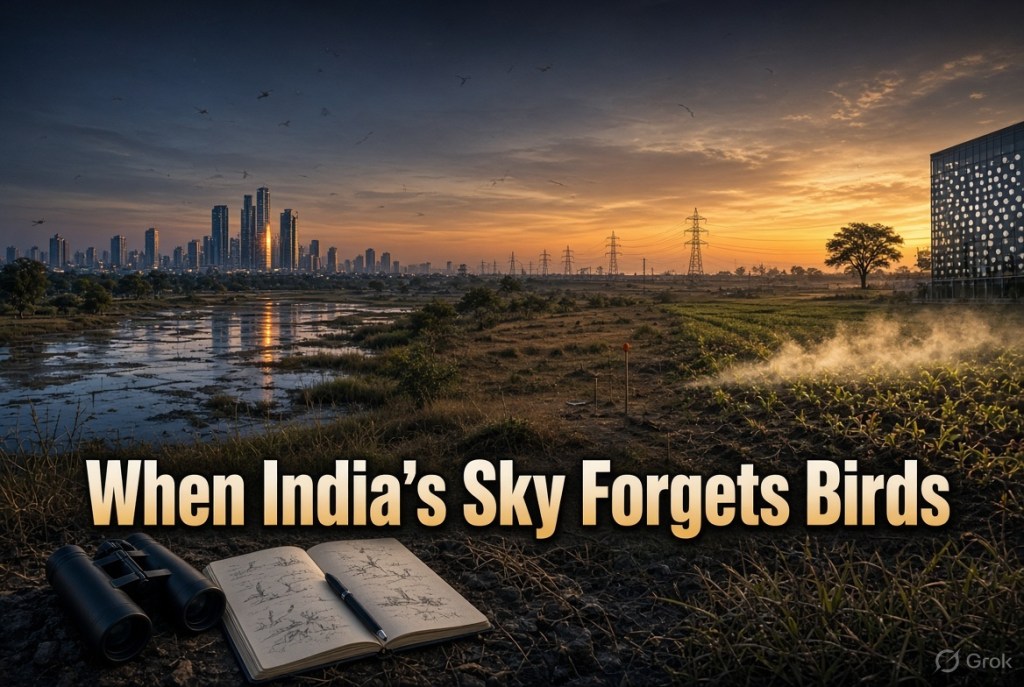
India’s next conservation revolution must therefore be about redesigning development rather than merely compensating for its damage. Municipal planning should incorporate native vegetation, urban ponds, bird-safe architecture and reduced light pollution. Agricultural policy should reward retention of field margins, nesting habitats and ecologically safer practices. Infrastructure planning should identify critical bird corridors before projects are finalised, not after ecological damage occurs. Wetlands should be monitored through measurable ecological indicators, not merely protected on paper. Citizen-science datasets should complement systematic surveys and inform long-term policy. The ultimate test is brutally simple: can an ordinary Indian neighbourhood still support an ordinary bird? India has not merely lost birds; in many places, it has dismantled the conditions that made their presence possible. When the sky becomes silent, it is not only the birds that have disappeared—the country has lost a piece of its ecological memory.
VISIT ARJASRIKANTH.IN FOR MORE INSIGHTS

