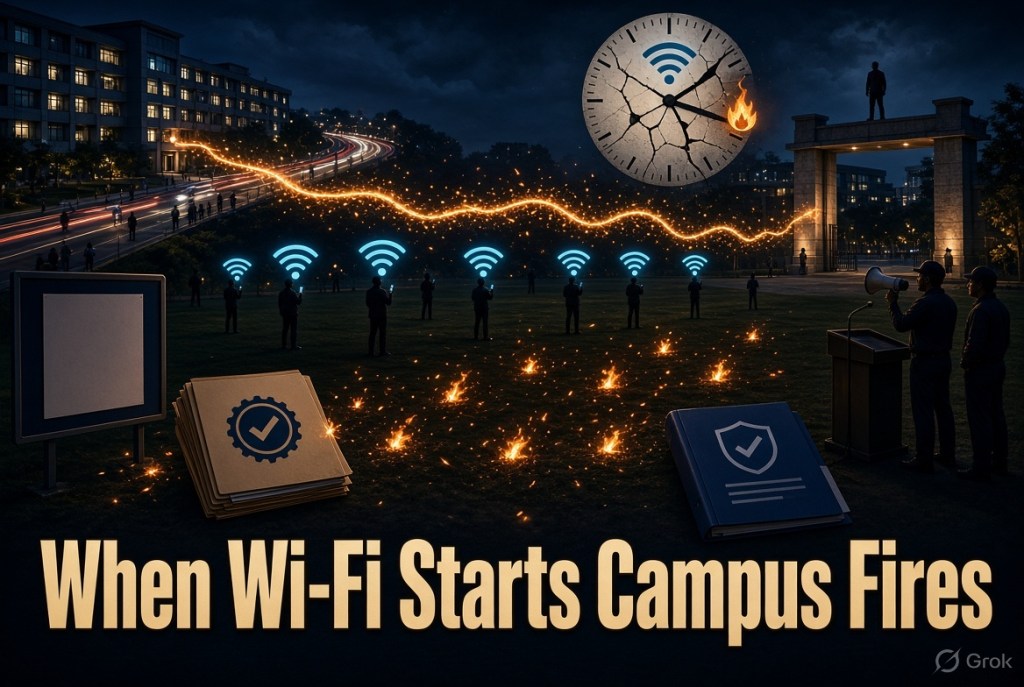
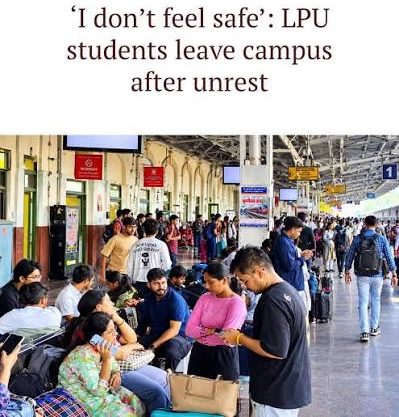
The violent unrest reported at Chitkara University in Rajpura and Lovely Professional University (LPU) in Phagwara between September 25 and 27, 2026, should not be reduced to episodes of student indiscipline. Taken together, the incidents reveal a structural challenge confronting India’s rapidly expanding private-university ecosystem: the speed of digital communication has overtaken the speed of institutional verification. At Chitkara, rumours surrounding an alleged disappearance or death of female students escalated into mobilisation and violence; at LPU, an unverified allegation of sexual assault reportedly triggered a much larger confrontation, including disruption of National Highway-44. Police investigations have so far not substantiated the central claims that drove the unrest. The deeper governance issue, therefore, is not merely what students believed, but why institutions were unable to establish trusted facts before rumours acquired the force of reality.

The Chitkara episode illustrates how misinformation can be manufactured from fragments of ordinary life. What reportedly began with eerie or “haunted” sounds associated with a girls’ hostel became connected, through digital circulation, to claims that students had disappeared or died. An ambulance, a visitor, a priest and unexplained sounds were progressively woven into a single narrative. Each ambiguous detail appeared to reinforce the others. This is a classic feature of digital rumour formation: uncertainty does not remain empty for long; it is rapidly populated by interpretation. Once a sufficiently large group accepts a narrative emotionally, subsequent information is no longer evaluated neutrally. It is filtered through the story already believed. The resulting mobilisation can acquire a momentum that formal institutional communication struggles to reverse.

The LPU incident demonstrated the potentially explosive consequences when the rumour involves sexual violence. A short social-media message alleging that a female student had been raped by an outsider inside girls’ hostel GH-3 reportedly circulated rapidly through student networks. By the early hours of September 27, a large mobilisation had developed, with the protest spilling beyond the university, National Highway-44 being blocked and property and vehicles damaged. Police constituted a Special Investigation Team, while the university suspended classes and postponed examinations. The Punjab and Haryana High Court subsequently sought a status report from the police. These developments are significant because they show how a digitally transmitted allegation can move through several stages—message, belief, mobilisation, confrontation and public-order crisis—before formal verification is complete.

The central governance problem is therefore the extraordinary asymmetry between rumour velocity and institutional velocity. A student can forward an allegation to hundreds of peers in seconds. A university may need security verification, administrative consultation, legal assessment and approval before issuing an official statement. That institutional caution is understandable, particularly when allegations involve crime or student safety. But in a digitally connected campus, silence has consequences. An information vacuum is rarely left vacant; it is occupied by screenshots, voice messages, speculation and increasingly confident interpretations. Crisis communication must consequently become an operational capability rather than a public-relations afterthought. Universities need verified emergency channels, rapid factual updates, designated communication officers, hostel-level information networks and mechanisms through which students can ask questions and receive authoritative answers in real time.
The policing challenge is equally profound. A large residential university is effectively a small urban ecosystem, containing hostels, roads, commercial spaces, transport facilities, visitors, contractors and thousands of young residents. Campus security therefore cannot depend exclusively on conventional policing that responds after disorder begins. The requirement is anticipatory coordination rather than merely reactive deployment. Universities and local police should maintain risk maps, joint control rooms, clearly defined escalation protocols, liaison officers and rehearsed procedures for crowd management and emergency verification. The objective should not be indiscriminate surveillance of students, but the ability to distinguish rapidly between a genuine emergency, an ambiguous event and a digitally amplified falsehood before each category produces an inappropriate response.

The LPU episode also demonstrates how ambiguous physical observations can become dangerous when interpreted through an atmosphere of fear. Reports concerning individuals carrying walkie-talkies reportedly contributed to suspicions about outsiders. Police subsequently said the individuals were off-duty Army personnel who had entered the campus to collect the ward of a fellow officer. Whatever the eventual findings surrounding the wider incident, the episode illustrates an important principle of crisis management: ambiguous facts become threatening when institutional trust has already collapsed. In a fearful environment, a walkie-talkie becomes suspicious equipment; an ambulance becomes evidence of a death; an unfamiliar visitor becomes a possible perpetrator. The challenge for authorities is therefore not simply to release facts but to establish credible channels through which facts can compete successfully with emotionally compelling speculation.

Political allegations have inevitably entered the discourse surrounding the Punjab incidents, including competing claims involving the state government, university authorities and possible political mobilisation. Such claims remain matters for evidence and investigation rather than assumption. The more consequential governance question lies elsewhere: how can an unverified digital allegation mobilise thousands of educated young people, disrupt a national highway and temporarily overwhelm institutional authority? That question cannot be answered through partisan explanations alone. It points towards a broader transformation in the architecture of social trust. Students increasingly receive immediate information through WhatsApp groups, Telegram channels, Instagram, short videos and forwarded voice messages. Institutional notices may remain formally authoritative, but they are no longer necessarily the first information students encounter—or the information they trust most.

The Punjab episodes should consequently be treated as a national case study in digital-age campus resilience. Every large residential university should have a standing crisis-communication protocol; independently auditable hostel-security arrangements; reliable visitor and access records; rapid verification teams; functioning CCTV command centres; emergency student communication channels; and a clearly rehearsed university-police standard operating procedure. But infrastructure alone will not solve the problem. Credibility must be accumulated before the crisis. Students who believe that administrators will provide timely, transparent and evidence-based information are less likely to surrender judgment to anonymous forwards. The ultimate lesson is brutally simple: universities can no longer communicate at the speed of bureaucracy when their students communicate at the speed of Wi-Fi. The next campus crisis may not begin with a siren, a protest call or an official complaint. It may begin with a notification—and by the time the administration reads it, thousands may already have believed it.
VISIT ARJASRIKANTH.IN FOR MORE INSIGHTS!!!

