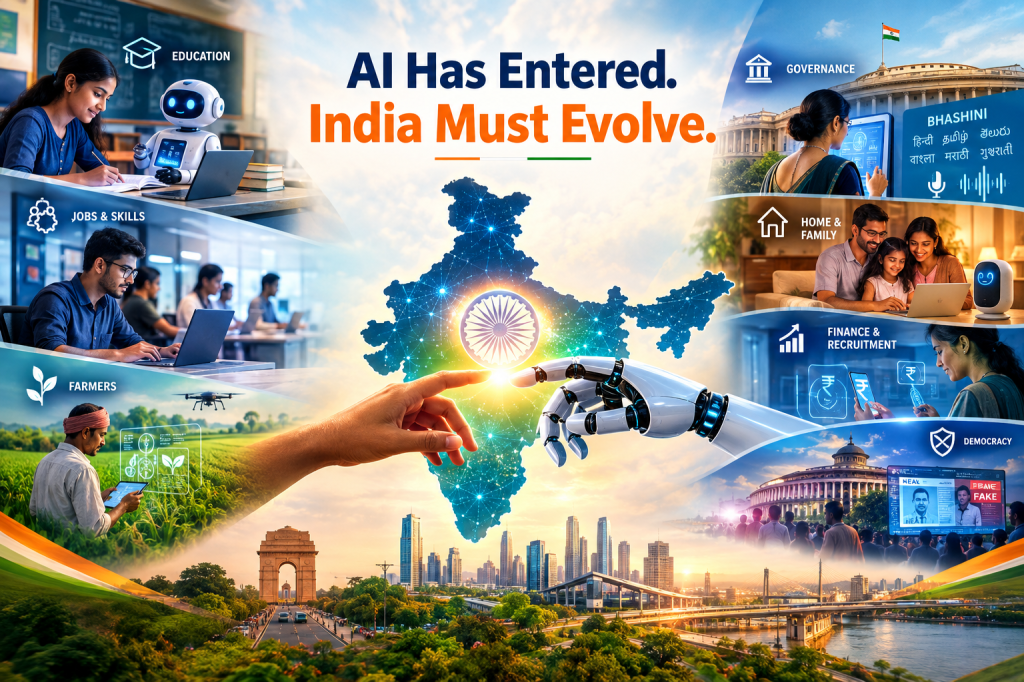
Artificial Intelligence is no longer a futuristic visitor waiting at India’s technological doorstep; it has already entered the classroom, workplace, government office, courtroom, farm, household and democratic ecosystem. India is an unusually consequential laboratory for this transformation because of its population scale, linguistic diversity, digital public infrastructure and enormous services workforce. The employment evidence already reveals the paradox. A Nomura analysis covering cases from 2022 through August 2026 recorded 83,100 AI-related hires against 31,921 layoffs and attrition-related cases in India. (The Print) AI, therefore, is neither simply a job destroyer nor merely a job creator. It is a mechanism for reallocating economic value—expanding demand for certain capabilities while reducing the value of others. The central challenge is no longer whether AI will transform India, but whether India’s educational, labour and institutional systems can transform fast enough to remain relevant.
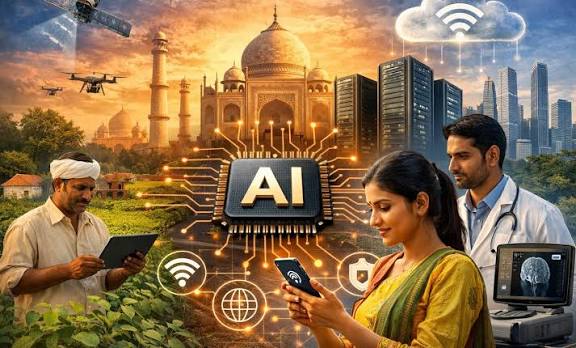
For India’s youth, the emerging opportunity is enormous—but so is the possibility of an entry-level employment squeeze. Nomura’s analysis indicates that AI is simultaneously generating technology-related hiring while reducing demand for some routine and support functions, with experienced workers possessing deeper business knowledge gaining importance. (mint) This creates an uncomfortable structural paradox: the repetitive assignments through which graduates traditionally acquired experience are precisely the tasks AI can increasingly automate. The solution cannot be to turn every Indian graduate into a programmer. The employability premium will increasingly belong to people who combine AI literacy with domain expertise, communication, critical thinking, creativity and judgement. The graduate of tomorrow must learn not merely to use AI, but to interrogate it, verify it, supervise it and improve upon it. India therefore faces an educational redesign challenge: the old ladder from degree to apprenticeship to experience may develop missing rungs unless universities and employers deliberately create new pathways into meaningful entry-level work.
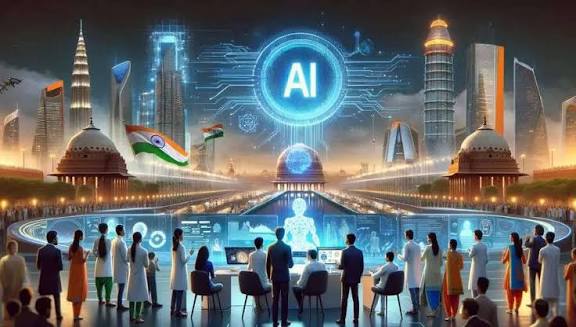
The most consequential transformation may, however, occur inside the Indian State. AI is beginning to move administration beyond merely processing applications towards recognising patterns, anticipating demand and personalising public-service delivery. BHASHINI demonstrates the scale of this possibility: as of August 2026, the government said the platform powered more than 800 government websites, supported 36 Indian text languages and 23 Indian voice languages, and had processed more than 9 billion cumulative AI inferences. (Press Information Bureau) This is not simply a translation project; it represents an attempt to make language itself part of India’s digital public infrastructure. Agriculture, welfare, healthcare, taxation, transport and infrastructure could similarly become increasingly data-driven. India is simultaneously expanding sovereign computational capacity: the IndiaAI Mission had onboarded more than 38,000 GPUs, while another 20,000 GPUs were announced in February 2026. (Press Information Bureau) The strategic significance lies not merely in computing power, but in connecting compute, data, language and public institutions into an indigenous AI ecosystem.
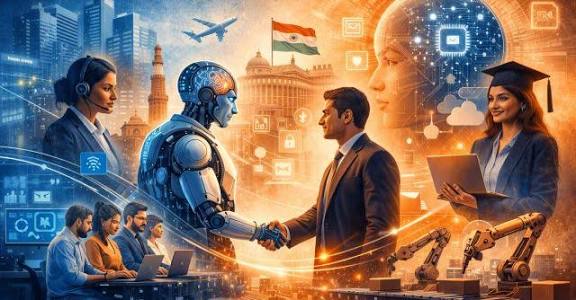
Yet the intelligent State can become either more humane or more intrusive depending on how its intelligence is governed. AI can detect duplicate beneficiaries, identify anomalies, improve tax administration, forecast healthcare requirements and help officials allocate scarce resources. But an algorithm trained on historically unequal data can also reproduce historical inequality at machine speed. Bias need not appear explicitly; it can enter through geography, language, connectivity, occupation, income or other proxies. Citizens who are poorly represented in datasets can become statistically invisible. This makes human accountability indispensable. An algorithm cannot become a convenient institutional escape route from responsibility. When an AI-assisted system affects welfare, employment, credit, healthcare or other consequential decisions, there must be transparency, human review and a meaningful avenue for challenge. India’s AI governance architecture increasingly speaks in terms of safe, trusted, human-centric and inclusive AI. The real test will be whether those principles survive contact with high-volume administration, where speed and efficiency can otherwise overpower individual rights.

AI is also quietly entering the Indian family, potentially creating one of the most profound social transformations. AI tutors can supplement children’s education; voice interfaces can help elderly citizens navigate services; generative tools can translate ancestral letters, restore photographs and preserve family histories. For families separated by migration, technology can strengthen continuity across distance. But convenience contains a subtle danger: a child may increasingly consult a machine instead of a parent; an elderly person may receive an automated health alert without receiving a human visit; family members may inhabit personalised digital environments designed by algorithms that increasingly determine what each person sees, hears and believes. The issue is not whether technology belongs inside family life—it inevitably will. The deeper question is whether it strengthens human relationships or gradually substitutes for them. The most successful family technology should therefore not be measured by how many human interactions it eliminates, but by how many meaningful human interactions it enables.
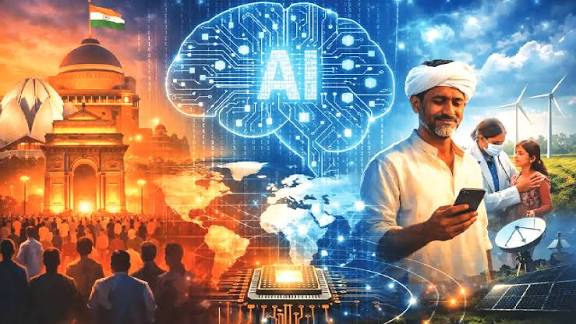
AI is simultaneously entering the marketplace of identity, opportunity and personal choice. Recruitment systems, educational platforms, financial applications, matrimonial services and workforce-management tools increasingly use algorithms to filter information and make recommendations. This can democratise access by reducing information costs and opening opportunities beyond traditional networks. But algorithms can also automate yesterday’s prejudices. If historical preferences become training data, technology may reproduce tradition while presenting it as neutral mathematics. The crucial question is therefore not merely whether an algorithm is accurate, but whose reality it has learned. An individual affected by an automated decision should be able to ask why it occurred, challenge erroneous information and obtain meaningful human review where the consequences are significant. The future of responsible AI must consequently be judged not only by computational accuracy but by explainability, contestability, fairness and accountability.
Democracy represents the most delicate frontier because AI can simultaneously expand participation and industrialise deception. Multilingual AI can make political communication more accessible across India’s linguistic geography, while synthetic audio, video and imagery can make fabricated material appear authentic. The Election Commission in 2026 directed that misleading or unlawful AI-generated or manipulated content brought to platforms should be acted upon within three hours, and required campaign-related synthetic or AI-altered material to carry clear disclosures such as “AI-Generated,” “Digitally Enhanced” or “Synthetic Content.” (Press Information Bureau) The deeper democratic problem extends beyond misinformation: when synthetic content becomes ubiquitous, citizens may begin distrusting even authentic evidence. Democracy consequently enters an epistemic crisis, where the question is not merely what people believe, but what evidence they can reasonably trust. Authentication systems, transparent labelling, media literacy, platform accountability and institutional verification will become as important to democracy as traditional electoral safeguards.
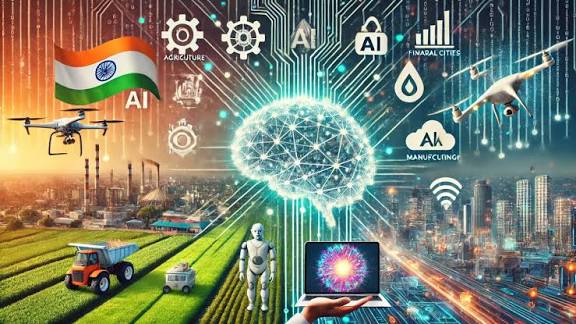
India’s AI revolution will ultimately be judged not by the number of GPUs installed, chatbots launched or models trained, but by whether technology expands human capability without shrinking human dignity. AI can make government faster, education more personalised, healthcare more predictive, enterprises more productive and communication more inclusive. It can simultaneously disrupt employment, reproduce discrimination, weaken privacy, fragment social relationships and industrialise synthetic reality. India therefore needs an AI social contract built around universal AI literacy, continuous reskilling, accountable algorithms, robust data protection, independent oversight, transparent public-sector deployment and meaningful human review of consequential decisions. The choice is neither technological romanticism nor technological resistance. It is institutional intelligence. India possesses the population scale, digital infrastructure, entrepreneurial energy and linguistic diversity to build an AI model with global significance. But technology does not automatically create progress; institutions decide who benefits from technology. The real revolution, therefore, is not that machines are becoming intelligent. It is that India must now decide what intelligence should mean when machines become part of everyday human life.
VISIT ARAJSRIKANTH.IN FOR MORE INSIGHTS


One response to “AI IS NOT COMING FOR INDIA—IT IS ALREADY LIVING IN IT”
well explained the pros and cons of AI
LikeLike