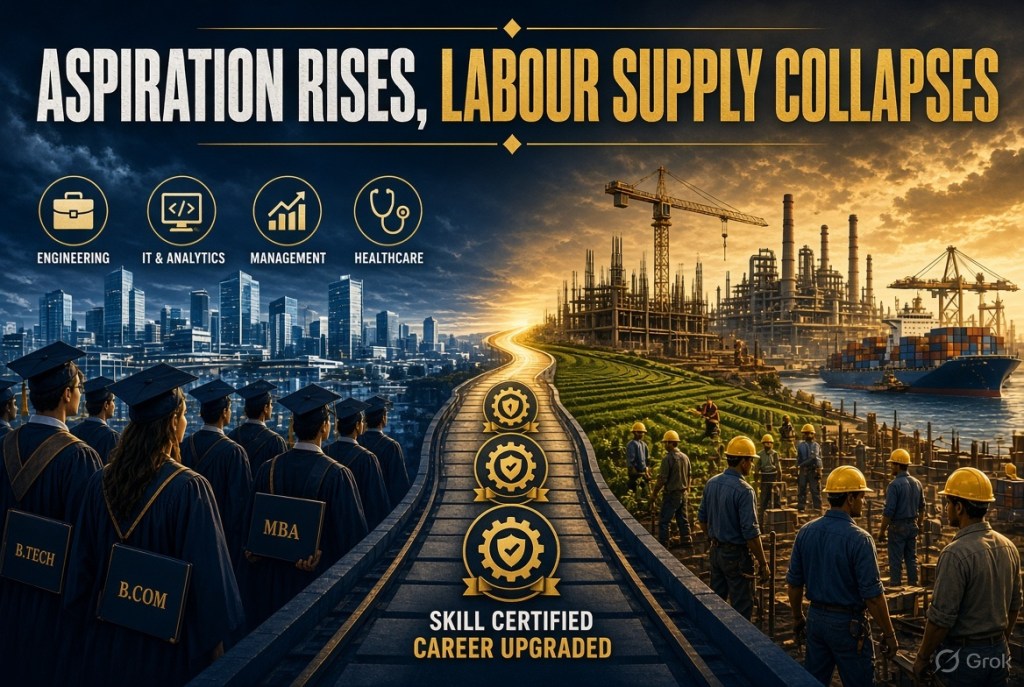
Andhra Pradesh is confronting one of the strangest contradictions in its economic development: a State with a large pool of educated young people seeking employment, yet industries increasingly dependent on workers arriving from other States to perform physically demanding jobs. This is not adequately explained by saying that “youth do not want to work”. It is a deeper labour-market paradox involving education, social aspiration, wages, occupational status, working conditions and the changing structure of economic opportunity. The State’s skill ecosystem itself illustrates the scale of the challenge. In February 2026, officials reported 1,14,899 job openings across integrated sectors on the emerging skill platform, while the government has simultaneously set ambitious employment-generation targets. The real question, therefore, is not simply how many jobs Andhra Pradesh creates, but why the jobs that exist and the workers who are available so often fail to meet each other.
At the heart of the problem is an aspiration economy created partly by educational expansion. Over the past two decades, higher education has transformed the expectations of rural and semi-urban families. A degree is increasingly interpreted not merely as an educational qualification but as a ticket out of physically strenuous work. A young person who has spent years in college may aspire to an office, a government post, a technology-enabled service job or a relatively comfortable formal workplace. Yet Andhra Pradesh’s growth story is simultaneously generating enormous demand in aquaculture, food processing, agriculture, construction, granite, manufacturing, ports, logistics and other occupations requiring physical endurance, shift work or specialised manual skills. The mismatch is consequently between the social status attached to a job and the economic value created by that job. A physically demanding occupation can be economically productive without being socially attractive. This distinction is crucial: the problem is not necessarily an unwillingness to work, but a widening gap between what education has taught young people to expect and what the regional economy currently offers.
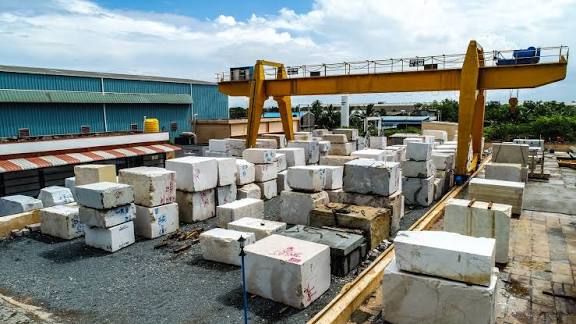
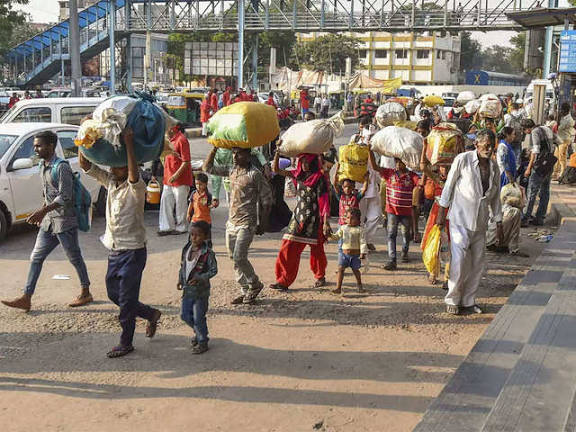
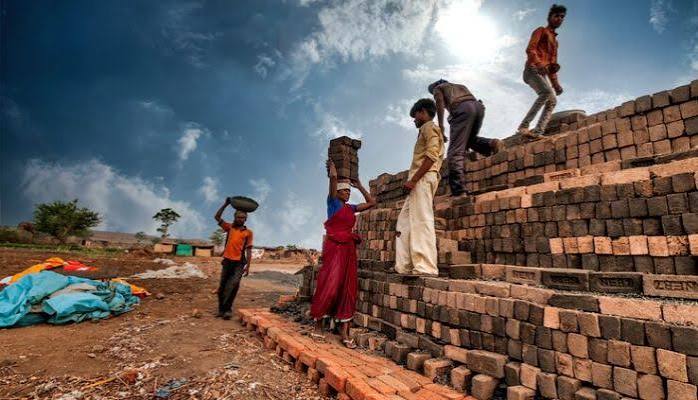
The resulting vacuum is increasingly being filled by interstate migrants. Andhra Pradesh’s migrant-labour economy extends across aquaculture and seafood processing in coastal districts, granite operations in Prakasam, agricultural transplantation and harvesting, construction, manufacturing, port-related activity and logistics. Workers from Bihar, West Bengal, Jharkhand, Odisha and Assam have become important components of these labour markets. The exact number of interstate migrants in Andhra Pradesh is difficult to establish because much employment remains informal and workers move continuously between districts and sectors. The existence of a large unorganised workforce is nevertheless clear: more than 88.8 lakh workers from Andhra Pradesh were registered on the national e-Shram database by July 2026, although this figure covers unorganised workers generally and should not be interpreted as a migrant-worker count. The more important economic fact is that migrant workers are supplying labour precisely where employers experience difficulty recruiting locally. In paddy agriculture, for example, specialised transplantation skills have created established migration corridors, while coastal processing and construction have developed their own labour networks.
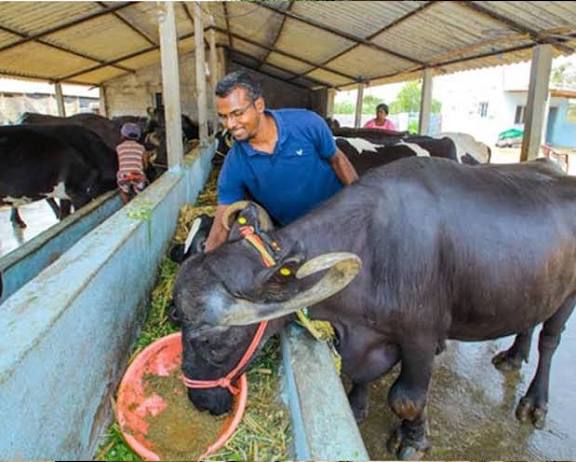
This creates an uncomfortable economic irony. Andhra Pradesh is investing heavily in human capital, while some of its most important physical economic activities are importing human labour. Meanwhile, young people from Andhra Pradesh themselves are increasingly willing to migrate when the opportunity offers a sufficiently attractive combination of wages, status and working conditions. MEA data reported in February 2026 show that 76,201 workers from Andhra Pradesh received emigration clearances between 2021 and 2025, demonstrating the continuing importance of overseas employment. The lesson is revealing: Andhra youth are not inherently opposed to hard work or migration. They respond to relative returns. If a Gulf, European or metropolitan Indian job offers substantially better wages, accommodation, safety or career progression, migration becomes acceptable. What appears locally as an aversion to blue-collar work may therefore be better understood as a rational response to the perceived hierarchy of wages, dignity, security and mobility.
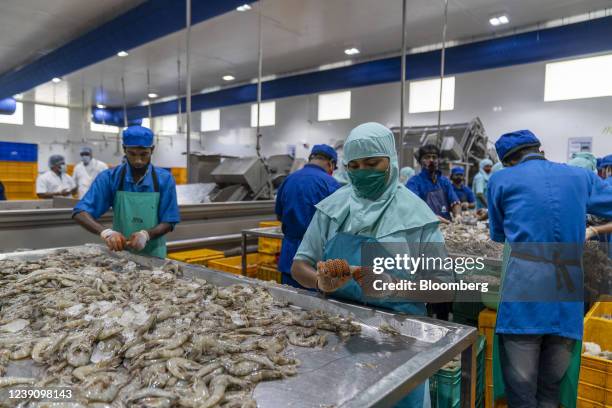
The real policy failure would be to moralise this behaviour. Telling young people to “work hard” or simply accept manual labour will not solve the problem. If a granite worker faces occupational hazards, a construction worker lacks predictable social security, an agricultural labourer has seasonal employment, or a processing worker operates in difficult shifts without a visible career ladder, the preference for alternative employment is economically understandable. The answer is to upgrade the job rather than lecture the worker. Blue-collar occupations must become technologically sophisticated, safer and capable of progression from helper to technician, supervisor and specialist. Automated granite cutting, precision agriculture, cold-chain management, industrial maintenance, maritime logistics, welding technology, robotics-assisted manufacturing and aquaculture technology can convert physically demanding occupations into skilled technical careers. Andhra Pradesh’s skilling architecture should therefore be redesigned around actual industrial demand rather than generic qualifications.
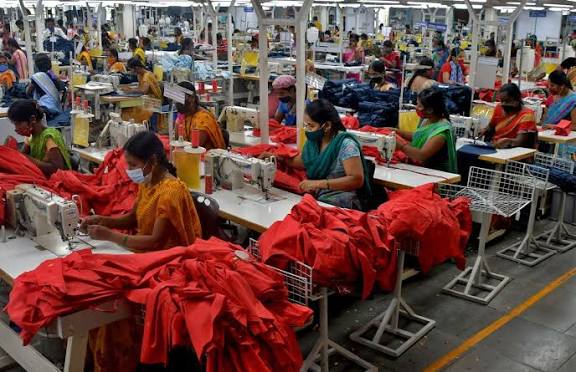
The second transformation must occur inside the workplace. Industry cannot simultaneously complain about labour shortages and expect workers to accept low-status, high-risk employment without corresponding compensation. Better wages, predictable working hours, safe accommodation, insurance, transport, skill certification and performance-linked progression can fundamentally alter the attractiveness of industrial occupations. This is particularly important because migrant workers should not be viewed as an inconvenient substitute for local labour. They are an essential component of Andhra Pradesh’s current production system and deserve formal protection. The national e-Shram system already provides a platform for integrating unorganised and migrant workers with social-security and employment services; Andhra Pradesh can build a much stronger state-level labour intelligence system around it. The objective should be neither to displace migrants nor to restrict labour mobility, but to create a transparent labour market in which both local and migrant workers compete on skills, wages and productivity rather than vulnerability.
The larger economic opportunity lies in turning this contradiction into a competitive advantage. Andhra Pradesh is entering a period of substantial infrastructure, port, manufacturing, logistics, renewable-energy and industrial expansion. The State has already indicated an intention to create large numbers of new employment opportunities, while officials have been directed to align training with emerging industrial requirements. The next step should be a District Labour Demand Map that forecasts, sector by sector, the number and type of workers required over the next five years. Every major industrial project should carry an employment-and-skills plan: how many welders, electricians, machine operators, crane technicians, refrigeration specialists, marine workers, logistics supervisors and agricultural technicians will be needed; how many can be sourced locally; what training is required; and what wages and career progression will make those occupations attractive. Skill development would then cease to be a classroom exercise and become an instrument of industrial strategy.
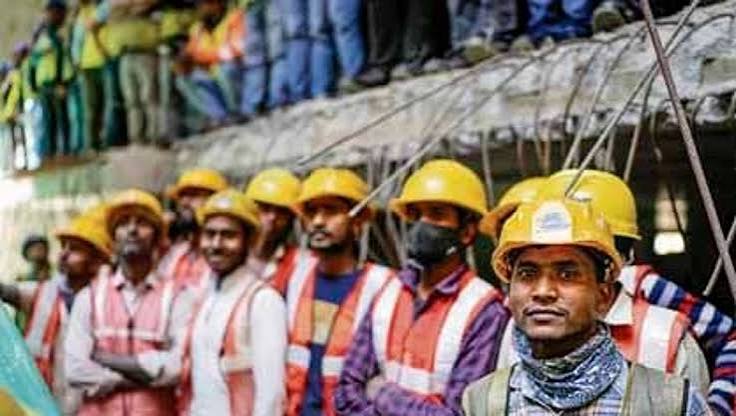
Ultimately, Andhra Pradesh’s labour paradox is not a story about lazy youth versus hardworking migrants. That framing is too simplistic—and potentially socially divisive—to explain the economics. It is a story about aspiration, incentives and structural mismatch. The State has successfully raised educational aspirations faster than it has redesigned the occupational ladder beneath them. The consequence is extraordinary: young people may wait for preferred jobs while industries search for workers; migrants may travel thousands of kilometres to perform jobs that local workers reject; and Andhra households may send their own workers abroad while industries at home import labour from Bihar, West Bengal, Jharkhand and Odisha. The solution is to make productive work—whether blue-collar, technical or entrepreneurial—compatible with dignity, technology, safety, income and upward mobility. The ultimate objective should not be to force Andhra youth into jobs they do not want, nor to reduce dependence on migrant workers at any cost. It should be far more ambitious: to build an Andhra Pradesh where the most difficult jobs become the most intelligently designed jobs, where skills command respect, and where economic growth creates an employment ecosystem in which aspiration and opportunity finally meet.
VISIT ARJASRIKANTH.IN FOR MORE INSIGHTS

