
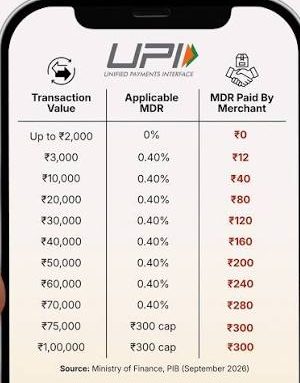
For years, UPI represented one of India’s most powerful economic propositions: instant payments, near-zero visible friction and universal digital acceptance without the conventional economics of card networks. The QR code became financial infrastructure, helping move India from a cash-intensive economy into the world’s largest real-time retail-payment ecosystem by volume. That model now enters a new phase. From 15 October 2026, eligible Person-to-Merchant (P2M) UPI transactions above ₹2,000 will attract a 0.4% Merchant Discount Rate (MDR), capped at ₹300 for transactions of ₹75,000 and above; P2P payments and P2M transactions up to ₹2,000 remain outside the charge regime, while specified essential sectors receive concessional treatment. Importantly, MDR is legally a merchant-side payment-system charge, not a consumer tax.
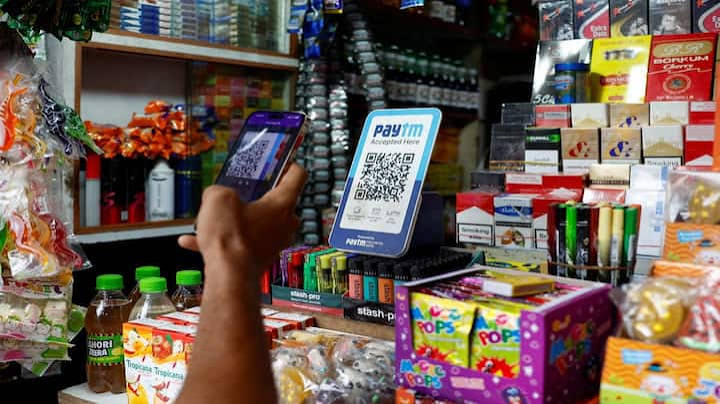
But the real economic question begins precisely where the legal definition ends. Consider a ₹10,000 purchase: the MDR is ₹40. The customer still sees ₹10,000 debited, because the framework does not permit the charge to be directly passed on. Yet economic incidence can travel through another route. A merchant may absorb the ₹40, accept a lower margin, adjust prices across products, reduce discounts, favour another payment method or redesign business practices. For a high-margin retailer, ₹40 may be negligible; for a low-margin trader, distributor or service provider, repeated deductions may matter. Therefore, “the consumer is not charged” and “the consumer bears no economic consequence” are not necessarily identical propositions. The first is a regulatory fact; the second is an empirical question that depends on competition, margins, price elasticity and merchant behaviour. The policy should consequently be judged not merely at the payment screen but across the entire economic chain.
The scale of UPI explains why monetisation has become economically significant. NPCI data show that UPI processed 24.51 billion transactions worth ₹29.82 lakh crore in August 2026 alone, with transaction volume up about 22% year-on-year. Such scale creates enormous infrastructure requirements: cybersecurity, fraud prevention, network capacity, dispute resolution, authentication, resilience and continuous technological upgrades. The Government has also historically supported UPI adoption through incentive mechanisms. The argument for a sustainable revenue model is therefore understandable. A digital public infrastructure cannot necessarily depend indefinitely on subsidies. But monetisation raises a larger public-economics question: when public investment built the rails and millions of citizens and businesses created the network’s scale through adoption, how should the economic value generated by that infrastructure be allocated? Sustainability is legitimate; opacity is the danger.
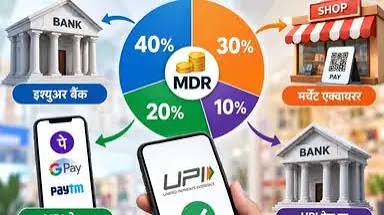
The critical analytical issue is therefore not whether UPI has costs—it certainly does—but whether policymakers distinguish gross ecosystem expenditure from net economic cost. Digital payments themselves generate substantial savings. Banks can reduce elements of cash handling, physical infrastructure and reconciliation costs; merchants gain faster settlement and automated records; consumers save time; businesses reduce cash-management risks; and the wider economy benefits from greater traceability and financial formalisation. These are real economic gains. A sophisticated cost framework should consequently ask not only, “What does UPI cost?” but also, “What costs has UPI eliminated?” If the justification for MDR considers infrastructure and cybersecurity expenditure but does not transparently account for the efficiencies created by digitisation, stakeholders cannot fully assess whether the charge represents cost recovery, reasonable ecosystem remuneration or something larger. The issue is not the existence of a fee but the quality of the accounting behind it.

The apparent smallness of 0.4% is precisely what makes the policy intellectually interesting. Four-tenths of one per cent appears trivial in isolation. On ₹10,000, it is ₹40; on ₹50,000, ₹200; and on ₹75,000, the uncapped calculation reaches ₹300, after which the prescribed ceiling applies. Yet microscopic percentages become consequential when multiplied across a vast transaction economy. At the same time, calling MDR a “tax” would be analytically imprecise: the Government has clarified that MDR is a charge within the merchant-payment ecosystem and is shared among participating banks, payment service providers and UPI application providers. The more precise concern is whether a quasi-public digital infrastructure, once monetised, can maintain a transparent relationship between cost, efficiency, price and value. That is a governance question, not merely a pricing question.
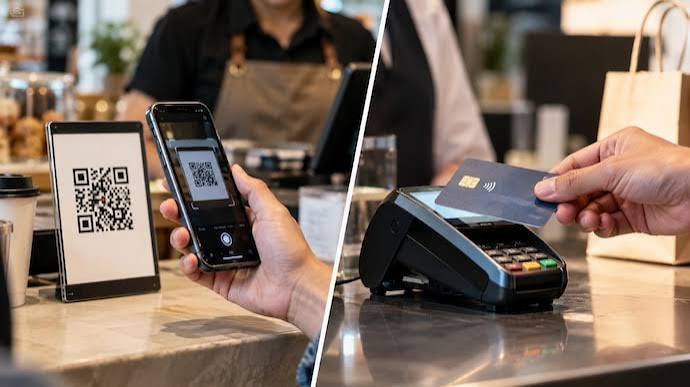
The second-order effects deserve equal attention. A merchant facing MDR on eligible higher-value payments could have incentives to encourage cash, prefer alternative instruments or restructure transactions. Transaction splitting could theoretically become an enforcement challenge if businesses attempt to keep individual payments below the threshold. A merchant prohibited from explicitly recovering MDR could nevertheless attempt to compensate indirectly through broader pricing. None of these possibilities makes the framework inherently unworkable; they demonstrate why implementation matters as much as policy design. Real-time monitoring, merchant-level analytics, transparent settlement statements and accessible grievance mechanisms will be important. The exemption for small merchants—based on monthly QR-code UPI receipts up to ₹1 lakh—also merits periodic review so that a threshold designed for inclusion does not eventually become an artificial boundary as businesses grow.

India therefore needs a transparent UPI cost architecture, not simply a new MDR number. An annual UPI Cost and Value Report could disclose ecosystem expenditure, cybersecurity and infrastructure costs, incremental versus sunk costs, measurable operational savings, MDR collections and their distribution among participants. The rate could then be reviewed periodically against transaction growth, unit costs and technological efficiencies. Small-merchant protection should be evaluated through measurable outcomes: increased digital acceptance, reduced cash-handling costs and deeper adoption beyond major cities. Equally important, enforcement against unlawful consumer pass-through must be simple and credible. The objective should neither be to freeze UPI permanently at zero cost nor to normalise charges without scrutiny. It should be to create a proportionate, transparent and evidence-based monetisation model.

UPI has now reached an extraordinary economic crossroads. It began as an instrument of inclusion, became national digital infrastructure and achieved a scale few payment systems anywhere have matched. August 2026 alone recorded ₹29.82 lakh crore of transactions across 24.51 billion payments. The next stage is monetisation. That evolution is not inherently problematic; infrastructure must ultimately have sustainable economics. But sustainability should not become a euphemism for invisible cost transfer. The consumer may continue to scan the same QR code, press the same button and see “₹10,000 paid”—apparently untouched by the new regime. Behind that frictionless experience, however, ₹40 is being allocated within the payment ecosystem. The number is tiny; the principle is enormous. Technology made payment effortless. Scale made it valuable. Now value is being monetised. The real policy challenge is to ensure that the economics of that value remain transparent, competitive and proportionate—because in the digital economy, the most consequential charges may be the ones consumers never see.
VISIT ARJASARIKANTH.IN FOR MORE INSIGHTS

