
A lie once required a printing press, a loudspeaker or a determined rumour-monger. Today, it requires only a smartphone, an old video and an algorithm trained to reward attention. The September 2026 episode at Delhi’s Indira Gandhi International Airport is therefore more than a curious social-media incident; it is a warning about the changing physics of public reality. On September 4, approximately 72.2 mm of rain fell around the airport within three hours, between 2:30 PM and 5:30 PM. Water temporarily accumulated in the Terminal 3 arrival forecourt, but drainage cleared it in roughly twenty minutes and airport operations continued safely. The physical event was limited and quickly resolved. The digital event was radically different. Social media transformed a manageable episode into a narrative of a “flooded Terminal 3”, while an old Dubai Airport video was circulated as purported Delhi footage. Reality moved at the speed of drainage; misinformation moved at the speed of the internet.
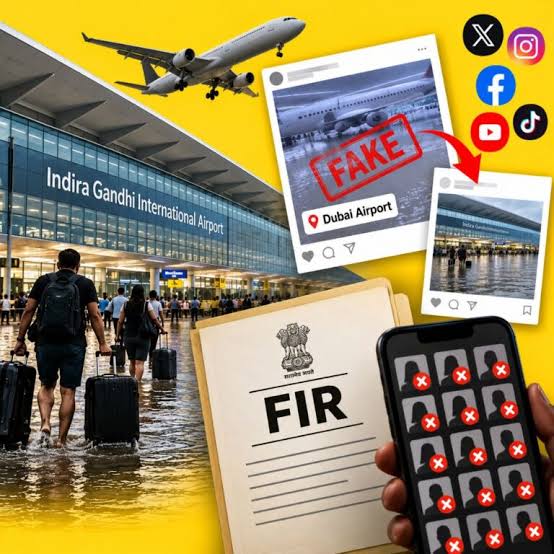
The episode exposes what may be called the verification deficit of the digital age. Information now travels almost instantaneously, while verification remains inherently procedural. A physical event occurs in one place; its digital representation can cross cities, languages, platforms and borders within minutes. By the time an airport authority, police agency or government department establishes the facts, millions may already have consumed a distorted version. The traditional sequence—event, verification, publication, public reaction—has been inverted into event, publication, amplification, reaction and, finally, verification. That inversion matters because the first version encountered by the public often becomes the psychological reference point against which subsequent corrections are judged. Truth may eventually arrive, but it arrives after perception has already been formed. In the digital information economy, therefore, the institutional challenge is no longer merely to establish facts; it is to establish and communicate them at sufficient speed to compete with falsehood.
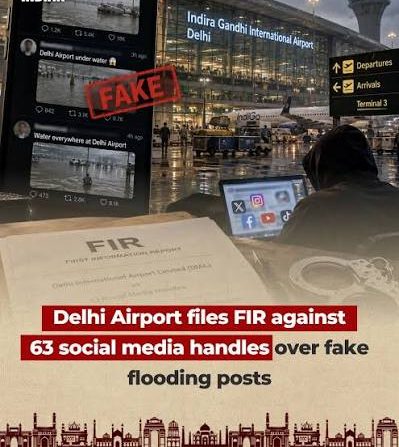
The real danger lies not in falsity itself but in consequence. A misleading airport video can generate passenger anxiety, overload helplines, trigger unnecessary administrative responses, divert police resources towards verification, damage confidence in critical infrastructure and create confusion during an emergency. If such misinformation appears immediately before a major international event such as the BRICS Summit, its implications become more strategic. A minor operational disturbance can be made to resemble institutional failure; institutional failure can then be made to resemble governance failure. This is how misinformation acquires power: it converts small facts into large perceptions. The scale of the original event becomes almost irrelevant once an algorithm begins multiplying its emotional significance. What begins as a puddle can end as a crisis of confidence. The physical infrastructure may function perfectly while the information infrastructure around it collapses.
The Delhi episode also exposes why the debate around deepfakes is too narrow. Misinformation does not need sophisticated artificial intelligence to become dangerous. Indeed, one of the most effective techniques is technologically simple: take an authentic image or video, remove its original context and attach a false one. The Dubai Airport footage was powerful precisely because the underlying video was real. This creates two fundamentally different forms of deception—fabricated reality and displaced reality. Fabricated reality shows something that never happened; displaced reality shows something that happened elsewhere and falsely claims that it happened here. The second can be more persuasive because visual authenticity creates an illusion of contextual authenticity. India’s emerging digital policy architecture must therefore look beyond synthetic generation towards provenance, metadata, chronology, geolocation and contextual verification. The future question will not simply be “Was this video generated by AI?” but “Where, when and under what circumstances did this image actually originate?”

Behind this lies a larger structural problem: social-media platforms are not neutral information pipes. Their economic architecture is built around engagement, and engagement is disproportionately generated by novelty, outrage, fear, conflict and emotional certainty. Nuanced explanations rarely compete successfully with dramatic claims. Algorithms therefore create an environment in which the most emotionally contagious version of an event can outrun the most accurate version. Human psychology reinforces the problem. People do not process information only through evidence; they also process it through identity, trust and group affiliation. A claim consistent with an individual’s existing worldview can acquire credibility before verification begins, while a correction may be rejected as an attack on the group itself. Misinformation thus becomes self-reinforcing: algorithms amplify emotion, emotion reinforces identity, identity resists correction, and resistance generates further engagement. What emerges is not merely fake news but a parallel information order.
India’s evolving regulatory response recognises the urgency of this transformation, including through the 2026 amendments to the Information Technology Rules addressing synthetically generated information, labelling, provenance and accelerated response mechanisms. Speed is essential because a legally valid response that arrives after a false narrative has become viral may be strategically worthless. But speed must not become an excuse for abandoning democratic safeguards. Excessively compressed compliance obligations can encourage platforms to over-remove material simply to minimise legal risk, potentially affecting journalism, satire, criticism, political expression and legitimate disagreement. The state cannot become the unquestionable arbiter of truth, any more than platforms can be allowed to become unaccountable arbiters of visibility. The objective must be a system in which deliberate manipulation is difficult to scale, corrections are rapidly accessible, platforms are accountable for systemic risks, and citizens retain meaningful avenues of appeal. The challenge is not to regulate speech out of existence, but to regulate the architecture through which deception acquires mass power.

India should therefore treat information resilience as critical infrastructure. Airports, railways, ports, power utilities, hospitals and other strategic institutions should maintain dedicated misinformation-response cells capable of issuing verified information within minutes of a developing incident. Every critical institution should possess an unmistakable official digital identity so citizens can instantly locate authoritative information. Police and investigative agencies need sophisticated digital-forensics capabilities to detect recycled, manipulated and synthetically generated material. Platforms should deploy systems to identify coordinated amplification, repeated circulation of debunked material and suspicious contextual changes. Provenance technologies should allow users to establish the origin, date and modification history of important images and videos. Independent fact-checking organisations, government verification units, newsrooms and civil-society networks should be connected through interoperable verification mechanisms, particularly in India’s many regional languages. The goal should be a distributed national verification ecosystem—not a single centralised authority claiming a monopoly over truth.
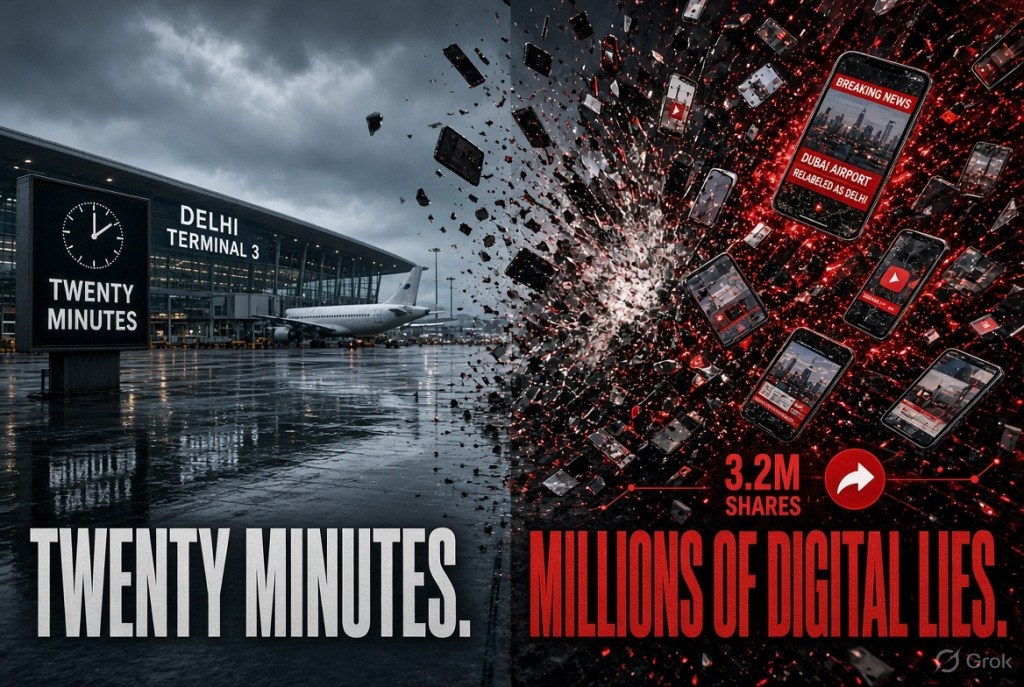
Ultimately, however, the most powerful firewall is the citizen. Digital literacy must graduate from teaching people a few tricks for spotting fake images to cultivating a deeper civic culture of verification. A dramatic video is not automatically evidence; an authentic photograph can be falsely relocated; a caption can manufacture an entirely new meaning; and forwarding is not verification. Every smartphone is now simultaneously a receiver, publisher and amplifier. Every citizen therefore participates in the information infrastructure. The Delhi Airport episode should be remembered not because water briefly accumulated at Terminal 3, but because it demonstrated the extraordinary distance between reality and its digital shadow. The water disappeared in twenty minutes. The narrative could survive for days. That is the real emergency. The future battle against misinformation will not be won by deleting yesterday’s lies; it will be won by building institutions, technologies, platforms and citizens capable of ensuring that tomorrow’s lies cannot travel faster than the truth.
VISIT ARJASRIKANTH.IN FOR MORE INSIGHTS

