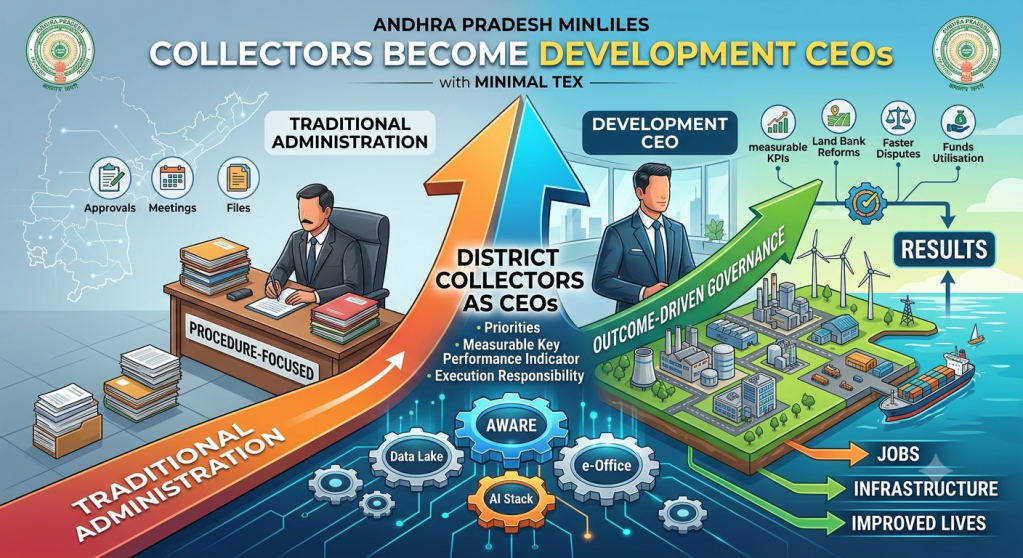
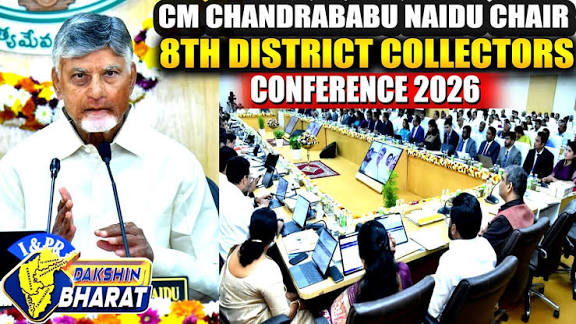
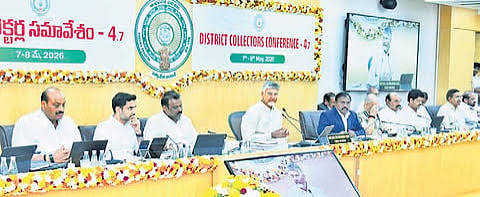
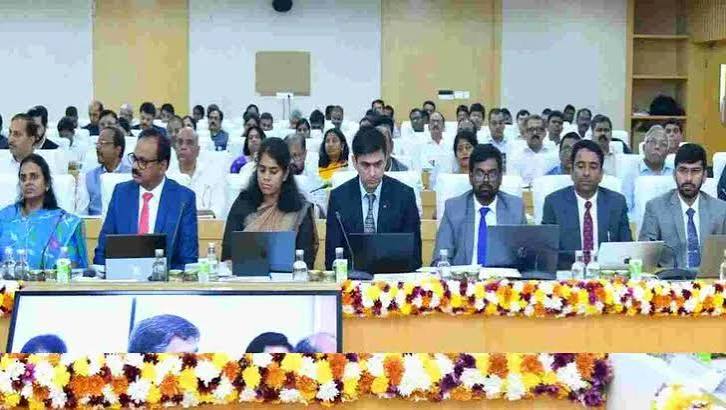
The most consequential message emerging from Andhra Pradesh’s 8th District Collectors’ Conference was not the review of schemes, enumeration of projects or celebration of district innovations. It was an attempt to rewrite the operating system of government itself. Chief Minister N. Chandrababu Naidu appears to be asking a deceptively simple question: Is the State administering programmes, or producing measurable outcomes? The distinction could determine whether Andhra Pradesh remains merely a well-administered State or becomes a high-performance governance system. His emerging philosophy resembles that of a CEO running an enormous, geographically dispersed enterprise—except that the balance sheet is not profit but jobs created, investments realised, disputes resolved, infrastructure delivered, children educated and citizens served. In this model, an idle file is deferred economic value; an unresolved grievance is delayed justice; an unutilised rupee is foregone development; and a stalled investment is employment denied.
The insistence that every district identify 25 priorities and every Assembly constituency 10–15 priorities is therefore far more consequential than a planning exercise. Governments frequently make everything a priority and consequently make nothing accountable. A finite list forces managerial concentration and creates ownership around five uncomfortable questions: What must be delivered? Who owns it? By when? With what resources? And what happens if it is not delivered? This potentially transforms the Collector from a departmental coordinator and revenue administrator into the operating CEO of district transformation. The Collector’s responsibility becomes not merely maintaining order but accelerating development, removing bottlenecks and synchronising departments. The district is where government finally meets reality: the farmer, investor, schoolchild, hospital, road, land parcel and grievance do not exist within departmental silos. If governance is ultimately judged at the point where the citizen encounters the State, the district must become the primary unit of performance.
The land agenda illustrates this philosophy with unusual clarity. The proposed Structured Common Land Bank Portal under the CCLA seeks to convert fragmented and underutilised government land into productive development capital. Land trapped in outdated records, disputes or departmental silos has little economic value until government creates certainty around it. The reported resolution of 232 long-pending disputes involving nearly 31,000 acres and land valued at around ₹5,000 crore reveals the extraordinary economic cost of administrative inertia. The proposed use of blockchain for protecting resurveyed lands, real-time integration of records and digitisation of historical backlogs points towards something larger than e-governance: institutional certainty. The objective should ultimately be to prevent disputes rather than merely dispose of them. In an investment economy, predictable land ownership, transparent transactions and development-ready parcels are not clerical conveniences; they are economic infrastructure.
The financial numbers expose another uncomfortable truth. Andhra Pradesh reportedly had approximately ₹16,603 crore available under the State Head Office for Centrally Sponsored Schemes, against expenditure of only ₹7,307 crore. Utilisation varied dramatically between departments, approaching 99% in some areas while falling to around 6% in Water Resources. This exposes the limitations of conventional budgetary achievement. A sanctioned rupee is not a spent rupee; a spent rupee is not necessarily an asset; and an asset is not automatically an outcome. The real KPI is the chain connecting allocation → expenditure → asset → service → social impact. This distinction is crucial for an infrastructure-hungry State. Every unspent allocation represents opportunity cost, while every delayed project compounds costs through inflation, lost productivity and public frustration. Financial management must therefore evolve from utilisation certificates towards outcome certificates: not merely asking whether money was spent, but what changed because it was spent.
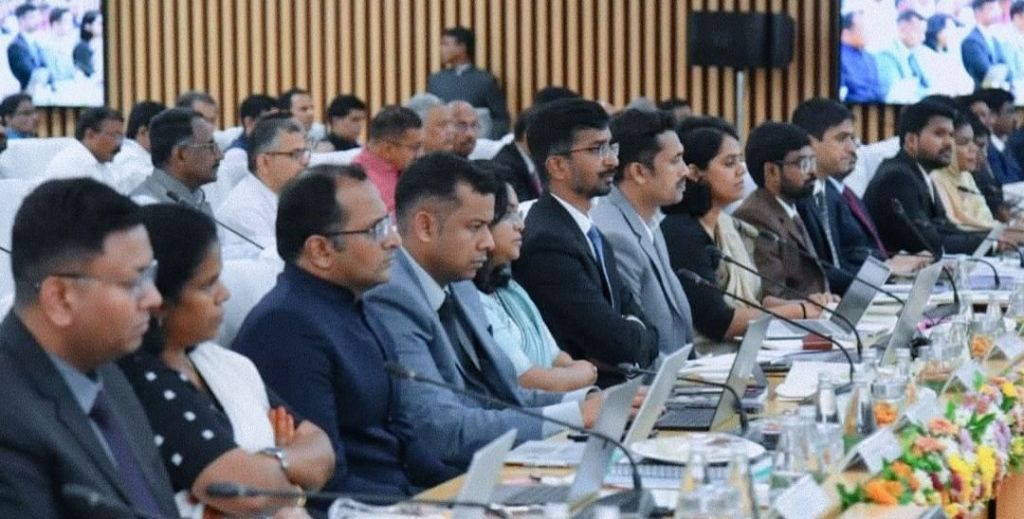
The same discipline must govern industrial investment. Andhra Pradesh has approved 359 SIPB projects involving a reported ₹13.85 lakh crore and potential employment of 10.6 lakh people, yet only 160 projects have commenced. The gap between approval and execution is where much of India’s investment story traditionally disappears. An announcement creates headlines; commencement creates construction employment; a functioning factory creates sustained jobs, exports, supply chains and local economic ecosystems. The proposition that investment delay is employment denial should therefore become an administrative doctrine. Every major project needs a digital lifecycle—from approval and land acquisition to utilities, environmental permissions, construction and commercial production—with responsibility visible at every stage. The bureaucratic question must change from “Where is the file?” to “Why has this investment not yet become an operating economic asset?” That is the difference between processing investment and producing growth.

This approach also makes district-specific development indispensable. Andhra Pradesh cannot be transformed through a single template imposed from Amaravati. Rayalaseema requires water security, irrigation, drought resilience and micro-irrigation; Uttarandhra needs connectivity, industrial corridors and new economic opportunities; agency areas require technology-enabled services adapted to difficult terrain; coastal districts can leverage ports, logistics, aquaculture and industrial integration; tourism districts need destination infrastructure and professional visitor ecosystems. The Collector consequently becomes the bridge between State-level ambition and local economic geography. District development should increasingly resemble a portfolio of specialised growth engines, each with measurable KPIs and State-level support. The innovations presented by Anantapur, Chittoor, Bapatla, Kurnool, Prakasam and Sri Sathya Sai suggest that administrative creativity is already distributed across Andhra Pradesh. The next challenge is to identify, validate, replicate and scale successful models without destroying their local ingenuity through excessive bureaucratic standardisation.
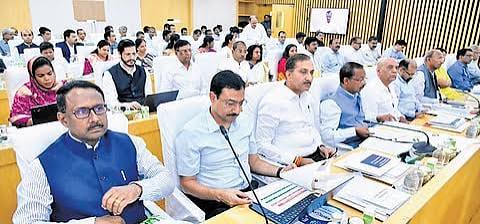
The potentially revolutionary layer is the digital architecture comprising AWARE, Data Lake, AI Stack, Manamitra and e-Office. Technology matters only when it changes administrative behaviour. Digitising a paper file without redesigning the decision process merely produces a faster version of yesterday’s bureaucracy. The real transformation occurs when data enables government to anticipate rather than react. If AWARE integrates rainfall, reservoir, groundwater, cyclone and flood information, intervention can begin before disaster strikes. If Data Lake eliminates repetitive data collection, officers can devote more time to problem-solving. If AI identifies emerging risks, field action can begin earlier. If Manamitra reduces unnecessary physical interfaces, citizens gain convenience and transparency. The reported performance of Nellore Collector Himanshu Shukla—100% disposal of 1,492 e-files with an average disposal time of 5 hours and 29 minutes—shows that administrative efficiency can become measurable rather than rhetorical. The ambition should be nothing less than a government capable of seeing problems before citizens are forced to complain about them.
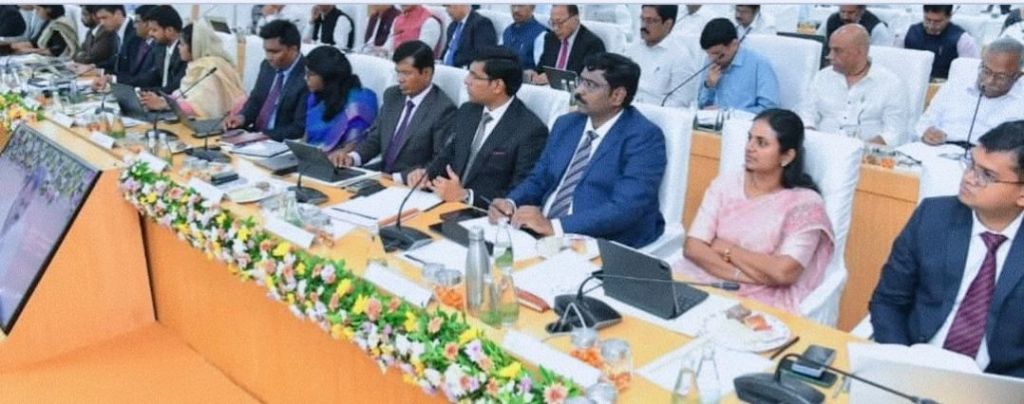
This capacity becomes particularly important as Andhra Pradesh confronts climate uncertainty, rainfall deficits, reduced Kharif cultivation and stressed water resources. Agriculture, drinking water, livestock, electricity and prices are interconnected; climate governance therefore cannot remain trapped inside departmental boundaries. The same integrated philosophy must extend to human capital. Sanjeevani’s healthcare architecture, Mission March SSC 2027, the identification of 3.28 lakh “Rising Stars” and deployment of more than 72,000 mentors represent attempts to intervene before educational disadvantage becomes permanent economic exclusion.
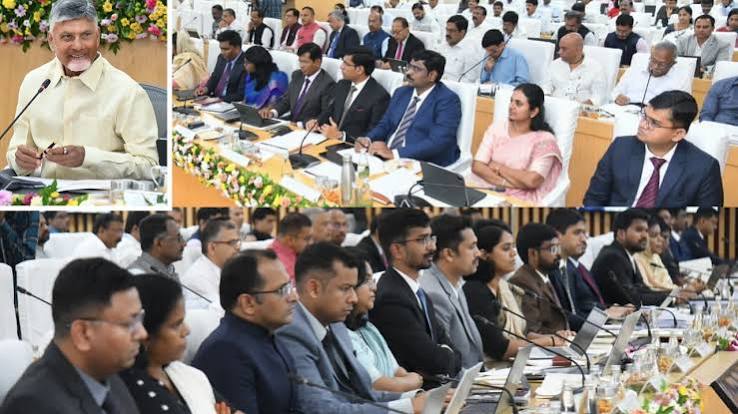
Yet attendance of 85.45% against a 95% target and thousands of schools below desired academic benchmarks reveal the distance between policy intent and ground reality. Ultimately, “One State, One Vision, One Team, One Mission—Swarna Andhra” will succeed only if it becomes an operating culture rather than a slogan. Chandrababu Naidu’s real experiment is whether political leadership can convert an entire administrative system into a 24×7 development machine—one that replaces reaction with anticipation, responsibility-sharing with ownership, meetings with measurable outcomes and approvals with completion. Andhra Pradesh’s greatest governance innovation, if the experiment succeeds, will not be a portal, scheme or project. It will be the recognition that administrative time is economic capital—and every day lost to delay is development stolen from the citizen. The ultimate KPI of government is not how many files move, but how many lives move forward because they did.
VISIT ARAJSRIKANTH.IN FOR MORE INSIGHTS


One response to ““CM BY TITLE, CEO BY INSTINCT: CHANDRABABU’S 24×7 GOVERNANCE MACHINE—THE COLLECTOR BECOMES CEO AND THE FILE BECOMES THE KPI””
Depicted APs real picture
LikeLike