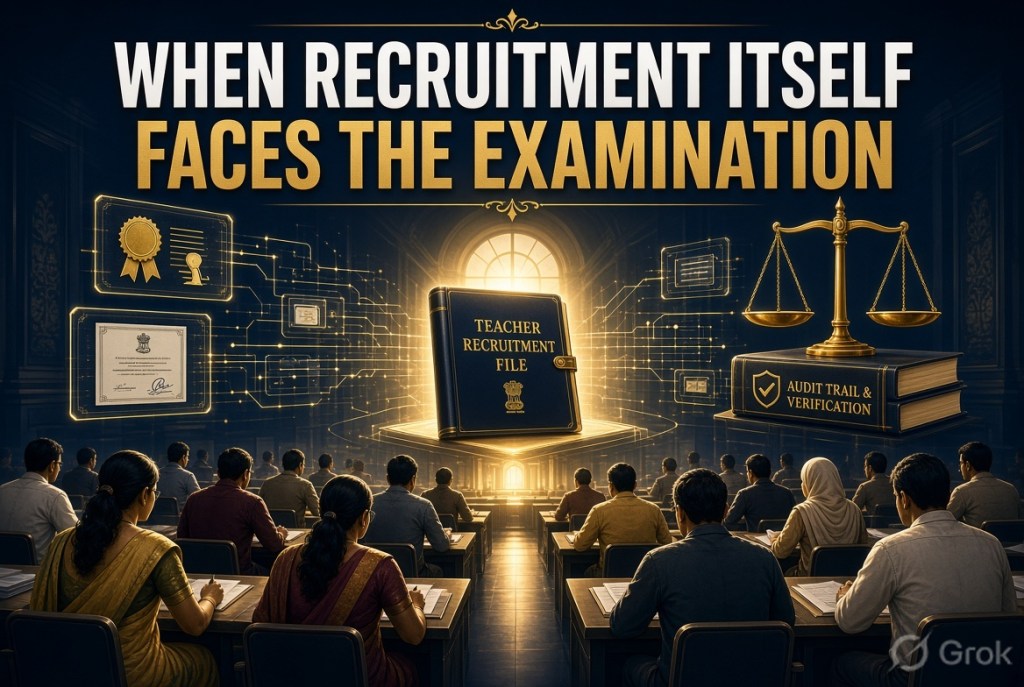
A government examination is never merely an examination. Behind every application number stands a young person carrying years of preparation, family expectations, financial sacrifice and the belief that merit can alter the course of a life. That is why the Andhra Pradesh Mega DSC–2025, involving 16,347 teaching posts, has evolved beyond a recruitment exercise into a test of governance itself. The controversies surrounding sports-quota appointments, certificates, merit lists, reservation methodology and examination procedures, coupled with extensive litigation, raise a larger institutional question: not whether every allegation is necessarily true, but whether a government can administer recruitment at extraordinary scale, confront genuine imperfections, correct errors transparently and still preserve citizens’ faith in the fairness of the State.
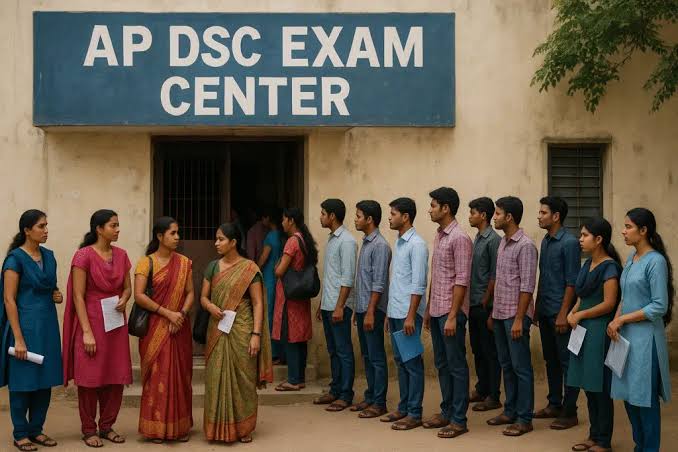
Mega recruitment inevitably creates administrative complexity. Thousands of candidates, multiple subjects, qualifications, categories, districts, reservation rules, digital applications, certificates, answer keys, rankings and appointments must ultimately converge into one legally sustainable outcome. A seemingly minor ambiguity in a Government Order can become a major dispute when multiplied across thousands of aspirants. A technical decision made in a Secretariat may look entirely different to a candidate who experiences recruitment through one intensely personal question: “Why was that person selected and I was not?” That question is not merely emotional; it is the foundation upon which perceptions of institutional legitimacy are built.

This is where the psychology of public administration becomes critical. A successful candidate generally experiences the system as fair; an unsuccessful candidate naturally searches for an explanation. When information is incomplete, suspicion occupies the vacuum. A delayed result can be interpreted as manipulation; a certificate discrepancy as fraud; a procedural change as favouritism; an unexpected selection as backdoor entry. Some allegations may ultimately withstand scrutiny; others may collapse under evidence. The State therefore cannot govern merely by publishing outcomes. Transparency is not the mechanical disclosure of information; it is the systematic reduction of uncertainty. Every important selection decision must be capable of being explained, verified and defended independently.
The sports-quota controversy illustrates this principle sharply. Special provisions for meritorious sportspersons are legitimate instruments of public policy, and horizontal reservation can recognise achievements that conventional examinations cannot adequately measure. At the same time, questions concerning certificate authenticity, selection methodology and professional suitability cannot be dismissed as either political attacks or established wrongdoing without evidence. The correct administrative response is forensic rather than rhetorical: verify certificates against original tournament records, participant lists, fixtures, results and issuing authorities; establish an auditable chain of verification; and publish reasoned findings wherever legally permissible. An official seal is not proof by itself, just as an allegation is not evidence.

The larger lesson is that digitisation does not automatically produce transparency. A sophisticated recruitment portal can reduce physical interference and accelerate processing, yet still remain a black box if candidates cannot understand how eligibility, marks, reservation, priority and final ranking were determined. Technology should therefore move beyond digitising paperwork towards creating an auditable recruitment architecture. Candidate-wise selection ledgers, immutable examination records, published answer keys and cut-offs, digitally authenticated certificates, structured objections and independently verifiable audit trails can transform technology from a processing tool into an instrument of institutional accountability. The objective should be simple: every consequential decision must leave a trace that can withstand administrative, judicial and public scrutiny.
There is also a legitimate policy tension between social justice and professional competence. Sports reservation should not be reduced to a choice between sporting excellence and academic merit. A better framework would create a two-gate model: sporting achievement establishes eligibility for the special avenue, while a reasonable threshold of subject knowledge and pedagogical competence protects the ultimate stakeholder—the child sitting in the classroom. The State has a responsibility both to honour exceptional sportspersons and to ensure quality teachers. Inclusive recruitment and professional standards are not opposing principles; properly designed, they can reinforce each other.
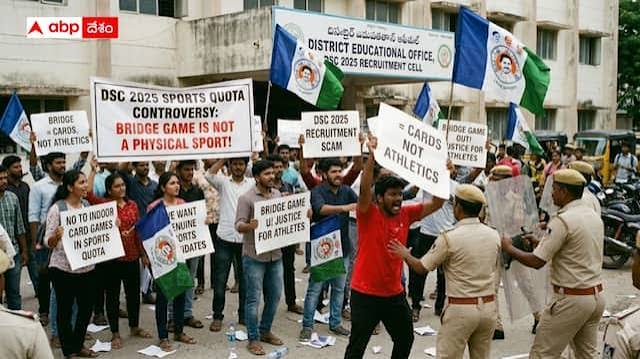
The scale of DSC–2025 also deserves a mature assessment. Governments are criticised when they fail to recruit; when they undertake recruitment for thousands of posts simultaneously, the scale itself increases the probability of procedural complexity, disputes and litigation. That does not excuse mistakes, but neither should every controversy automatically be interpreted as institutional collapse. The correct response lies between denial and destruction: identify disputed cases, independently audit them, protect candidates who have complied with the rules, act decisively against proven wrongdoing and allow uncontested recruitment to proceed wherever legally sustainable. A large public system should be judged not by whether it never encounters an error, but by whether it possesses the institutional capacity to detect and correct one.

The real opportunity now is to convert DSC–2025 from a recruitment controversy into a Recruitment Integrity Framework for Andhra Pradesh. Rules should be frozen and clearly published before notification; reservation rosters should be auditable; certificates should be digitally authenticated; provisional merit lists should permit structured objections; examination records should carry immutable audit trails; disputed selections should undergo independent scrutiny; and final decisions should be supported by recorded reasons. The ultimate question is not merely “Who got the job?” but “Can every candidate understand why that person got the job?” That is the difference between an examination that merely produces appointments and a public institution that produces trust. The greatest test of government is not perfection; it is whether, when challenged, truth can be independently discovered, mistakes can be corrected and merit can still prevail.
VISITI ARJASRIKANTH.IN FOR MORE INSIGHTS

