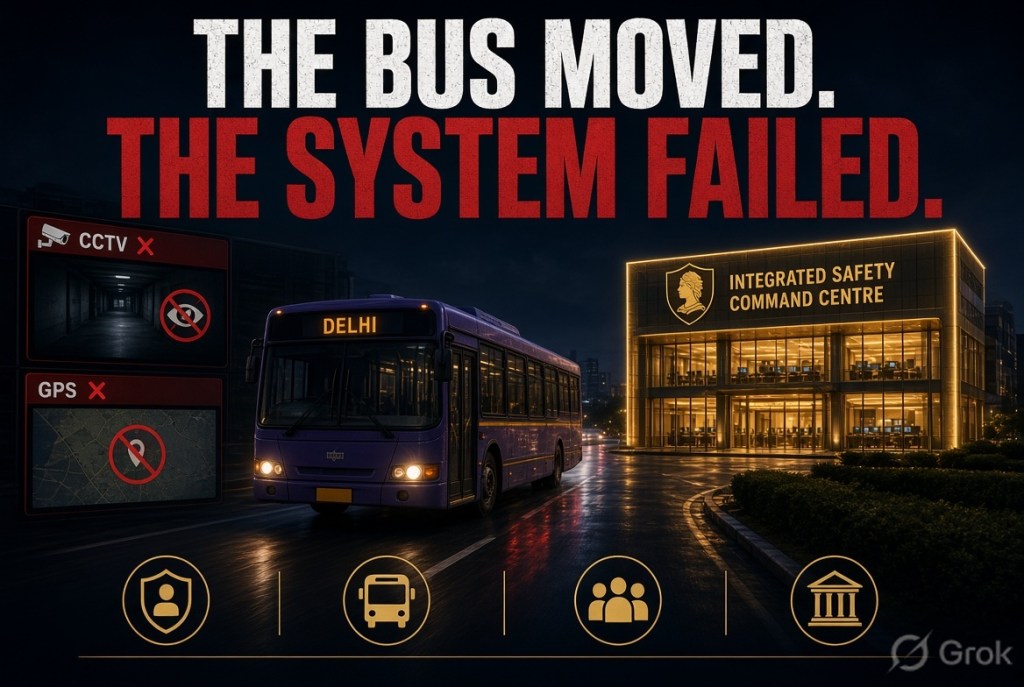
Fourteen years after Nirbhaya transformed India’s national conversation on women’s safety, the most disturbing question is no longer whether India possesses adequate laws, technology, funding or institutions. It is why all four can exist simultaneously—and still fail a vulnerable girl travelling in a bus. The August 2026 assault of a teenage girl inside a moving sleeper bus in the Delhi-NCR region is therefore not merely another horrific crime; it is a devastating governance audit. The bus reportedly travelled nearly 47 kilometres from Greater Noida towards Delhi, crossed multiple jurisdictions and moved through an ecosystem supposedly saturated with CCTV, GPS, traffic enforcement, police personnel and emergency mechanisms. Yet the crime continued until the victim herself reached the police. That is not simply a policing failure. It is a systems failure.
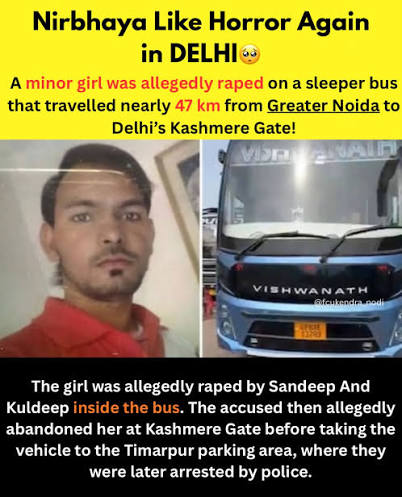
The parallel with Nirbhaya is chilling because the technology has changed while the vulnerability has not. In 2012, a moving bus became a concealed chamber of violence. In 2026, another moving bus again became one. In both instances, curtains or covered windows reportedly defeated public visibility, while transport personnel allegedly exploited the vulnerability of a female passenger. Fourteen years of technological modernisation should have made such an occurrence dramatically more difficult. Instead, India appears to have modernised its equipment faster than it modernised its institutional coordination. The paradox is profound: cameras can multiply, GPS can become ubiquitous, panic buttons can be mandated and command centres can expand, yet a criminal can still discover a blind spot between departments, jurisdictions and human responses.
The reported 11 pending traffic challans against the bus, including seven issued in July, expose a second and potentially more structural weakness. A challan is not enforcement; it is evidence that a violation has been detected. If repeated violations merely accumulate in databases without triggering inspection, suspension, impounding or permit review, regulation becomes a sophisticated archive of warnings rather than a mechanism of prevention. A vehicle reportedly carrying multiple violations, including concerns relating to safety equipment and prohibited curtains, should have triggered escalating scrutiny before becoming the setting for a grave crime. The crucial question is therefore not only why individuals allegedly committed the offence, but why the regulatory system permitted a repeatedly non-compliant vehicle to remain operational. The State must move from recording violations to automatically responding to patterns of risk.

Technology presents an equally uncomfortable paradox. GPS, CCTV, panic buttons and vehicle-location systems are useful only when they constitute a functioning chain from detection to intervention. A panic button that does not generate an actionable alert is decoration. GPS transmitting information nobody monitors is digital theatre. CCTV that records but does not trigger timely intervention is an expensive black box. Artificial intelligence that produces thousands of alerts without connecting them to accountable responders merely creates the illusion of vigilance. The fundamental principle should be simple: technology is not security unless somebody is responsible for responding to what technology detects. India’s Safe City investments must therefore be judged not by the number of cameras installed or devices activated, but by response time, intervention rates, device functionality and lives actually protected.
The deeper failure lies in the fragmentation of responsibility. Transport departments certify vehicles; traffic authorities issue challans; police handle crime; private operators employ drivers and conductors; technology platforms generate data; emergency services receive distress calls; and urban agencies operate surveillance networks. Yet the criminal does not respect departmental boundaries. A bus can cross a jurisdiction in minutes while government systems remain trapped within administrative silos. Delhi-NCR magnifies this weakness because vehicles can originate in one state, traverse another jurisdiction and terminate in a third. Criminal opportunity exploits precisely what bureaucracy struggles to overcome: fragmented authority. Women’s safety requires an integrated operational architecture in which transport regulation, policing, technology, emergency response and inter-state coordination function as one safety chain rather than disconnected administrative compartments.

The directives issued on August 31—requiring functional GPS and panic buttons, prohibiting curtains and unauthorised films, verifying crew credentials, sensitising transport personnel and strengthening parking controls—are necessary. But India’s problem has rarely been a shortage of orders. It is the enormous distance between the order and the outcome. A regulation becomes meaningful only when violation produces a predictable and unavoidable consequence. Every commercial passenger vehicle should therefore possess a continuously updated digital safety profile linked to permit renewal, fitness certification, insurance and enforcement history. Repeated violations should automatically escalate scrutiny. Crew verification should be centralised, periodically renewed and interoperable across states. Safety equipment should undergo independent functionality tests rather than being treated as compliant merely because it has been installed. The principle should shift from “device present” to “device works when a life depends on it.”

The Nirbhaya Fund embodies the same contradiction between intent and impact. A country capable of allocating substantial public resources for women’s safety cannot measure success by sanctions, announcements or expenditure authorisations alone. Under-utilisation of funds represents more than an accounting deficiency; it can mean delayed surveillance systems, inadequate training, weak emergency infrastructure or missing institutional capacity. Public expenditure on safety should therefore be evaluated through measurable outcomes: emergency response times, functioning safety devices, prosecution effectiveness, conviction support systems, trained personnel and coverage of vulnerable transport corridors. Money allocated but not converted into operational protection is not a completed public-policy intervention. It is merely an unfinished promise.
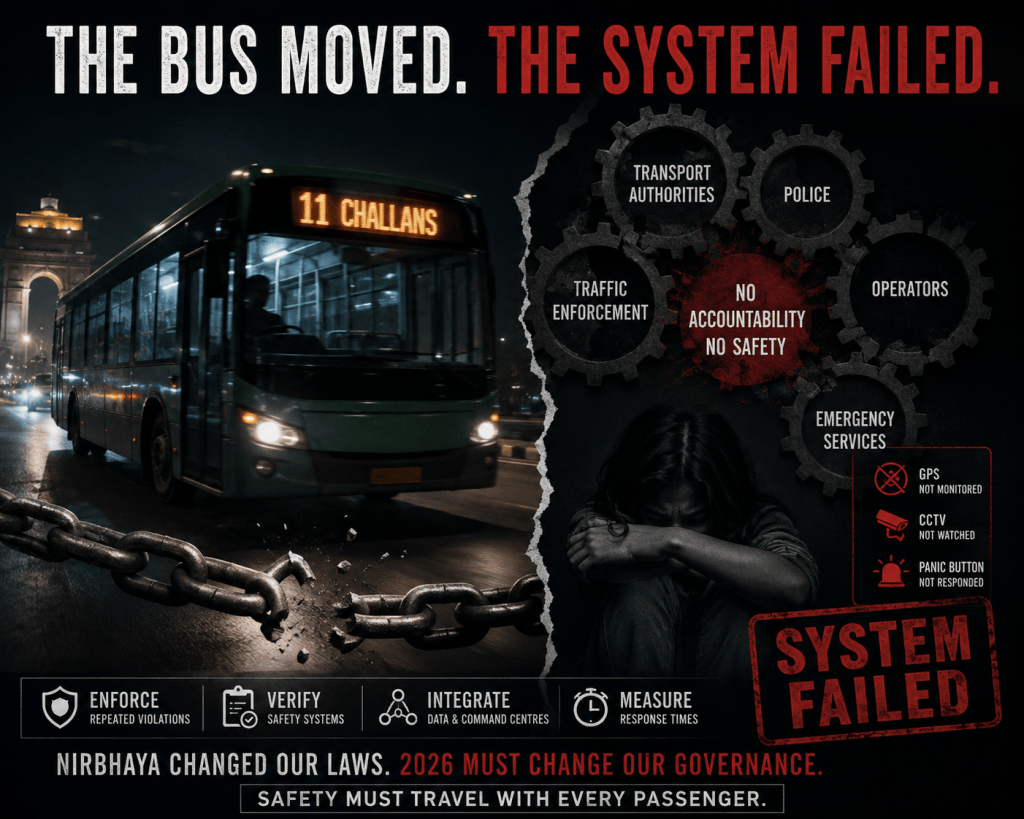
India now needs a radical transition from rule-based safety to outcome-based safety governance. Every technological alert must have an accountable human endpoint. A panic activation should simultaneously identify the vehicle, precise location, operator, crew and nearest responding unit. Route deviations, unexplained stoppages, device failures and emergency activations should generate graded alerts. Command centres should monitor exceptions in real time rather than merely preserve data for post-crime investigation. Passengers too must become part of the safety architecture. International approaches such as the “four Ds”—Distract, Direct, Delegate and Document—demonstrate how bystanders can safely intervene, while public-transport safeguarding models show how drivers and conductors can be trained to recognise vulnerability and respond appropriately. Security cannot be outsourced entirely to police, technology or legislation.

Nirbhaya changed India’s laws. The 2026 tragedy must change India’s governance architecture. The next revolution cannot simply be another law, another committee, another camera or another command centre. It must be coordination with consequences. Every department must know not only what it is responsible for, but what happens when its responsibility intersects with another department’s failure. Every bus must be treated as a moving public space, not a private enclosure. Every safety device must be tested as though a life depends upon it—because one inevitably will. The ultimate measure of Nirbhaya’s legacy is therefore not how many laws India passed after 2012, but whether a frightened girl boarding a bus in 2026 can reasonably believe that the State is travelling with her. If the answer remains no, then Nirbhaya has not merely been remembered. She has been failed again.
VISIT ARJASRIKANTH.IN FOR MORE INSIGHTS

