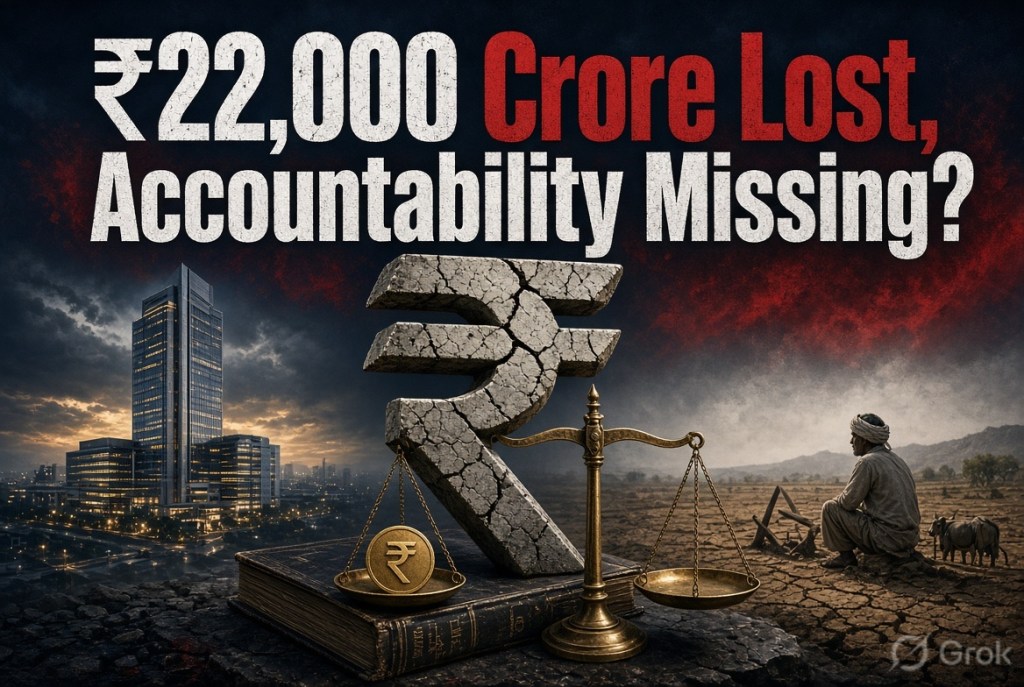
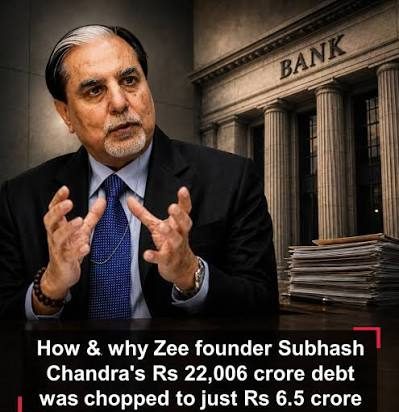
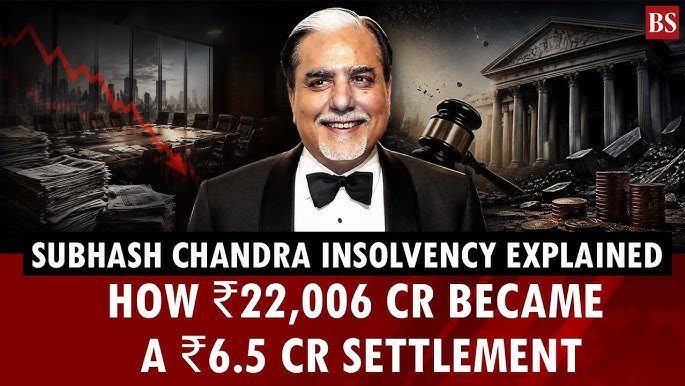
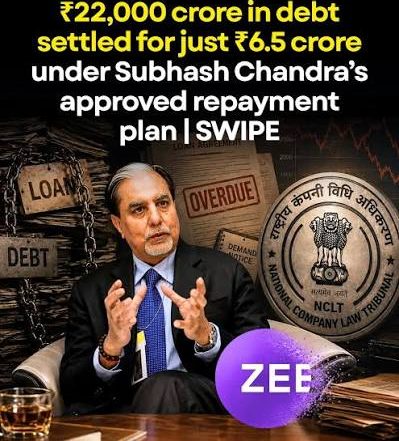
The personal insolvency case involving a prominent industrialist has produced a number so extraordinary that it demands attention far beyond one business group or one individual: creditor claims of approximately ₹22,006 crore against a repayment plan of merely ₹6.5 crore. That translates into a recovery of roughly 0.03% and an extraordinary haircut of about 99.97%. The legal explanation is important: the ₹22,006 crore was not simply money personally borrowed by the individual but largely represented corporate borrowings backed by personal guarantees. Yet precisely because personal guarantees exist to protect lenders when corporate borrowers default, the case raises a profound question about the credibility of India’s financial architecture. If a promoter can provide personal guarantees when his declared wealth runs into tens of thousands of crores, but years later present a dramatically diminished personal estate and obtain insolvency protection with negligible recovery, where exactly does accountability begin and end?
The most unsettling part of the story is the extraordinary transformation in reported personal wealth. The material placed before the tribunal referred to wealth of approximately ₹45,888 crore in 2017, falling to around ₹31.79 crore by 2024, including a residence valued at about ₹25 crore. Such a contraction is not inherently proof of wrongdoing: markets collapse, businesses fail, guarantees crystallise, assets are pledged, and fortunes can genuinely disappear. But a decline of this magnitude should inevitably trigger a fundamental public-interest question: how does a person once regarded as extraordinarily wealthy become personally almost assetless within six or seven years while billions of rupees of creditor exposure remain unresolved? When the financial system is asked to accept such a transformation, forensic examination is not merely a procedural luxury. It becomes essential to public confidence. The dissent within the tribunal itself illustrates the seriousness of the concern, particularly over whether the dramatic erosion of wealth required deeper investigation before the repayment plan was approved.
The mechanics of personal guarantees make the issue even more intellectually troubling. A personal guarantee is supposed to convert the promoter’s personal financial strength into an additional layer of protection for lenders. Banks extend credit partly because the promoter stands behind the obligation. But if the guarantee ultimately produces almost no recovery, the economic value of that guarantee becomes questionable. The case reportedly began with a ₹170 crore borrowing in 2016, against which personal-guarantor insolvency proceedings were initiated in 2022, before claims connected with other guarantees eventually expanded the total to approximately ₹22,006 crore. The distinction between corporate debt and guaranteed personal liability is legally crucial, but economically the banking system faces the same underlying problem: credit was extended within a corporate ecosystem whose promoters had represented personal financial backing, yet creditors may recover only a microscopic fraction from the guarantor. If this becomes a repeatable pattern, personal guarantees risk becoming more symbolic than substantive.
The controversy becomes sharper because insolvency law is simultaneously a mechanism of rehabilitation and a mechanism of creditor recovery. The Insolvency and Bankruptcy Code was never intended to punish genuine financial failure. Its philosophy is to provide an orderly resolution, maximise value and prevent endless litigation. The principle of creditor “commercial wisdom” is therefore central. In this case, approximately 80.81% of voting creditors reportedly supported the repayment plan, and the deciding tribunal member placed significant weight on that collective judgment, including the possibility that rejection might produce an even smaller recovery. That reasoning is legally understandable. But it creates a disturbing paradox: if creditors themselves are forced to choose between an almost negligible recovery today and potentially zero recovery tomorrow, can the resulting approval genuinely be described as a market verdict? A creditor voting for the least damaging option is not necessarily endorsing the economic fairness of the outcome.
The voting structure adds another layer to the controversy. Several entities with reported family or business connections to the promoter collectively exercised approximately 61.78% of voting rights, yet their eligibility was not excluded because of the relatively narrow statutory definition of an “associate”. This is where law and economic reality can diverge dramatically. An entity may technically fall outside a statutory definition while still possessing relationships that raise legitimate questions about independence. If parties closely connected to a promoter can influence the creditors’ vote on the repayment plan, the process may remain legally compliant while generating an uncomfortable perception of institutional asymmetry. The lesson should not be that every connected entity is automatically disqualified; it should be that insolvency law must continuously evolve so that formal legal definitions cannot unintentionally overpower the underlying principle of independent creditor decision-making.
Now compare this extraordinary corporate landscape with the experience of an ordinary Indian farmer seeking a comparatively tiny loan. A small farmer may have to produce land records, identity documents, crop details, banking history, collateral or guarantees, undergo repeated verification and face intense scrutiny before receiving a loan that may be measured in lakhs rather than thousands of crores. If repayment fails, the consequences can become economically and socially devastating. The contrast is not simply emotional; it exposes a structural question about risk distribution in India’s financial system. When a small borrower struggles, the system can become intensely personal and coercive. When a large promoter collapses, the system mobilises lawyers, tribunals, insolvency professionals, committees of creditors, restructuring mechanisms and multiple layers of judicial review. Sophisticated institutional machinery is necessary for large financial failures—but justice becomes questionable if complexity itself becomes a privilege available predominantly to the wealthy.
The potential social cost of a ₹22,000 crore erosion is enormous. Even without claiming that the entire amount could literally be transferred to farmers, its scale illustrates the opportunity cost of financial failure at the top. At an indicative average support requirement of around ₹1 lakh per stressed farmer, ₹22,000 crore represents the equivalent financial scale of assistance for roughly 2.2 million farmers; at ₹90,000, it would cross 2.4 million. The point is not that banks could simply redistribute unrecovered corporate debt to farmers. The point is that capital destroyed or unrecovered at extraordinary scale has consequences for the entire economy. Every large banking loss ultimately interacts with provisioning, capital adequacy, lending capacity, depositor confidence and, where public-sector institutions are involved, the broader financial system. When ordinary citizens are repeatedly told that resources are scarce, the spectacle of enormous claims producing microscopic recovery inevitably generates questions about distributive justice.
India therefore needs a deeper reform conversation—not against insolvency, but against insolvency without sufficient accountability. Personal guarantees should carry credible economic consequences; extraordinary asset depletion should invite proportionate forensic scrutiny; beneficial ownership and family-linked voting relationships should receive stronger transparency requirements; and creditors should have clearer safeguards against conflicted voting. Most importantly, the system must distinguish genuine entrepreneurial failure from situations where wealth, control and liability become separated in ways that leave creditors carrying the burden. The objective should not be to deny a genuinely bankrupt person a fresh start. It should be to ensure that bankruptcy is a second chance, not a sophisticated escape route. The farmer borrowing a few lakhs and the industrialist guaranteeing thousands of crores cannot live under completely different moral universes of credit. A modern insolvency regime must protect entrepreneurship without socialising private failure, respect creditor rights without destroying legitimate rehabilitation, and ensure that the immense machinery of the state does not inadvertently become more accessible to those who have already benefited most from the financial system. The real scandal would not be that one fortune collapsed. Fortunes can collapse. The deeper danger is if the rich can privatise gains, corporatise liabilities and ultimately transfer the consequences of failure to institutions whose losses are quietly absorbed by society.
VISIT ARJASRIKANTH.IN FOR MORE INSIGHTS
 ARJA SOCIAL PERSPECTIVES