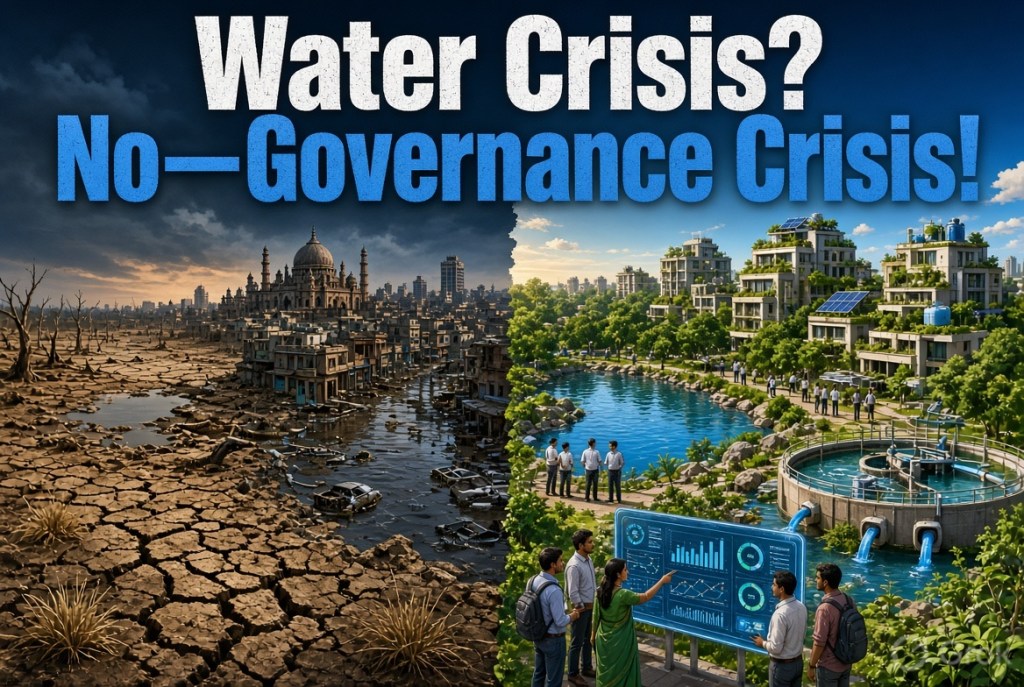
India’s urban water crisis is routinely narrated through the familiar vocabulary of deficient rainfall, depleted reservoirs, population growth and climate change. All are real, but none captures the central problem. India’s cities are not simply experiencing a water shortage; they are experiencing a governance shortage. The fundamental challenge is the failure to connect source sustainability, equitable distribution, demand management, groundwater protection, wastewater reuse and citizen behaviour into one integrated urban water system. Water security cannot remain a commodity that government departments deliver and citizens merely consume. It must become a shared civic responsibility, where governments regulate and enable, institutions coordinate, markets innovate and citizens participate as custodians of the resource.
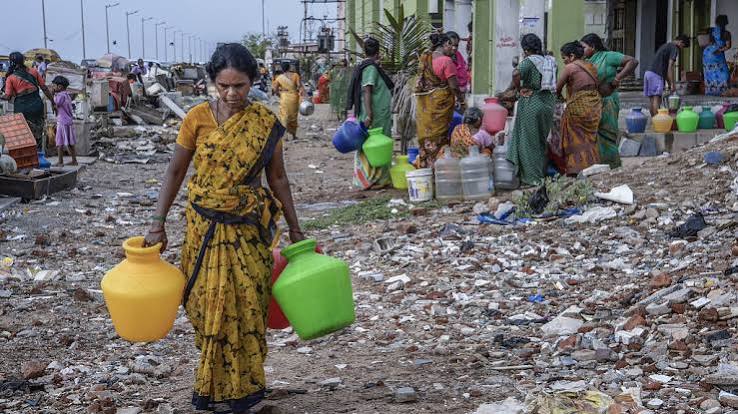
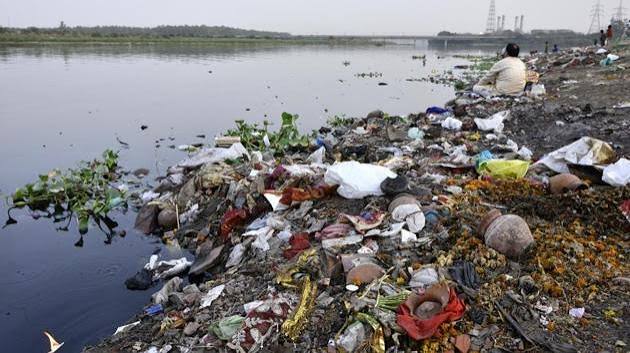
The paradox is visible across India. Mumbai can receive enormous monsoon rainfall and still face seasonal water stress; Chennai can receive substantial annual precipitation yet oscillate between floods and drought; Pune can experience water scarcity in summer and destructive flooding during the monsoon; Bengaluru can receive intense rainfall while simultaneously watching groundwater levels decline. This contradiction exposes the failure of conventional urban planning. The question is no longer simply how much rain falls on a city, but how much is captured, stored, infiltrated, reused and equitably distributed. A city that allows rainwater to become stormwater, stormwater to become flooding and wastewater to become pollution is not suffering from natural scarcity alone. It is suffering from man-made hydrological mismanagement.
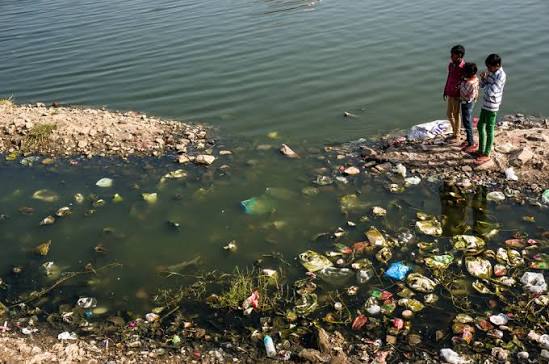
Bengaluru represents perhaps the most powerful warning. Its historic lake-and-tank network once functioned as a decentralised water-management system, supporting storage, groundwater recharge and flood moderation. Urban expansion, encroachment, catchment degradation and pollution progressively weakened that ecological infrastructure. Yet Bengaluru also demonstrates that institutional correction is possible when government regulation meets community vigilance. Lake groups, resident associations, environmental organisations and local stakeholders have increasingly demanded restoration, monitoring and accountability. The larger lesson is unmistakable: technology without social ownership becomes infrastructure; technology with public participation becomes governance. A sewage-treatment plant, recharge structure or restored lake can succeed technically and fail socially unless citizens understand, monitor and protect it.
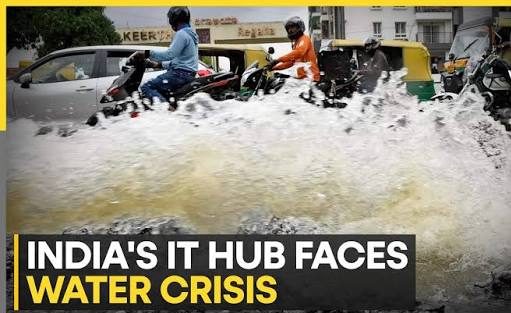
The instinctive governmental response to scarcity is usually to build more supply—larger reservoirs, longer pipelines, inter-basin transfers, desalination plants and distant water sources. Infrastructure is essential, but supply expansion without demand management can become an expensive postponement of the next crisis. Every additional litre supplied can generate additional consumption unless pricing, metering, recycling and conservation accompany it. The resilient city therefore requires a portfolio rather than a single lifeline: multiple sources, decentralised storage, rainwater harvesting, groundwater recharge, wastewater recycling, leakage reduction and demand management. The objective should shift from “How can we bring more water?” to “How can we make every litre perform multiple functions?”
This is precisely where public participation moves from being desirable to indispensable. A government can notify a lake as protected, but citizens must prevent dumping and encroachment. Regulations can mandate rainwater harvesting, but residents must maintain the systems. Municipalities can establish sewage-treatment infrastructure, but communities and institutions must ensure that treated water is actually reused. Groundwater laws can restrict extraction, but enforcement requires local monitoring. Urban water governance must therefore evolve from the paternalistic model of “government provides, citizen receives” to a partnership model of “government enables, regulates and measures; citizens participate, conserve and monitor.” Resident Welfare Associations, educational institutions, industries, markets and neighbourhood groups should become active units of urban water management rather than passive beneficiaries of municipal supply.
India already has encouraging examples of such collective action. Chennai’s experience with rainwater harvesting demonstrated how regulation combined with widespread household adoption can influence groundwater conditions. Community-led conservation initiatives in Rajasthan, Kerala and several parts of Andhra Pradesh show that local participation can revive traditional water systems and strengthen livelihoods. The significance of these models lies not in their individual engineering solutions but in their institutional architecture. Communities become invested when they can see the asset, understand the benefit and influence the outcome. The revival of tanks, ponds, recharge structures and watersheds becomes sustainable when citizens perceive them not as government projects but as community assets with shared ownership. India must therefore scale participation rather than merely replicate infrastructure.
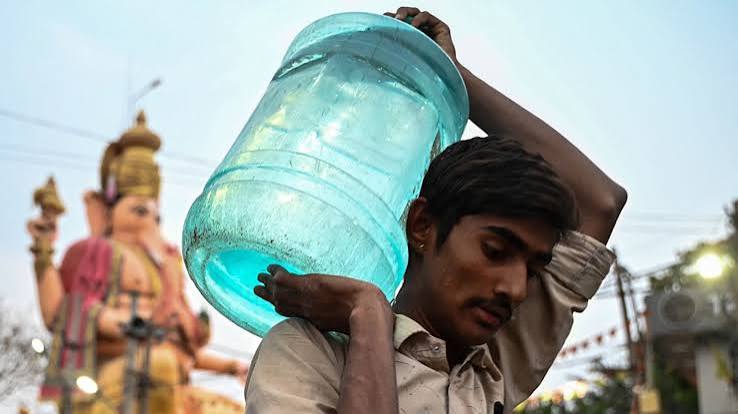
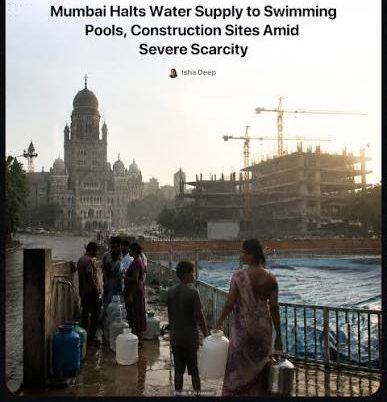
The next revolution must be data-driven water democracy. City-wide averages conceal extraordinary inequalities. One neighbourhood may consume several times more water than another while some communities depend on tankers or intermittent municipal supply. Without ward-level information on consumption, leakage, groundwater extraction, recharge, wastewater generation and reuse, urban authorities are effectively managing blind. Municipalities should publish transparent water dashboards and establish measurable targets for every ward. Citizens should know how much water their locality receives, how much is lost, how much wastewater is treated, how much is reused and whether local groundwater is improving or deteriorating. Such transparency converts citizens from complainants into informed stakeholders—and informed stakeholders are far more powerful than periodic protests.
The final challenge is cultural. India possesses an extraordinary inheritance of water wisdom—johads, tankas, temple tanks, village ponds, stepwells and interconnected irrigation systems—but modern urbanisation often treats water as an invisible utility rather than a shared ecological asset. The future must combine this traditional intelligence with contemporary tools such as smart metering, wastewater recycling, permeable surfaces, recharge wells, wetlands, green roofs, retention basins and predictive analytics. Yet even the best technology will fail without trust. Recycled water, for instance, may be technically safe but socially resisted. Governments must therefore publish quality data, establish independent certification, demonstrate safety and begin reuse in non-potable applications such as landscaping, construction, flushing and industrial cooling. Trust is not created by notification; it is built through transparency and repeated performance.

India’s urban water crisis is ultimately a referendum on the quality of democratic governance. The decisive question is not how many dams can be built or how many kilometres of pipelines can be laid, but whether governments, citizens, businesses and communities are willing to accept shared responsibility for every drop. No administration can monitor every rooftop, recharge pit, borewell, pipeline and household simultaneously. Public administration can establish the rules; participation provides the reach. The city of the future must therefore evolve from a water-consuming city into a water-cycling city—where every rooftop captures rain, every lake is protected, every drop of wastewater is considered a resource and every citizen understands that water security is partly a personal responsibility. The most dangerous question is, “What is the government doing about water?” The transformative question is: “What are we doing together?” When that question becomes a civic habit, India will not merely manage its water crisis—it will begin to redesign the relationship between citizen, city and nature.
VISIT ARJASRIKANTH.IN FOR MORE INSIGHTS


2 responses to ““India Isn’t Water-Short. We’re Governance-Short.” ”
Water is the source of life ane essential for human survival. Conserving water means safeguarding our future.
LikeLike
very well analyzed with emphasis on demad side management strategies.
LikeLike