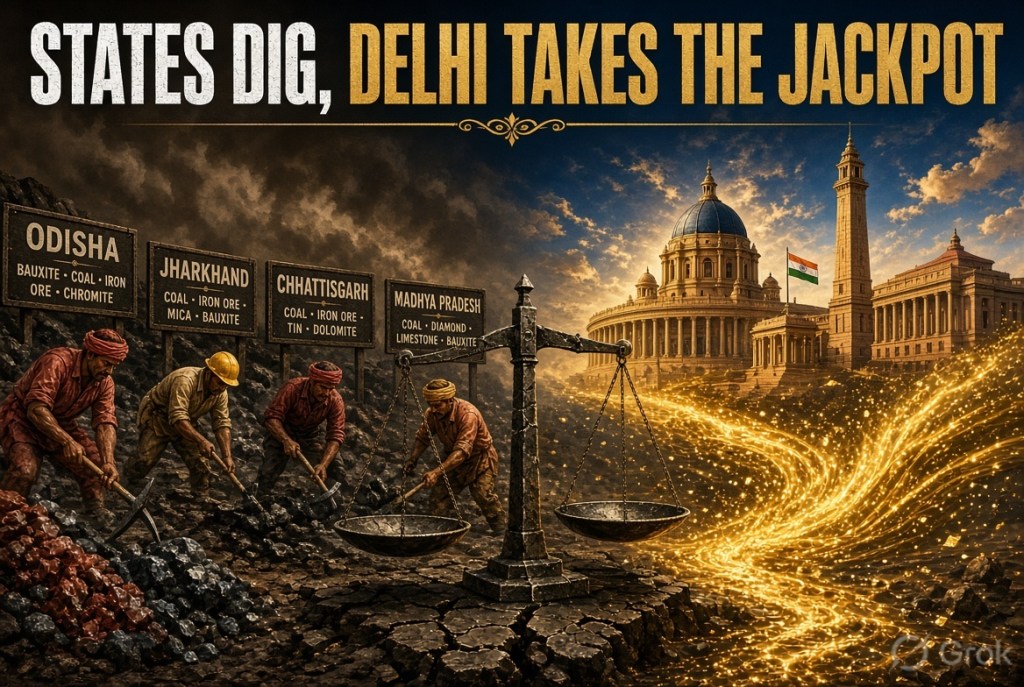
India’s latest mineral-taxation controversy is being presented as a reform designed to create a “uniform and predictable fiscal regime”. That description, however, conceals the more consequential question: predictable for whom, and at whose expense? The MMDR Amendment Bill, 2026, is not merely a technical intervention in mining taxation; it is the latest episode in India’s unfinished struggle over fiscal federalism. The Centre is seeking to consolidate the revenue architecture surrounding mineral wealth, while states remain responsible for the political, social, environmental and administrative consequences of extraction. The real issue is therefore not whether India requires a simpler mining-tax regime. It is whether the Union can centralise the fiscal upside while leaving the states to absorb most of the downside.
The constitutional journey itself reveals why the present controversy matters. In 1989, the Supreme Court’s seven-judge bench in India Cements treated royalty as a tax, constraining the ability of states to impose additional levies. States subsequently explored their power under Entry 49 of the State List—the taxation of lands and buildings—to impose taxes on mineral-bearing land. The constitutional ambiguity persisted through subsequent litigation, including the 2004 Keshwaram judgment, which questioned aspects of the earlier reasoning. The decisive moment arrived in July 2024, when a nine-judge Constitution Bench ruled that royalty is not a tax and affirmed the states’ constitutional authority to tax mineral rights and mineral-bearing lands. More significantly, the judgment operated retrospectively, recognising state dues dating back to 2005. What followed was not simply a legal clarification but a potential redistribution of enormous fiscal resources.
The financial consequences were staggering. Coal India faced potential liabilities estimated at ₹70,000–80,000 crore, Tata Steel around ₹17,350 crore, NMDC approximately ₹15,800 crore and JSW Steel about ₹4,690 crore. For mineral-rich states, these sums represented potentially transformative public revenue rather than marginal fiscal receipts. Odisha derives more than one-fifth of its state revenue from mineral royalties, while Jharkhand has similarly significant exposure to mineral extraction. The Supreme Court provided companies a 12-year repayment window beginning April 1, 2026, without interest or penalties for the earlier period. Instead of allowing this constitutional settlement to work through its implementation, Parliament is now attempting to reshape its fiscal consequences through legislation. The issue has consequently moved from the courtroom into the heart of India’s federal political economy.
The asymmetry is difficult to ignore. Mining occurs in states, and states confront almost every consequence associated with it. Land acquisition, rehabilitation and resettlement, tribal concerns, environmental conflicts, law and order, local infrastructure, employment pressures and political resistance are administered primarily on the ground. When a mine pollutes a river, citizens do not petition Delhi first; they approach the district administration and state agencies. When mining generates displacement, local governments face the human consequences. When mineral corridors require roads, power, water and social infrastructure, states are expected to facilitate them. Yet the emerging fiscal architecture seeks to strengthen the Centre’s control over the revenue lever. This creates a classic federal imbalance: the level of government closest to the consequences is not necessarily the level of government retaining the corresponding fiscal gains.
The amendment’s most consequential implication is its attempt to bring mineral-bearing lands explicitly within the central framework, effectively closing the constitutional route that states had used through Entry 49. Simultaneously, liabilities arising from the 2024 judgment are proposed to be extinguished. The Centre’s argument has a legitimate economic foundation: retrospective taxation can generate uncertainty, complicate investment decisions and weaken India’s competitiveness in a capital-intensive sector. But the remedy deserves greater scrutiny. India needs critical minerals urgently and remains heavily dependent on imports of strategic resources such as lithium, cobalt and nickel. Yet eliminating a constitutionally recognised state revenue instrument in order to improve investor certainty risks treating federal fiscal rights as the easiest variable to adjust. Corporate certainty cannot become a euphemism for state-level fiscal surrender.
The problem becomes sharper when viewed through the principle of compliance. Companies that have already paid retrospective liabilities may find themselves in a fundamentally different position from those that contested, delayed or withheld payment. If Parliament subsequently creates a legislative clean slate, the message to future taxpayers can become deeply problematic: delay compliance, litigate aggressively and perhaps wait for political intervention to erase the liability. Such a system creates moral hazard. Predictability is not merely the certainty that a tax will not be imposed; it is also the certainty that legally determined obligations will be treated consistently. A tax regime that potentially rewards non-compliance while disadvantaging early compliance risks undermining the very credibility that the reform claims to strengthen.
The proposed compensation mechanism for states therefore deserves much greater institutional scrutiny. Compensation is meaningful only when its formula, duration, funding source, indexation mechanism and legal enforceability are clearly established. A broad assurance from the Centre cannot substitute for a durable federal fiscal arrangement. Otherwise, states could be asked to surrender a constitutionally recognised revenue stream in exchange for transfers whose quantum and timing remain dependent on future Union budgets and policy priorities. That would transform fiscal federalism from a constitutional relationship into an administrative dependency. The GST experience should itself remind policymakers that when taxation powers are pooled or altered, the compensation architecture is not a footnote; it is the foundation of political trust.

There is also a deeper irony: taxation may not be the principal obstacle preventing India from becoming a major mining power. Exploration remains inadequate, geological information is uneven, high-risk exploration requires patient capital, infrastructure in mineral-bearing regions is often deficient and environmental clearances can be prolonged. Most revealingly, several critical-mineral auctions have struggled to attract bidders, with fourteen blocks offered in 2024 reportedly receiving no bids. Since 2023, multiple blocks have similarly encountered inadequate market response. India therefore risks fixing the tax meter while leaving the exploration engine stalled. A uniform tax regime cannot create a mineral deposit, construct a railway through a remote mineral belt, resolve land conflicts, accelerate environmental decisions or eliminate geological risk. Investors seek an ecosystem of geological certainty, infrastructure, regulatory speed, contractual credibility and long-term policy stability—not merely a centralised taxation regime.
The larger danger is institutional rather than merely fiscal. India’s federal structure deliberately distributes responsibilities because the benefits, costs and risks of economic activity are rarely located at the same governmental level. If the Centre progressively consolidates the most valuable revenue streams while states continue to carry the expenditure, regulatory burden and political consequences, fiscal federalism risks becoming hollow. A better approach would be a negotiated mineral fiscal compact between the Union and producing states, potentially through an institutional mechanism inspired by the GST Council. Revenue-sharing formulas, environmental compensation, district mineral development, exploration incentives and critical-mineral priorities could be collectively determined. The MMDR Amendment Bill may eventually survive, be modified or become another constitutional contest. But the fundamental question will remain: Can India call itself a cooperative federation if states are expected to bear the risks of mining while Delhi increasingly captures the rewards? Mineral wealth may lie beneath state soil, but if the revenue architecture increasingly flows upward, the states will dig, regulate, rehabilitate and absorb the backlash—while Delhi operates the cash register. That is not merely mining reform. It is a stress test of Indian federalism itself.
VISIT ARJASRIKANTH.IN FOR MORE INSIGHTS

