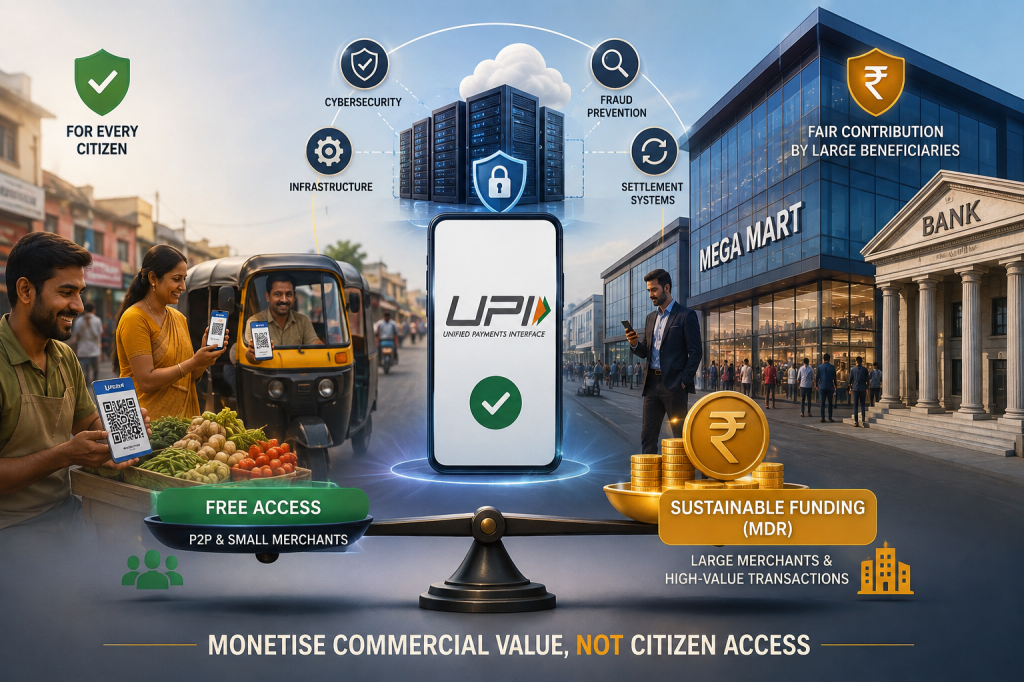
India’s Unified Payments Interface has accomplished something that generations of financial infrastructure struggled to achieve: it has transformed digital payments from a technological possibility into an everyday social habit. A vegetable vendor, auto driver, street entrepreneur, salaried professional and multinational corporation can participate in the same instant-payment ecosystem with nothing more than a mobile phone and a QR code. The emerging debate over reintroducing a calibrated Merchant Discount Rate (MDR) for selected high-value merchant transactions should therefore not be reduced to the simplistic question of whether “free UPI” is ending. It is a much larger economic question: who should finance a digital public utility whose benefits now permeate almost every layer of the economy? UPI has become so deeply embedded in Indian economic life that its sustainability is no longer merely a banking-sector issue; it is an infrastructure question comparable to financing roads, telecommunications or electricity networks.
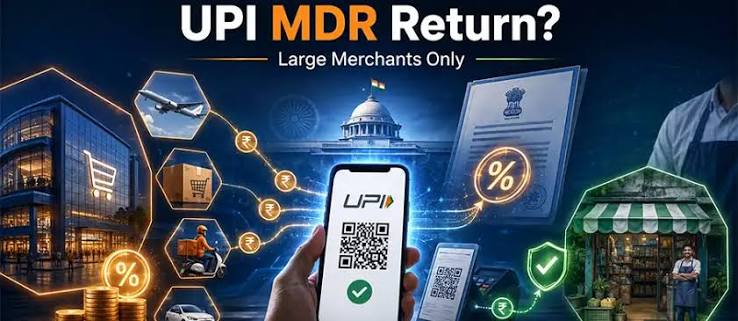
The paradox of UPI is deceptively simple: the transaction is free, but the infrastructure is not. Every supposedly zero-cost transaction requires servers, switching infrastructure, authentication, cybersecurity, fraud detection, settlement systems, technical support, redundancy and continuous capacity expansion. The costs may appear microscopic at the individual transaction level, but multiplied across an enormous national payment ecosystem, they become economically significant. NPCI operates the core architecture, while banks provide account, authentication and settlement infrastructure; payment service providers and fintech platforms provide the interfaces through which citizens actually experience UPI. Behind the apparently effortless QR-code payment lies a sophisticated technological machine operating continuously, securely and at extraordinary scale. The political success of UPI has therefore created an unusual economic challenge: India has built a digital utility so successful that society now assumes its operation should cost nothing to the user.
The real question, however, is not whether UPI costs money. It unquestionably does. The fundamental question is who should bear those costs and according to what principle. At present, the economic burden is distributed among banks, NPCI, payment companies and, indirectly, the public exchequer through various support mechanisms. This model was strategically justified during UPI’s expansion phase because eliminating transaction charges accelerated adoption and helped create powerful network effects. But the economics of a system handling extraordinary volumes inevitably change once it becomes systemic infrastructure. A model designed to maximise adoption cannot automatically be the optimal model for long-term sustainability. When an infrastructure becomes indispensable, its financing architecture must evolve. Otherwise, the apparent price of zero eventually becomes a hidden dependence on cross-subsidisation, institutional absorption of costs and continuing government support.
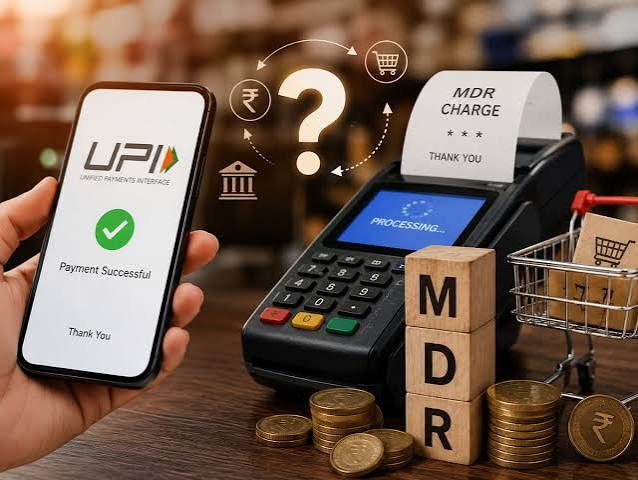
Yet there is another side that complicates the argument for charging banks and payment institutions more aggressively: financial institutions themselves have already captured enormous benefits from the migration from cash to digital payments. UPI reduces dependence on ATMs, cash transportation, currency replenishment, physical security, branch-level transaction processing and manual reconciliation. Digital transactions also generate valuable customer relationships and data trails that can support lending, merchant analytics, fraud detection and cross-selling of financial products. For banks, therefore, UPI is not merely an expenditure. It is simultaneously infrastructure, customer acquisition, operational efficiency and a gateway into a broader digital financial ecosystem. Any serious MDR debate must recognise this hidden return. Asking banks to finance part of UPI is justified precisely because they are among the principal beneficiaries of its transformation of India’s payments economy.
The same multi-sided dividend extends far beyond banks. Merchants receive instantaneous settlement, lower cash-handling risks, easier accounting and greater transaction visibility. Consumers save time, avoid carrying cash and gain a universally interoperable payment mechanism. Governments benefit from greater formalisation, improved transaction trails and potentially stronger tax compliance. Small businesses can enter formal financial networks without investing in expensive payment infrastructure. UPI has therefore created an ecosystem in which one transaction can simultaneously generate value for the consumer, merchant, bank, fintech platform and state. This is why the economics of UPI cannot be understood through the narrow lens of transaction cost alone. The system generates a much larger economic surplus, and the challenge is determining how that surplus should be distributed between public interest, private innovation and infrastructure sustainability.
The zero-MDR regime was instrumental in creating this extraordinary network. Removing the direct price barrier encouraged merchants to install QR codes, persuaded consumers to adopt digital payments and allowed banks and fintech companies to compete for an expanding user base. “Free” effectively became an adoption subsidy, enabling India to overcome the classic chicken-and-egg problem of digital networks: merchants joined because consumers were already there, and consumers joined because merchants increasingly accepted UPI. But once network effects reach systemic scale, the policy objective changes. The question is no longer “How do we make people use UPI?” It becomes “How do we ensure that the infrastructure they now cannot live without remains financially resilient?” Continuing a zero-price architecture indefinitely may preserve popularity while gradually weakening the economics of the institutions that sustain it.
A carefully calibrated MDR for large merchants and selected high-value transactions could provide an answer without damaging financial inclusion. A modest rate—far below conventional card-payment charges—could create a meaningful recurring revenue stream while leaving person-to-person transfers, small merchants and ordinary low-value transactions untouched. Such a model would effectively introduce a “commercial user pays, citizen remains protected” principle. Large retailers, e-commerce platforms, airlines, hotels and other high-volume commercial beneficiaries derive substantial value from instant, interoperable and low-cost payments; asking them to contribute a fraction of that value is economically defensible. The revenue could support cybersecurity, fraud prevention, technological upgrades, redundancy and resilience while reducing dependence on taxpayer-supported incentives. Properly designed, MDR would therefore not represent the privatisation of UPI; it would represent the gradual construction of a sustainable financing model for a public digital rail.

But the greatest danger is that policymakers mistake price incidence for economic incidence. Legally, an MDR may be imposed on merchants; economically, some portion could eventually migrate into consumer prices, particularly in low-margin sectors. A merchant facing even a small transaction charge may incorporate it into pricing, reduce discounts or recover it through other commercial mechanisms. The consumer could therefore remain formally free of a UPI fee while indirectly paying for it. The answer is not to reject MDR but to design it with surgical precision: preserve zero-cost P2P payments; protect micro and small merchants; apply modest, transparent and preferably capped rates to large commercial transactions; prohibit explicit consumer surcharges; and periodically review the structure against actual infrastructure costs. India should publish credible aggregate cost benchmarks so that MDR does not quietly evolve from a sustainability mechanism into an unrestricted revenue stream.
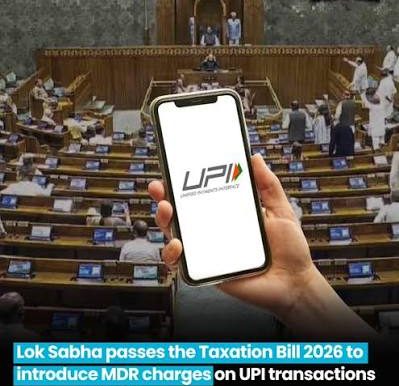
Ultimately, the UPI debate is not about whether Indians should pay for digital payments. It is about how a nation should finance a digital public utility after it has become indispensable. The principle should be simple: monetise commercial value, not financial inclusion. The ordinary citizen should not be discouraged from using UPI; the small shopkeeper should not be penalised for entering the formal economy; yet large commercial beneficiaries should reasonably contribute to the infrastructure from which they derive substantial value. Free UPI created India’s digital-payment revolution. Sustainable economics must now protect it. The real choice is therefore not between “free UPI” and “paid UPI”, but between fragile free infrastructure and intelligently financed free access. If India gets that distinction right, a tiny MDR will not become the price of using UPI—it will become the price paid by those who can afford to keep India’s most transformative digital public utility accessible to everyone.
VISIT ARJASRIKANTH.IN FOR MORE INSIGHTS

