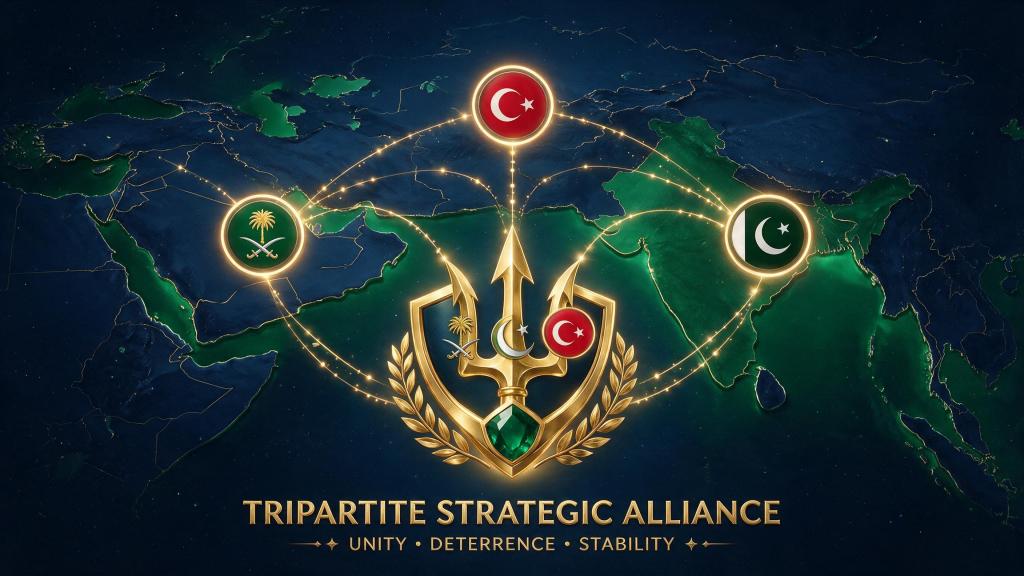
Something extraordinary is beginning to take shape across the Islamic world: three geographically separated Sunni-majority powers—Saudi Arabia, Türkiye and Pakistan—are attempting to construct a common strategic shield across the Arabian Peninsula, Anatolia and South Asia. Their recent defence agreement, under which an armed attack against one is to be treated as an attack against all, represents a significant departure from the traditional architecture of West Asian security. It is not yet a NATO-style military alliance, nor does it possess NATO’s institutional depth, but its political symbolism is enormous. Geography makes the arrangement even more fascinating: Iran and Iraq stand between the principal Arab and Turkish strategic theatres, while Syria remains a crucial geopolitical corridor. This is therefore not a conventional neighbourhood alliance. It is a triangle of strategic connectivity without territorial continuity, held together by converging interests rather than contiguous borders.
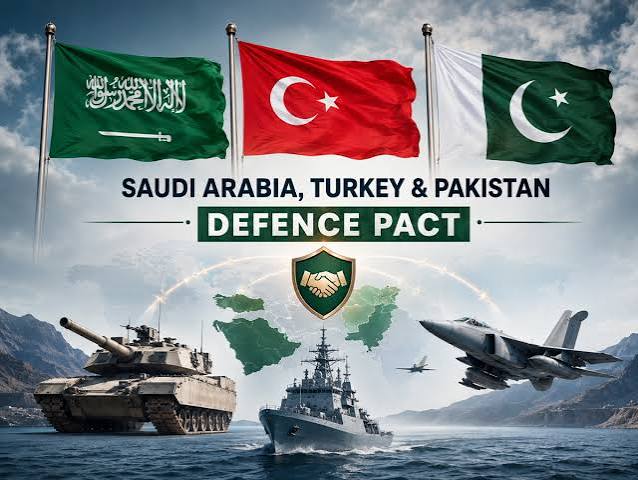
The power of this emerging triangle lies in the extraordinary complementarity of its three members. Saudi Arabia brings financial strength, energy influence, religious significance and control over one of the world’s most strategically important geographical spaces. Türkiye contributes a sophisticated defence-industrial ecosystem, advanced drones, missile systems, military technology and the operational experience of a major NATO military power pursuing increasing strategic autonomy. Pakistan contributes one of the world’s largest standing militaries, extensive combat experience and, most importantly, nuclear deterrence. Individually, each possesses vulnerabilities; collectively, their capabilities begin to look remarkably complementary. Riyadh supplies economic muscle and strategic geography; Ankara offers technology and military-industrial capacity; Islamabad contributes military depth and nuclear credibility. The alliance’s real currency, therefore, is not religious solidarity alone—it is strategic complementarity disguised as civilisational convergence.
The deeper story is the gradual erosion of the assumption that regional security can indefinitely remain outsourced to external powers. For decades, Gulf security rested substantially upon American military presence, intelligence capabilities, air-defence systems and extended deterrence. That architecture has not disappeared, but confidence in its permanence has weakened. Repeated regional conflicts, missile and drone attacks, the confrontation involving Iran, uncertainty surrounding American strategic priorities and the growing ambitions of regional powers have encouraged states to build multiple layers of insurance. The emerging message is not necessarily “America out”; it is far more sophisticated: “America may remain important, but America cannot be our only insurance policy.” The Mecca agreement therefore reflects a broader transition from dependency to strategic hedging, in which regional powers increasingly seek the ability to protect themselves while maintaining relationships with competing global centers of power.
For Saudi Arabia, the calculation is particularly sophisticated. The transformation envisioned under Vision 2030 requires not merely capital and technology but strategic tranquillity. Tourism, mega-projects, logistics, artificial intelligence, infrastructure and economic diversification cannot flourish indefinitely beneath the shadow of missiles, regional wars and geopolitical disruption. Riyadh therefore needs deterrence without permanent strategic dependency. A deeper relationship with Pakistan provides access to substantial military capability, while Türkiye offers advanced defence technology and operational sophistication. The bilateral Saudi-Pakistan defence relationship had already created a foundation; the trilateral framework now attempts to widen that foundation into a larger strategic architecture. For Riyadh, this is less about creating another military bloc than about constructing multiple concentric rings of security around an ambitious economic transformation.
For Türkiye, the agreement represents another chapter in Ankara’s long-running pursuit of strategic autonomy. Türkiye remains a NATO member, yet its foreign policy increasingly operates through overlapping partnerships rather than a single strategic axis. The new arrangement enables Ankara to strengthen relationships with two influential Muslim powers while simultaneously expanding the geopolitical market for its defence industry. It also gives Türkiye another platform from which to project influence into the Gulf and South Asia. For Pakistan, the equation is equally attractive: Islamabad gains a deeper strategic relationship with one of the world’s wealthiest states and one of the region’s most technologically capable military powers, while enhancing its diplomatic relevance beyond the traditional India-Afghanistan framework. Yet the triangle contains an inherent contradiction: its members do not share identical threat perceptions. Saudi Arabia worries primarily about Gulf security, Iran and regional instability; Türkiye faces challenges extending across Syria, the eastern Mediterranean, the Black Sea and its neighbourhood; Pakistan’s strategic attention remains dominated by India and Afghanistan.
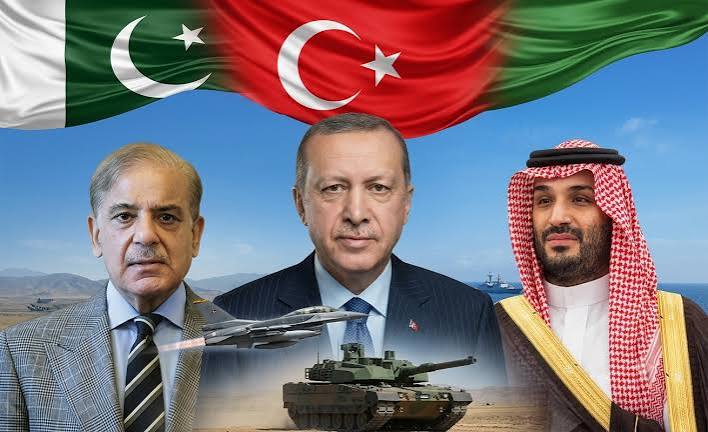
This divergence is the triangle’s greatest weakness. “An attack on one is an attack on all” is politically dramatic, but collective defence becomes credible only when the machinery behind the slogan is defined. What exactly constitutes an armed attack? Who determines whether the threshold has been crossed? How rapidly must the other members respond? Does assistance mean troops, intelligence, air defence, weapons, financing or diplomatic support? These are not semantic questions; they determine whether an alliance is operational or merely rhetorical. NATO’s credibility derives not simply from its collective-defence principle but from decades of integrated planning, interoperability, exercises, intelligence structures, command arrangements and institutional trust. The emerging triangle has none of that depth yet. Its immediate challenge is therefore to transform political solidarity into military credibility without allowing military integration to overwhelm national sovereignty.
Iran will inevitably be central to the strategic interpretation of the agreement, even if none of the participants describes it as an anti-Iranian arrangement. Tehran is likely to examine the development through the lens of strategic encirclement. Iran already faces pressure from Israel, Western powers and competing regional actors; a coordinated security framework stretching conceptually from Pakistan through the Gulf to Türkiye could complicate its strategic calculations. Yet the situation is more nuanced than a simple Sunni-versus-Shia confrontation. Saudi Arabia itself has pursued channels of dialogue with Iran, Pakistan has historically maintained complex relations with Tehran, and Türkiye’s interests do not always coincide with those of Riyadh. The triangle could therefore become either a stabilising deterrent or another layer of regional polarisation. Its success may ultimately depend on whether it develops as a shield for its members or a sword against perceived adversaries.
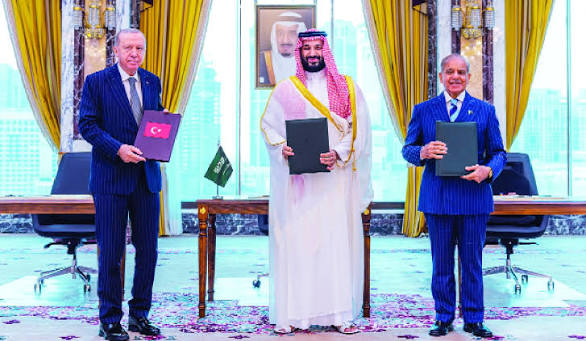
For India, the development demands neither alarmism nor complacency but strategic sophistication. India’s expanding economic and energy relationship with Saudi Arabia makes Riyadh an increasingly important partner, while Türkiye and Pakistan occupy far more complicated positions in India’s strategic calculations. The presence of Pakistan means that New Delhi cannot dismiss the agreement as merely another West Asian initiative. At the same time, there is no automatic basis for interpreting it as an anti-India military coalition. India’s appropriate response is therefore to deepen its independent strategic architecture: strengthen relations with Saudi Arabia and the wider Gulf, maintain pragmatic engagement with Türkiye, expand partnerships with other regional powers and reinforce maritime, technological and defence capabilities. The larger lesson is even more important.
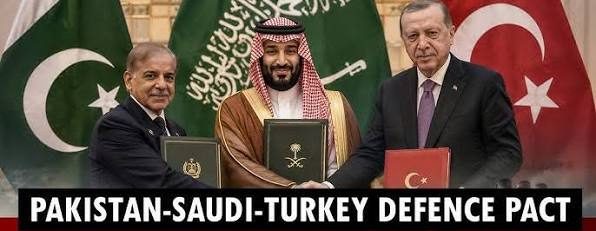
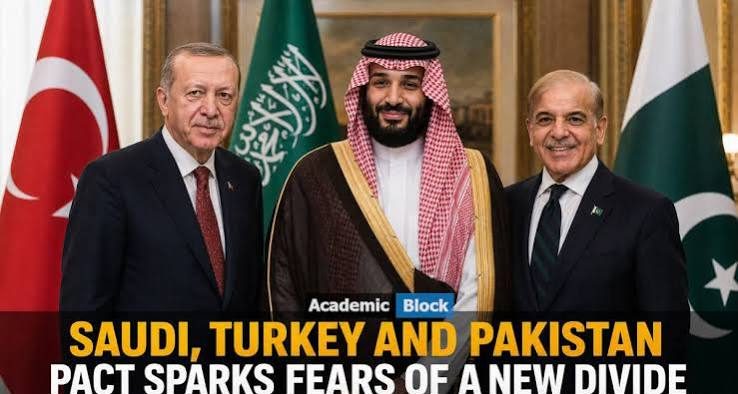
The emerging Mecca framework signals that the old world in which external powers designed regional security arrangements is gradually giving way to a world in which regional powers themselves are drawing the map. The Sunni triangle is not yet an “Islamic NATO,” nor is it guaranteed to become one. But it represents something potentially more consequential: the birth of an indigenous security imagination stretching across three strategic theatres. The triangle may eventually fracture under the weight of divergent interests—or evolve into a durable architecture of collective deterrence. Either way, the handshake matters because it reveals a profound geopolitical shift: the Middle East and South Asia are beginning to write their own security equations, and the next map of Eurasia may be drawn not by the great powers alone, but by the powers that were once expected merely to follow them.
VISIT ARJASRIKANTH.IN FOR MORE INSIGHTS

