
India’s most disturbing governance failures rarely begin with spectacular corruption. More often, they begin with something deceptively ordinary: a missing frisking protocol, overlapping responsibilities, inadequate segregation of duties, an undisclosed relationship, privileged information, a weak audit trail, or a selection committee operating within a tightly connected ecosystem. The NEET-UG 2026 paper-leak investigation and the controversy surrounding the Research, Development and Innovation (RDI) Fund appear to belong to completely different worlds—one concerns millions of students competing for scarce educational opportunities, while the other concerns ₹1 lakh crore of public support for India’s deep-tech ambitions. Yet beneath the surface lies a common institutional pathology: the failure to build sufficient distance between those entrusted with public resources or information and those capable of benefiting from that access. The deeper crisis is therefore not merely corruption; it is governance architecture.
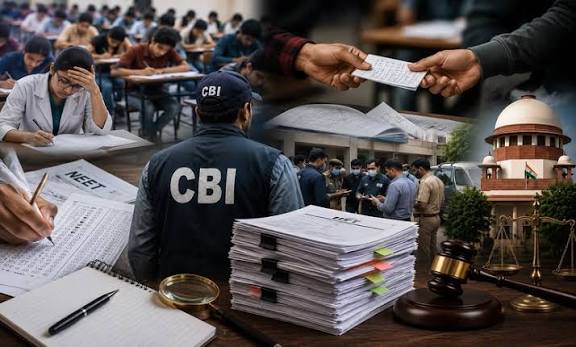
The NEET investigation is particularly disturbing because the alleged breach reportedly penetrated the very sanctum in which examination questions were generated. The CBI investigation has identified P.V. Kulkarni, Manisha Mandhare and Manisha Havaldar as key actors and alleged that overlapping responsibilities in question-setting and translation created opportunities to access and reconstruct confidential questions. What makes the episode especially revealing is that the alleged mechanism was not necessarily technologically sophisticated. Handwritten notes, memory, textbooks and reconstructed questions were reportedly sufficient. This is the paradox of modern institutional failure: governments may invest heavily in digital infrastructure while overlooking elementary principles of physical and procedural security. The system did not merely fail to prevent sophisticated intrusion; it allegedly made privileged access itself the vulnerability.

The structural weaknesses are even more consequential. Individuals reportedly entrusted with sensitive question-setting responsibilities also possessed overlapping access through translation functions, undermining the basic security principle of need-to-know. Allegations of inadequate frisking and limited CCTV retention further suggest that security was treated as a procedural formality rather than an adversarial risk-management exercise. Once confidential material was allegedly extracted, it could be monetised through clandestine coaching networks and intermediaries, with amounts reportedly ranging from tens of thousands to several lakhs of rupees and unconventional forms of security allegedly being collected from beneficiaries. The lesson is profound: a high-stakes examination is not merely an academic exercise; it is critical national infrastructure. When its security collapses, the damage extends far beyond the examination hall because every compromised question represents a potential assault on the principle of merit.
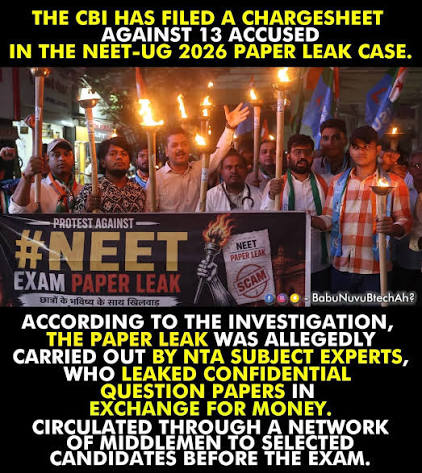
The scale of the CBI investigation, reportedly running into more than 20,000 pages, also illustrates how institutional vulnerabilities evolve into organised ecosystems. A leak rarely remains a single transaction. It creates networks involving insiders, intermediaries, brokers, beneficiaries, communication channels and financial trails. Digital messages, physical movements, housing records, handwritten material and payment transactions can together reconstruct the architecture of a conspiracy. Yet the most important victim remains invisible in the charge sheet: the honest candidate. A student may spend years preparing, sacrificing family resources and postponing employment, only to discover that the competitive examination itself may have been compromised. When merit is made uncertain, aspiration becomes distrust. When distrust becomes widespread, institutional legitimacy begins to erode.
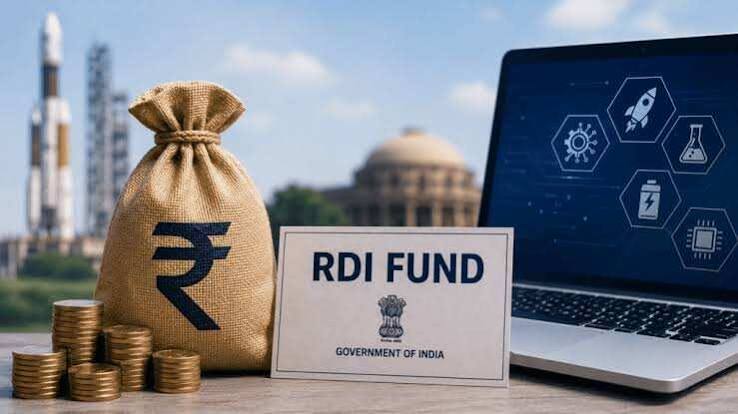
The RDI Fund controversy presents a completely different factual setting but an eerily similar governance dilemma. The ₹1 lakh crore initiative is intended to provide patient capital for high-risk, high-potential innovation and strengthen India’s deep-tech ecosystem. However, parliamentary disclosures and media reports have raised questions because 15 of the first 22 beneficiaries reportedly had investment links to seven members of the selection committee. These companies reportedly received around ₹1,377 crore out of ₹2,192 crore distributed in the first round. This does not, by itself, establish wrongdoing. The government has maintained that interests were disclosed, conflicted members recused themselves and prescribed safeguards were followed. But public governance cannot be judged solely by the absence of proven criminality. It must also be judged by whether the architecture inspires reasonable confidence that decisions were independent, impartial and demonstrably fair.

This is where the concept of institutional distance becomes critical. In a small and specialised deep-tech ecosystem, government may reasonably argue that experts inevitably know, advise, invest in or collaborate with potential beneficiaries. That reality cannot simply be wished away. But precisely because the ecosystem is small, safeguards must become stronger, not weaker. A committee member with a financial relationship to an applicant may recuse himself, but recusal alone may not eliminate informational advantages, prior influence, network effects or perceptions of preferential access. The same principle applies to the alleged NEET ecosystem. In one case, privileged insiders allegedly possessed examination information unavailable to millions; in the other, questions have arisen about whether companies connected to decision-makers enjoyed informational or relational advantages. The common denominator is information asymmetry: knowledge or proximity becoming a potential competitive advantage in systems that are supposed to operate on equal rules.

The two controversies therefore reveal a broader transition that India’s governance systems must urgently make—from disclosure-based compliance to prevention-based institutional design. It is insufficient to say that a conflict was disclosed; the system must demonstrate that the conflict could not influence the decision. It is insufficient to say that an examination was conducted under security protocols; the system must be designed on the assumption that insiders will test those protocols. Examination systems require strict separation of question-setting, translation, custody and evaluation; zero-trust access; independent security audits; immutable digital logs; continuous surveillance; and rigorous personnel rotation. Public funding programmes require comprehensive beneficial-interest disclosures, independent technical evaluation, mandatory cooling-off periods, rotating committees, external audits and publication of appropriately redacted evaluation and allocation records. Recusal should not merely be declared; it should be independently verifiable.

The larger lesson is uncomfortable: governance failure is rarely one dramatic decision. It is usually a chain of small permissions. Someone receives unnecessary access. A relationship is considered harmless. A camera records too little. A committee becomes too concentrated. An application becomes known to a connected network. An audit is delayed. Each decision appears manageable in isolation; together they create institutional vulnerability. NEET and the RDI controversy should therefore not be reduced to questions of individual guilt or administrative defence. They should become catalysts for redesigning the systems themselves. India is investing enormous public resources in human capital, innovation and opportunity. But examinations without credible security become theatre, while innovation funding without credible independence risks becoming patronage. The ultimate test of governance is not whether the gatekeeper promises to be fair; it is whether the gate is designed so that even a compromised gatekeeper cannot determine who gets through.
VISIT ARJASRIAKANTH.IN FOR MORE INSIGHTS

