
The hunger for instant justice has become one of the strongest demands of modern democracies. Every national shock—whether a massive financial scam, examination paper leak, crime against women, corruption case, or cyber offence—creates immediate public pressure for swift punishment. Governments naturally respond by announcing fast-track courts as symbols of urgency, accountability, and institutional resolve. The recent proposal to establish dedicated fast-track courts for examination malpractice cases, including the 2026 paper leak investigations, reflects this growing expectation. However, India’s judicial challenge is not merely a shortage of special courts; it is a deeper structural imbalance where the demand for justice has expanded much faster than the capacity of the justice delivery system. A courtroom cannot become faster merely because a new nameplate is placed outside its door.

India’s experience with Fast Track Special Courts (FTSCs) provides an important lesson in institutional reform. Initially created to accelerate trials in sensitive cases involving rape and offences under the Protection of Children from Sexual Offences (POCSO) Act, these courts represented a significant commitment towards victim-centric justice. Yet, over time, their performance revealed a fundamental truth of governance: specialised institutions can deliver results only when supported by a complete ecosystem. A fast-track court without adequate judges, prosecutors, investigators, forensic facilities, courtrooms, and administrative staff becomes merely a faster entry point into the same old bottleneck. Justice is not delivered by courts alone; it is produced through a coordinated chain of institutions.
The growing pendency in specialised courts reflects a larger national challenge. New cases continue to enter the judicial system at a pace that frequently exceeds disposal capacity. This phenomenon is not unique to courts; it is a common feature of all public institutions where demand continuously outpaces supply. A hospital cannot solve overcrowding merely by creating emergency wards without doctors and nurses. Similarly, courts cannot eliminate delays simply by creating additional benches without strengthening the supporting infrastructure. The issue is therefore not the absence of judicial mechanisms but the mismatch between the scale of public expectations and the resources allocated to fulfil them.

The biggest obstacle facing faster justice is the shortage of human resources. Judicial vacancies, inadequate numbers of prosecutors, insufficient court officers, limited administrative staff, and heavy workloads collectively slow down proceedings. Every criminal trial is a complex coordination exercise involving investigators, forensic experts, prosecution teams, defence lawyers, witnesses, and judges. A delay at any stage creates a ripple effect throughout the system. Establishing additional courts without increasing manpower only divides existing resources into smaller units. True reform requires expanding institutional capacity rather than merely rearranging existing structures.
The changing nature of crime has added another layer of complexity. Modern criminal investigations increasingly depend on scientific evidence, digital records, cyber analysis, DNA examination, and electronic documentation. In this environment, forensic laboratories have become the invisible backbone of criminal justice. However, limited forensic capacity, shortage of trained experts, and increasing technological complexity often delay investigations and trial proceedings. A judge cannot deliver faster justice without complete evidence, and investigators cannot complete cases efficiently without adequate scientific support. Strengthening forensic infrastructure is therefore as important as increasing the number of courts.

Technology represents the most promising opportunity for transforming judicial efficiency. India’s digital justice initiatives, including e-filing, virtual hearings, electronic case management, and online access to judicial records, have already changed the functioning of courts. The next generation of reform must move beyond digitisation towards intelligent judicial administration. Artificial intelligence can assist in case classification, scheduling, workload management, legal research, and identification of procedural delays. Digital evidence management systems can reduce documentation bottlenecks. However, technology must remain a supporting instrument that enhances judicial capability while preserving the independence, wisdom, and human judgement at the heart of justice.
The justice delivery system must also be viewed as an integrated governance structure rather than an isolated judicial function. The judiciary, executive departments, police agencies, prosecution authorities, forensic institutions, and legal aid systems operate as interconnected pillars. Failure in one institution creates consequences across the entire chain. Delayed investigation affects prosecution; delayed forensic reports affect trials; procedural inefficiencies increase pendency. Therefore, judicial reform requires a whole-of-government approach involving coordinated planning, institutional accountability, continuous training, and measurable performance improvement. Justice cannot travel faster than the slowest institution supporting it.
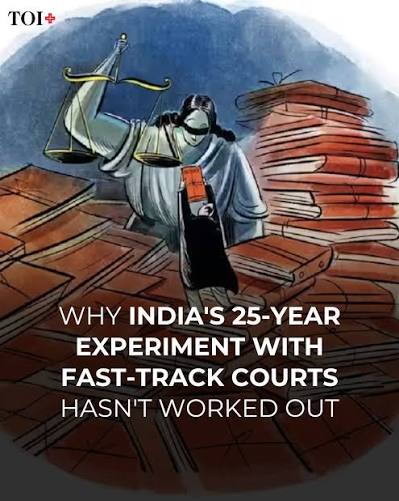
Global experience demonstrates that countries which successfully reduced judicial delays did not rely on temporary solutions or crisis-driven announcements. They invested consistently in judicial appointments, professional training, technology adoption, alternative dispute resolution, specialised expertise, and modern infrastructure. Equally important was reducing unnecessary litigation through better administrative decision-making and efficient grievance mechanisms. India’s judicial transformation requires the same long-term vision. Fast-track courts may provide immediate relief in specific categories, but permanent improvement will come only from strengthening the ordinary justice system that serves millions of citizens every day.

The real test of judicial reform is not the number of fast-track courts created after every crisis but the confidence of an ordinary citizen walking into any courtroom and receiving timely, fair, and predictable justice. Speed without fairness is dangerous, but fairness without timely delivery loses social meaning. India’s challenge is to build a justice system where urgency becomes institutional culture rather than emergency response. The future of justice cannot depend on temporary acceleration; it must be built on permanent capacity. When judges, technology, forensic science, administration, and accountability move together, fast justice will no longer be a special arrangement—it will become the natural rhythm of a modern democracy.
VISIT ARJASRIKANTH.IN FOR MORE INSIGHTS

