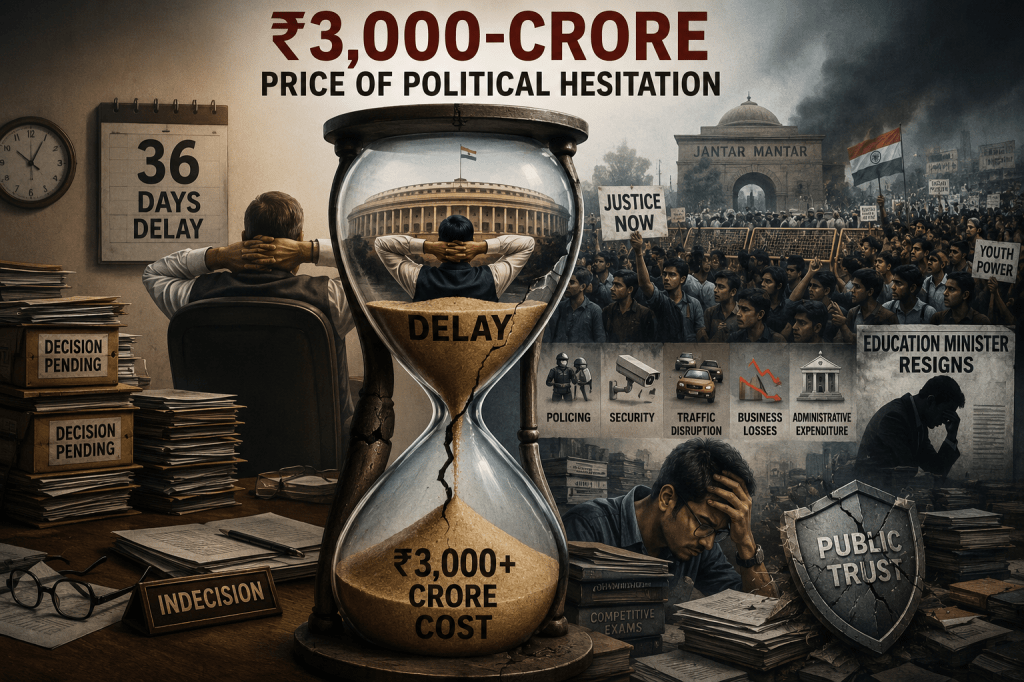
Democracies are judged not merely by their ability to conduct elections but by their capacity to respond swiftly, transparently and courageously when public confidence begins to erode. The 36-day youth movement at Jantar Mantar in 2026 exposed a timeless governance lesson: delayed decisions eventually become the nation’s most expensive policies. What initially emerged as a demand for accountability over alleged examination irregularities gradually transformed into one of independent India’s largest youth mobilisations, ultimately culminating in the resignation of the Union Education Minister. Yet the resignation did not represent administrative success; rather, it symbolised a governance failure. The real story lies in how hesitation, indecision and the absence of moral courage converted a manageable administrative issue into an economic, institutional and political crisis that reportedly imposed losses exceeding ₹3,000 crore on the nation. Governments seldom collapse because citizens protest; they lose credibility when timely leadership is replaced by prolonged indecision.

The crisis was never merely about examinations. It was fundamentally about leadership under pressure. In public administration, every office carries constitutional authority, but only a few demand moral courage. A minister confronted with mounting public distrust has two options: engage transparently with citizens or postpone difficult decisions in the hope that public anger will dissipate. History repeatedly demonstrates that postponement is rarely a strategy; it is merely the transfer of today’s manageable problem into tomorrow’s national crisis. By failing to address legitimate concerns with speed, transparency and accountability, the government allowed uncertainty to replace confidence, speculation to replace communication and confrontation to replace dialogue. The eventual resignation therefore appeared less like a decisive act of accountability and more like an admission that the cost of delay had become politically unsustainable.
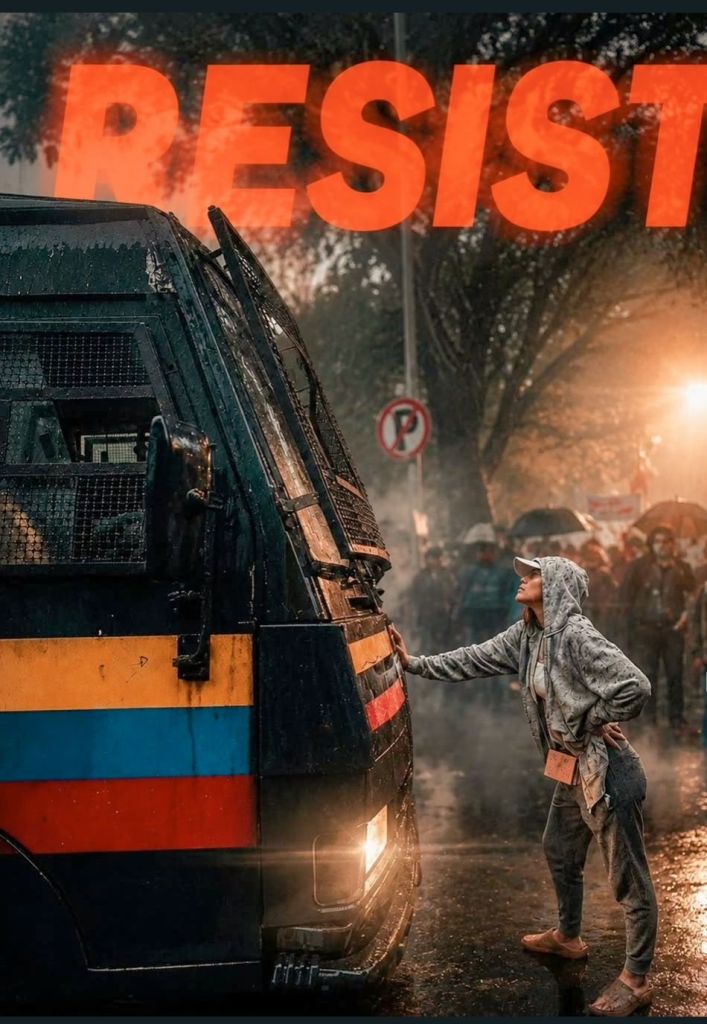
The economic consequences were staggering. Maintaining a continuous protest for over a month required substantial logistical expenditure on tents, sanitation, electricity, communication systems, food distribution and volunteer coordination. Citizens willingly financed the movement, contributing both money and time, with supporters travelling from across India and abroad. Yet these visible costs represented only a fraction of the larger financial burden. The prolonged deployment of police personnel, rapid action units, intelligence agencies, traffic management systems, surveillance infrastructure, emergency medical arrangements and administrative machinery imposed enormous public expenditure. Every additional day of indecision translated into additional costs borne ultimately by taxpayers. The nation paid not because protests occurred, but because resolution came far too late.
The commercial impact proved even more severe. Large sections of central Delhi experienced prolonged disruption as security restrictions, barricades, traffic diversions and metro station closures reduced economic activity. Retail establishments, restaurants, hotels, transport operators, street vendors and thousands of small businesses reported substantial declines in customer footfall during one of the busiest commercial periods of the year. Industry estimates placed the cumulative business losses between ₹1,500 crore and ₹3,000 crore. While precise figures may vary, the direction is unmistakable. Small traders, daily-wage earners and informal-sector workers bore the greatest burden despite having no role in either creating or resolving the dispute. Delayed governance thus evolved into an invisible economic tax imposed on ordinary citizens.
The administrative consequences extended beyond financial losses. Lakhs of commuters faced daily inconvenience due to traffic diversions, metro disruptions and security arrangements. Students preparing for competitive examinations endured prolonged psychological uncertainty at a time when confidence in recruitment systems was already fragile. Parliamentary proceedings suffered repeated interruptions as political attention shifted from legislative priorities to crisis management. Democratic institutions gradually became consumed by reactive administration instead of proactive governance. Every additional day expanded the scope of public demands, illustrating a fundamental principle of governance: unresolved grievances rarely remain confined to their original issue. Delay magnifies both the complexity and the eventual cost of resolution.
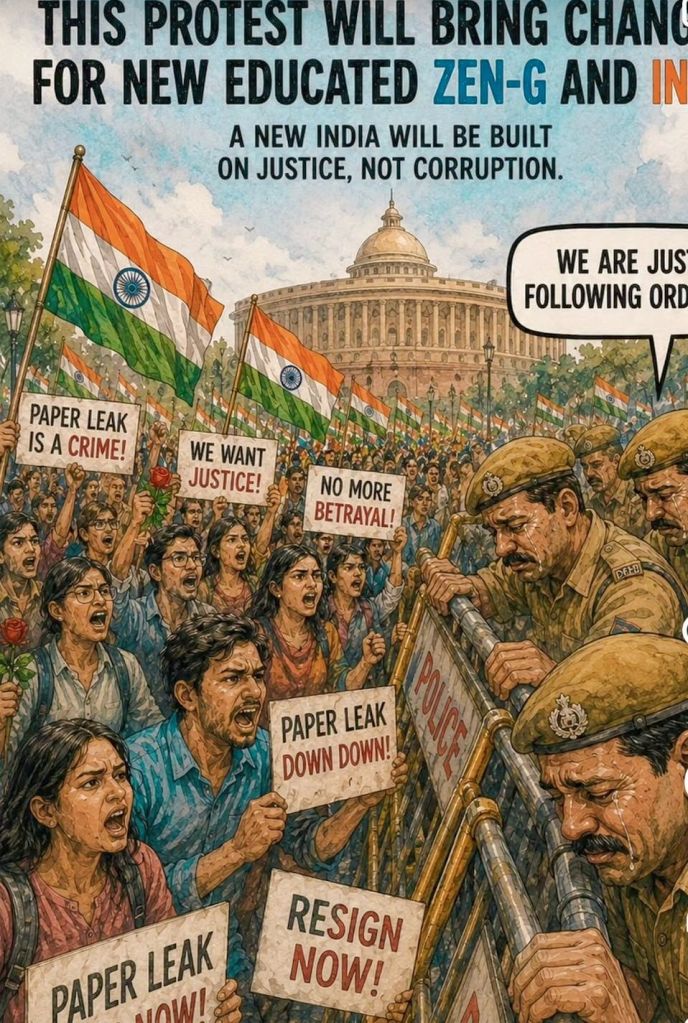
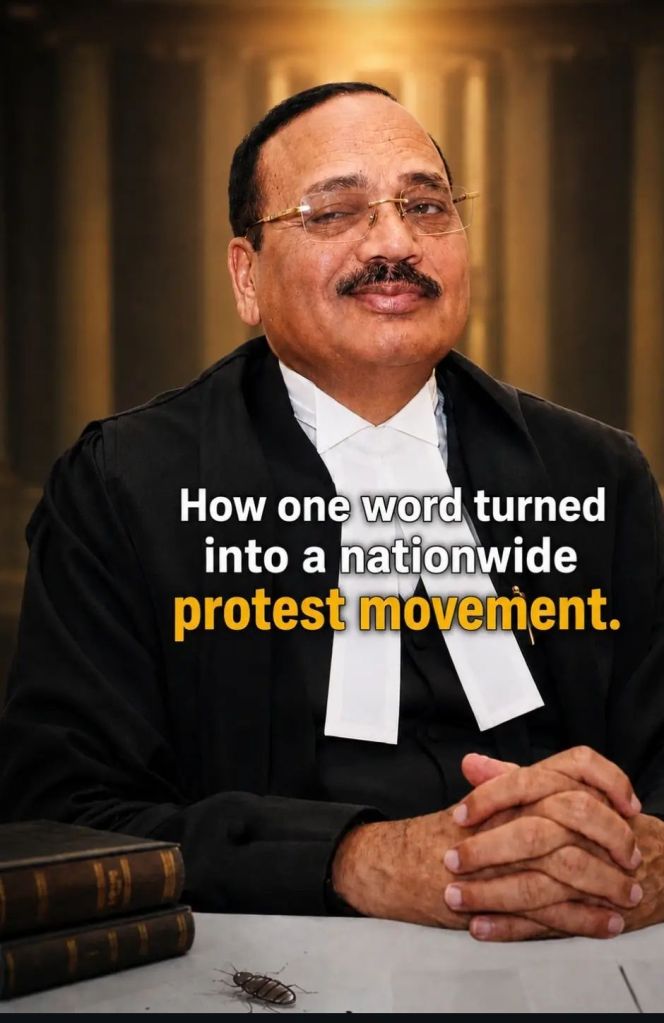
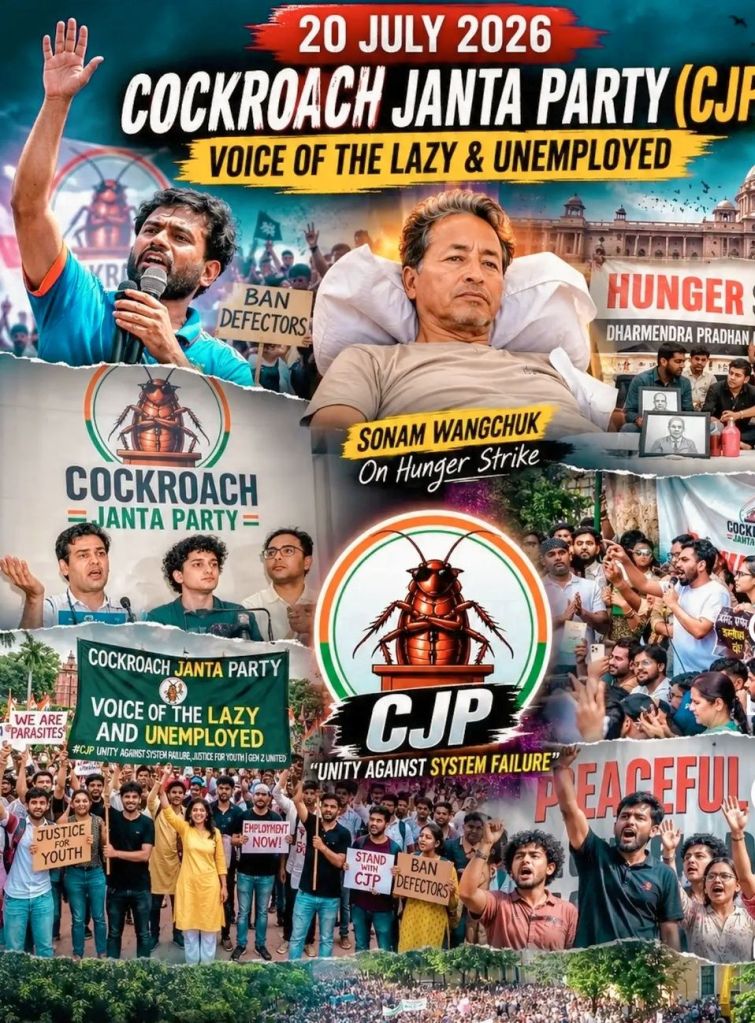
The movement also revealed the arrival of a new democratic architecture driven by India’s digitally connected youth. Social media transformed ordinary citizens into organisers, communicators, fundraisers and volunteers, enabling decentralised mobilisation without reliance on conventional political machinery. A satirical online identity evolved into a disciplined nationwide civic campaign capable of sustaining momentum for weeks. This represents a profound structural shift in democratic participation. Governments can no longer assume that delaying engagement will weaken public movements. In the digital age, delayed responses often strengthen public mobilisation by providing additional time for narratives to consolidate, networks to expand and public sympathy to deepen.
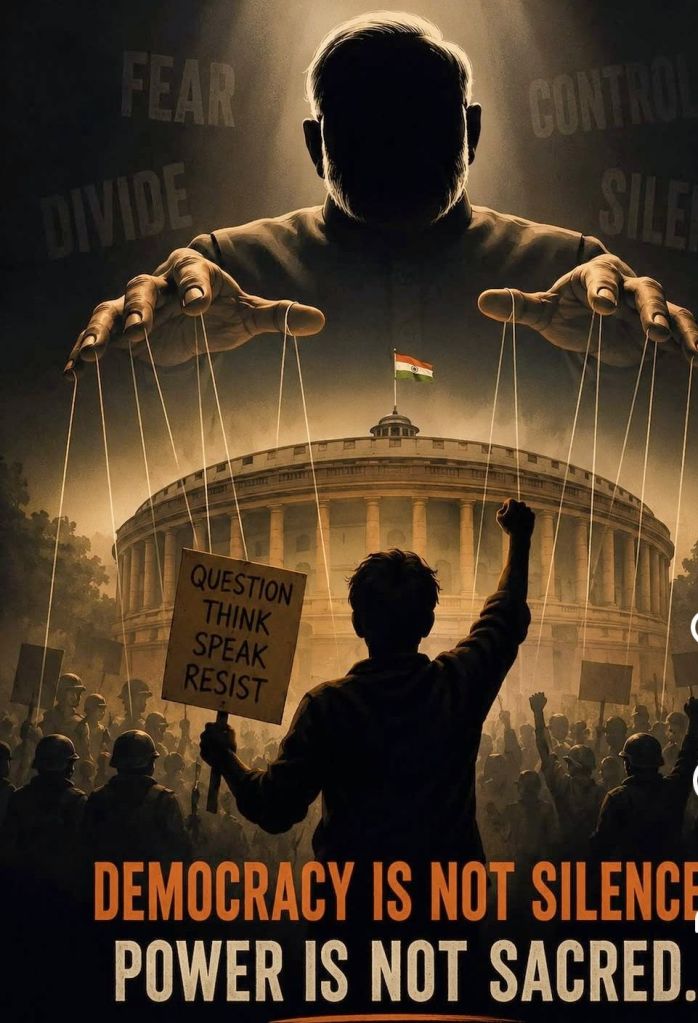
Perhaps the most enduring casualty was institutional trust. Competitive examinations remain the principal ladder of social mobility for millions of young Indians. Their legitimacy depends as much on public confidence as on procedural integrity. Once that confidence weakens, every subsequent examination, recruitment process and official assurance comes under heightened scrutiny. Trust, unlike infrastructure, cannot be rebuilt through financial allocations alone. It demands transparency, accountability and visible leadership. The reluctance to take timely decisions transformed an administrative controversy into a broader crisis of confidence affecting educational governance itself. Institutional credibility, painstakingly built over decades, can be undermined within weeks if leadership fails to inspire confidence during moments of uncertainty.
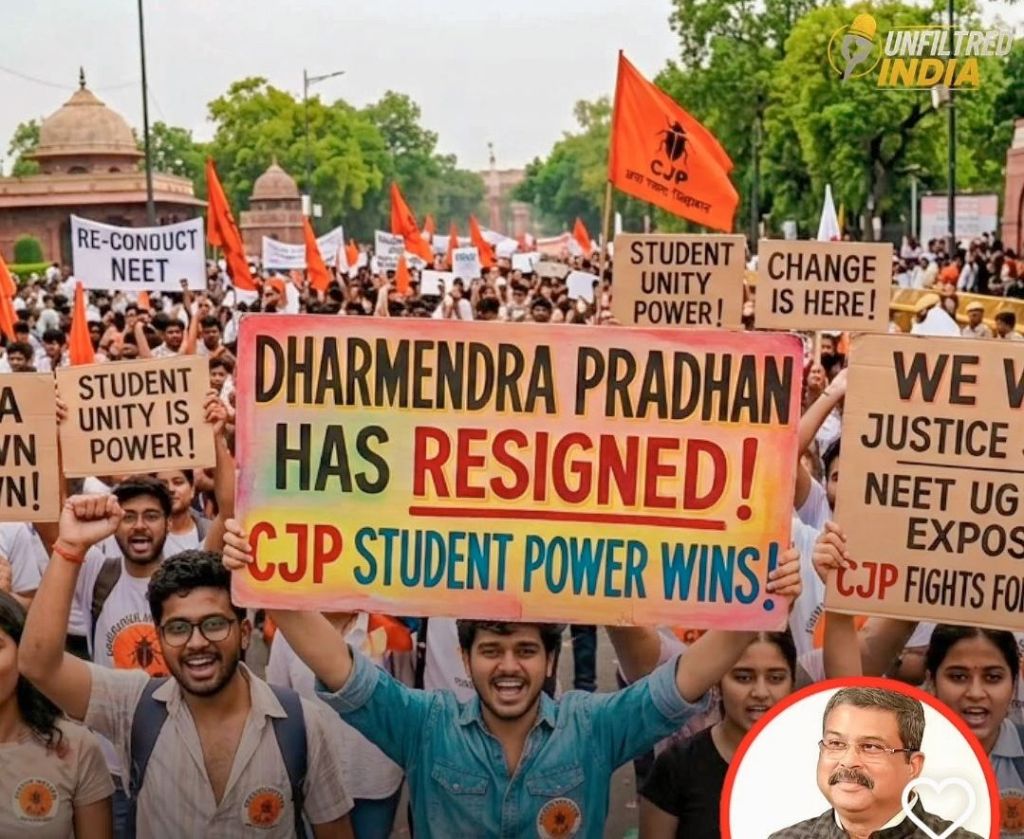
The lesson extends far beyond a single protest or a single ministry. Effective governance is measured not by the avoidance of controversy but by the speed, integrity and courage with which controversy is addressed. Moral courage is not demonstrated by resigning after a movement reaches its peak; it is demonstrated by confronting uncomfortable realities before they become national crises. The reported ₹3,000-crore economic disruption should therefore be viewed not merely as the financial cost of a prolonged protest but as the price of delayed decision-making. Democracies cannot eliminate dissent, nor should they attempt to. They can, however, prevent dissent from becoming a national economic liability through timely engagement, transparent communication and decisive leadership. In governance, delayed decisions are rarely neutral—they invariably become the costliest decisions a nation is forced to pay.
VISIT ARJASRIKANTH.IN FOR MORE INSIGHTS

