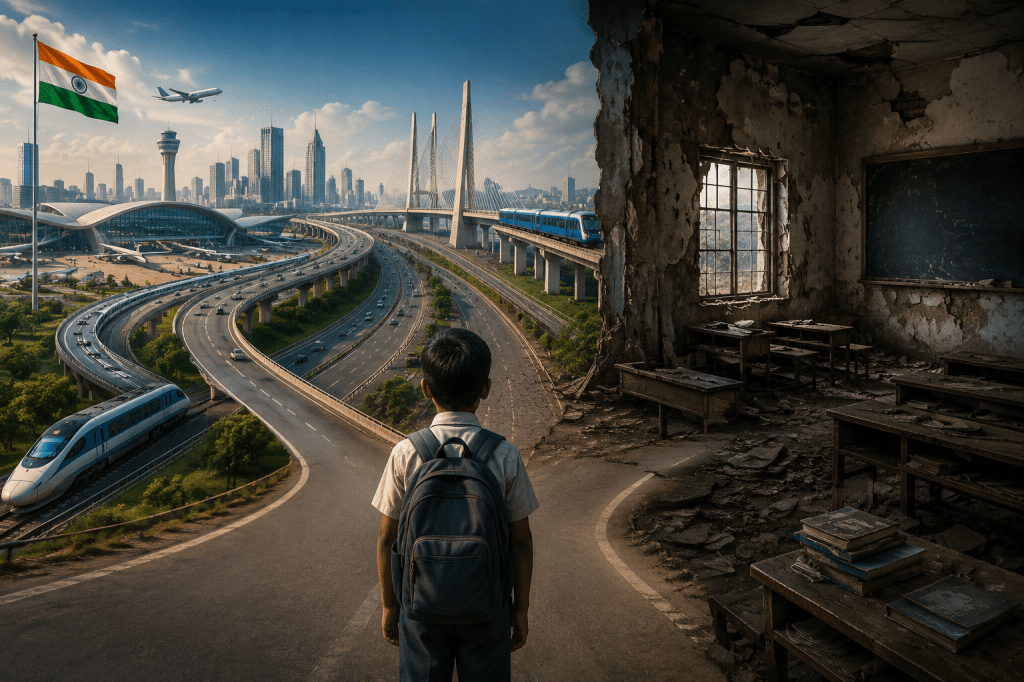
India is experiencing one of the most striking development paradoxes of the twenty-first century. Rarely has the nation built so many highways, airports, expressways, railway corridors, ports, and digital infrastructure within such a short period. Modern transport networks have become powerful symbols of governance, economic ambition, and state capacity. Yet beneath this remarkable physical transformation lies a quieter but far more consequential challenge—the gradual weakening of India’s education ecosystem. Civilisations are not ultimately defined by the kilometres of roads they construct but by the quality of citizens they produce. Infrastructure moves goods and people; education moves societies. Roads reduce travel time, but classrooms determine the direction in which a nation ultimately travels. When public policy persistently favours physical capital over human capital, the consequences emerge slowly but profoundly, creating structural weaknesses that no expressway can repair.
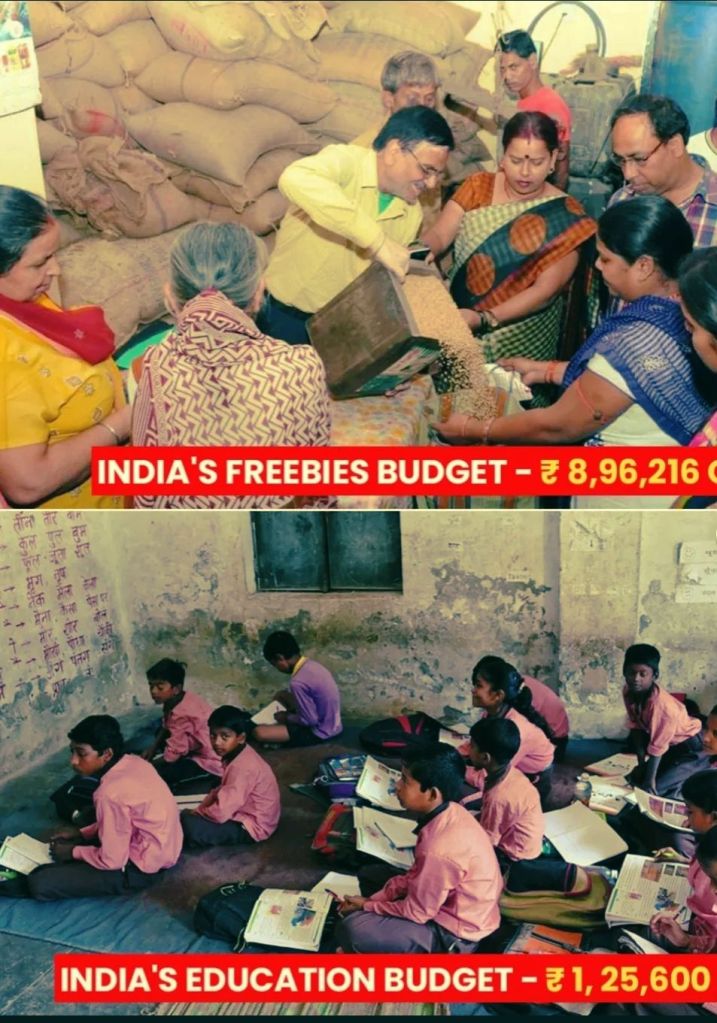
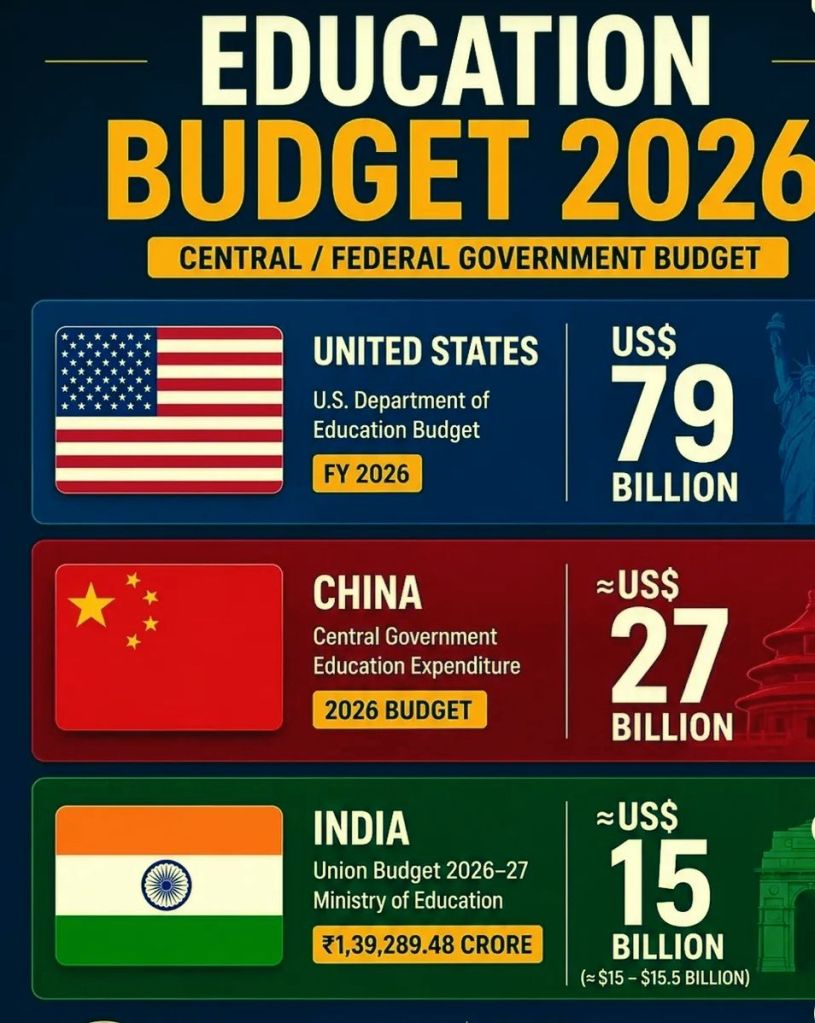
Budgetary trends reveal this shift with remarkable clarity. Over the past decade, allocations for highways and transport infrastructure have expanded significantly, while education’s share in public expenditure has steadily declined as a proportion of the overall Union Budget despite increases in absolute spending. The Union Budget 2026–27 allocates nearly ₹1.39 lakh crore to education, reflecting nominal growth, yet the relative fiscal priority accorded to education remains well below the aspirations envisioned under the National Education Policy. Simultaneously, health expenditure has remained modest, and skill development continues to receive a comparatively limited allocation despite repeated emphasis on demographic dividends. Budgets often reveal governmental priorities more accurately than political speeches. Visible infrastructure offers immediate electoral visibility, whereas investments in education yield benefits over decades, making them politically less attractive despite being economically indispensable.
This preference reflects a structural dilemma inherent in democratic politics. Highways, bridges, airports, and metro corridors can be inaugurated within an electoral cycle, photographed, publicised, and associated with visible governance outcomes. Education, by contrast, produces delayed dividends through improved productivity, innovation, scientific capability, institutional quality, and social mobility. A child entering primary school today contributes meaningfully to the economy only after fifteen or twenty years. Consequently, governments operating within short political cycles often face incentives to prioritise projects delivering immediate visibility rather than reforms whose benefits accrue to future administrations. Yet international economic research consistently demonstrates that sustained investment in education generates among the highest long-term returns available to any public expenditure. Human capital multiplies productivity across every sector, including the very infrastructure that governments seek to expand.
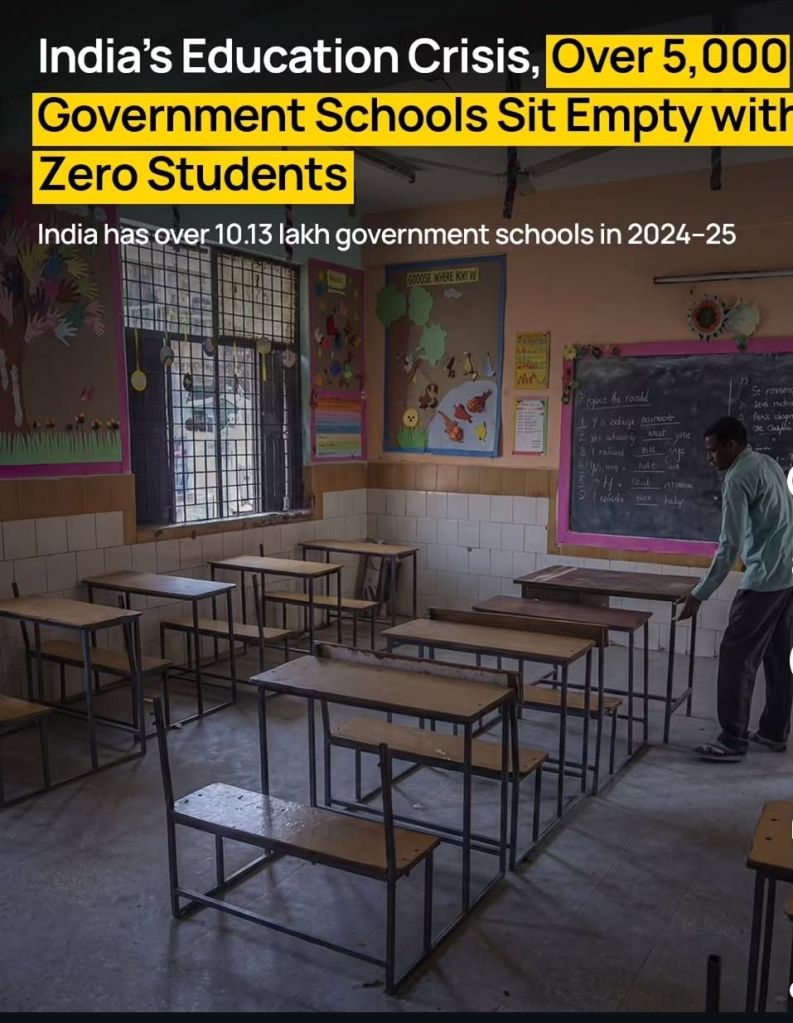
The consequences of this imbalance are increasingly evident across India’s educational landscape. Many government schools continue to struggle with teacher shortages, ageing infrastructure, uneven learning outcomes, overcrowded classrooms, inadequate laboratories, and digital disparities. Simultaneously, millions of middle-class families have become increasingly dependent upon expensive private coaching institutions merely to compensate for deficiencies within formal schooling. India has undoubtedly succeeded in expanding enrolment across schools and higher education institutions, representing a significant social achievement. However, enrolment alone does not guarantee learning. The central challenge confronting Indian education is no longer access but quality. Employers increasingly report shortages of critical skills despite the large number of graduates entering the labour market each year. The economy therefore faces the paradox of abundant degrees but insufficient competencies.
The disconnect becomes even more visible in India’s skilling agenda. Successive governments have emphasised vocational education, digital literacy, entrepreneurship, artificial intelligence, manufacturing competitiveness, and workforce readiness through ambitious programmes and policy announcements. Nevertheless, financial allocations for skill development remain modest when compared with the magnitude of India’s demographic challenge. Employability assessments continue to indicate that a significant proportion of graduates require substantial additional training before becoming industry-ready.
Simultaneously, youth unemployment among educated individuals remains a persistent policy concern. Industries frequently report difficulty in recruiting workers possessing the technical, analytical, and communication skills required by modern manufacturing and service sectors. The challenge therefore extends beyond education alone; it reflects a broader misalignment between fiscal priorities, labour market requirements, and institutional capacity.

Equally concerning is the gradual erosion of confidence in educational governance itself. Repeated controversies surrounding competitive examinations have raised serious questions regarding institutional credibility and administrative accountability. Allegations relating to examination irregularities, paper leaks, delayed results, and procedural inconsistencies affect not merely individual candidates but public confidence in the fairness of the entire merit-based system. For millions of young Indians, competitive examinations represent the principal avenue for social mobility. Any perceived compromise in their integrity carries consequences extending well beyond administrative lapses. Educational institutions derive legitimacy not simply from conducting examinations but from ensuring that every deserving candidate believes the process remains transparent, impartial, and secure. Restoring that confidence demands robust institutional reforms, stronger technological safeguards, and visible accountability whenever failures occur.
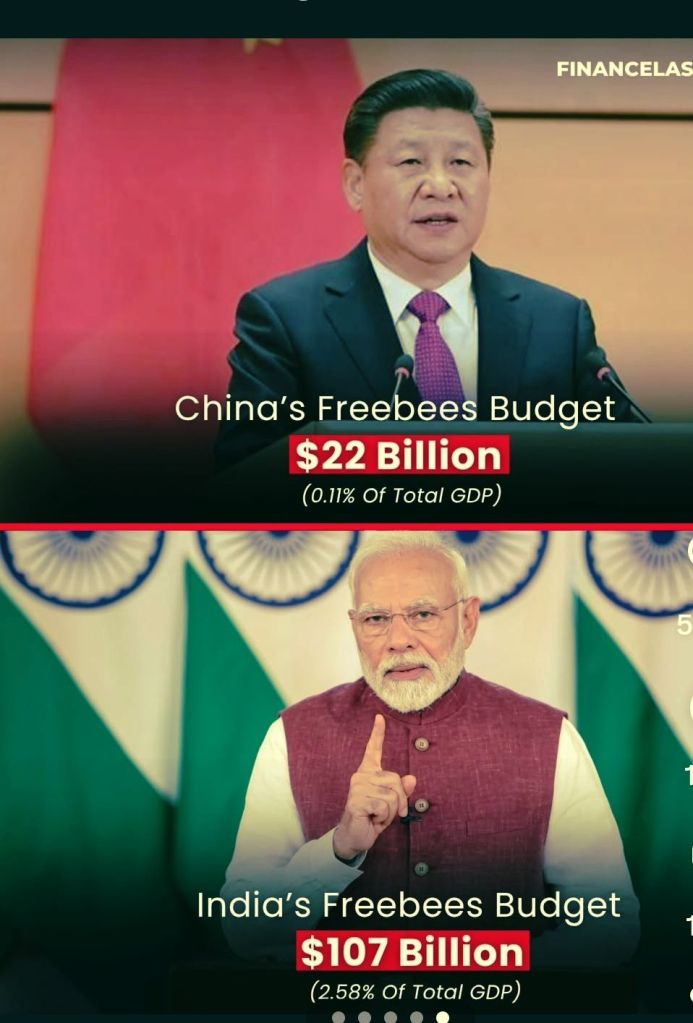
The social consequences of these educational shortcomings are becoming increasingly visible. Youth demonstrations concerning examination processes, recruitment delays, employability, and limited opportunities should not be viewed merely as isolated law-and-order issues. They represent expressions of deeper anxieties regarding economic mobility, institutional fairness, and future prospects. Democratic societies benefit when such concerns are addressed through dialogue, timely institutional responses, and evidence-based reforms rather than solely through administrative management. Sustainable governance requires recognising that public dissatisfaction often reflects underlying structural challenges rather than transient political disagreements. Addressing symptoms without resolving root causes merely postpones larger governance challenges.
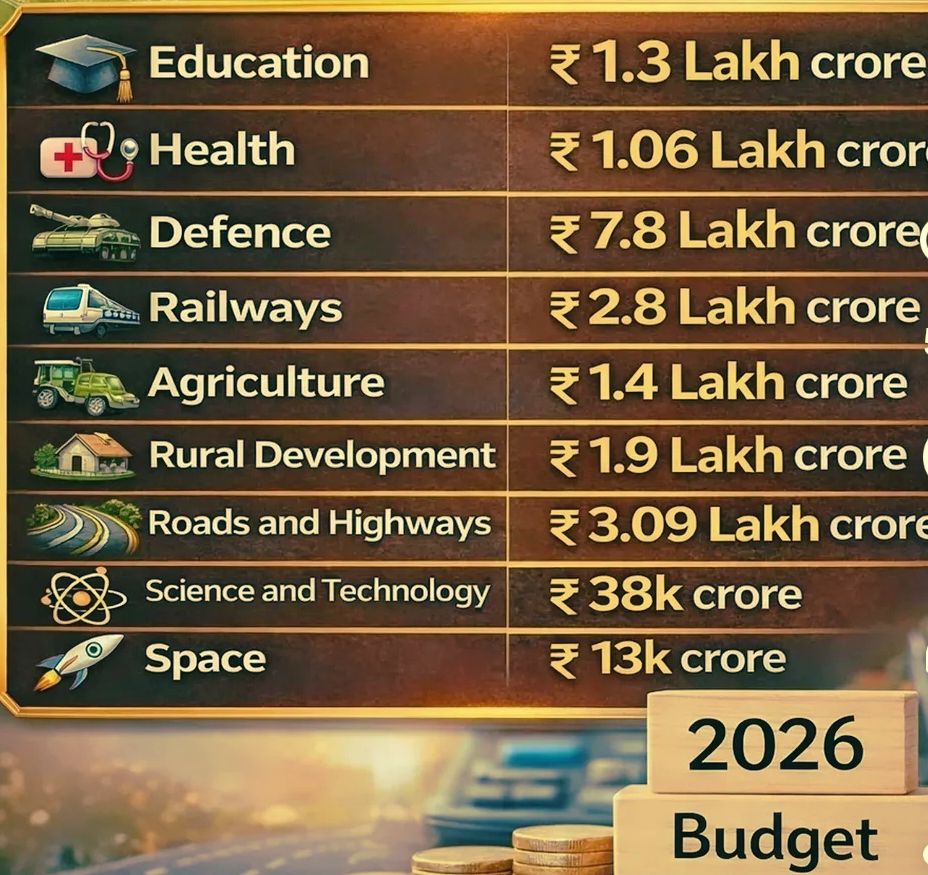
India’s aspiration to become Viksit Bharat 2047 cannot rest upon infrastructure alone. Expressways undoubtedly enhance logistics, airports improve connectivity, and industrial corridors stimulate investment. However, physical infrastructure derives its true economic value only when supported by educated citizens, skilled workers, innovative researchers, competent administrators, and credible public institutions. The next phase of India’s development must therefore restore education to the centre of national strategy through sustained investment in schools, teacher capacity, research universities, vocational training, secure examination systems, and measurable learning outcomes. Nations ultimately compete not by the width of their highways but by the depth of their human capital.
Concrete may transform skylines, but classrooms determine civilizations. If India continues to expand roads faster than opportunities for learning, it risks constructing an impressive physical landscape without adequately preparing the generations destined to inherit it.
VISIT ARJASRIKANTH.IN FOR MORE INSIGHTS

