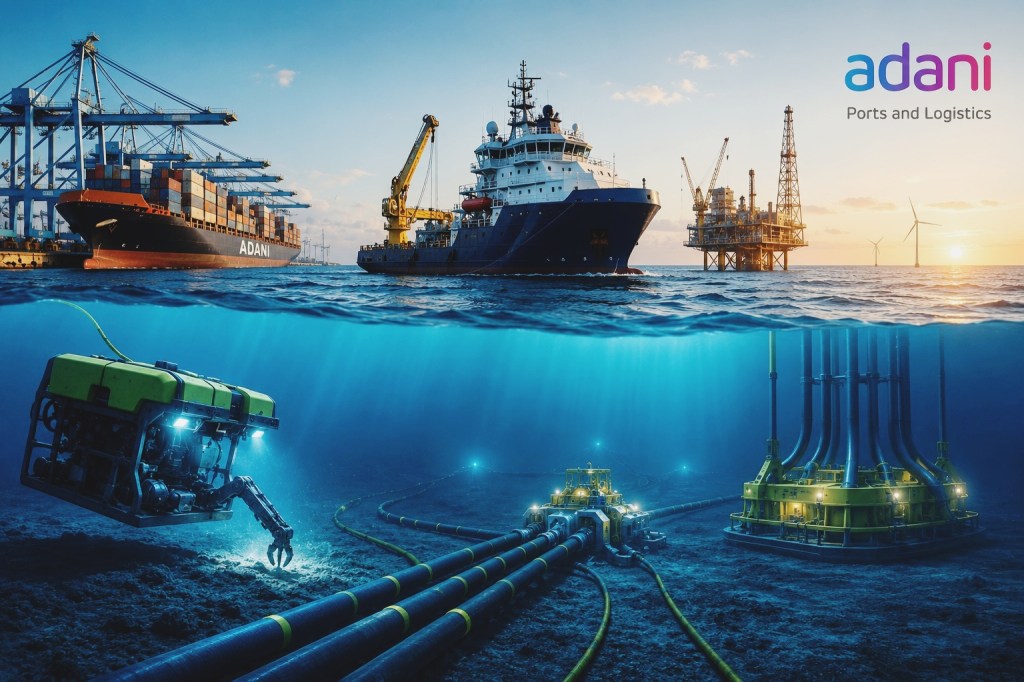
Visionary entrepreneurs do not merely identify opportunities—they anticipate structural transformations long before markets acknowledge them. Gautam Adani’s entrepreneurial journey reflects this uncommon ability to think decades ahead. Time and again, he has demonstrated that enduring business leadership comes not from reacting to change but from shaping it. Three decades ago, when India largely viewed ports as cargo-handling facilities, Adani visualized Mundra as an integrated maritime ecosystem combining ports, logistics, railways, industrial zones and energy infrastructure. That seemingly audacious vision fundamentally altered India’s maritime landscape. Today, Adani Ports and Special Economic Zone (APSEZ) appears to be repeating the same strategic playbook through its rapid expansion into offshore marine services. What many perceive as diversification is, in reality, the next phase of a long-term maritime strategy that once again places Adani several moves ahead of competitors.
The Mundra story offers valuable insight into this pattern of strategic foresight. During the 1990s, India’s ports were largely public-sector dominated, congested and disconnected from integrated supply chains. Private participation in port development was widely considered risky. Adani, however, recognized that India’s economic rise would ultimately depend upon globally competitive logistics infrastructure rather than isolated port terminals. Mundra was therefore conceived not as a port but as a complete maritime-industrial ecosystem supported by rail connectivity, warehousing, special economic zones and energy assets. Today, it has evolved into India’s largest commercial port and the cornerstone of APSEZ’s leadership. The lesson extends far beyond infrastructure: transformational enterprises invest before demand becomes obvious, creating capacity for tomorrow instead of merely responding to today’s requirements.
Having established dominance in ports, APSEZ now confronts a different strategic reality. Ports remain among the world’s most valuable infrastructure assets, but their growth is inherently constrained by geography, regulatory approvals, concession periods and hinterland demand. Coastlines are finite, and opportunities for large greenfield ports are becoming increasingly limited. Rather than waiting for these structural limits to restrict future growth, Adani has expanded the definition of the maritime business itself. Offshore marine services allow APSEZ to move beyond fixed coastal infrastructure into globally deployable marine assets capable of serving projects across continents. This represents a strategic transition from owning maritime gateways to participating in virtually every stage of the global offshore value chain.
The economics of offshore marine services differ fundamentally from conventional port operations. Offshore support vessels generate long-term, predominantly dollar-denominated revenues through contracts supporting offshore oil and gas exploration, subsea construction, underwater cable installation, offshore wind farms, deep-water engineering and marine logistics. Unlike ports, whose revenues depend largely on regional cargo flows, offshore assets can operate wherever global energy and infrastructure investments emerge. As nations accelerate investments in offshore hydrocarbons, renewable energy, subsea communication cables and underwater infrastructure, demand for sophisticated marine support fleets is expected to expand substantially. APSEZ is therefore positioning itself not merely as India’s leading port operator but as an international marine infrastructure enterprise serving projects across the Middle East, Africa, Europe and Asia.
This transformation has been executed with remarkable strategic discipline. The acquisition of Ocean Sparkle in 2022 established a dominant domestic marine services platform with harbour tugs, pilotage and port-support capabilities. The acquisition of an 80 percent stake in Astro Offshore in 2024 significantly expanded APSEZ’s international footprint, providing access to offshore support vessels and global energy customers. The subsequent collaboration with Oceaneering International introduced advanced capabilities in remotely operated vehicles (ROVs), subsea engineering and deep-water operations. Supported by a planned investment of approximately US$1.36 billion through FY2031, APSEZ is steadily assembling one of Asia’s most sophisticated offshore service portfolios. Strong growth in marine revenues indicates that the strategy is already delivering commercial momentum while diversifying earnings beyond traditional port operations.
One vessel, in particular, symbolises the scale of this transformation. The offshore support vessel Energy Savannah, subsequently renamed Astro Atlas, attracted international attention while operating near strategically significant subsea infrastructure between Sicily and Malta. Equipped with advanced dynamic positioning systems, heavy-lift subsea cranes and the capability to operate at depths exceeding 3,000 metres, the vessel illustrates the technological sophistication now entering APSEZ’s portfolio. Such assets are designed not merely for offshore construction but also for inspection, maintenance and support of critical underwater infrastructure. In an era where subsea cables transmit the overwhelming majority of global internet traffic and offshore energy assets underpin national energy security, these vessels operate at the intersection of commerce, technology and geopolitics.
The significance of this shift extends well beyond corporate strategy. Offshore infrastructure has emerged as one of the world’s most strategic economic assets. Undersea fibre-optic cables carry global digital communications, offshore wind farms support clean energy transitions, subsea pipelines secure energy supplies and underwater power interconnectors strengthen regional electricity networks. Consequently, companies capable of constructing, maintaining and servicing such infrastructure increasingly become strategic enablers of national resilience. Commercial competence alone is no longer sufficient; operators must also navigate geopolitical sensitivities, technological complexity and heightened international scrutiny. APSEZ’s evolution therefore reflects not simply business diversification but participation in the emerging architecture of global maritime security and infrastructure.
Adani’s offshore ambitions also complement India’s broader aspiration to become a leading maritime power under initiatives such as the Maritime Amrit Kaal Vision. As India expands its commercial presence across the Indo-Pacific, the Middle East, Africa and Europe, globally competitive Indian infrastructure companies become important instruments of economic influence. APSEZ’s growing international port network, combined with advanced offshore capabilities, enhances India’s role in global trade, energy logistics and marine engineering. This is not geopolitical competition through military means, but economic statecraft driven by infrastructure, technology and commercial excellence. It reinforces India’s image as a reliable partner in building and sustaining critical global maritime assets.
History consistently rewards those who recognise structural shifts before they become conventional wisdom. Mundra demonstrated that ports were never merely cargo terminals—they were platforms for economic transformation. The expansion into offshore marine services reflects the same philosophy on a much larger canvas. While many competitors continue measuring success by the number of ports they control, Adani is extending his vision beyond the shoreline into the oceans themselves, where offshore energy, subsea connectivity, marine engineering and underwater infrastructure will increasingly define the future of global commerce. Three decades ago, he built a port before India fully recognised its strategic importance. Today, he is building capabilities beneath the sea before much of the industry appreciates that tomorrow’s maritime power will be determined as much by what lies underwater as by what stands on the coast. That ability to see the next horizon before others even notice it remains Adani’s most enduring competitive advantage.
VISIT ARJASRIKANTH.IN FOR MORE INSIGHTS

