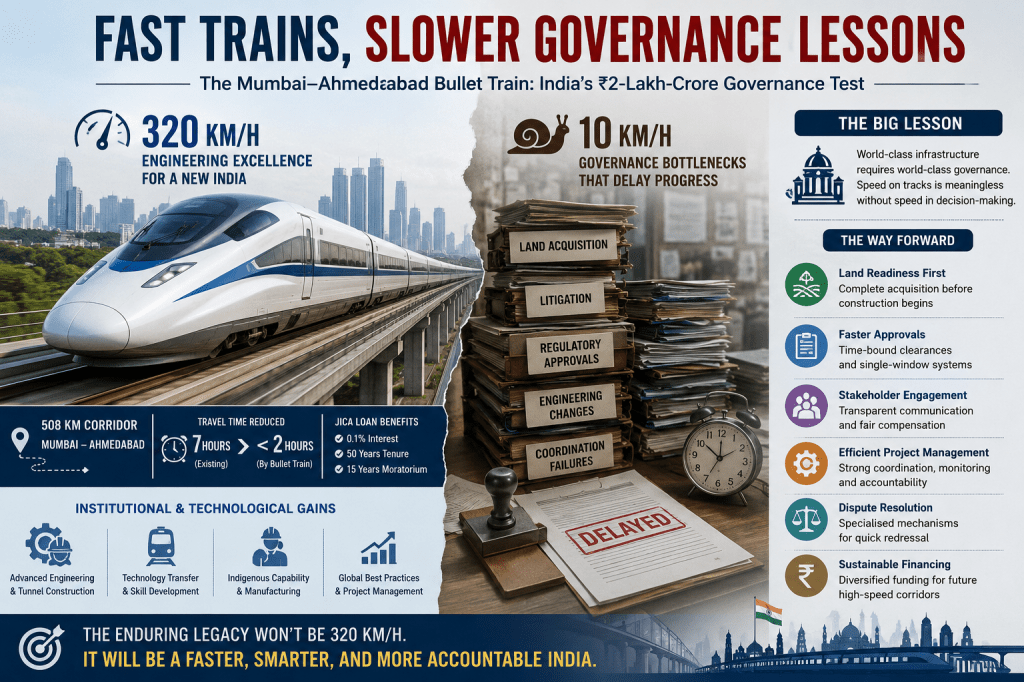
India’s first bullet train project is far more than a transportation initiative; it is an institutional stress test of the country’s capacity to conceive, finance, and execute mega infrastructure in the twenty-first century. The 508-kilometre Mumbai-Ahmedabad High-Speed Rail (MAHSR) corridor marks India’s entry into the exclusive league of high-speed rail nations, yet it also exposes deep structural weaknesses that continue to impede large public investments. Originally estimated at ₹1.08 lakh crore and targeted for completion in 2023, the project’s cost has nearly doubled to around ₹2 lakh crore, while the first operational section is now expected only by August 2027. The real story, therefore, is not about trains travelling at 320 km per hour. It is about the speed—or lack thereof—of governance, institutional preparedness, regulatory coordination, and administrative execution. Whether the project becomes India’s greatest engineering achievement or its costliest lesson depends less on Japanese technology than on India’s ability to reform its project delivery architecture.

When Prime Minister Narendra Modi and former Japanese Prime Minister Shinzo Abe jointly laid the foundation stone in September 2017, the project symbolised a new era of Indo-Japanese strategic cooperation and India’s technological ambitions. Based on Japan’s globally acclaimed Shinkansen system, the corridor is expected to reduce travel time between Mumbai and Ahmedabad from nearly seven hours to less than two. The financial architecture appeared equally remarkable. The Japan International Cooperation Agency (JICA) extended one of the world’s most concessional infrastructure loans, carrying just 0.1 percent interest, a repayment period of 50 years, and a 15-year moratorium. Such financing dramatically lowered borrowing costs and made the project economically feasible. Yet this extraordinary arrangement reflects strategic diplomacy rather than a universally replicable financing model. Future high-speed rail corridors will almost certainly require more diversified and commercially sustainable funding structures.
The most visible challenge has been the dramatic escalation in project cost. An increase of nearly 83 percent cannot be explained by inflation alone; it reflects deficiencies in project preparation and execution. Delays arising from land acquisition disputes, prolonged litigation, exchange-rate fluctuations, engineering modifications, utility relocation, taxation, rehabilitation packages, environmental compliance, and multimodal station integration steadily transformed a financially manageable project into one of India’s most expensive infrastructure ventures. The prolonged dispute over land acquisition in Mumbai’s Vikhroli area demonstrated how a single unresolved parcel can delay an entire corridor and trigger cascading financial consequences. Infrastructure economics, therefore, is determined not merely by engineering efficiency but by administrative predictability. The greatest risks frequently arise outside construction sites—in courtrooms, government offices, and negotiation tables.
Perhaps the most significant lesson emerging from MAHSR is that land acquisition remains India’s single largest infrastructure constraint. Nearly 1,400 hectares were required across Gujarat, Maharashtra, and the Union Territory of Dadra and Nagar Haveli. Thousands of negotiations with landowners, legal proceedings, compensation disputes, political disagreements, and community concerns substantially slowed implementation. The contrasting pace of acquisition between Gujarat and Maharashtra further illustrates how political stability, administrative coordination, and stakeholder engagement directly influence project timelines. Infrastructure planning cannot begin with construction contracts alone. It must first establish legal certainty, transparent compensation mechanisms, community participation, and public trust. Future corridors must complete land acquisition before construction schedules are announced rather than attempting both simultaneously.

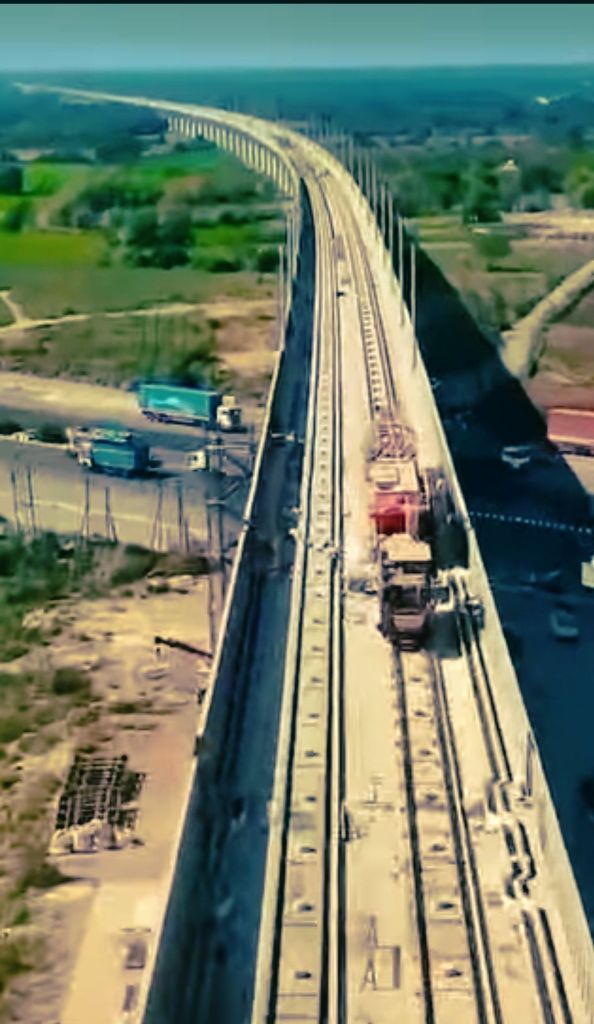
The project also dispels a common misconception that high-speed rail can simply emerge through upgrading existing railway infrastructure. True high-speed operations require dedicated standard-gauge corridors, fully grade-separated alignments, advanced digital train control systems, precision-engineered curves, sophisticated signalling, and the complete elimination of level crossings. India’s extensive broad-gauge railway network, despite impressive modernisation through technologies such as Kavach, was never designed for sustained operations at 320 km per hour. Consequently, constructing entirely new corridors becomes unavoidable, making civil works and land acquisition the largest cost components. High-speed rail is therefore not an incremental enhancement of conventional railways but an entirely different engineering ecosystem requiring distinct technical standards, operational protocols, and safety frameworks.
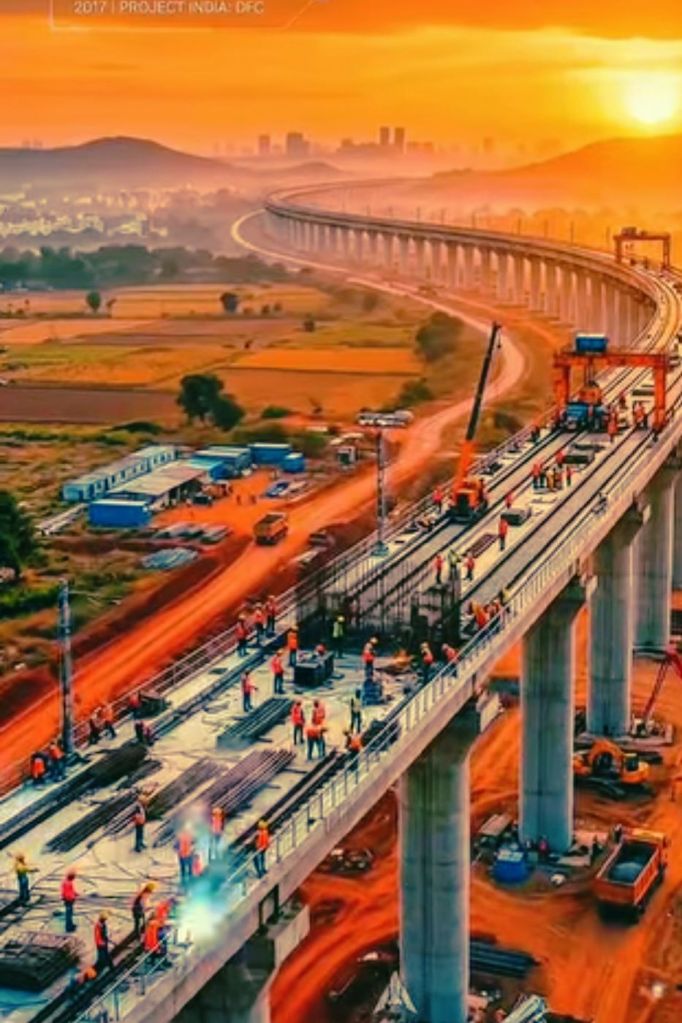
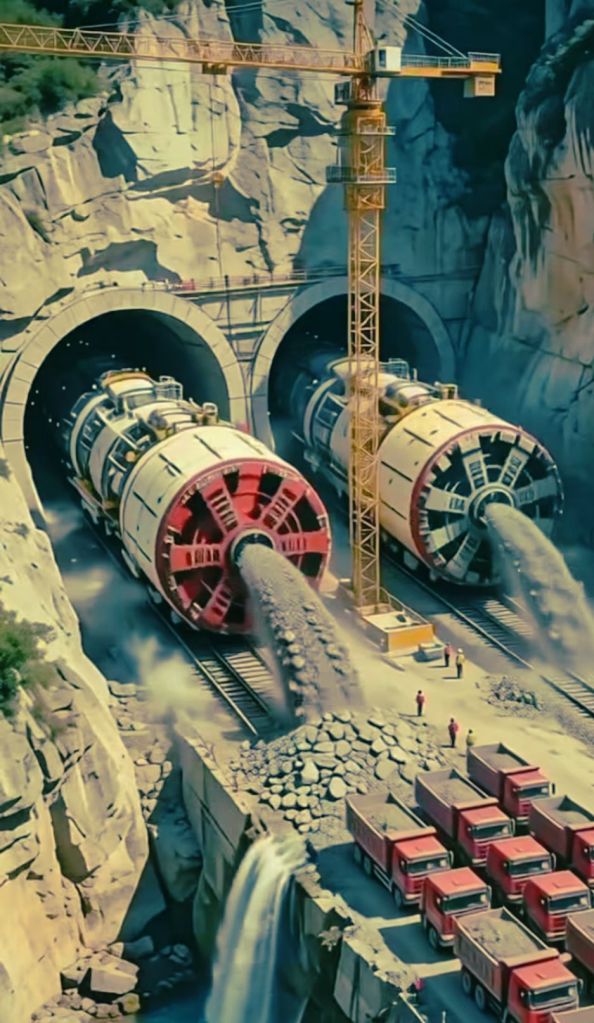
Despite its delays and cost overruns, the MAHSR project has generated substantial institutional dividends. Indian engineers and contractors have entered previously unexplored technological domains, including construction of a 21-kilometre tunnel near Mumbai featuring an undersea section beneath Thane Creek. Domestic capabilities have expanded in ballastless track technology, seismic-resistant structures, advanced signalling systems, precision bridge construction, tunnel boring, and specialised project management. Technology transfer arrangements are simultaneously strengthening indigenous manufacturing capabilities, enabling Indian firms to participate more competitively in future high-speed rail projects. These accumulated capabilities represent strategic national assets. In the long run, the knowledge ecosystem created through this project may prove even more valuable than the physical corridor itself.
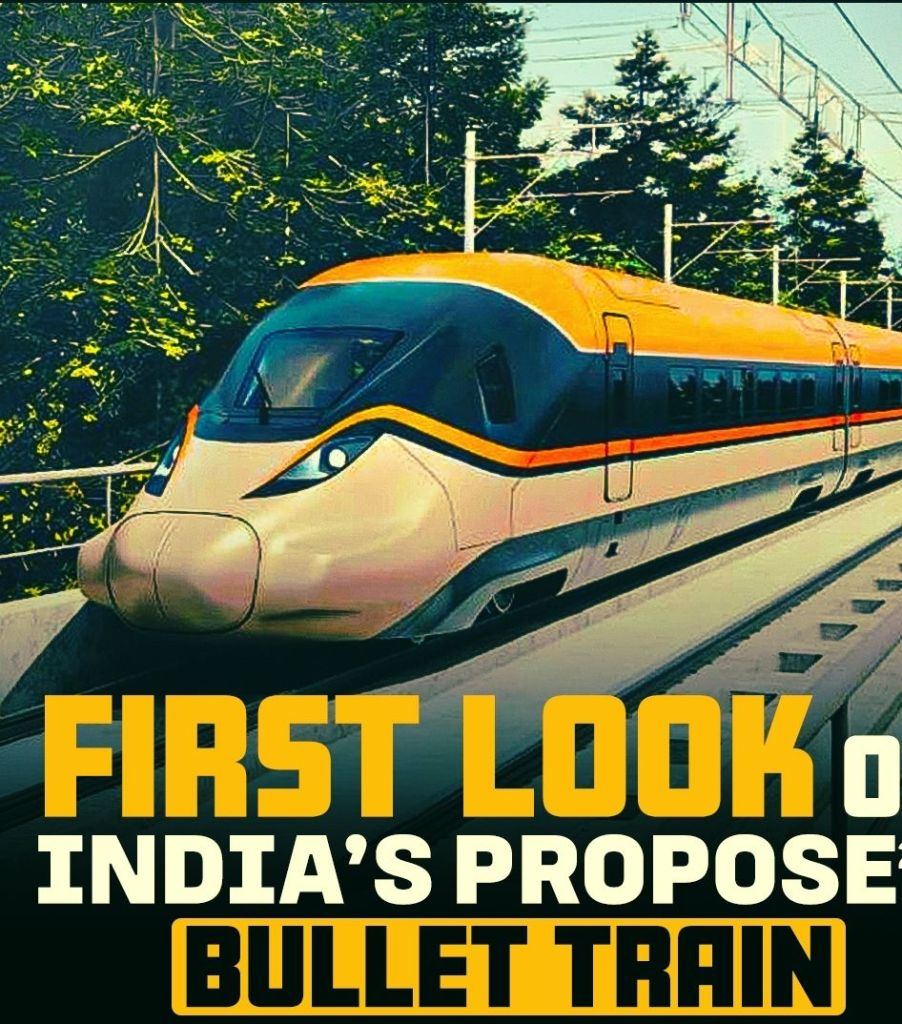
However, India’s broader ambition of developing nearly 4,000 kilometres of high-speed rail across multiple corridors raises serious questions about scalability. If future projects progress at the pace experienced by the Mumbai-Ahmedabad corridor, the envisioned national network could take several decades to materialise. Standardising bridge designs, tunnel specifications, station architecture, rolling stock procurement, and construction methodologies will undoubtedly improve efficiency. Nevertheless, institutional capacity cannot be replicated as easily as engineering blueprints. Simultaneous execution of multiple corridors demands a much larger ecosystem comprising skilled project managers, specialised contractors, resilient supply chains, diversified financing mechanisms, faster dispute resolution, and stronger intergovernmental coordination. India’s infrastructure ambitions must therefore be matched by equally ambitious investments in institutional capability.
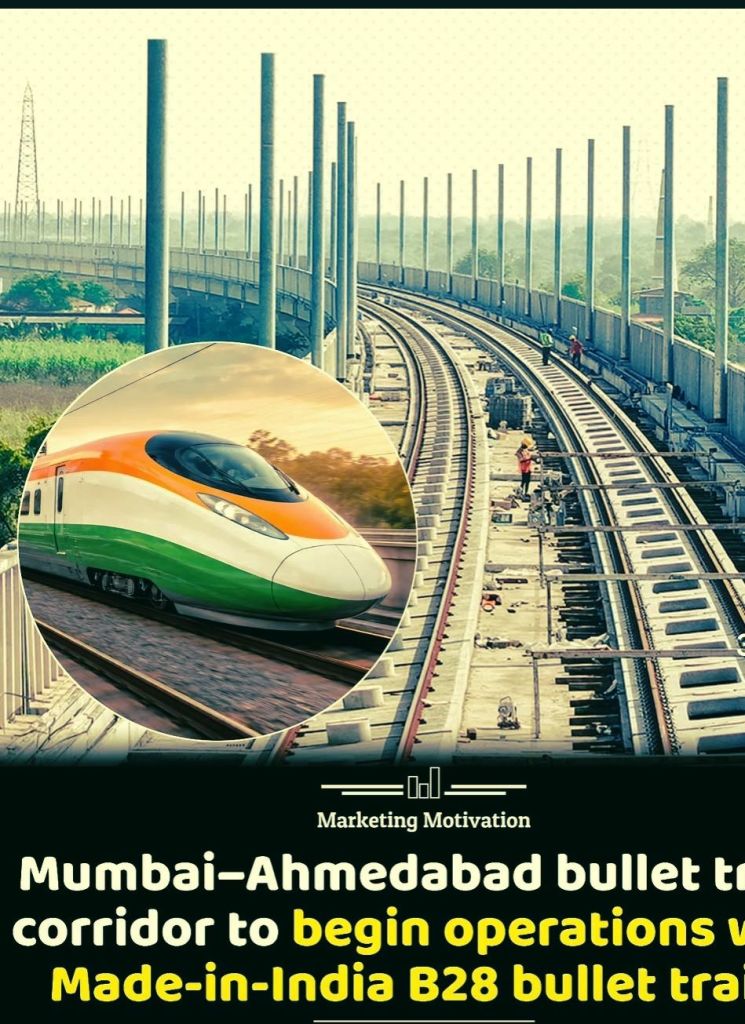
The Mumbai-Ahmedabad Bullet Train should ultimately be viewed neither as a failure nor as an unquestioned success. It is India’s most expensive classroom in infrastructure governance—a living laboratory where engineering excellence meets administrative reality. The project has exposed weaknesses in planning, coordination, land governance, and project management while simultaneously demonstrating India’s capacity to master world-class engineering. Its greatest legacy may not be transporting passengers at 320 km per hour but transforming how India conceives, finances, regulates, and delivers complex infrastructure. If the lessons from this corridor are systematically institutionalised, India’s first bullet train will be remembered not for its delays or escalating costs, but for accelerating something even more important than speed: the maturity of India’s governance architecture.
VISIT ARJASRIKANTH.IN FOR MORE INSIGHTS

