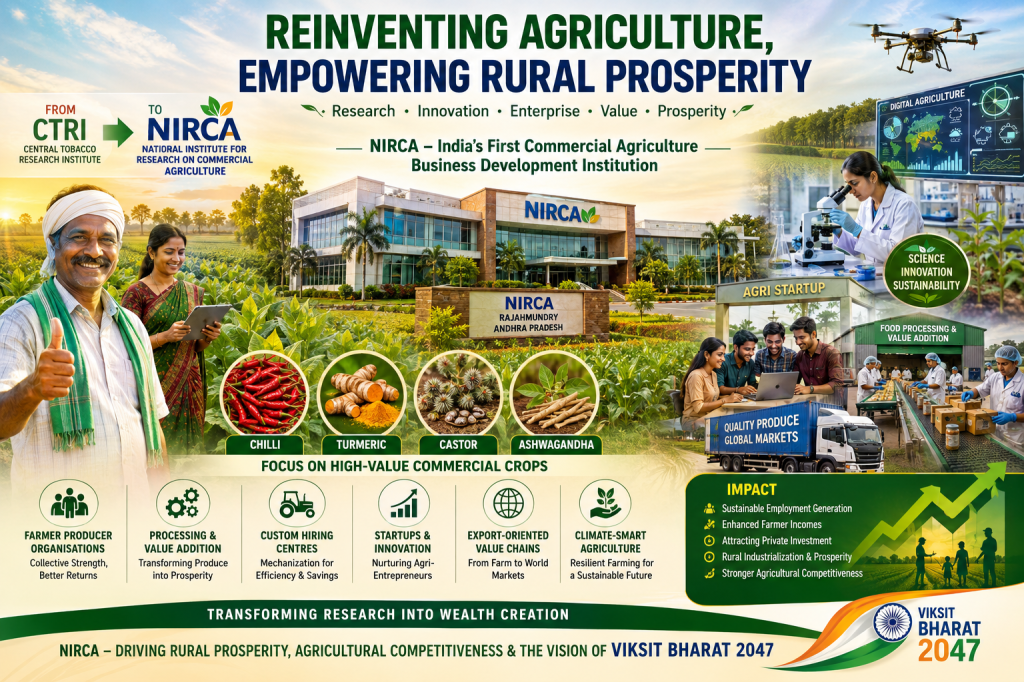
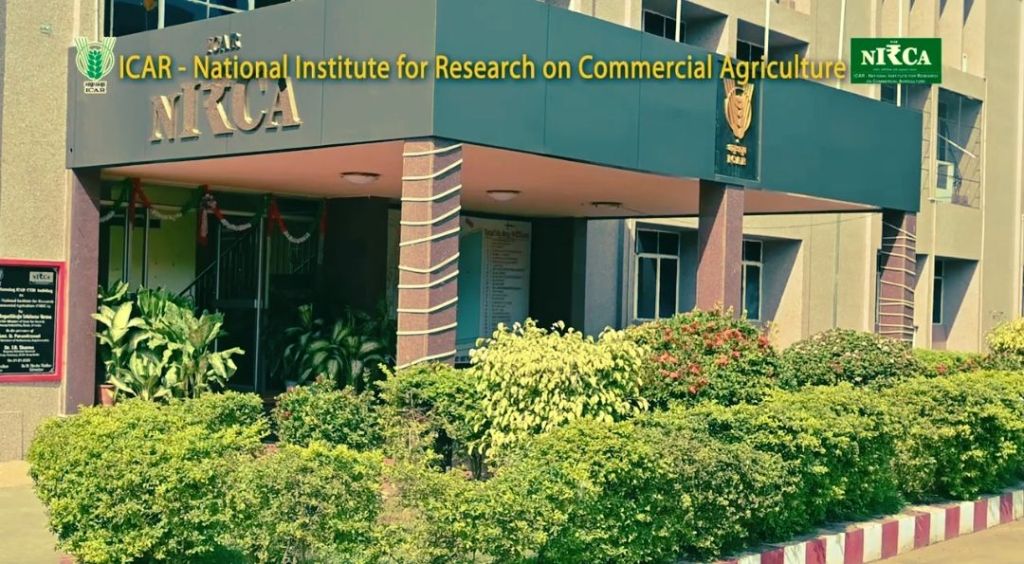
The greatest institutions are not those that preserve yesterday’s successes but those that reinvent themselves to solve tomorrow’s challenges. The transformation of the Central Tobacco Research Institute (CTRI), whose legacy dates back to 1936 and which was formally established in 1947 at Rajahmundry, into the National Institute for Research on Commercial Agriculture (NIRCA) represents one of the boldest institutional reinventions in Indian agriculture. It is far more than an administrative restructuring. It signifies a paradigm shift—from commodity-centric research to market-driven innovation, from scientific experimentation to enterprise creation, and from increasing production to creating prosperity. If backed by visionary leadership, policy convergence and strategic investments, NIRCA can evolve into India’s first integrated Commercial Agriculture Innovation and Business Development Institution, where research becomes the foundation of industries, exports, employment and rural economic transformation.
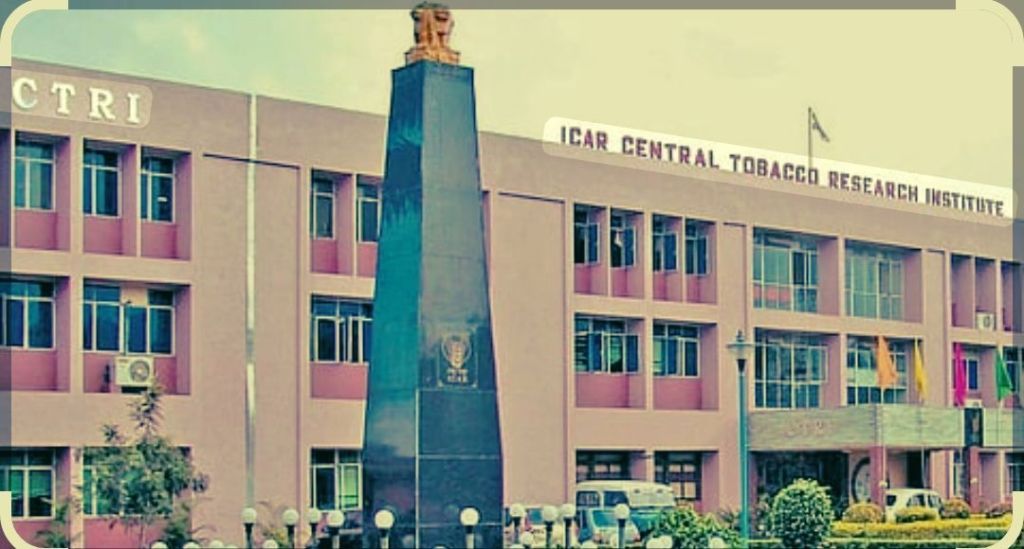
For nearly eight decades, CTRI served as the scientific backbone of India’s tobacco economy. Its pioneering work in breeding, crop management, mechanization, seed production and extension services substantially enhanced productivity and sustained millions of livelihoods across the tobacco value chain. That legacy deserves recognition. However, the challenges confronting Indian agriculture today are fundamentally different. Climate change, volatile global markets, sustainability standards, digital technologies, changing consumer preferences and the rapid growth of high-value agriculture demand institutions that think beyond crops and embrace entire value chains. The future belongs to research organizations capable of converting scientific knowledge into commercial opportunities, attracting private investment, nurturing entrepreneurship and generating sustainable rural employment.
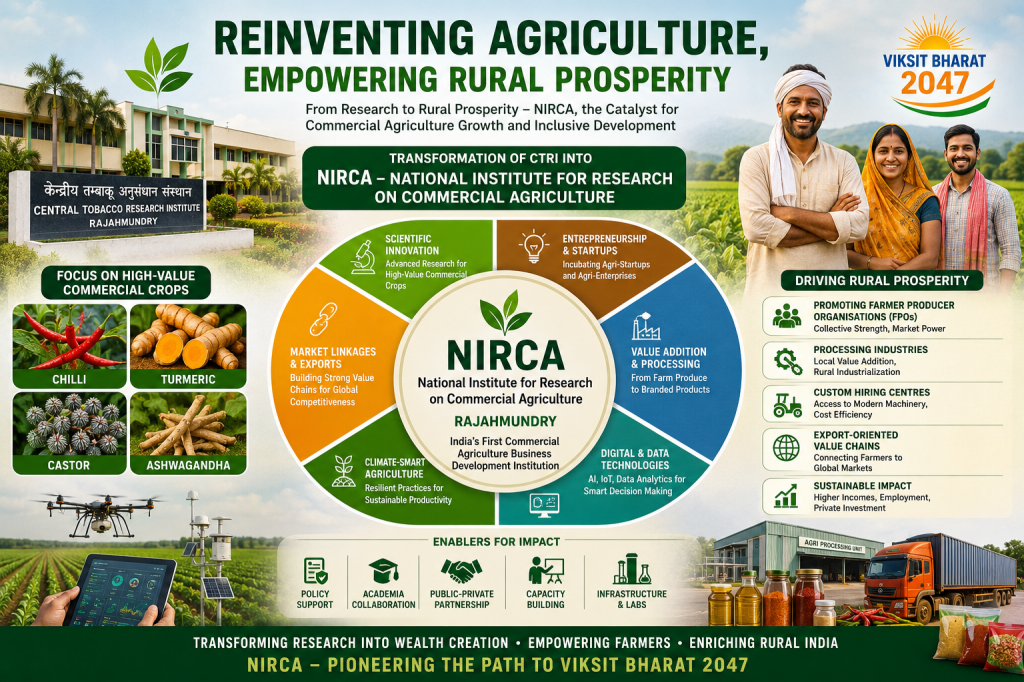
NIRCA’s expanded mandate covering tobacco, chilli, turmeric, castor, ashwagandha, medicinal and aromatic plants and other commercial crops perfectly complements the national vision of Viksit Bharat 2047. India already enjoys global leadership in several of these commodities, yet much of the economic value is captured elsewhere through processing, branding and exports. The challenge is no longer increasing production but retaining value at the source. NIRCA can lead this transition by helping production regions evolve into integrated commercial agriculture ecosystems where farmers become suppliers of premium spices, nutraceuticals, herbal extracts, essential oils, pharmaceuticals, bio-based industrial products and globally branded agricultural commodities rather than merely producers of raw materials.
The institute possesses a rare combination of institutional assets capable of driving such transformation. Its six regional research stations can be repositioned as specialised Centres of Excellence dedicated to crop-specific innovation, processing technologies and value-chain development. Existing infrastructure, including the KVK Value Addition Training Centre and RUDISETI skill ecosystem, can be integrated into a National Commercial Agriculture Skill and Entrepreneurship Academy. Every improved variety, processing technology, farm implement, digital solution and climate-smart innovation should culminate in a startup, Farmer Producer Organisation, rural enterprise or export venture. The success of a public research institution should increasingly be measured not only by publications and varieties released but by enterprises incubated, technologies commercialised, investments attracted, exports generated and jobs created.
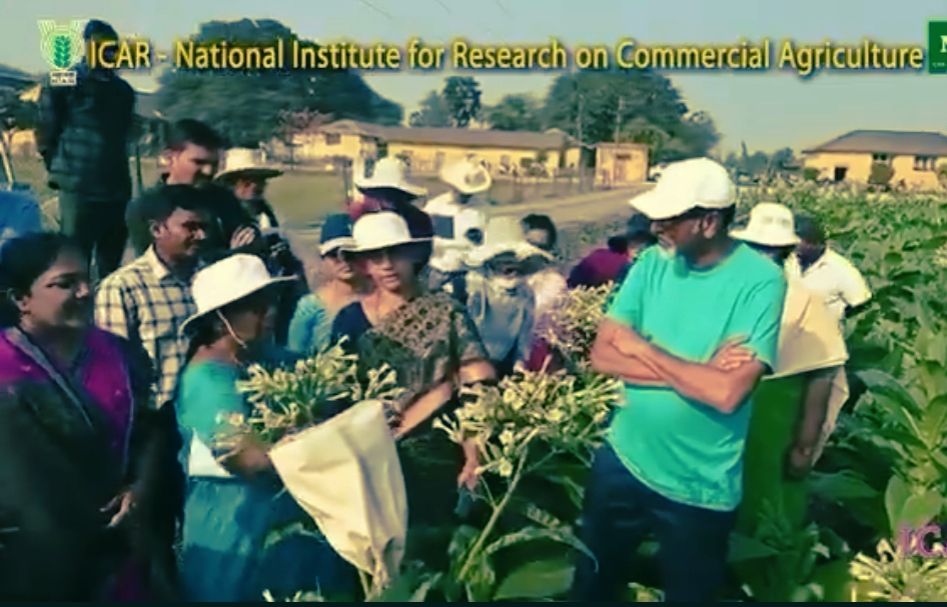
The institute can immediately demonstrate this new approach through high-impact interventions. Establishing a chilli drying and phytosanitation facility at Guntur under the Mission for Integrated Development of Horticulture, securing a Centre of Excellence for Value Addition from the Ministry of Food Processing Industries, creating an Export Promotion and Facilitation Centre with the Ministry of Commerce, establishing a Rural Business Incubation Centre through NABARD, and promoting Custom Hiring Centres for chilli and turmeric through CSR-supported Krishi Vigyan Kendras would bridge critical gaps in post-harvest management, mechanisation, quality assurance and export preparedness. These initiatives would rapidly improve competitiveness while creating new entrepreneurial opportunities for rural youth.
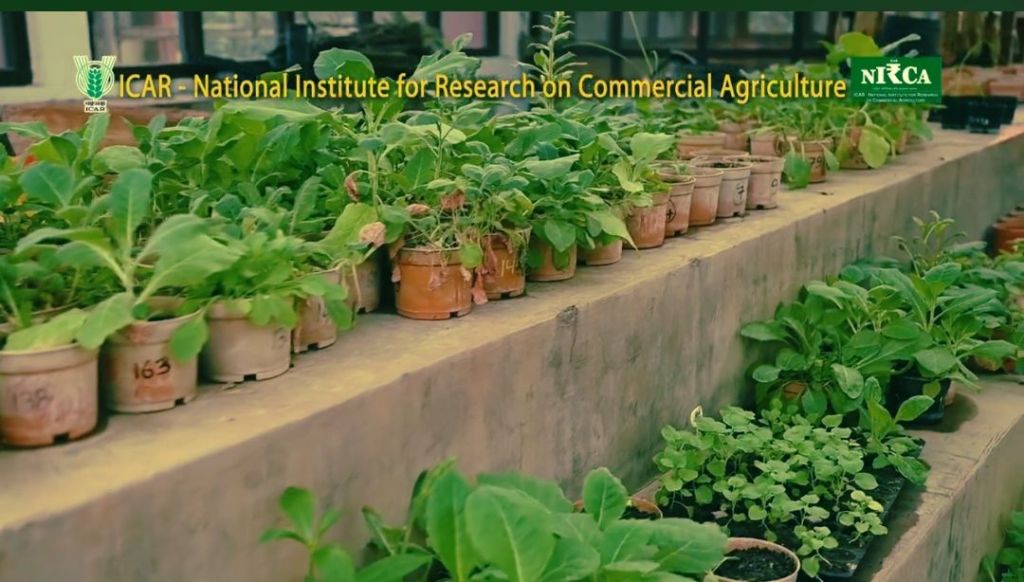
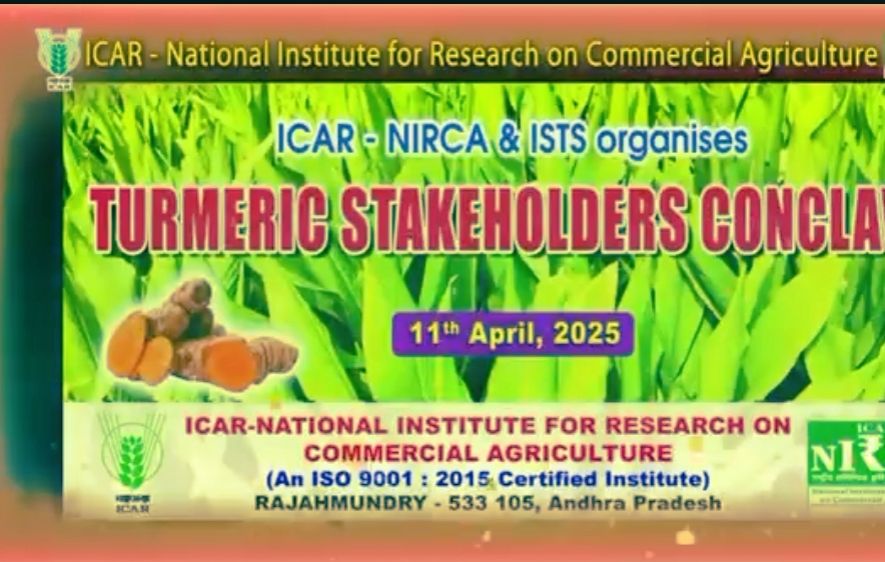
The medium-term opportunities are even more compelling. The high-curcumin turmeric belt of Chintapalli and Duggirala can be transformed into a globally recognised premium turmeric cluster supplying pharmaceutical, nutraceutical and wellness industries. Chintoor chilli can emerge as a flagship tribal value chain through scientific processing, branding and export promotion. Collaboration with the Indian Institute of Spices Research can position Andhra Pradesh as India’s Organic Spice Capital, while local castor processing industries can manufacture lubricants, cosmetics, pharmaceuticals and bio-polymers instead of exporting raw produce. Simultaneously, rapidly expanding global demand for ashwagandha under the Ministry of AYUSH presents a unique opportunity to promote climate-resilient cultivation across water-efficient regions such as Nallamala and Nuziveedu, linking farmers directly with high-value domestic and international wellness markets.
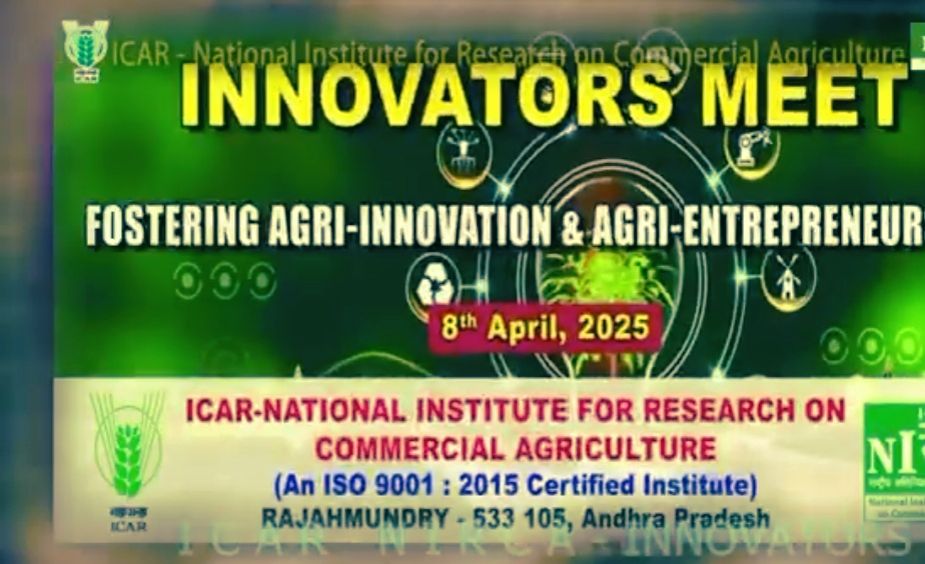
The next stage of agricultural transformation will be driven less by farmers alone than by agripreneurs capable of commercialising innovation. NIRCA should therefore establish a world-class Commercial Agriculture Business Incubation Centre supporting startups in precision agriculture, artificial intelligence, drone services, digital advisory platforms, nursery development, mechanisation, food processing, quality certification, logistics, exports and climate-smart farming. Young graduates must begin viewing agriculture not as a sector of distress but as India’s next frontier of innovation and enterprise. Every startup emerging from NIRCA can stimulate employment across production, processing, packaging, transportation, retail and export ecosystems, creating a powerful multiplier effect in the rural economy.
This transformation requires equally innovative institutional architecture. A dedicated Commercial Agriculture Investment Platform or Special Purpose Vehicle should mobilise blended finance from NABARD, commercial banks, the Ministries of Agriculture, Commerce, Food Processing and AYUSH, CSR initiatives and private investors. In parallel, an Andhra Pradesh Commercial Agriculture Authority can provide mission-mode coordination for research, value addition, exports, branding, investment promotion and entrepreneurship. Anchored by NIRCA, Rajahmundry can evolve into India’s first Commercial Agriculture Innovation City comprising processing parks, export facilitation centers, testing laboratories, incubation hubs, logistics corridors, startup campuses and Farmer Producer Organizations, creating an ecosystem comparable with globally successful agricultural innovation clusters.
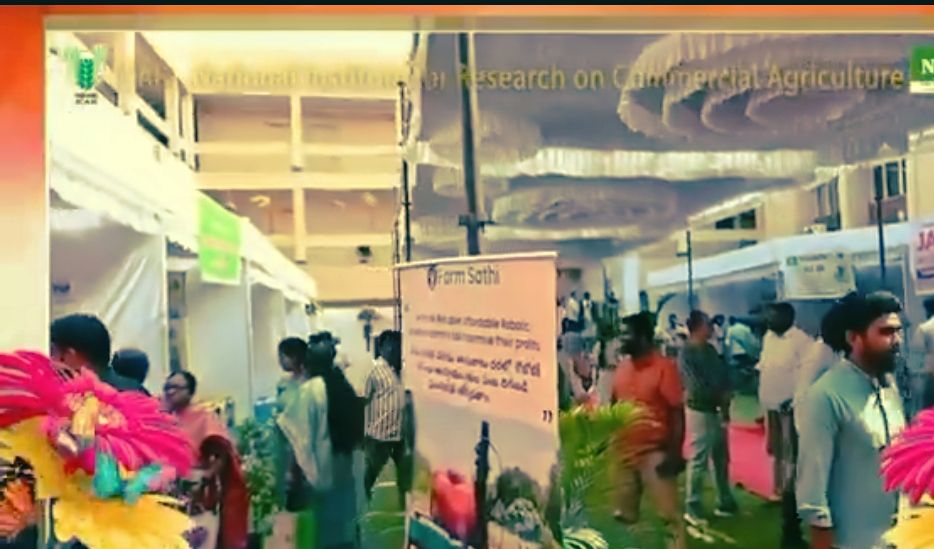
India’s agricultural future will not be secured simply by producing more food; it will be secured by creating greater value from every innovation, every crop and every entrepreneur. NIRCA possesses the scientific credibility, institutional legacy, technological capability and farmer confidence to lead this transition. Its evolution from CTRI should therefore be recognized not merely as diversification beyond tobacco but as the birth of a new development model in which science fuels enterprise, innovation attracts investment, sustainability strengthens competitiveness and research directly creates wealth. If pursued with ambition and strategic clarity, NIRCA can become far more than a premier research institution—it can become India’s Silicon Valley of Commercial Agriculture, where every scientific breakthrough becomes a business opportunity, every value chain becomes an engine of prosperity and every farmer becomes a partner in building a globally competitive, climate-resilient and innovation-driven rural economy.
VISIT ARJASRIKANTH.IN FOR MORE INSIGHTS

