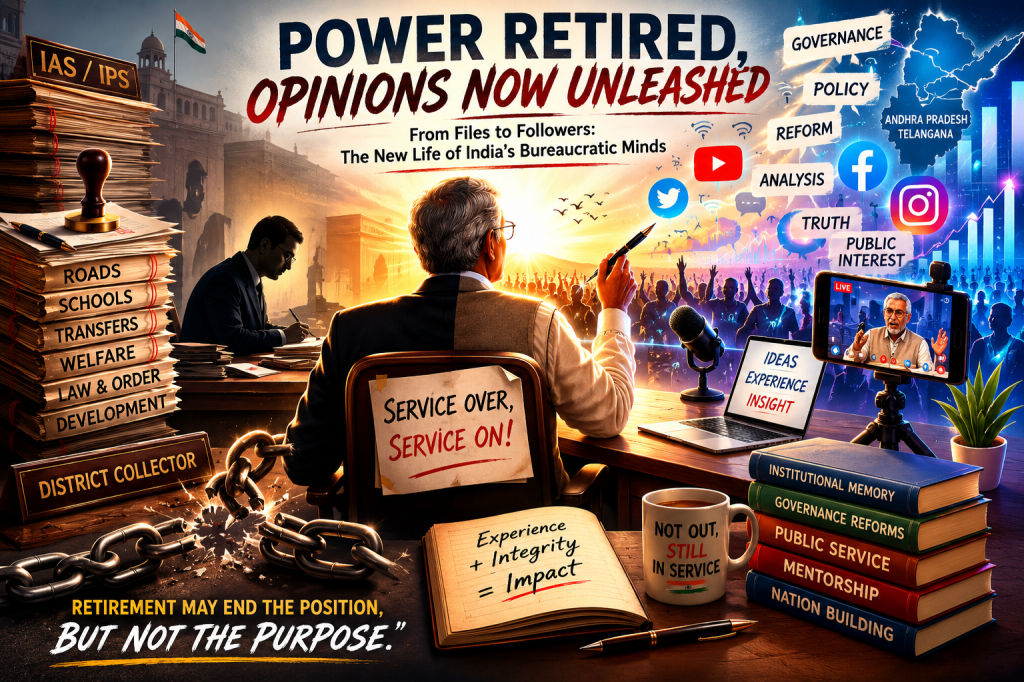
For decades, they occupied the invisible throne of governance. Their signatures sanctioned roads, approved schools, transferred officials, regulated institutions, and shaped the everyday realities of millions of citizens. They were the custodians of the administrative state, operating within a culture that prized neutrality, discretion, and anonymity above personal visibility. Yet across many states , a fascinating transformation is unfolding. Retired bureaucrats—former IAS, IPS, and allied service officers—are increasingly emerging as social media influencers, television commentators, YouTube analysts, and self-styled public intellectuals. Having spent much of their careers speaking through files, they now speak directly to society. This transition from administrative authority to digital activism raises one of the most provocative questions in contemporary public life: why do so many discover their reformist zeal only after relinquishing the power to implement it?
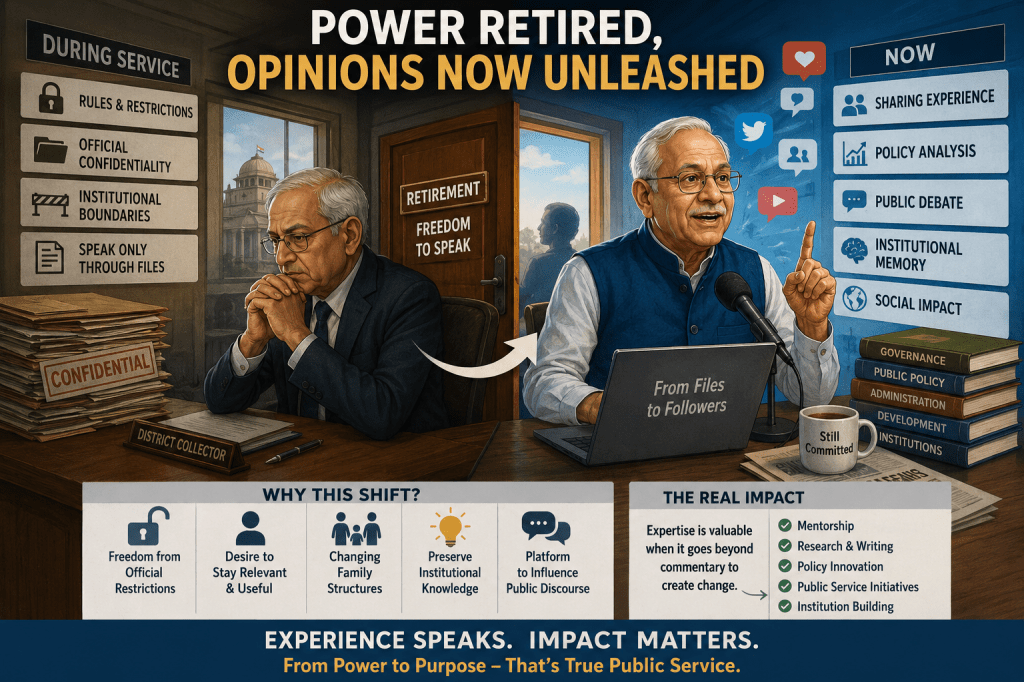
The phenomenon reflects a broader shift in the relationship between expertise and public discourse. In an age dominated by instant commentary, retired civil servants possess a rare commodity—insider knowledge. Their understanding of governance machinery, policy formulation, institutional bottlenecks, and political dynamics offers perspectives unavailable to ordinary observers. Consequently, audiences are drawn to their analyses of education reforms, law and order challenges, urban planning failures, environmental concerns, and welfare delivery systems. Their interventions often enrich democratic debate by translating bureaucratic complexity into public understanding. Yet the admiration they receive is frequently accompanied by skepticism. Citizens listen carefully, but many also wonder whether these insights would have been more valuable when these officers commanded districts, departments, and state institutions.
At the heart of this skepticism lies a fundamental contradiction between authority and hindsight. During service, bureaucrats function within a highly structured ecosystem governed by hierarchy, political accountability, and institutional discipline. They are expected to implement policies formulated by elected governments rather than publicly challenge them. Professional survival often depends upon balancing idealism with pragmatism, conviction with restraint, and innovation with political feasibility. Public dissent can invite transfers, stalled promotions, or institutional marginalization. Retirement, however, dissolves these constraints. Freed from official obligations and career consequences, many officers suddenly articulate opinions with remarkable clarity and confidence. What was once expressed cautiously within conference rooms now appears boldly on television panels and social media timelines.
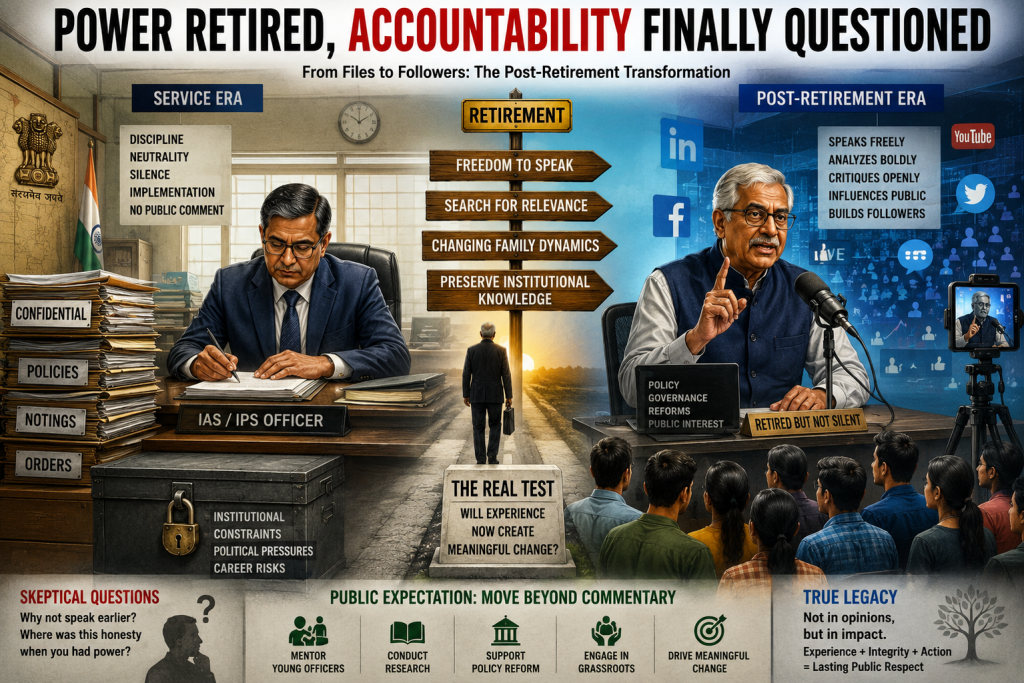
This transformation inevitably fuels accusations of retrospective courage. Critics argue that identifying systemic flaws after retirement is easier than confronting them while in office. Public memory tends to be unforgiving toward those perceived as silent beneficiaries of the very systems they later criticize. Consequently, some retired officers face an implicit charge that their activism represents an attempt to reconstruct their legacy rather than reform society. The question often posed by citizens is deceptively simple: if the problems were so evident, why were they not addressed when authority and opportunity existed? While such criticism may appear harsh, it reflects a legitimate concern regarding consistency between past action and present advocacy.
Yet dismissing retired bureaucratic activism as mere hypocrisy would be intellectually shallow. Human psychology offers a more nuanced explanation. Bureaucratic careers are not simply professions; they are identities. For three or four decades, senior officers inhabit an ecosystem where influence, relevance, and public recognition are woven into everyday life. Retirement abruptly dismantles this architecture. Official residences must be vacated, government vehicles disappear, staff support vanishes, and the daily deference associated with office evaporates. The transition can be psychologically jarring. Individuals accustomed to being decision-makers suddenly find themselves observers. In this vacuum, digital platforms offer a compelling alternative arena where accumulated expertise can still command attention and where influence can be rebuilt without formal authority.
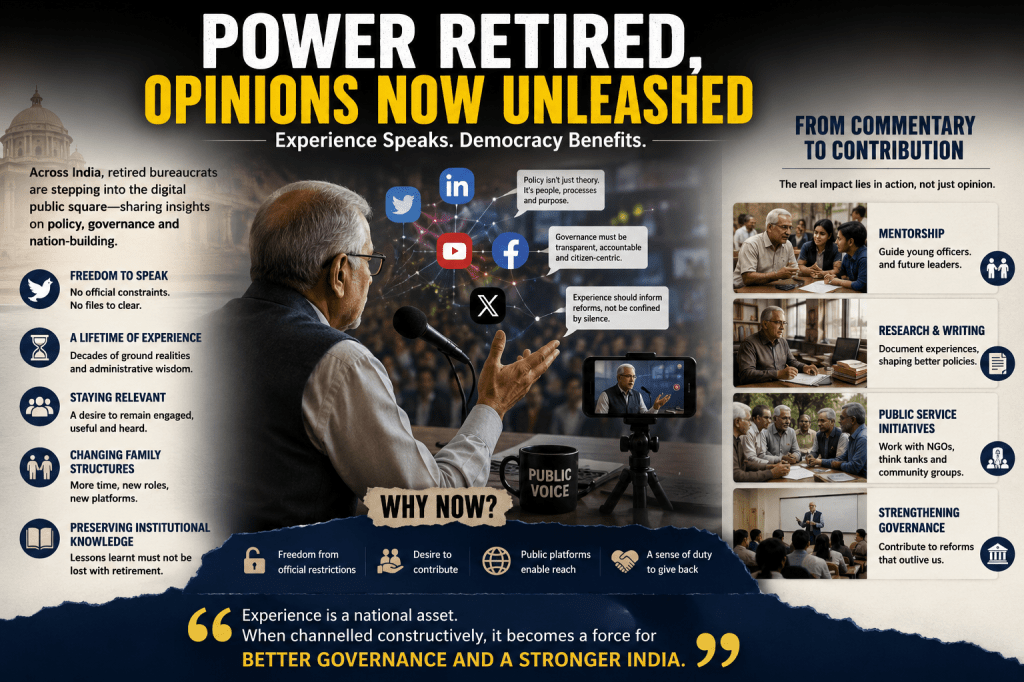
The social transformations occurring within Indian families further intensify this search for relevance. Many retired officers belong to a generation shaped by hierarchical institutions and close-knit family structures. Today, however, urbanization, globalization, and migration have altered these realities. Children frequently live in distant metropolitan centres or foreign countries. Joint families have fragmented into nuclear units. The traditional spaces where elders once transmitted experience and wisdom have shrunk considerably. Social media fills this void by creating a new public audience. Followers replace subordinates, subscribers replace institutional networks, and online engagement substitutes for the validation once provided by official power. The digital sphere becomes both a platform for expression and a mechanism for preserving social significance.
There is also a deeper existential dimension to this phenomenon. Bureaucrats accumulate extraordinary institutional knowledge over decades of service. They witness political transitions, administrative successes, policy failures, social conflicts, and governance innovations. Retirement often confronts them with an unsettling realization: an entire reservoir of practical wisdom may disappear unless consciously shared. Public commentary therefore becomes a means of preserving institutional memory. Many retired officers genuinely believe they are performing a civic duty by documenting lessons learned and highlighting governance challenges. Their observations frequently reveal the complexities hidden beneath simplistic public narratives. In this sense, their contributions can strengthen democratic understanding rather than merely satisfy personal ambitions.
However, governance itself is rarely as straightforward as public commentary sometimes suggests. Particularly in Andhra Pradesh and Telangana, administration operates within a dense web of political calculations, caste dynamics, regional aspirations, economic interests, and competing social pressures. A district collector, police commissioner, or departmental secretary does not possess unlimited freedom to act according to technocratic logic. Every decision requires negotiation among stakeholders with divergent interests. Recognizing these constraints does not absolve bureaucrats of responsibility, but it does explain why many remained cautious during service. The challenge, therefore, is not whether retired officers should speak, but how they speak. Public trust depends upon intellectual honesty—acknowledging not only the failures of current administrations but also the limitations, compromises, and shortcomings that characterized their own tenures.
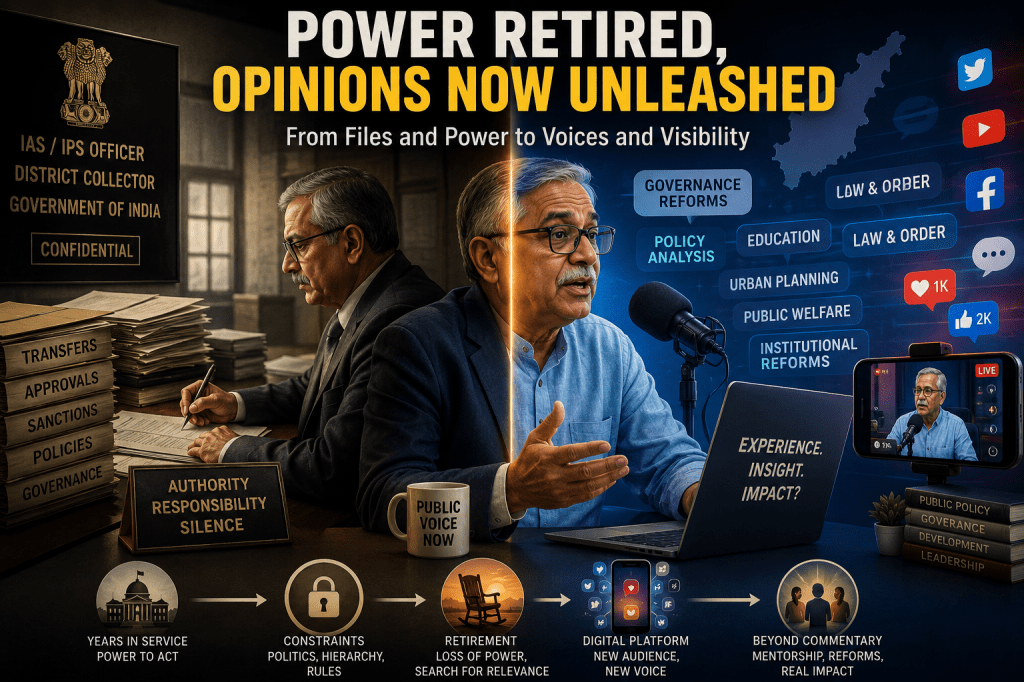
Ultimately, the rise of the retired bureaucrat as a digital activist reflects the complex intersection of experience, ego, public service, relevance, and genuine concern for society. Their voices can enrich public debate, illuminate policy challenges, and bridge the gap between citizens and institutions. Yet commentary alone cannot constitute legacy. The true measure of this new public role lies in whether expertise is transformed into constructive action. If retired officers channel their knowledge into policy research, educational institutions, governance reforms, mentorship programmes, and grassroots initiatives, they can continue serving society in meaningful ways. If their engagement remains confined to television studios and social media platforms, it risks becoming an exercise in post-retirement visibility. Democracies need more than commentators who explain what went wrong; they need experienced administrators willing to demonstrate how governance can be made better. Only then does the digital afterlife of power become a meaningful continuation of public service rather than merely a search for relevance.
VISIT ARJASRIKANTH.IN FOR MORE INSIGHTS

