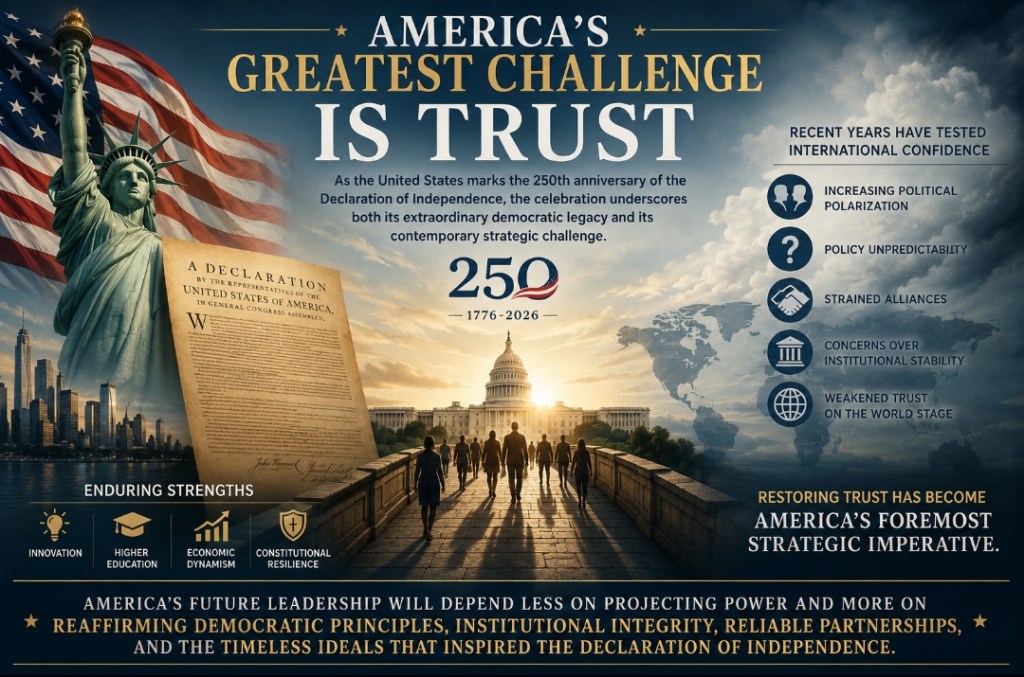
On July 4, 2026, the United States commemorates 250 years since the adoption of the Declaration of Independence, one of history’s most consequential political declarations. This milestone is far more than a celebration of national longevity; it is a tribute to an idea that transformed global politics forever—that governments derive legitimacy from the consent of the governed, that liberty is an inalienable right, and that equality before law is not merely an aspiration but a constitutional obligation. For nearly two and a half centuries, America’s greatest strength was never confined to its military superiority or economic wealth. It was the power of an idea. Nations admired the United States because it appeared to prove that constitutional democracy, institutional resilience, and individual freedom could coexist and flourish. As America enters its third century, however, the celebration unfolds against a difficult backdrop: its most valuable strategic asset—global credibility—has suffered a profound erosion during the second Trump administration.
America’s journey from thirteen fragile colonies to the world’s foremost superpower remains one of history’s most remarkable national transformations. The republic survived civil war, economic collapse, global conflicts, social upheavals, and ideological confrontations because its institutions repeatedly demonstrated an extraordinary capacity for self-correction. Successive generations strengthened rather than abandoned the constitutional framework crafted in the eighteenth century. Waves of immigrants enriched its social fabric, universities became engines of global innovation, scientific breakthroughs reshaped industries, and democratic institutions evolved to expand civil rights. By the late twentieth century, American influence rested not merely upon aircraft carriers, financial markets, or technological dominance, but upon something far more enduring: international confidence in the predictability of its institutions and the integrity of its constitutional order.
This confidence became America’s most powerful form of strategic capital. Throughout the post-war era, countries aligned themselves with Washington not solely because they feared American military capabilities but because they trusted the consistency of its commitments. The United States emerged as the principal architect of a rules-based international order that promoted multilateral institutions, collective security arrangements, open trade, and democratic governance. Its diplomacy, despite periodic inconsistencies and controversial interventions, was generally perceived as anchored in institutional continuity rather than personal political impulses. American credibility functioned as an invisible currency that enhanced alliances, deterred adversaries, stabilized markets, and amplified diplomatic influence across continents.

Yet reputations built painstakingly over centuries can weaken surprisingly quickly when consistency gives way to uncertainty. During the second Trump administration, perceptions of American leadership have deteriorated across many regions of the world. International observers increasingly question whether Washington remains a predictable partner capable of sustaining long-term commitments. Concerns extend beyond specific policy decisions to a broader impression that foreign policy has become excessively personalized, transactional, and driven by domestic political calculations. For allies accustomed to carefully coordinated diplomacy, abrupt policy reversals, confrontational rhetoric, public disagreements, and shifting strategic priorities have generated uncertainty about the durability of American assurances. In international relations, credibility cannot be manufactured through declarations; it is accumulated through reliability.
The consequences reach far beyond diplomatic etiquette. Strategic alliances thrive on confidence that commitments made today will remain valid tomorrow. When predictability diminishes, even close partners begin diversifying their security arrangements, economic partnerships, and diplomatic engagements. Europe increasingly debates strategic autonomy. Several Asian partners seek greater regional balancing. Emerging powers hedge their relationships more cautiously. Such developments do not necessarily reflect hostility toward America; rather, they reveal a rational adaptation to perceived uncertainty. History repeatedly demonstrates that trust, once eroded, is among the most difficult strategic assets to rebuild because credibility depends upon sustained behaviour rather than persuasive communication.
Domestic developments have further complicated America’s global image. Political polarization has reached extraordinary levels, institutional confidence has weakened, and ideological divisions increasingly define public discourse. Disputes over immigration, voting rights, judicial independence, economic inequality, media credibility, and democratic norms have produced an image of a nation struggling with its own constitutional equilibrium. The United States has always experienced political conflict, yet previous generations generally projected institutional resilience despite internal disagreements. Today, domestic instability is amplified instantly through global media, shaping international perceptions of American governance. A nation that appears deeply divided internally inevitably faces greater difficulty persuading others of the superiority of its democratic model abroad.

Perhaps the greatest irony surrounding America’s 250th anniversary is the risk that the celebration becomes focused on personalities rather than principles. The Declaration of Independence belongs neither to any president nor to any political party. It belongs equally to every generation of Americans because it embodies universal ideals that transcend electoral cycles. Liberty, constitutional governance, representative institutions, equality before law, and respect for individual dignity remain timeless aspirations rather than partisan achievements. Allowing this historic milestone to become identified with contemporary political divisions diminishes the enduring philosophical significance of 1776. The anniversary should remind citizens that the republic’s legitimacy rests upon constitutional values, not upon the popularity or personality of any individual leader.
None of this suggests that American decline is inevitable or irreversible. The country’s structural strengths remain exceptional. Its universities continue leading global scientific research. Its technological ecosystem drives innovation in artificial intelligence, biotechnology, aerospace, finance, and digital infrastructure. Its economy remains among the world’s largest and most dynamic. Its judiciary, federal institutions, entrepreneurial culture, and civil society retain enormous adaptive capacity. Most importantly, the American Constitution has repeatedly demonstrated remarkable resilience through periods of profound national crisis. The foundations of American power therefore remain largely intact. What has weakened is confidence in how those foundations are being managed and projected to the world.
History teaches that great powers rarely lose influence simply because competitors become stronger. More often, they diminish because they gradually abandon the very principles that once inspired confidence beyond their borders. America’s greatest export has never been military hardware, financial capital, or technological innovation alone. It has been the belief that constitutional democracy can provide both freedom and stability. If the United States wishes to reclaim its moral leadership during its third century, it must restore predictability, strengthen institutional integrity, rebuild alliances through respectful engagement, and demonstrate that democratic values remain its guiding compass rather than its campaign rhetoric. At 250, America’s defining challenge is not preserving power—it is recovering trust. Only by renewing the ideals of 1776 can the republic once again become not merely the world’s strongest nation, but one of its most trusted.
VISIT ARJASRIKANTH.IN FOR MORE INSIGHTS


One response to ““The Statue of Liberty Casts a Shadow: America at 250 and the Cost of Losing the World’s Trust””
The author reveals a very genuine and quite realistic assessment of the present scenario these days, the America is facing globally. His views are unbiased and highly balanced.He is critical and shrewd in his approach to enlighten the minds of the readers.It helps igniting the minds of American readers to introspect and enact for restoration of the pride of their great nation. Simultaneously,the people outside America feel that their geniune concerns are highlighted appropriately. A comprehensive narration, worth reading.
Thank you author.
LikeLike