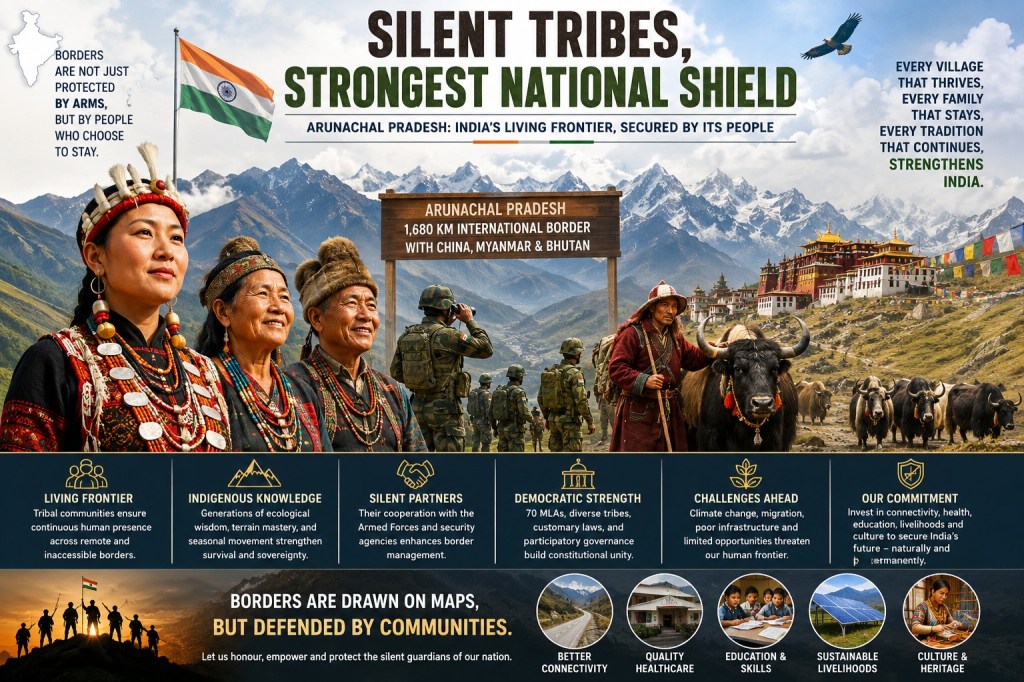
Modern nations often measure national security through military budgets, sophisticated surveillance systems, satellites, missiles, and fortified borders. Yet India’s first and most enduring line of defence is frequently neither technological nor military. It lives quietly in the remote mountains of Arunachal Pradesh, where indigenous communities have transformed everyday existence into an extraordinary act of national service. Stretching across nearly 1,680 kilometres of international borders with China, Myanmar, and Bhutan, Arunachal Pradesh is not merely a frontier state; it is one of India’s most strategic civilizational frontiers. Here, sovereignty is not defended only by soldiers but also by ordinary citizens whose uninterrupted presence across some of the world’s most inhospitable landscapes gives tangible meaning to the Republic’s territorial integrity. In these mountains, patriotism is neither ceremonial nor symbolic—it is lived every single day.
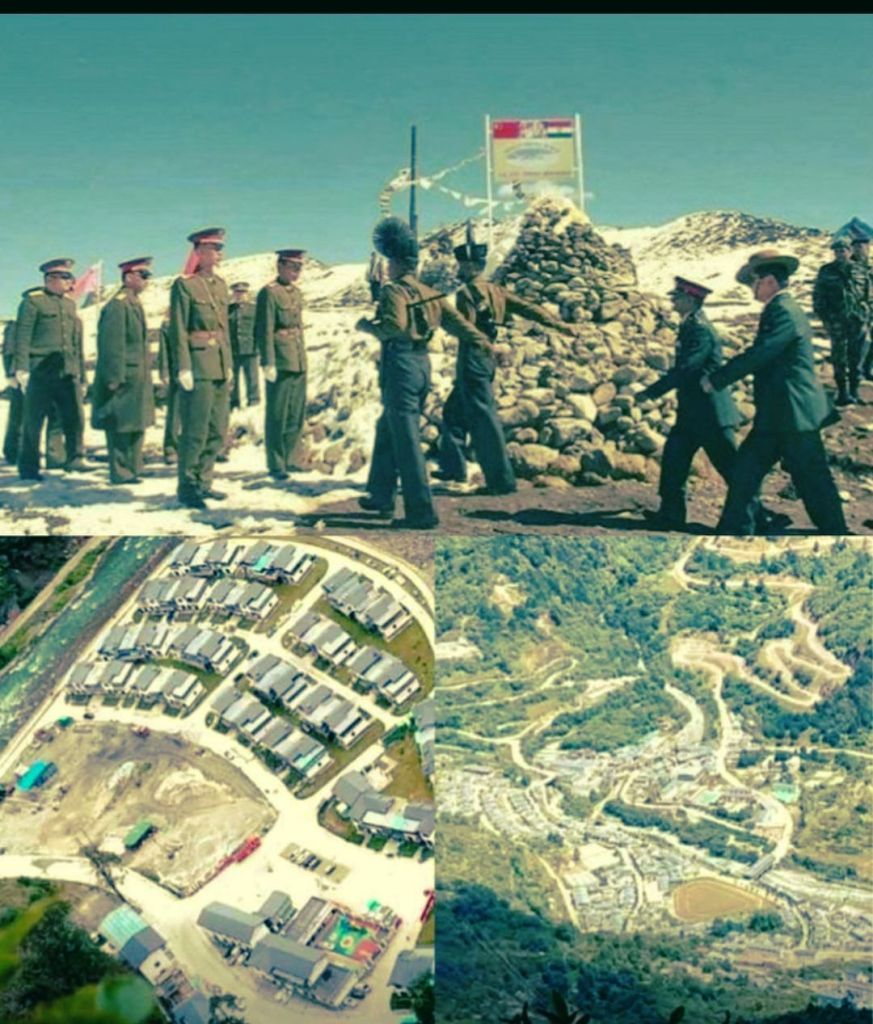
The geographical realities of Arunachal Pradesh make conventional border management exceptionally challenging. More than eighty percent of the state is covered by dense forests, while towering Himalayan peaks, deep river valleys, glaciated passes, unpredictable weather, and fragile transport infrastructure severely restrict administrative access. Many settlements remain isolated for significant periods each year, making permanent state presence difficult. No satellite, drone, sensor, or surveillance network can continuously occupy every ridge, valley, grazing ground, or mountain trail. It is the indigenous inhabitants who provide this indispensable human continuity. Every inhabited village, cultivated terrace, monastery, grazing pasture, and traditional pathway becomes a living assertion of India’s sovereignty. The lesson is profound: borders are ultimately secured not merely through fortifications but through communities that choose to remain rooted where geography itself discourages habitation.

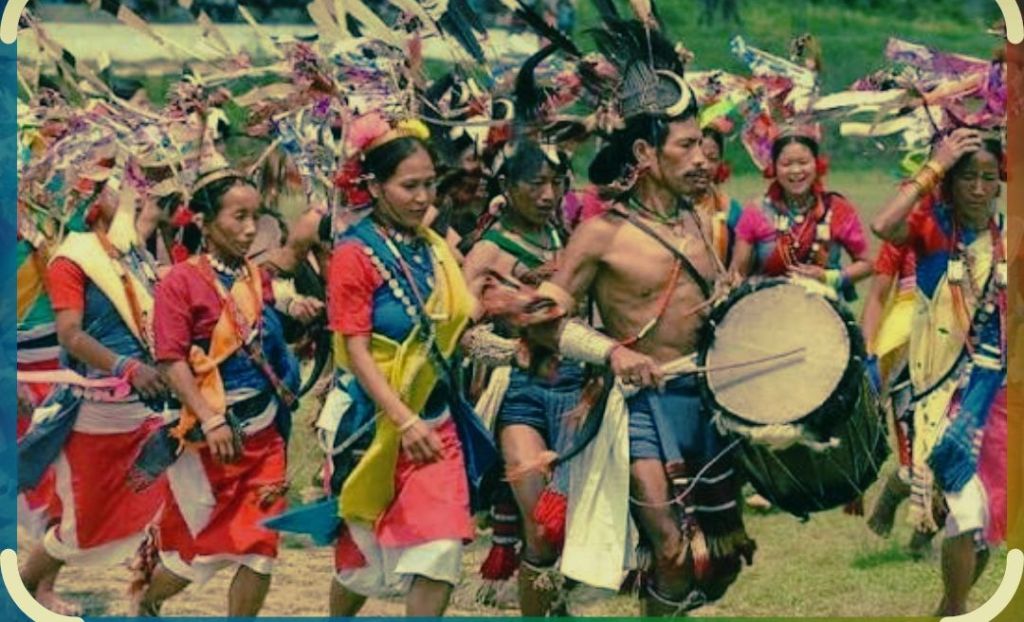
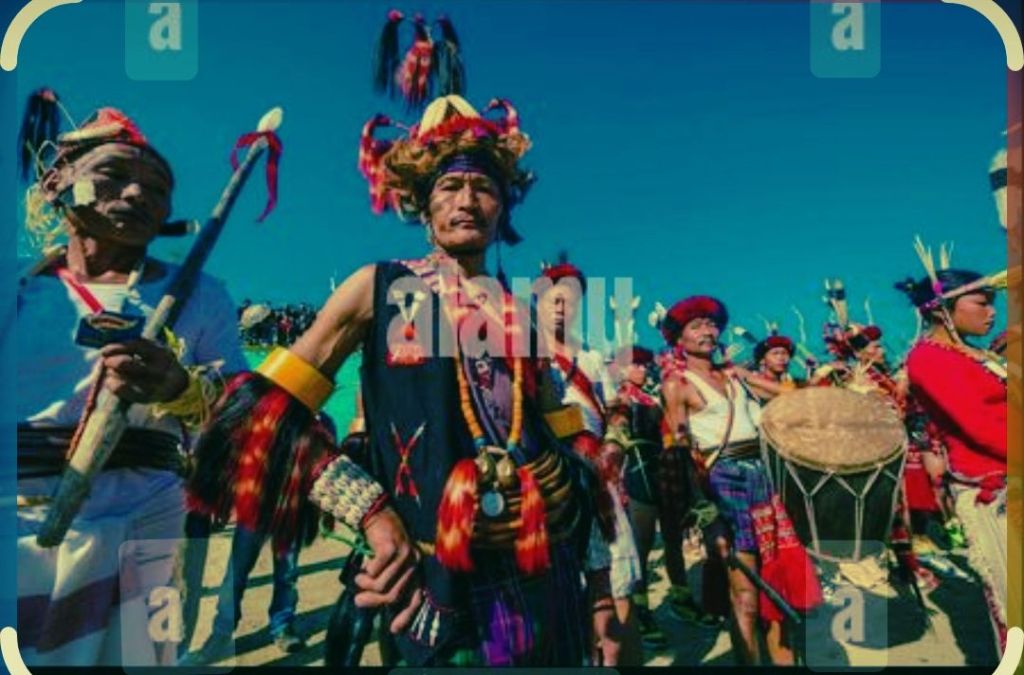
Arunachal Pradesh’s extraordinary tribal diversity is simultaneously a cultural treasure and a strategic advantage. More than twenty-six major tribes and numerous sub-tribes have evolved distinctive systems of governance, ecological adaptation, and community resilience across diverse ecological zones. The Monpas have preserved centuries-old Buddhist traditions in the high-altitude regions around Tawang. The Membas and Mishmis have mastered life in some of the most demanding Himalayan valleys. The Nyishi, Adi, Apatani, Galo, Tagin, Sherdukpen, Aka (Hruso), Nocte, Wancho, Tangsa, Singpho, Lisu, and many other communities collectively represent one of India’s richest civilizational mosaics. They differ in language, customs, attire, and belief systems, yet together they create an unbroken human landscape that strengthens India’s strategic presence. Their diversity has never weakened national unity; instead, it has transformed cultural pluralism into a powerful instrument of territorial permanence.
Among these remarkable frontier communities, the Brokpas occupy a particularly distinctive place. As traditional nomadic yak herders closely associated with the Monpa cultural landscape, they undertake seasonal migrations across alpine meadows situated between 9,000 and 15,000 feet above sea level. Their survival depends upon an intimate understanding of mountain ecology, glaciers, weather patterns, grazing cycles, and high-altitude adaptation acquired through generations of lived experience. The yak sustains every dimension of their existence—transport, nutrition, clothing, trade, and cultural identity. More importantly, their seasonal movements ensure continuous human presence across remote Himalayan regions where permanent settlements remain sparse. The Brokpas demonstrate that indigenous knowledge is not merely anthropological heritage; it is a strategic national asset that reinforces India’s physical presence across sensitive frontier landscapes.

Perhaps the most remarkable contribution of Arunachal’s tribal communities lies in their silent partnership with the Indian state. They wear no uniforms, hold no military rank, and seldom receive public recognition, yet their knowledge of forests, mountain passes, rivers, and isolated settlements makes them indispensable stakeholders in border management. Their observations often complement the efforts of the Indian Army, the Indo-Tibetan Border Police, and other security agencies operating under extraordinarily difficult conditions. Their continued habitation prevents strategic vacuums that hostile forces could potentially exploit. This partnership illustrates a sophisticated understanding of national security in which civilian resilience and military preparedness reinforce each other. In Arunachal Pradesh, sovereignty is protected not only through deployments but through communities whose everyday lives sustain the Republic’s frontier.
Equally significant is Arunachal Pradesh’s remarkable model of democratic governance. With Sixty Members of the Legislative Assembly representing diverse tribal societies, governance requires continuous dialogue between constitutional institutions and customary traditions. Tribal customary laws continue to influence land ownership, inheritance, dispute resolution, resource management, and community decision-making. Consequently, governance cannot rely upon uniform administrative models designed elsewhere. Infrastructure development, healthcare, education, telecommunications, and welfare programmes succeed only when they respect local institutions and cultural practices. Administrative legitimacy in Arunachal emerges not merely from statutory authority but from community participation, demonstrating that constitutional democracy can successfully accommodate deep cultural diversity while strengthening national integration.
However, these silent guardians confront challenges that extend well beyond geopolitics. Climate change is rapidly transforming fragile Himalayan ecosystems. Shrinking alpine pastures, erratic snowfall, changing rainfall patterns, glacial retreat, and biodiversity loss increasingly threaten traditional livelihoods. Simultaneously, expanding educational opportunities and economic aspirations encourage younger generations to migrate towards urban centres. Limited healthcare, inadequate digital connectivity, restricted market access, insufficient employment opportunities, and fragile physical infrastructure accelerate demographic decline in border villages. The consequences extend beyond cultural loss. If frontier settlements weaken, India risks diminishing one of its most effective strategic assets—a permanent indigenous presence that no artificial intelligence, satellite constellation, drone network, or military installation can completely replace. Sustainable border security ultimately depends upon sustainable border communities.
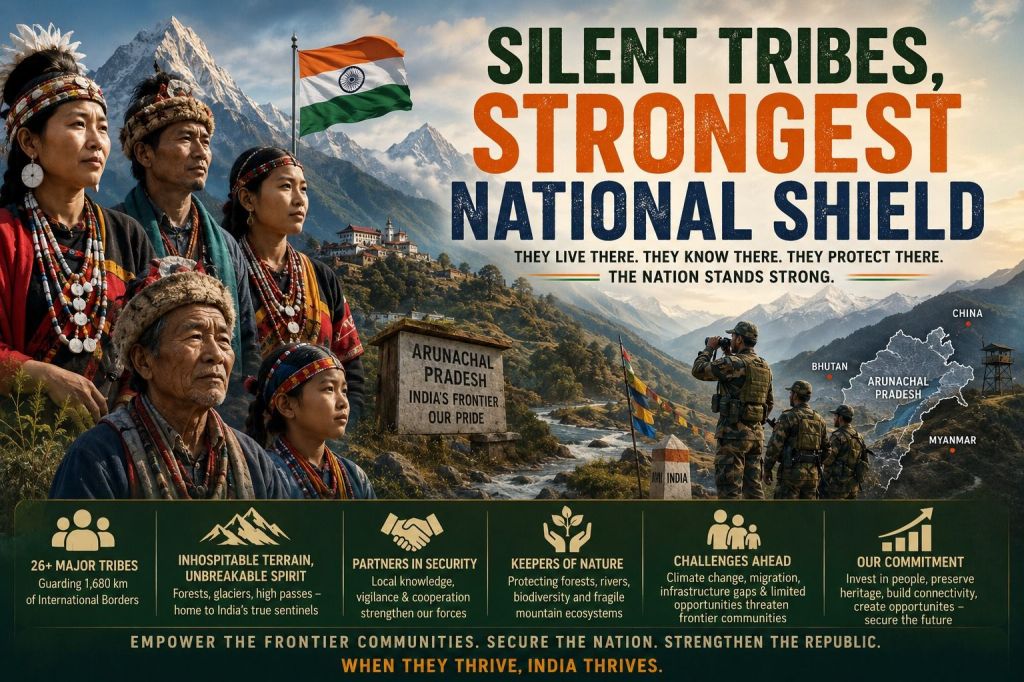
India therefore requires a broader understanding of national security—one that recognises frontier communities not merely as beneficiaries of welfare but as equal partners in sovereignty, environmental stewardship, constitutional governance, and strategic resilience. Investments in all-weather roads, quality healthcare, modern education, digital infrastructure, climate-resilient livelihoods, sustainable tourism, indigenous entrepreneurship, and preservation of traditional ecological knowledge are not acts of regional development alone; they are investments in India’s long-term strategic stability. Arunachal Pradesh offers the Republic a timeless lesson: the strength of a nation is measured not only by the sophistication of its weapons but by the resilience of its people. In the silent forests, icy passes, remote valleys, and ancient mountain trails of Arunachal, patriotism speaks dozens of tribal languages, follows diverse cultural traditions, and wears many identities. Yet every village that survives, every family that remains, and every community that continues to call these mountains home silently strengthens the sovereignty, security, and constitutional unity of India.
VISIT ARJASRIKANTH.IN FOR MORE INSIGHTS

