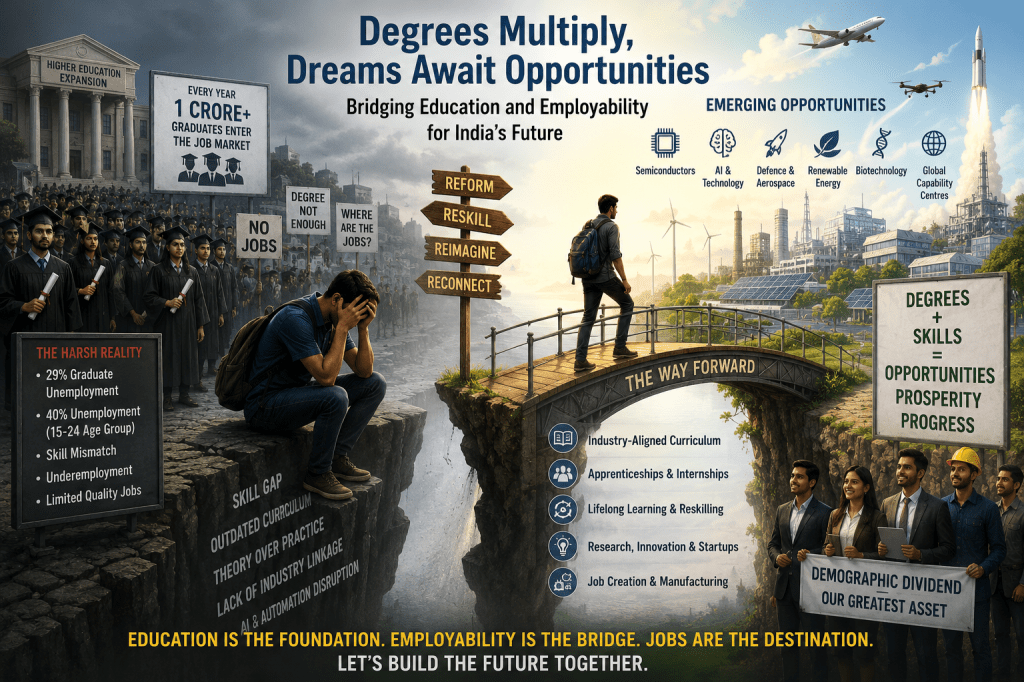
India stands at one of the most extraordinary yet paradoxical moments in its development journey. Never before has the nation produced such a vast number of graduates, engineers, and professionally qualified youth. Never before has access to higher education expanded so rapidly across urban and rural India. Yet, at the very moment when educational attainment is reaching historic highs, anxiety among educated young Indians has become increasingly visible. The country that proudly celebrates its demographic dividend now finds itself confronting a disturbing contradiction: millions of young people are acquiring degrees but struggling to secure meaningful employment. Educated unemployment has evolved from an isolated labour market issue into one of the most significant socioeconomic challenges facing contemporary India.

The scale of educational expansion over the past decade has been unprecedented. Nearly 15,000 new colleges have been added, bringing the total number of colleges to approximately 53,000 and universities to around 1,400. Engineering education emerged as the centrepiece of this expansion, symbolizing India’s aspirations to become a global knowledge economy. For the academic year 2025-26 alone, the All India Council for Technical Education approved nearly 16 lakh engineering seats across 5,875 institutions. Every year, India now produces close to 10 million graduates, including approximately 2.5 million graduates in science, technology, engineering, and mathematics. Few countries in the world can match such educational output. However, the economy has failed to generate a proportional number of high-quality jobs, creating a widening gap between academic achievement and economic opportunity.

Nowhere is this imbalance more evident than in the engineering sector. During 2025-26, nearly 12.5 lakh engineering graduates entered the labour market, competing for roughly 4.5 lakh available opportunities. Only around 3.6 lakh secured placements. The remaining graduates entered an increasingly crowded and uncertain employment landscape. This is not a cyclical downturn caused by temporary economic weakness; it represents a structural mismatch between the supply of graduates and the demand for skilled labour. India continues to produce engineers on an industrial scale while generating only a fraction of the professional opportunities necessary to absorb them. The consequence is the emergence of a degree-driven economy where educational qualifications are expanding far more rapidly than productive employment.

The unemployment statistics reveal an even more troubling picture. Graduate unemployment among young people is estimated at nearly 29 percent, while unemployment in the 15–24 age group approaches 40 percent. Overall graduate unemployment remains significantly higher than the national average. Equally concerning is the issue of employability. Numerous studies suggest that barely half of all graduates possess the skills required by modern employers. In engineering, some assessments indicate that more than 80 percent struggle to secure relevant employment, internships, or industry exposure. Even among those who find jobs, many are employed in positions that neither match their qualifications nor provide adequate compensation. Beneath the official employment figures lies a vast reservoir of underemployment, where degrees exist but productive utilization of talent remains elusive.

A major contributor to this crisis is the persistent disconnect between academia and industry. Much of India’s higher education system continues to prioritize examinations, memorization, and theoretical instruction over practical problem-solving and workplace readiness. Students often complete degrees without meaningful exposure to industrial environments, research laboratories, emerging technologies, or real-world projects. Meanwhile, employers increasingly seek expertise in artificial intelligence, cybersecurity, semiconductor technologies, robotics, advanced manufacturing, data science, renewable energy systems, and digital transformation. Beyond technical competence, industries demand communication skills, adaptability, teamwork, creativity, and critical thinking. Unfortunately, these competencies remain inadequately integrated into large segments of the educational ecosystem, leaving graduates academically qualified but professionally unprepared.
The rapid rise of artificial intelligence has further complicated the employment landscape. For nearly three decades, India’s engineering employment model relied heavily on information technology services, which accounted for a substantial share of graduate recruitment. Today, AI-driven automation is reshaping this model. Routine coding, software testing, maintenance functions, and back-office processes that once served as entry points for fresh graduates are increasingly being automated. While new opportunities are emerging in AI development, machine learning, prompt engineering, algorithm auditing, digital transformation consulting, and intelligent systems management, educational institutions have struggled to adapt their curricula at the pace demanded by technological disruption. As a result, the gap between classroom learning and workplace requirements continues to widen.

The consequences of educated unemployment extend far beyond economics. When education fails to deliver opportunity, frustration inevitably acquires social and political dimensions. Across India, protests demanding recruitment notifications, government vacancies, examination schedules, and employment guarantees have become increasingly common. The rise of online movements expressing frustration with the employment ecosystem reflects a generation grappling with uncertainty and disillusionment. More concerning are the psychological consequences. Rising levels of stress, anxiety, depression, delayed family formation, financial dependence, and even suicides linked to unemployment reveal the human cost of unmet aspirations. Education creates expectations of upward mobility. When those expectations collide with limited opportunities, the resulting disappointment can erode social cohesion and weaken confidence in institutions.

Yet India’s future remains far from predetermined. Significant opportunities are emerging in defence manufacturing, aerospace, semiconductors, renewable energy, electric mobility, advanced materials, biotechnology, artificial intelligence, space technology, and Global Capability Centres. Government initiatives such as Skill India, PM-SETU, Startup India, Make in India, and the National Education Policy provide important foundations for reform. However, incremental adjustments will not be sufficient. India requires a fundamental redesign of its education-to-employment ecosystem. Industry participation in curriculum development must become mandatory. Apprenticeships and internships should be integrated into every degree programme. Research and development investments must increase dramatically to generate innovation-led employment. Manufacturing expansion must accelerate to absorb technical talent at scale. Equally critical is the establishment of lifelong learning systems that enable workers to continuously upgrade skills in an era of rapid technological change.

India’s demographic dividend remains one of the greatest opportunities in modern economic history, but dividends materialize only when assets are productively utilized. A nation that produces millions of graduates while creating too few quality jobs risks transforming its greatest strength into a source of instability. The challenge before India is no longer simply educational expansion; it is the creation of an ecosystem where education translates into employability, productivity, innovation, and prosperity. Degrees without opportunities generate frustration rather than progress. The future of India’s growth story will depend not on how many graduates it produces, but on how effectively it transforms those graduates into a skilled, confident, and productively employed workforce. If that transformation succeeds, the demographic dividend will power India’s rise. If it fails, the degree may become the most expensive symbol of unrealized aspiration.
VISIT ARJASRIKANTH.IN FOR MORE INSIGHTS

