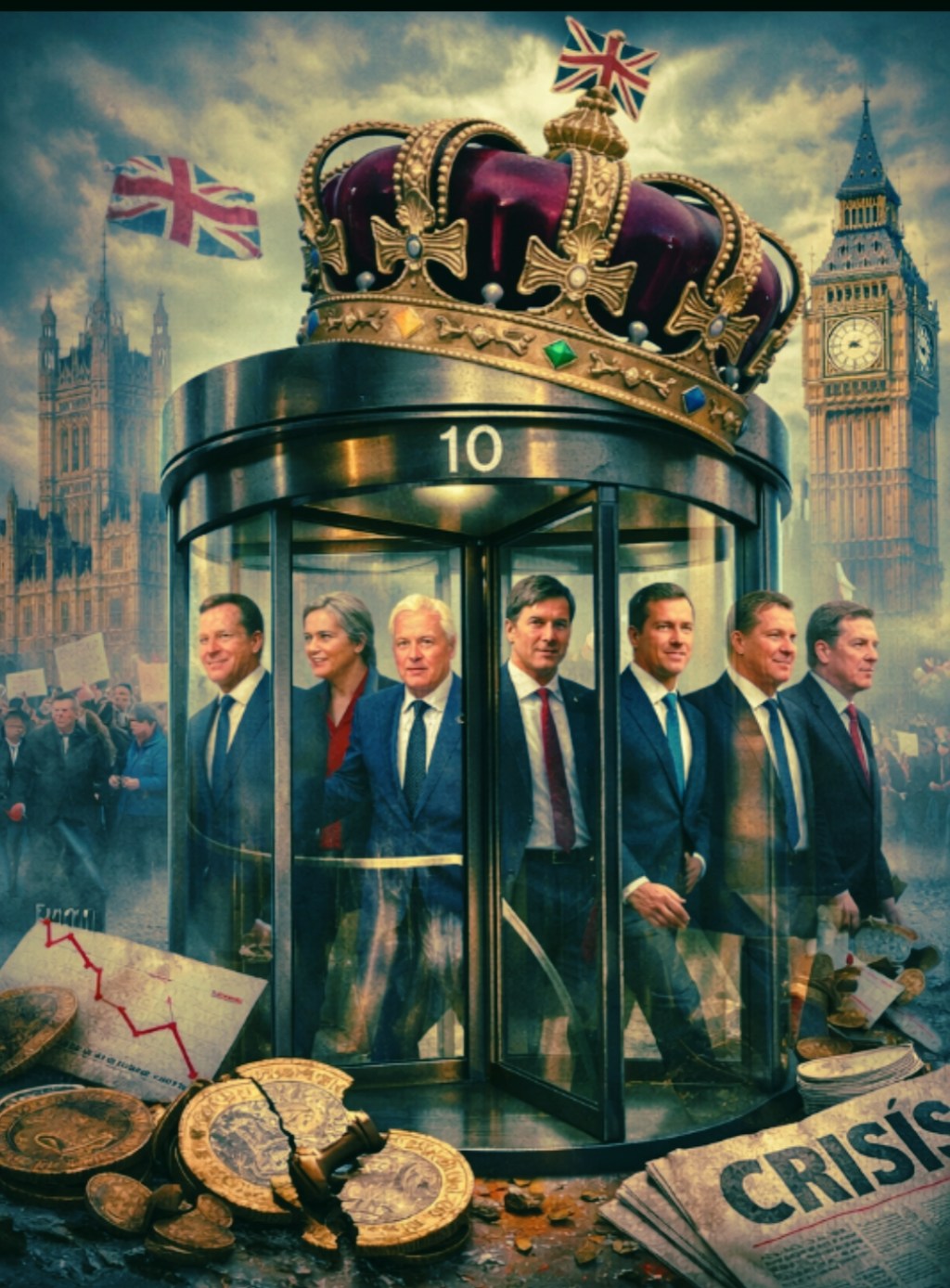
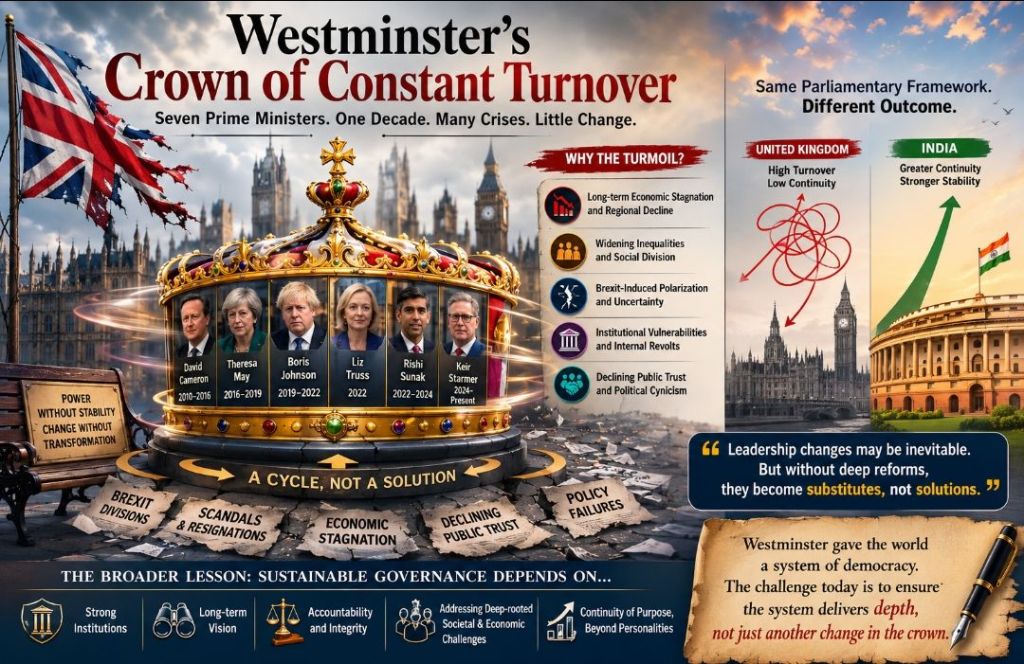
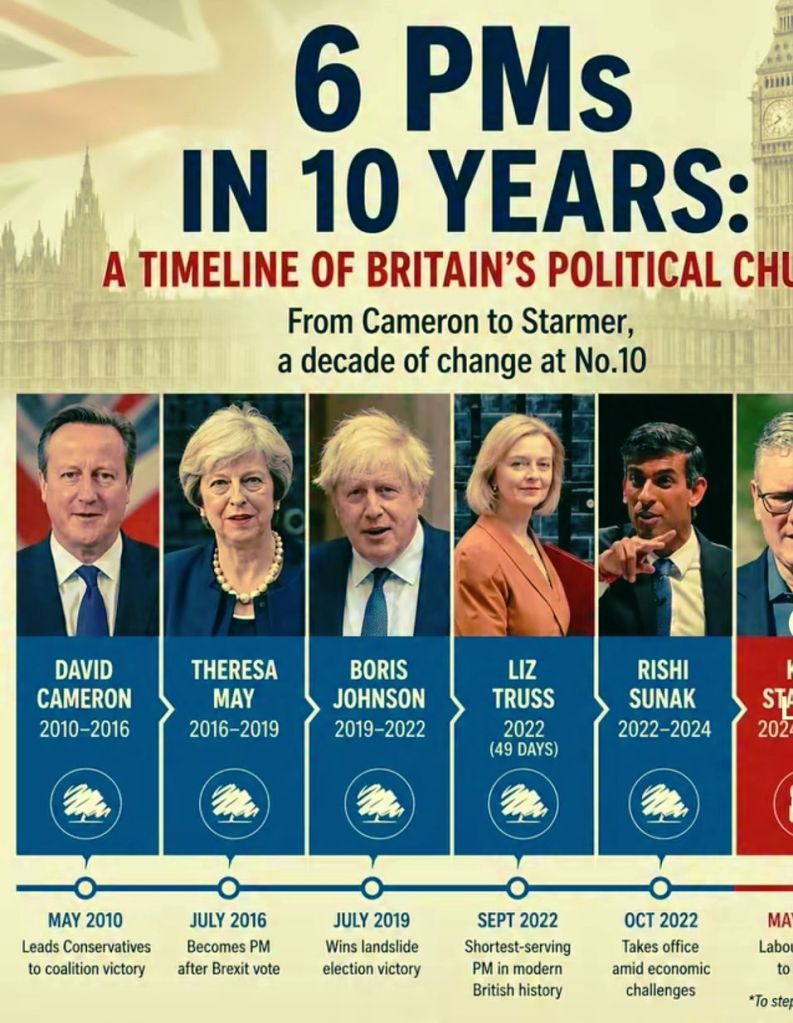
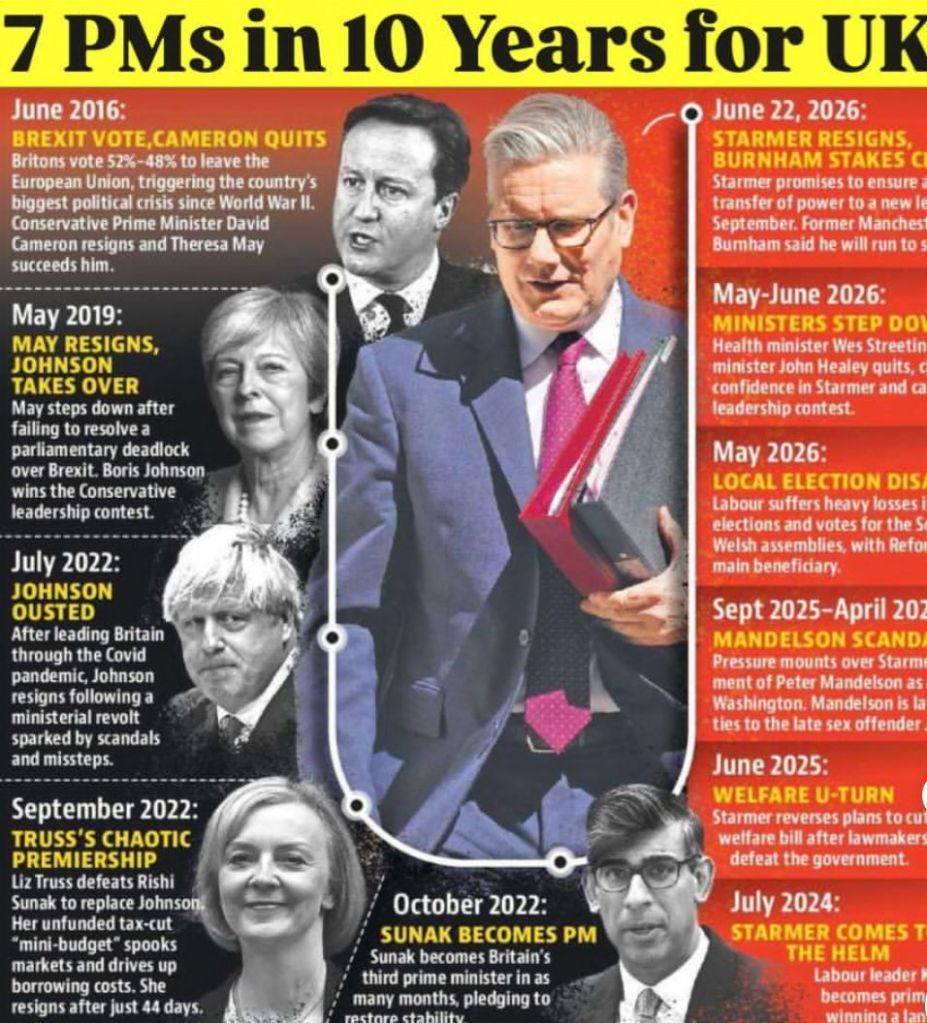
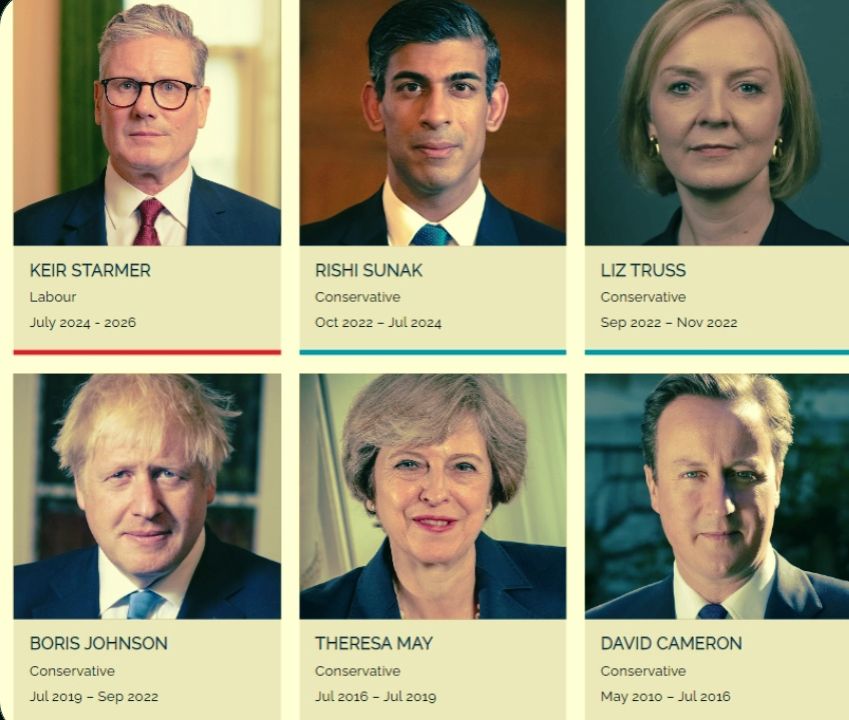
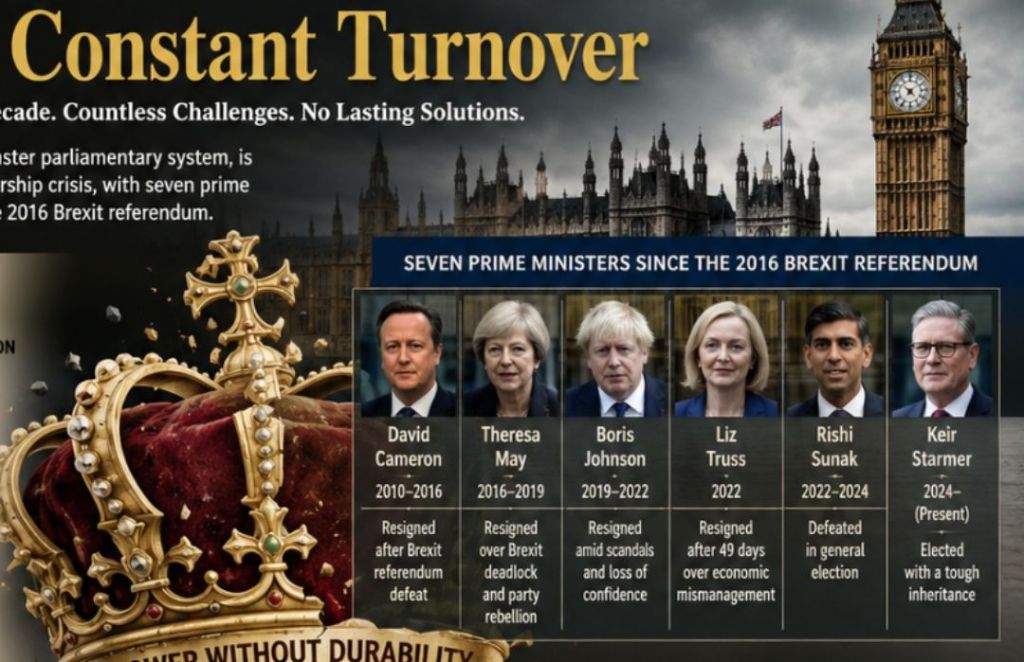
History occasionally produces ironies so profound that they appear almost fictional. The United Kingdom, the birthplace of the Westminster model of parliamentary democracy and the nation that exported its institutions across continents, now finds itself confronting a crisis of political continuity at the highest level of government. Since the Brexit referendum of 2016, Britain has witnessed an extraordinary procession of prime ministers entering and exiting 10 Downing Street with unprecedented frequency. David Cameron resigned after losing the referendum he had initiated. Theresa May fell after failing to secure parliamentary support for her Brexit settlement. Boris Johnson was overwhelmed by scandal and internal rebellion. Liz Truss survived only forty-nine days after financial markets rejected her economic experiment. Rishi Sunak departed following electoral defeat. Keir Starmer, elected with the promise of restoring stability and public confidence, ultimately lost political authority within his own ranks. Britain now stands on the threshold of welcoming its seventh prime minister in less than a decade, an astonishing statistic for a nation once regarded as the global benchmark of parliamentary governance.
To many external observers, the reasons behind these departures often appear surprisingly mundane. A referendum, a scandal, a controversial budget, an internal party dispute, or a decline in popularity may seem insufficient grounds for the repeated collapse of national leadership. However, these visible events are merely triggers rather than causes. The deeper explanation lies within a complex interaction of institutional vulnerabilities, economic stagnation, social fragmentation, and declining public trust. Prime ministers are changing rapidly not because individual leaders are uniquely flawed, but because they are attempting to govern a society facing structural challenges that no single personality can easily resolve. Leadership crises have become symptoms of a broader malaise affecting the British political system itself.
The origins of this instability can be traced to the aftermath of the global financial crisis of 2008. For more than fifteen years, Britain has struggled with sluggish productivity growth, widening regional inequalities, pressure on public services, declining real wages, and persistent questions about economic competitiveness. Brexit, far from resolving these tensions, intensified many of them. It divided communities, fractured traditional political coalitions, disrupted established trade relationships, and revived constitutional debates regarding Scotland and Northern Ireland. Successive governments inherited increasingly complex challenges that demanded long-term structural reforms. Yet political incentives often encouraged short-term tactical responses rather than strategic solutions. The consequence has been a widening gap between public expectations and governmental capacity to deliver meaningful change.
This environment has produced a political culture increasingly dominated by personalities rather than policies. Leadership transitions have become substitutes for substantive reform. When economic conditions fail to improve or public dissatisfaction rises, political parties frequently conclude that replacing the leader is easier than confronting entrenched structural problems. The prime minister becomes a sacrificial figure offered to public frustration, while the underlying economic and social challenges remain largely untouched. Britain has thus entered a cycle where governments change leaders repeatedly without fundamentally altering policy outcomes. Political renewal is promised through new faces, but the systemic constraints confronting each successor remain remarkably similar.
The architecture of the Westminster system itself has amplified these pressures. Unlike presidential systems, where leaders enjoy fixed terms, a British prime minister governs only so long as he or she retains the confidence of parliamentary colleagues. Internal party mechanisms permit leadership challenges that can rapidly destabilize governments. Small groups of dissatisfied legislators possess the ability to trigger contests capable of reshaping national politics. Simultaneously, twenty-four-hour media cycles and social media platforms intensify scrutiny and accelerate political crises. Leaders are increasingly compelled to respond to hourly controversies rather than pursue coherent long-term strategies. Governance becomes reactive, driven by headlines, opinion polls, and internal party management rather than sustained national planning.
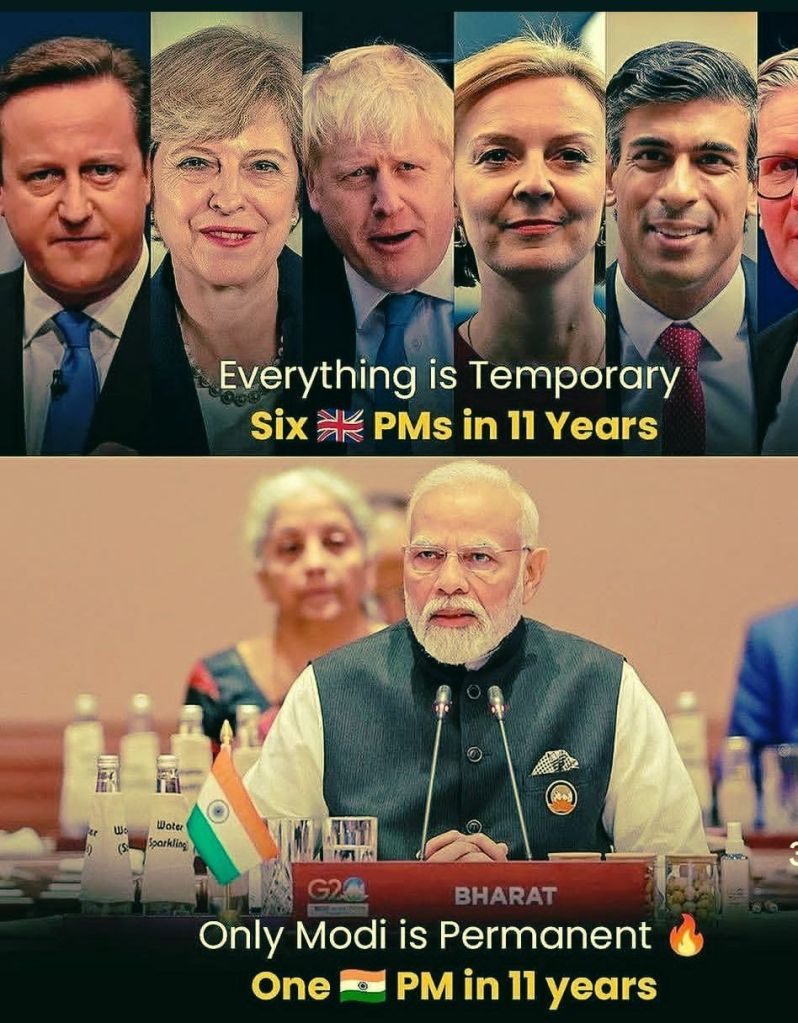
The contrast with India offers a fascinating comparative perspective. Both nations formally operate within the Westminster tradition, yet their political trajectories have diverged significantly. Since 2014, India has experienced a prolonged period of executive continuity under Prime Minister Narendra Modi, who secured a third consecutive mandate in 2024. Strong electoral legitimacy, disciplined party structures, anti-defection safeguards, and a governance model emphasizing long-term developmental objectives have contributed to political stability at the national level. This continuity has enabled policy initiatives to evolve across multiple years without the disruptions caused by repeated leadership transitions. The irony is striking: the nation that created the Westminster model now struggles to sustain leadership within it, while one of its most prominent former colonies has adapted the same framework with greater political durability.
Yet the lesson is not that stability automatically guarantees effective governance, nor that Britain merely requires stronger personalities at the helm. The challenge is fundamentally institutional. Britain may need to reconsider the ease with which leadership contests can be initiated, ensuring governments possess sufficient time to implement policies before facing internal upheaval. Long-term economic planning must be protected from immediate political pressures. Electoral reforms deserve careful examination to strengthen democratic legitimacy and representation. Greater devolution of authority could reduce the excessive concentration of responsibility within the office of the prime minister. Most importantly, British politics requires a governing vision that extends beyond crisis management and media-driven reactions toward a coherent national strategy for the future.

India, meanwhile, should observe Britain’s difficulties with reflection rather than celebration. Political stability is undoubtedly valuable, but excessive concentration of authority can generate risks of its own. Strong institutions, judicial independence, federal balance, internal party democracy, and constitutional accountability remain essential safeguards in any democracy. The objective should never be leadership permanence but rather stability combined with responsiveness and accountability. Ultimately, the rapid turnover of British prime ministers is not a story of individual shortcomings. It is the story of a political system struggling to reconcile rising public expectations with diminishing governing capacity.
Referendums, scandals, budgets, and leadership rebellions merely ignite the fire; the combustible material lies in economic stagnation, institutional fragility, social polarization, and eroding trust. Perhaps the greatest political paradox of the twenty-first century is that the empire which once taught much of the world how to govern now finds itself searching for lessons in stability from nations that once learned governance from it. In history’s grand theatre, few reversals are more remarkable—or more instructive.
VISIT ARJASRIKANTH.IN FOR MORE INSIGHTS

