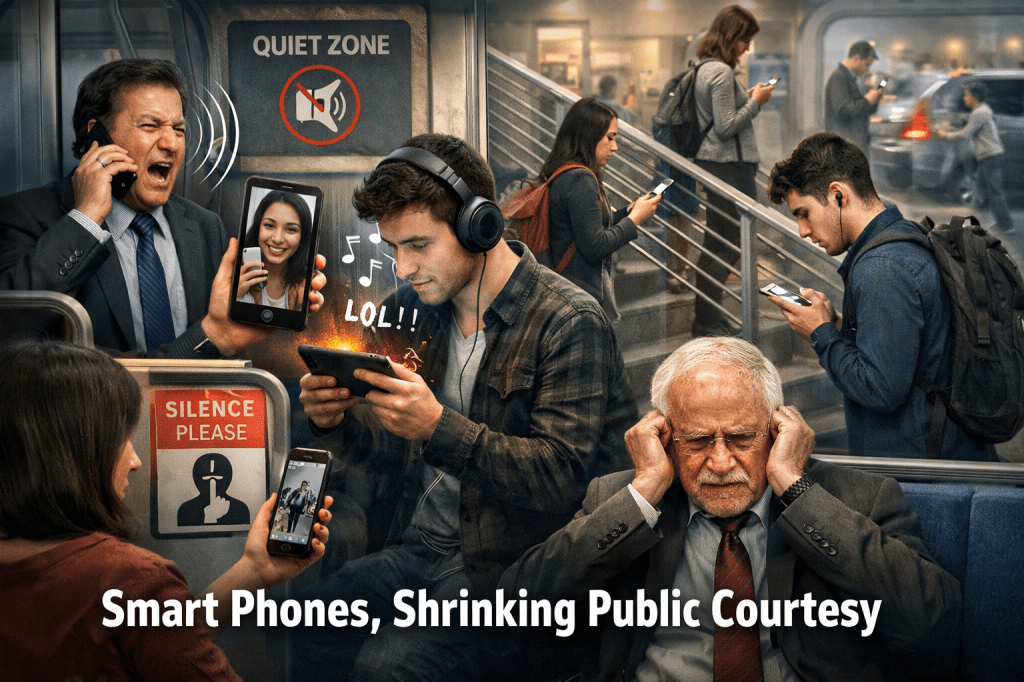
The smartphone is widely regarded as the defining technological artefact of the 21st century—an instrument that has collapsed distances, democratized knowledge, redefined commerce, and placed global connectivity within the palm of the hand. It has empowered individuals in ways previously unimaginable, dissolving barriers of geography, class, and access. Yet, beneath this extraordinary civilizational leap lies an unsettling paradox: the same device that promised universal connection is steadily eroding the most basic foundation of collective urban life—shared silence and public courtesy. The crisis is no longer technological; it is behavioural, even cultural.
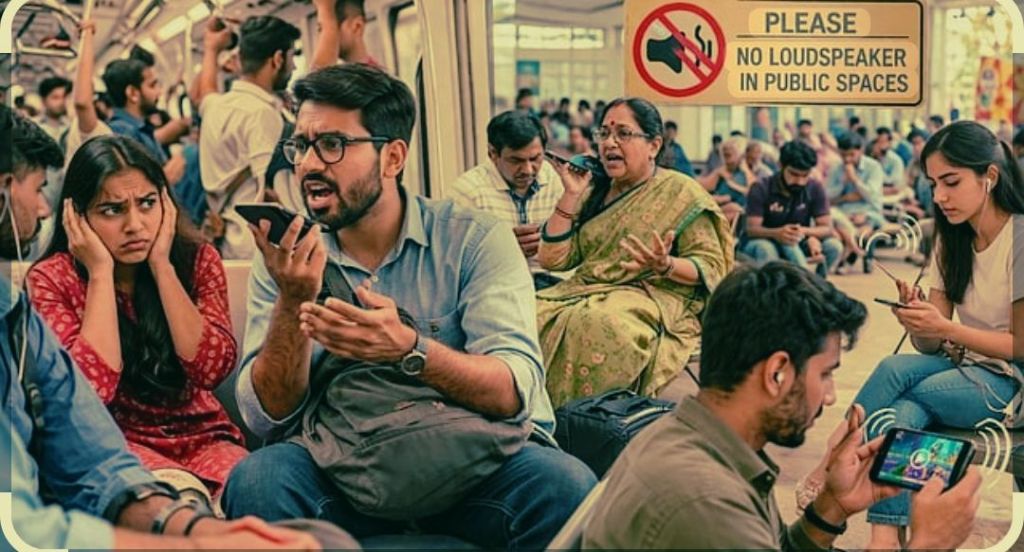
The modern smartphone has evolved far beyond its original function as a communication tool. It has become a personal broadcasting station, continuously transmitting audio, video, and speech into shared environments that were never designed for such intrusion. Public spaces—trains, buses, waiting rooms, corridors, parks—have quietly transformed into involuntary stages for private lives. Loud speaker calls, viral videos played without headphones, and intrusive video conversations have blurred the boundary between private expression and public obligation, producing a new form of ambient social disorder.

The everyday manifestations of this shift are visible across urban life. A commuter conducts a full-volume conversation in a crowded metro carriage as if the compartment were an extension of their living room. A traveller streams short-form videos in a waiting hall, turning silence into forced spectatorship. A pedestrian halts abruptly on a staircase while absorbed in a screen, disrupting the natural flow of movement behind them. A customer at a service counter prolongs queues while engaged in unrelated personal or business calls. Individually trivial, these actions collectively represent a silent breakdown of civic etiquette.
The psychological and social costs of such behavior are more serious than they appear. Human cognition is highly sensitive to speech, which the brain instinctively prioritizes over background noise. As a result, unsolicited conversations in public spaces are not merely distractions but cognitive intrusions. They fragment attention, elevate stress levels, and erode the mental calm that shared environments are meant to provide. Libraries, hospitals, transport hubs, and religious spaces—once sanctuaries of controlled silence—are increasingly forced to compete with uncontrolled digital soundscapes.

The issue extends beyond inconvenience into safety and social trust. Distracted walking caused by smartphone absorption has become a global urban hazard, contributing to collisions, falls, and traffic accidents. Video calls conducted in public expose unsuspecting individuals and surroundings without consent, raising new dimensions of privacy violation. More subtly, repeated exposure to inconsiderate public behaviour normalizes it, weakening the unwritten social contract that sustains coexistence in densely populated societies.
Traditional corrective mechanisms have struggled to contain this phenomenon. Public signage requesting silence is routinely ignored, and verbal reminders often trigger defensiveness rather than reflection. Earbuds and noise-cancelling technologies mitigate some disturbances but fail to address sudden bursts of loud speech or speakerphone usage. In high-density environments such as airports, railway stations, and co-working spaces, sound diffusion makes enforcement difficult, exposing the limitations of design without behavioural alignment.

At its core, the problem reflects a deeper civilizational lag: technological acceleration has far outpaced social adaptation. Society has enthusiastically adopted smartphones but has not evolved equivalent norms governing their public use. Historically, every major technological shift—from automobiles to smoking to public sanitation—has required parallel cultural recalibration through etiquette, regulation, and institutional design. The smartphone era demands a similar evolution: not restriction of technology, but refinement of behavior in shared spaces.
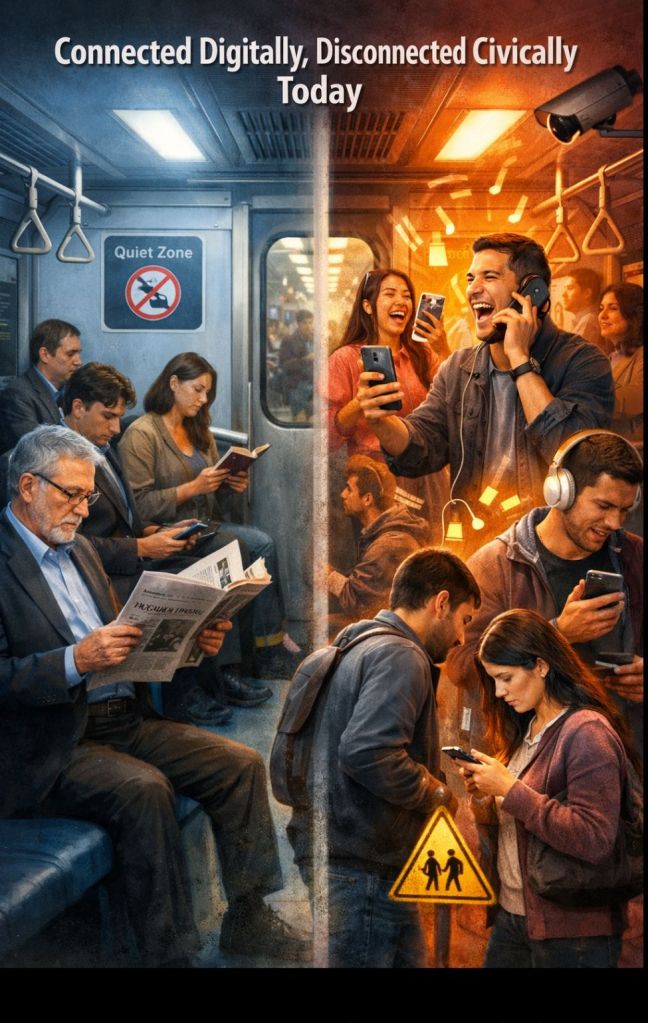
The solution, therefore, lies in a multi-layered framework of responsibility rather than prohibition. Individual discipline remains the first line of defence: using headphones, lowering volume, silencing notifications, and stepping aside for calls are simple yet powerful acts of civic respect. Institutions must reinforce these norms through design—quiet zones in transport systems, phone-free areas in hospitals and libraries, and acoustic booths in workplaces. Technology can assist through contextual intelligence, automatically suggesting silent modes in sensitive environments. Governments, meanwhile, can strengthen awareness campaigns and update nuisance regulations to reflect digital-age realities. Ultimately, the smartphone does not diminish civilization; it tests it. The measure of a modern society will not be the sophistication of its devices, but the sophistication of its restraint in using them.
VISIT ARJASRIKANTH.IN FOR MORE INSIGHTS

