The twenty-first century has delivered India a lesson far more uncomfortable than any military confrontation or economic slowdown: modern national security is no longer decided only at borders, stock exchanges, or diplomatic summits. It is increasingly determined inside kitchens, farms, rooftops, apartment complexes, and neighborhood communities. The Russia–Ukraine war, semiconductor shortages, oil shocks, supply-chain disruptions, and rising protectionism across advanced economies have exposed a brutal strategic truth — globalization may generate prosperity, but it also manufactures dangerous dependencies. India now stands at a historic inflection point where resilience itself must become the new architecture of development.
For nearly three decades, India embraced globalization as a pathway to growth, aspiration, and modernity. The strategy undeniably transformed the country.
Exports expanded, foreign investment flowed in, digital connectivity exploded, and millions escaped poverty. Yet beneath this success, structural vulnerabilities quietly deepened. India continues to import nearly 80–85 percent of its crude oil requirements, meaning every geopolitical tremor in West Asia or Europe instantly transmits inflation into Indian households. Transport costs rise, fertilizers become expensive, food prices increase, and fiscal stability weakens. A nation of 1.4 billion people cannot indefinitely anchor its economic stability to energy decisions taken thousands of kilometers away. Energy dependence is no longer merely an economic concern; it is a strategic liability.

The same fragility extends into the digital ecosystem. India’s technological backbone — cloud infrastructure, operating systems, social media architecture, e-commerce algorithms, semiconductor dependence, and even data storage frameworks — remains heavily influenced or controlled by foreign corporations. This creates not only economic leakage but also a subtle erosion of technological sovereignty. Similarly, India’s dependence on imported edible oils leaves ordinary households exposed to commodity volatility beyond domestic control. Regions dependent on Gulf remittances face vulnerabilities tied to migration shifts and geopolitical instability abroad. What appears interconnected globally may actually be deeply insecure locally.
Yet perhaps the most dangerous dependency is psychological rather than economic. India has normalized a culture of excessive centralized consumption without questioning whether such lifestyles strengthen national resilience or weaken it. Urban households increasingly depend entirely on external systems for food, water, electricity, waste disposal, transportation, and even social interaction. Imported processed foods replace traditional nutrition systems. Disposable consumption generates mountains of waste while simultaneously deepening import dependence. This may appear as modernity, but it is in fact fragility disguised as convenience. A society unable to function for even a few days without uninterrupted supply chains is not truly resilient, regardless of GDP numbers.

Even inflation in India is not always entirely market-driven anymore. Panic itself has evolved into an economic force. Media amplification of shortages often triggers irrational purchasing, artificial scarcity, speculative hoarding, and psychological inflation. In poorly regulated spot markets, perception frequently becomes more powerful than actual supply. Prices rise not merely because commodities are unavailable, but because fear itself becomes monetized. India therefore suffers not only from supply-side constraints, but from a deeper challenge of behavioral economics and public coordination. National resilience cannot be built only through budgets and policies; it must also emerge through disciplined civic culture.

This is where India’s developmental conversation must fundamentally evolve. The future cannot rely solely on top-down governance or centralized welfare architecture. The real answer lies in what may be called distributed national resilience — millions of citizens participating in localized self-reliance. India’s strongest defense against future shocks may ultimately emerge not from bureaucracies alone, but from decentralized behavioral transformation. There are already successful examples proving this principle. Women-led Self-Help Groups across rural India have created durable social capital, strengthened local economies, and improved financial resilience. Delhi’s Bhagidari model demonstrated that when Resident Welfare Associations become active governance partners, corruption declines and civic accountability improves. Communities often solve problems faster than centralized systems because local ownership generates responsibility.
Food security offers the first battlefield of this transformation. India’s growing dependence on multinational processed food ecosystems weakens both public health and rural livelihoods simultaneously. A substantial share of urban household expenditure now flows into packaged consumption instead of local agricultural systems. Redirecting even a fraction of that spending toward local farmers, Farmer Producer Organizations, cooperative markets, and traditional nutrition chains could trigger rural revival while improving public health outcomes. Water offers another revolutionary opportunity. Telangana’s groundwater recharge models, Bengaluru’s rooftop harvesting innovations, and Gujarat’s women-led “Bhungroo” injection wells demonstrate how decentralized water systems can dramatically improve sustainability. These are not environmental experiments alone; they are strategic models of economic survival.

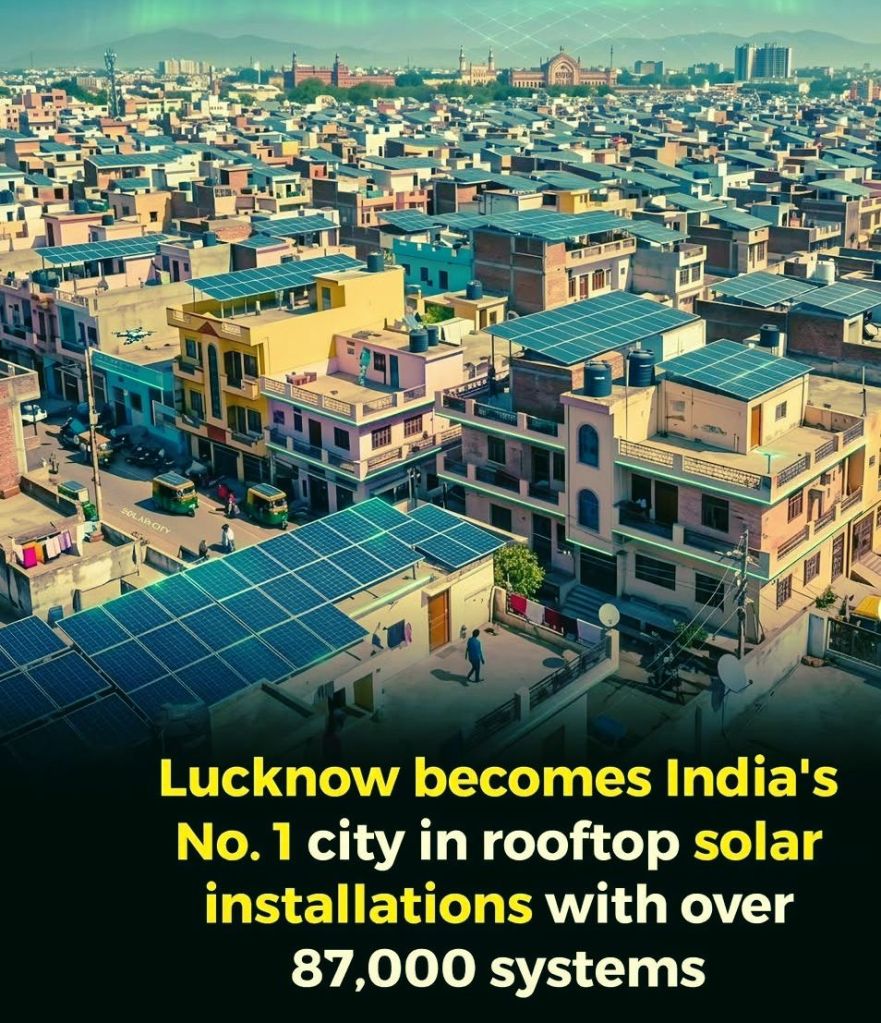
Energy may become the most transformative arena of all. India receives over 300 sunny days annually, yet millions of rooftops remain economically inactive. Rooftop solar systems under initiatives such as the Pradhan Mantri Surya Ghar Yojana can decentralize energy generation, reduce household electricity costs, and lower dependence on imported fuel. Combined with net-metering, ordinary citizens themselves become micro-energy producers. Similarly, converting organic urban waste into Compressed Bio-Gas can reduce methane emissions, lower LPG dependence, improve sanitation, and support agriculture through organic manure generation. In one integrated framework, India can simultaneously strengthen energy security, environmental sustainability, and urban resilience.

But none of this succeeds without cultural change. India urgently requires a national behavioral transformation where resilience becomes aspirational rather than sacrificial. China’s rise offers an important lesson. Beijing did not reject globalization; it controlled its exposure while systematically building domestic capability over decades. India need not imitate China politically, but it must understand the strategic logic of calibrated self-reliance. Imports cannot remain the default instinct of development. Domestic capability, local production, community participation, and decentralized sustainability must become foundational principles.
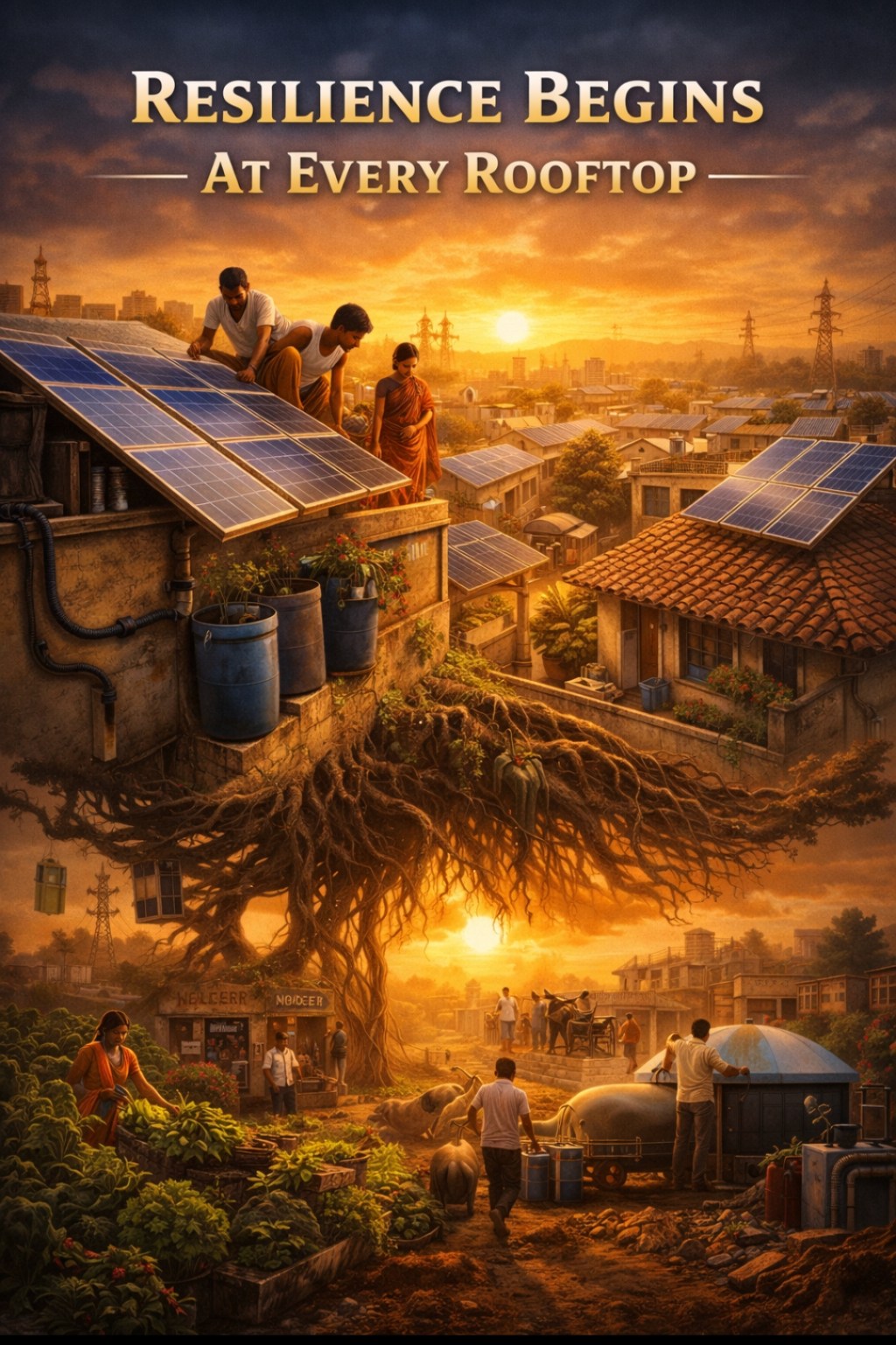
Ultimately, India’s future strength will not be built only in Parliament, ministries, or corporate boardrooms. It will emerge through millions of small but disciplined decisions — one rooftop solar panel, one rainwater harvesting pit, one composting unit, one local vegetable purchase, one reduced unnecessary expense, and one self-reliant neighborhood at a time. The next Indian revolution may not arrive through slogans or grand speeches. It may quietly emerge through organized citizenship.
VISIT ARJASRIKANTH.IN FOR MORE INSIGHTS

