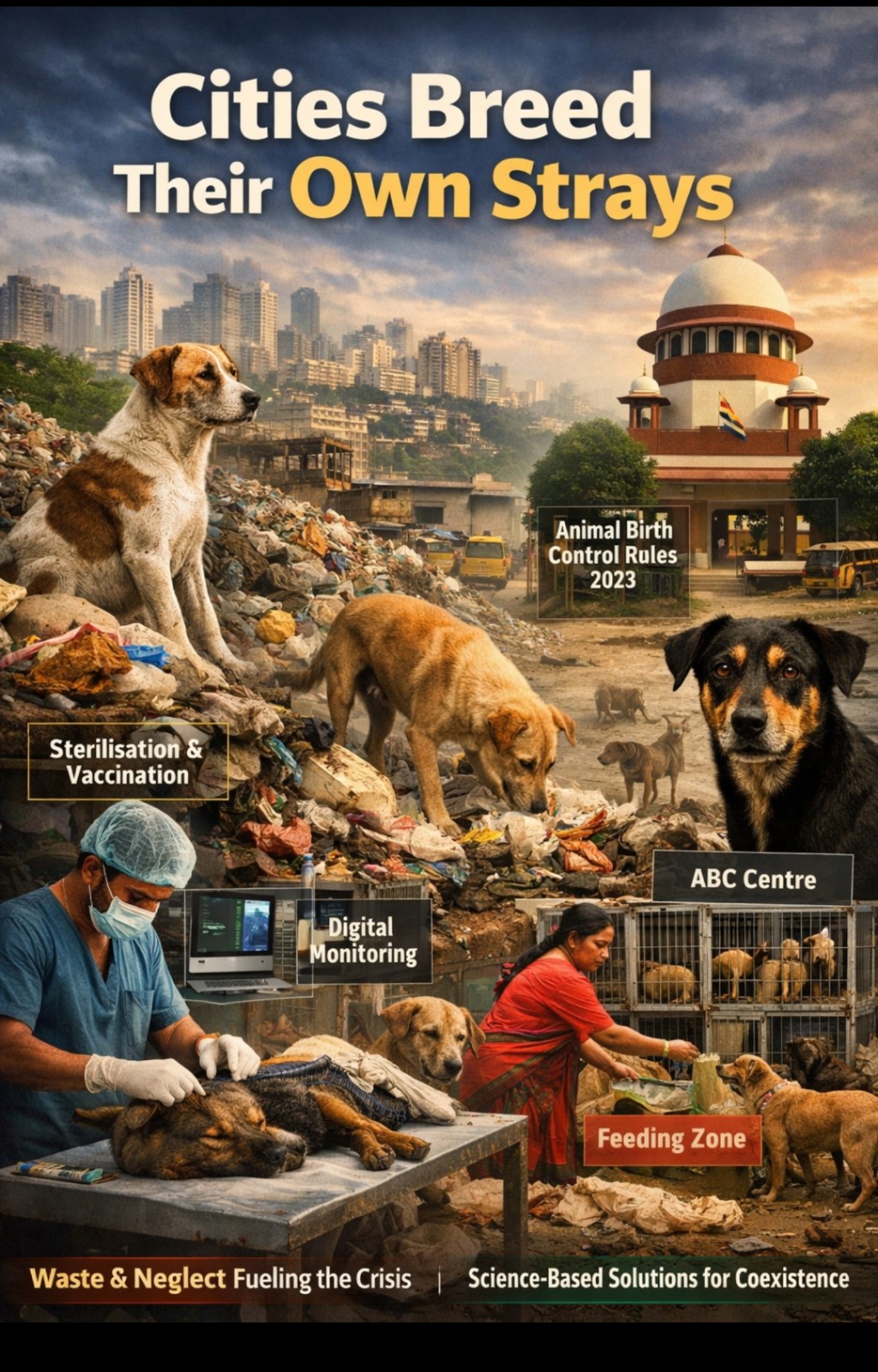
India’s stray dog crisis is often narrated through panic: bite incidents, rabies fears, viral videos, and angry demands for immediate “removal.” Yet beneath this emotional turbulence lies a far more uncomfortable truth. Stray dogs are not invaders descending upon Indian cities from some external wilderness. They are products of the human ecosystem itself—born from overflowing garbage dumps, unmanaged food waste, slaughter remnants, open urban disposal systems, and administrative neglect. In many ways, stray dogs are not outside civilization; they are one of its unintended urban consequences. To demand their complete disappearance while preserving the same waste-producing habits is to seek an impossible contradiction: a human city without the ecological footprint of human behavior.

This is why the debate extends beyond animals. It is fundamentally about the moral and ecological maturity of Indian urbanization. Modern cities increasingly behave as though public space belongs exclusively to humans, while every other form of life exists merely on temporary tolerance. Yet stray dogs have coexisted with Indian settlements for centuries, forming territorial ecosystems that often regulate themselves when managed scientifically. The real issue is therefore not whether dogs have a right to exist—they unquestionably do. The deeper question is whether India can build a framework of coexistence rooted in science, discipline, and civic responsibility instead of oscillating between sentimental extremism and violent intolerance.

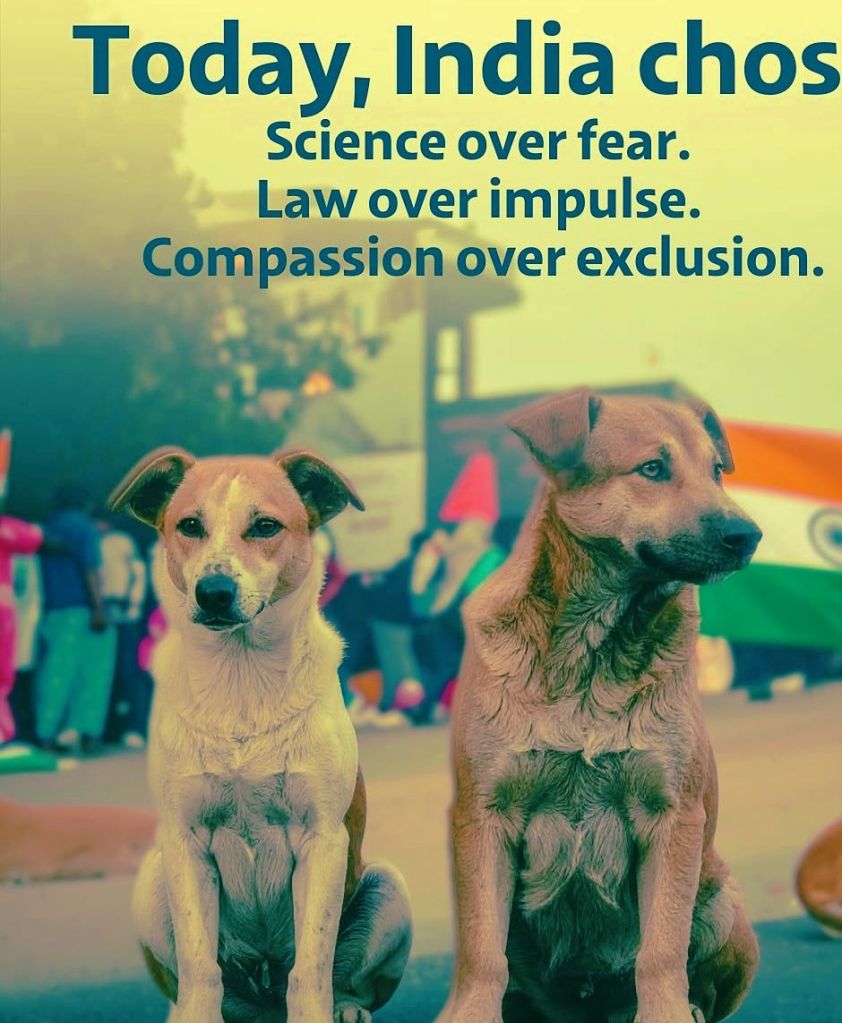
Into this emotionally charged conflict, India’s Supreme Court has stepped as an increasingly important constitutional referee. The judiciary now finds itself balancing two competing dimensions of Article 21 jurisprudence: the citizen’s right to safety and the ethical obligation toward animal welfare embedded within India’s legal and constitutional culture. The Court has repeatedly clarified that compassion cannot become administrative paralysis, just as public fear cannot justify cruelty. This balancing act has transformed stray dog governance from a municipal sanitation issue into a national constitutional dilemma involving ethics, public health, ecology, and urban governance simultaneously.
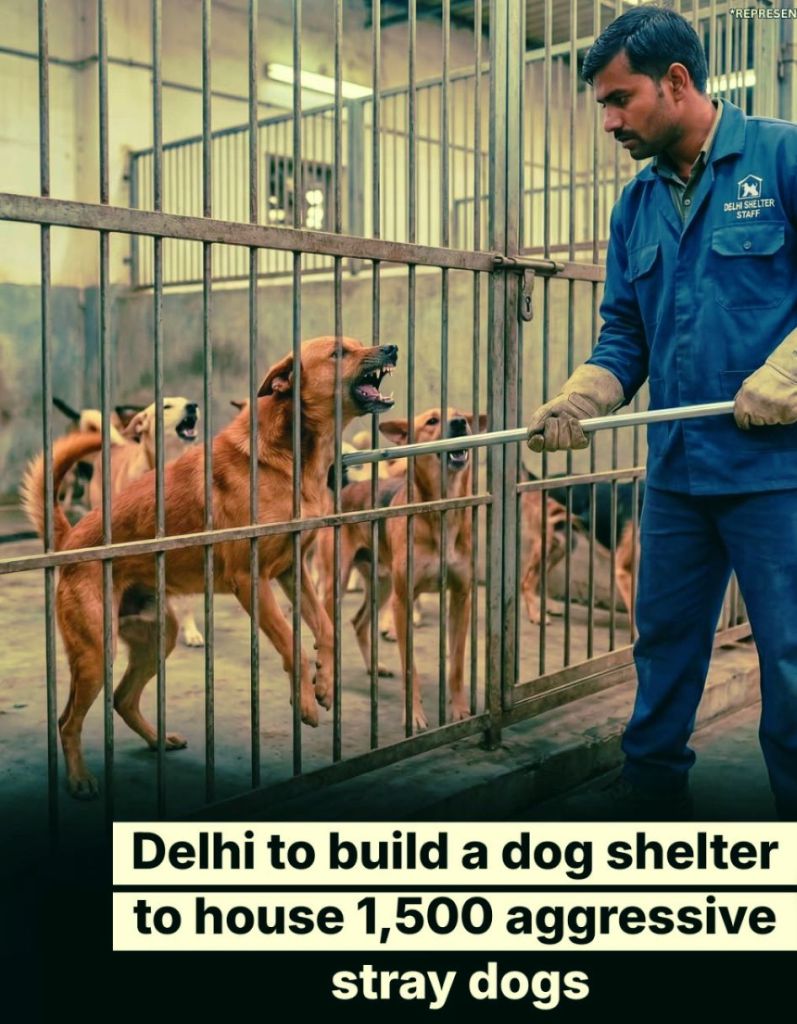
The Court’s evolving orders between 2025 and 2026 reflect this transition from reactive urgency to calibrated realism. In August 2025, a two-judge bench directed the complete removal and permanent relocation of stray dogs from Delhi-NCR streets within eight weeks. The order emerged from genuine public anxiety over rising attacks, yet it immediately triggered backlash from animal welfare groups and urban ecologists. Critics argued—correctly—that India lacks the shelter infrastructure necessary for mass relocation and that uprooting territorial dogs often destabilizes behavior patterns, creating fresh aggression instead of safety. The order sounded administratively decisive but ecologically disconnected from ground reality.

Recognizing these contradictions, the Chief Justice transferred the matter to a larger three-judge bench for broader examination. By November 2025, the Court adopted a significantly more balanced framework. Instead of demanding blanket relocation, it directed authorities to remove stray dogs only from highly sensitive public spaces such as schools, hospitals, and transport hubs while simultaneously mandating the creation of Animal Birth Control (ABC) centres across districts. In May 2026, the Court reinforced this “calibrated approach” and refused attempts to dilute it. It also permitted euthanasia for rabid or dangerously aggressive dogs, strictly under veterinary certification. This aspect remains controversial, but legally it reflects a difficult principle modern states cannot entirely avoid: compassion does not require society to tolerate preventable lethal risk.
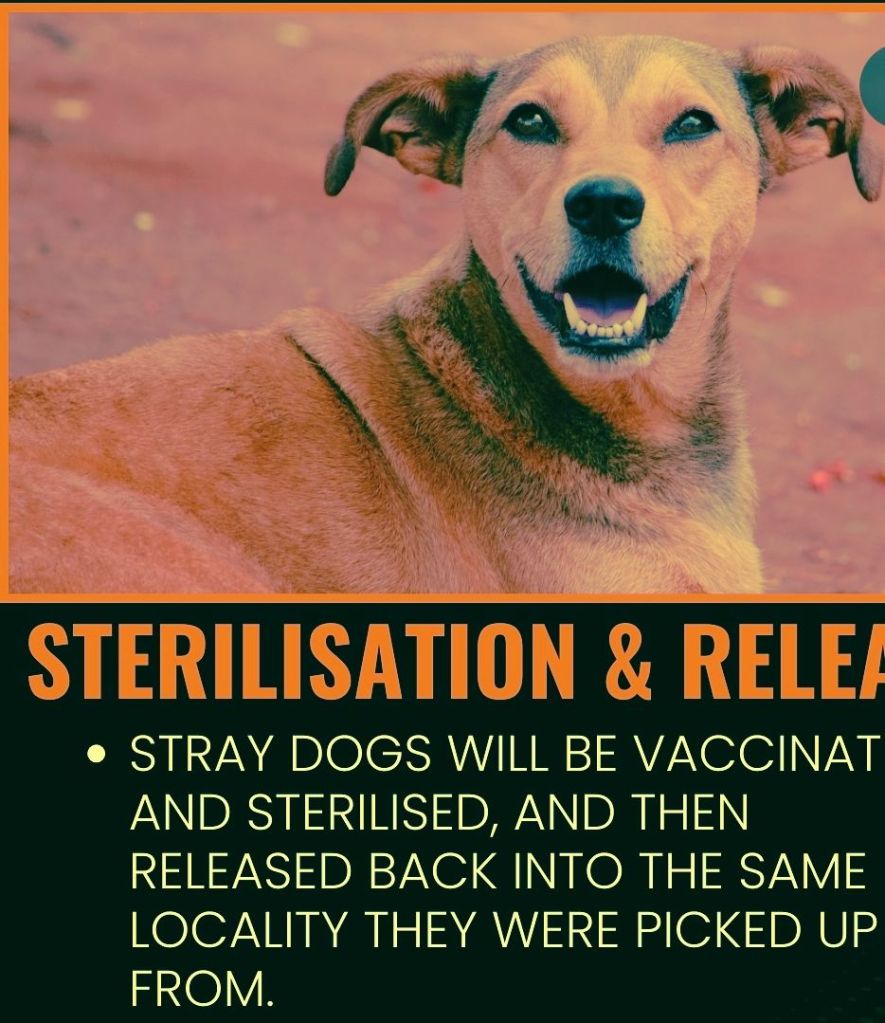
The legal foundation of this framework lies in the Animal Birth Control Rules, 2023, framed under the Prevention of Cruelty to Animals Act, 1960. These rules institutionalize the globally recognized “Sterilisation–Vaccination–Release” model and explicitly reject indiscriminate killing or arbitrary relocation. The scientific reasoning is straightforward. Territorial dogs, once sterilized and vaccinated, gradually stabilize population growth while reducing rabies transmission and aggressive behavior. The problem in India is not absence of law but collapse of execution. ABC programs remain underfunded, inconsistent, and geographically fragmented. Municipal bodies often lack veterinary staff, surgical infrastructure, transport systems, and long-term monitoring capacity. India possesses legal frameworks on paper, but implementation still suffers from chronic administrative weakness.

This governance failure has produced what may be called the “Three-Faction Urban Conflict.” First are pro-feeding residents who view stray dogs as community beings deserving care and compassion. Second are anti-feeding residents who prioritize safety and perceive dogs primarily as threats. Third are NGOs, contractors, and municipal actors operating in the volatile space between welfare obligations and political pressure. The result is continuous confrontation—illegal relocations, feeding disputes, accusations of cruelty, vigilante violence, and neighborhood polarization. Relocation, in particular, remains one of the most damaging practices. Removing territorial dogs creates ecological vacuums that are quickly occupied by new, unsterilized, unvaccinated animals, thereby worsening instability instead of solving it.
The path forward requires abandoning the fantasy of “dog-free cities” and embracing the discipline of managed coexistence. The Supreme Court’s recognition of the Lucknow ABC model as a benchmark is important because it demonstrates that scientific population control works when governance becomes serious. Sterilization rates crossing 80 percent have shown measurable impact on population stabilization and rabies control. India therefore needs district-level ABC centres, trained veterinary teams, transparent monitoring systems, digital tagging and microchipping, scientifically designated feeding zones, and stable municipal funding. Equally important is public education: feeding must become regulated responsibility, not chaotic emotionalism.

Ultimately, India’s stray dog crisis is not really about dogs. It is about the character of urban civilization itself. A society reveals its maturity not by eliminating every inconvenience through force, but by managing coexistence through intelligence, science, and institutional discipline. The colony gate is not a border separating humanity from nature. It is merely a symbolic fence around human denial. Stray dogs are not alien intruders in Indian cities; they are reflections of the systems humans themselves have built. The question before India is therefore profound: can a rising civilization learn to govern shared life responsibly, or will it continue mistaking ecological complexity for something that can simply be removed from sight?
VISIT ARJASRIKNTH.IN FOR MORE INSIGHTS

