
For decades, India feared the excessive power of the State. Bureaucratic socialism, licensing regimes, public monopolies, and centralized controls were once seen as the greatest threats to economic freedom and innovation. But modern India now confronts a different and equally profound dilemma: what happens when economic sovereignty quietly migrates from democratic institutions into the hands of a few sprawling corporate empires whose roots penetrate every strategic sector of national life? The republic that once worried about “state overreach” now risks entering an era of “corporate overreach,” where concentration of economic power begins reshaping not only markets, but also governance, regulation, public discourse, and the very architecture of opportunity itself.

India’s economic imagination was once built around steel plants, oil refineries, public banks, railways, power corporations, irrigation projects, and state-led industrialization. Public Sector Undertakings were not merely commercial enterprises; they were instruments of nation-building designed to create strategic capability, employment, infrastructure, and long-term sovereignty. That era has now decisively receded. In its place stands a new order dominated by a handful of conglomerates whose influence stretches simultaneously across ports, airports, telecom, retail, finance, logistics, media, energy, digital commerce, entertainment, sports broadcasting, data infrastructure, and increasingly even public perception itself. Their expansion is no longer sectoral; it is ecological. These firms do not grow like ordinary businesses competing within boundaries. They grow like banyan trees — extending roots into every available space until smaller plants beneath them are denied sunlight, soil, oxygen, and eventually survival.
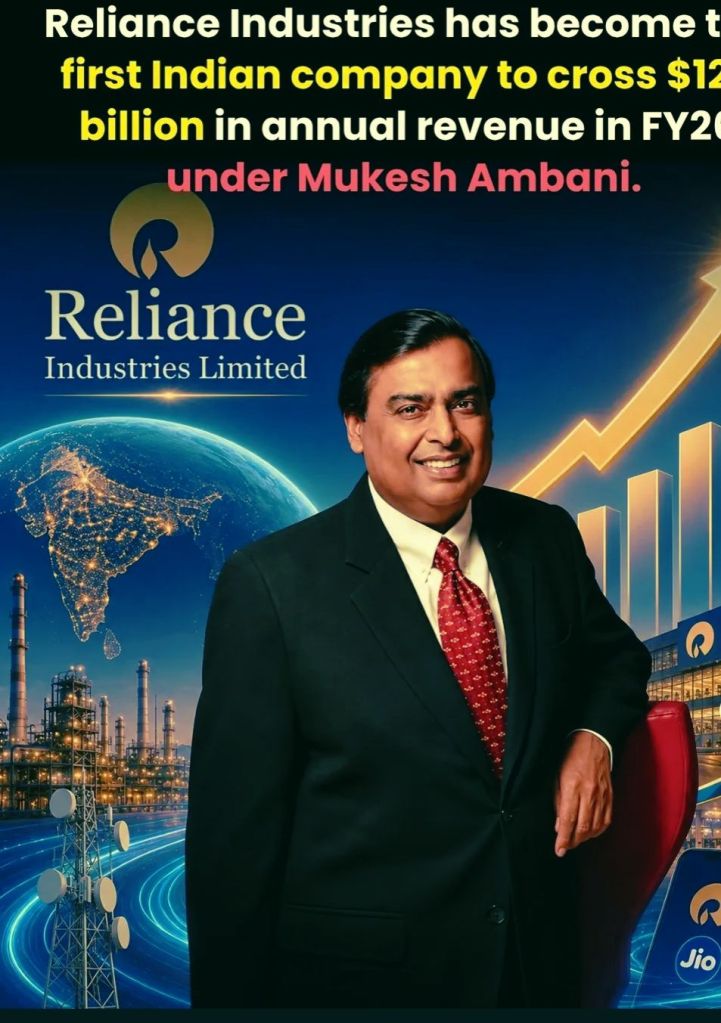
The concern is not that India has produced large corporations. Every aspiring major economy requires scale, industrial champions, and globally competitive firms. The deeper concern lies in the nature of their expansion. Historically, successful industrial powers accumulated wealth by conquering external markets. Japanese industrial giants, South Korean chaebols, and Chinese manufacturing behemoths generated national strength by exporting aggressively, building technological superiority, and earning foreign exchange abroad while strengthening domestic ecosystems at home. Their scale was tied to global competitiveness. India’s dominant conglomerates, however, increasingly appear structured around capturing domestic consumption itself. Their balance sheets expand rapidly, but much of that expansion emerges from domestic market concentration, preferential access to infrastructure, regulatory asymmetry, spectrum allocations, natural resource concessions, land advantages, financial leverage, and strategic proximity to state power. Wealth is not being brought substantially into India from the world outside; rather, purchasing power is increasingly being extracted from Indian consumers within protected domestic ecosystems.

This distinction is critical because economies thrive through competitive innovation, not through concentrated dependence. When growth arises primarily from proximity to power rather than productivity, capitalism gradually mutates into relationship capitalism. Scale itself becomes a political advantage. The larger a conglomerate becomes, the more difficult it becomes for regulators, lenders, policymakers, and even governments to impose discipline upon it. Institutions slowly begin adapting themselves to economic power rather than economic power remaining accountable to institutions. The consequences are already visible in the silent disappearance of India’s middle entrepreneurial layer — regional manufacturers, independent distributors, family retailers, mid-sized enterprises, and sectoral challengers that traditionally generate resilient employment and decentralized prosperity. India celebrates unicorns and billionaires, but beneath the headlines, thousands of smaller economic ecosystems are steadily being compressed.

Retail transformation illustrates this phenomenon vividly. Quick-commerce platforms and deep-discount digital ecosystems have trained consumers to celebrate convenience and subsidized pricing. Yet those subsidies are often financed by enormous capital pools that neighborhood retailers and independent traders can never match. The small businessman is not necessarily losing because he is inefficient; he is losing because he is fighting entities capable of absorbing losses long enough to eliminate resistance itself. Once competition weakens and market concentration stabilizes, pricing power inevitably follows. The telecom revolution offers a similar paradox. Cheap data undeniably democratized digital access and transformed Indian society. Yet the same disruption also compressed the sector into a handful of dominant players, weakening long-term plurality. Citizens enjoyed immediate benefits while unknowingly participating in the construction of future monopolistic structures. This is the hidden contradiction of modern Indian capitalism: consumers celebrate lower prices today while silently financing tomorrow’s concentration of economic power.

Meanwhile, the Indian state itself appears trapped in policy schizophrenia regarding Public Sector Undertakings. Governments continue disinvestment and asset monetization while simultaneously recapitalizing struggling PSUs with taxpayer money. Instead of strategically modernizing public institutions and transforming them into globally competitive enterprises, policy oscillates between neglect and monetization. The result is neither efficient privatization nor effective public ownership. India once feared inefficient socialism; it now risks drifting toward inefficient oligarchy. Supporters of conglomerate-led growth frequently invoke the South Korean chaebol model, but such comparisons often ignore the most important feature of that system: discipline. Korean conglomerates received protection only in exchange for brutal export performance and relentless global competitiveness. Failure invited withdrawal of support. The Korean state acted as a demanding shareholder, not a passive patron. India’s version increasingly appears inverted — domestic dominance itself becomes the achievement without equivalent pressure to become globally transformative.

This distinction separates nation-building capitalism from rent-extracting capitalism. When a handful of groups dominate finance, infrastructure, telecom, logistics, media, and retail simultaneously, economic concentration inevitably evolves into narrative concentration. Criticism becomes economically riskier. Regulation becomes institutionally softer. Political financing becomes opaque. Policymaking itself risks gradual capture. Democracies rarely lose balance dramatically; they lose it through silent accumulations of influence that slowly normalize dependency. None of this implies hostility toward private enterprise. India urgently requires globally competitive corporations capable of building semiconductor ecosystems, AI infrastructure, green energy systems, advanced manufacturing, and export-oriented industrial strength. But capitalism survives only when markets remain contestable. The role of regulation is not to punish scale; it is to ensure that scale does not extinguish competition itself.

India therefore stands at a historic crossroads. One path leads toward a dynamic industrial ecosystem where large corporations coexist with thriving SMEs, independent regulators, strong PSUs, innovative startups, and competitive markets. The other leads toward a gated economic order dominated by a few interconnected giants whose expansion increasingly depends upon extracting purchasing power from Indian citizens while limiting the rise of future challengers. A healthy forest survives because sunlight reaches the ground. When only a few giant trees absorb everything above and below the soil, the ecosystem weakens no matter how magnificent those trees appear from a distance. The real test of India’s economic maturity is not whether its billionaires become wealthier. It is whether ordinary entrepreneurs still retain enough sunlight to grow beneath them.
VISIT ARJASRIKANTH.IN FOR MORE INSIGHTS

