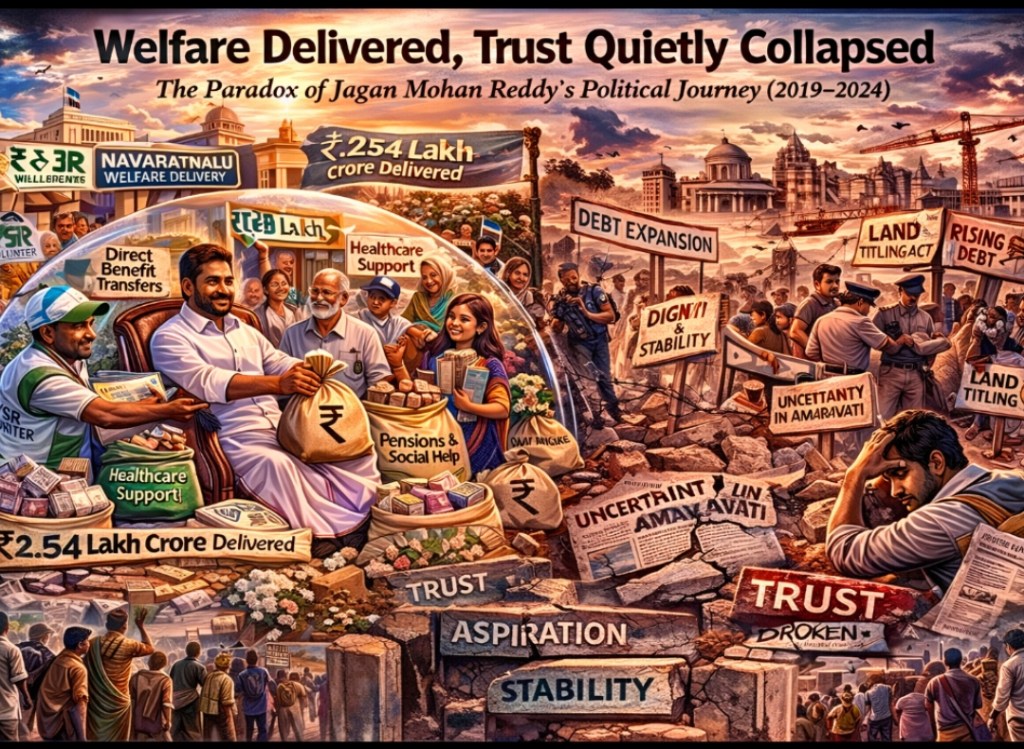
Y.S. Jagan Mohan Reddy stands today as one of the most intriguing contradictions in contemporary Indian democracy. Few leaders have delivered welfare on such a massive scale, and yet few have faced an electoral rejection so sharp and symbolic in Andhra Pradesh. His political journey between 2019 and 2024 does not represent the collapse of welfare politics itself; rather, it reflects the collapse of welfare politics when it is not backed by trust-building governance, emotional security, and a future narrative. Jagan’s experience underlines a harsh democratic reality: citizens may accept subsidies as temporary relief, but they will not permanently trade their aspirations, dignity, and confidence for monthly transfers.
From 2019 to 2024, the YSRCP government built what could be described as a welfare state executed with industrial discipline. Under the Navaratnalu framework, the administration reportedly transferred more than ₹2.54 lakh crore through Direct Benefit Transfers across nearly 29 beneficiary categories. Schemes like Amma Vodi and Vidya Deevena became powerful anchors of political messaging, especially among women and families relying heavily on public education. English medium reforms, distribution of tablets, doorstep pension delivery, and expansion of Aarogyasri health coverage created the impression of a government that reached the last household with speed and certainty. Even on employment narratives, the government projected over 40 lakh livelihoods through MSMEs and hiring initiatives, including 6.31 lakh posts. If governance was judged purely by the scale of money reaching people’s accounts, Jagan’s model should have appeared politically invincible.
Yet politics is never a pure financial transaction. Governance is not merely administration—it is also psychology, symbolism, perception, and the management of collective emotions. Welfare may create gratitude, but elections are shaped by confidence. Here, the first major political setback emerged from Amaravati. The decision to stall the capital’s momentum and float the “three capitals” approach produced a long-term narrative of instability.
Farmers who had pooled land for Amaravati felt a deep sense of uncertainty, while the urban middle class interpreted the move less as decentralization and more as political disruption. A capital is not merely infrastructure; it is a state’s ambition written in concrete. When that ambition appears frozen, investor sentiment and public optimism also freeze.
Whether the policy was right or wrong, the perception battle was lost early, and perception is often more decisive than paperwork.
Parallel to this, Andhra Pradesh witnessed a visible fiscal stress narrative. Borrowing expanded sharply, with debt reportedly rising from around ₹4.12 lakh crore to above ₹7 lakh crore. Debt itself is not automatically a political failure—many growing states borrow aggressively—but the public concern was about the balance of spending.
Revenue expenditure grew rapidly, while capital expenditure appeared less visible in everyday life. Welfare ensured survival, but large-scale economic expansion, industrial confidence, and job ecosystems did not appear to accelerate at the same pace. This created what can be called an “oxygen without blood” situation: people were kept afloat, but many felt the state was not building the growth machinery required for the next decade. For young voters especially, welfare is helpful, but employment is identity. A government may distribute benefits, but youth measure governance through opportunity.
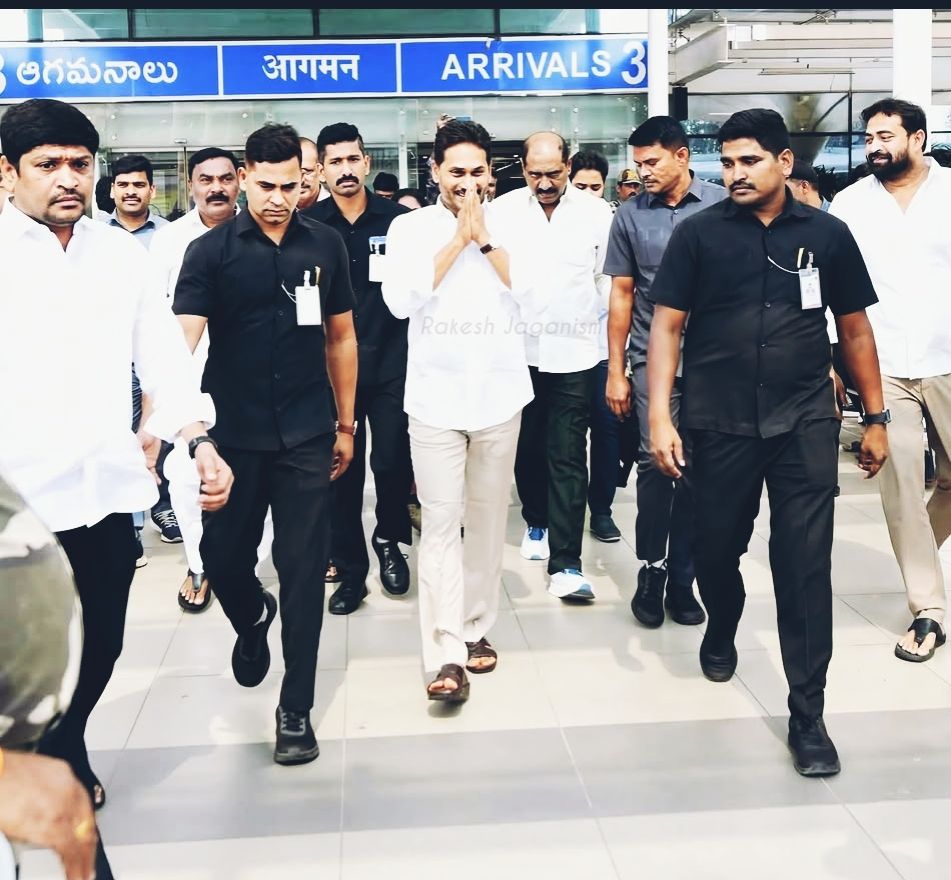
The law-and-order narrative added another psychological layer. The arrest of Chandrababu Naidu in the skill development case may have had legal arguments, but politically it produced unexpected consequences. In democracies, public emotions often follow what psychologists describe as reactance theory: when people feel power is being used to corner or humiliate a rival, they develop sympathy for the target. Jagan’s assertion of authority was interpreted by many not as strength, but as excessive political dominance. This did not generate fear; it generated resentment. The public mood shifted from evaluating corruption allegations to evaluating political style. In electoral politics, voters do not always punish allegations alone—they punish what they perceive as bullying, overconfidence, or disproportionate use of power.
Another deeply sensitive episode was the Land Titling Act. The policy intention may have been modernization of land records and reduction of disputes, but the communication strategy collapsed. In a state where land is not merely property but a symbol of lineage and security, even a small doubt can ignite mass anxiety. The policy was easily portrayed as “land grabbing,” and that narrative triggered the strongest voter emotion: loss aversion. People can tolerate temporary economic hardship, but they panic when they sense their ancestral land could become vulnerable. Here, the opposition did not need complex arguments; it only needed a fear-based slogan. Jagan offered cash-based reassurance, but fear spreads faster than logic, especially when trust is fragile.
Beyond policy, the deeper political issue was aspiration. Welfare schemes satisfy short-term consumption needs, but elections are often decided by long-term self-image. A young graduate does not want to remain permanently labeled as a beneficiary; he wants to become a contributor. The middle class does not want only subsidies; it wants dignity through stable employment, strong infrastructure, and predictable governance. Over time, Jagan’s model became boxed into the label of “dole governance,” and once such a label sticks, it becomes extremely difficult to convince voters that the same administration can build the future. The challenge was not that welfare was wrong; the challenge was that welfare alone could not become the entire political personality of a state.
Adding to the complexity was the impact of personal narrative. The unresolved “Babai” murder controversy and the visible family rift involving Sharmila created cognitive discomfort among some supporters. Voters may not know the full truth, but they instinctively judge leadership stability through signals of internal stability. Public family conflict, regardless of its actual causes, tends to weaken the aura of moral clarity. Politics is not only about performance; it is also about credibility, symbolism, and emotional coherence.
After defeat, the YSRCP appears to be struggling with organizational fatigue. Like many dominant parties after a shock loss, it risks falling into a psychological paralysis. Reports of a “coterie culture” suggest a leadership environment where confirmation bias may operate—where only positive feedback reaches the top, and unpleasant ground realities are filtered out. In addition, Jagan’s limited unscripted media engagement has created an image of inaccessibility. In modern politics, silence is rarely interpreted as strategy; it is often interpreted as arrogance or avoidance. Meanwhile, party cadres appear demotivated, and in such environments, a dangerous phenomenon emerges: learned helplessness, where workers believe effort will not change outcomes, so silence becomes survival.
Still, revival is not impossible. Jagan remains a leader with a proven administrative machinery and strong welfare credibility. But a comeback cannot be built only through social media attacks on fiscal management or repeated reminders of past transfers. The next political chapter requires a shift from distribution to construction—visible infrastructure, industrial acceleration, and job creation credibility. Andhra Pradesh needs a narrative that combines welfare compassion with growth ambition. Jagan must also clarify the land narrative directly, acknowledging communication gaps and rebuilding trust. More importantly, he must rebuild the party structure beyond volunteers. Volunteers deliver schemes; cadres deliver emotional connection, ground intelligence, and political resilience.
Most critically, Jagan must humanize his leadership style. He must break the wall, accept defeat publicly as a democratic verdict, and re-enter the political space with humility and hunger. Politics is not only arithmetic; it is theatre of emotion. If he wants his cadre to fight again, he must show he is emotionally present, politically accessible, and intellectually adaptable.
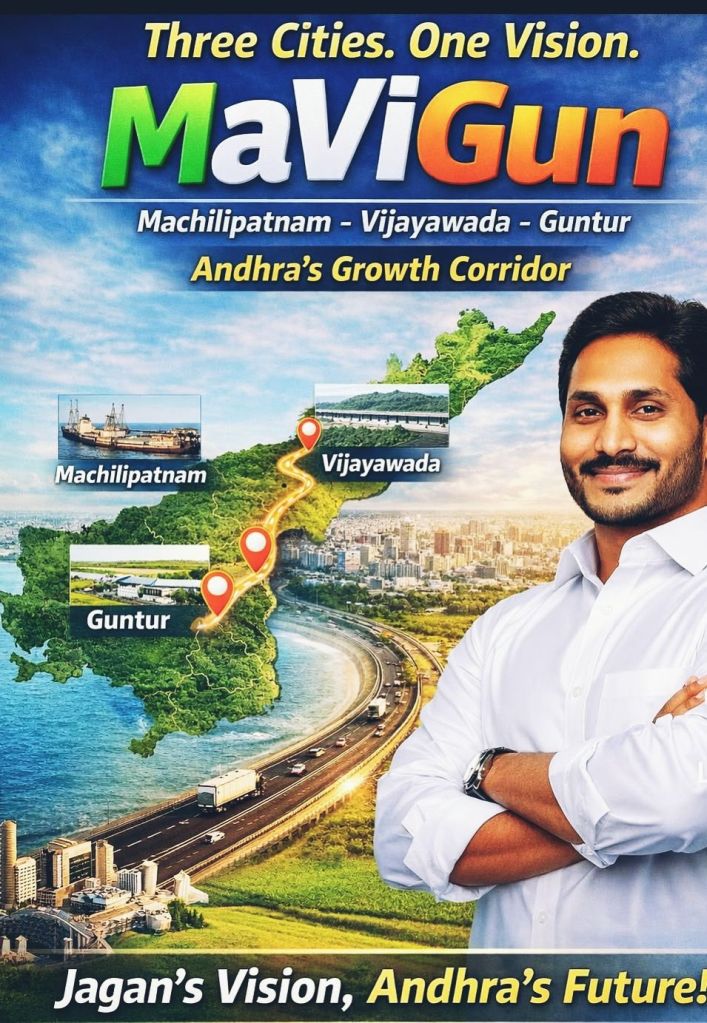
The final lesson from Jagan Mohan Reddy’s story is not that welfare failed. Welfare succeeded, but it could not substitute for stability, confidence, and a future vision. Cash can buy relief, but it cannot buy belief. In the end, elections are won not by the size of schemes, but by the size of trust. If Jagan wants to rise again, he must evolve from being a transactional administrator into a transformational leader—one who builds not only bank balances, but the state’s collective confidence.
VISIT ARJASRIKANTH.IN FOR MORE INSIGHTS
 ARJA SOCIAL PERSPECTIVES