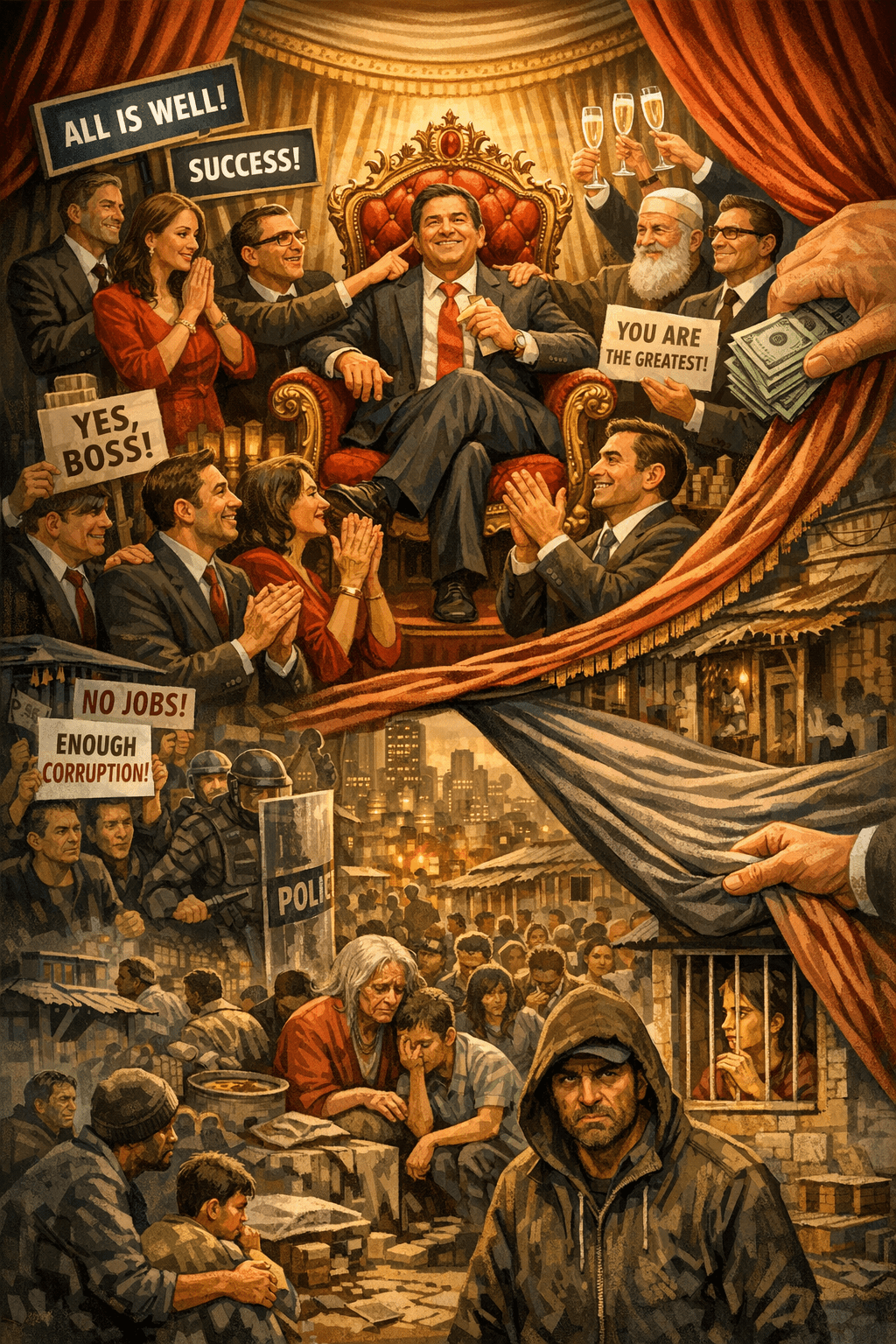
Politics rarely collapses because of the opposition alone. More often, it collapses from within — silently, invisibly, and with devastating psychological precision. Across democracies, especially in India’s deeply personality-driven political culture, leaders seldom lose touch with the people overnight. They are gradually disconnected from reality by those closest to them. The greatest threat to political leadership is therefore not criticism from rivals, but insulation from truth within one’s own camp. Electoral defeat is usually the final visible symptom of a much deeper internal decay. By the time a leader senses public anger, layers of controlled access, curated optimism, emotional dependency, and manufactured applause have already buried reality beneath political theatre. Modern politics increasingly suffers not from lack of information, but from excessive filtration of truth.
Every political ecosystem eventually produces what may be called the “coterie trap” — an invisible republic of relatives, loyalists, personal assistants, business intermediaries, fixers, and self-appointed gatekeepers whose survival depends upon uninterrupted proximity to power. These individuals rarely rise through ideological depth or administrative brilliance. They emerge through emotional access, inherited familiarity, strategic loyalty, or an extraordinary ability to flatter without accountability. Their principal talent is not governance, policy, or mobilisation. It is control over access. The closer one stands to the leader’s ear, the greater the influence one accumulates. Gradually, formal institutions weaken while informal power networks strengthen. Party constitutions survive on paper, but actual authority migrates into drawing rooms, private offices, WhatsApp circles, and invisible corridors of influence.
The first casualty of the coterie system is truth itself. Honest political feedback becomes dangerous because it threatens the monopoly of the inner circle over perception management. Electoral warnings are dismissed as negativity. Grassroots anger is labelled factional propaganda. Corruption complaints disappear before reaching the leadership. Senior party workers who raise uncomfortable questions are isolated as “anti-leadership.” Over time, leaders begin hearing only carefully curated optimism. Every welfare scheme is projected as historic. Every crowd becomes “unprecedented.” Every criticism is framed as conspiracy. Governance slowly transforms into a theatre of manufactured applause where perception matters more than reality. Inside such ecosystems, silence is often mistaken for approval when, in truth, silence may represent exhaustion, fear, or irreversible public disengagement.
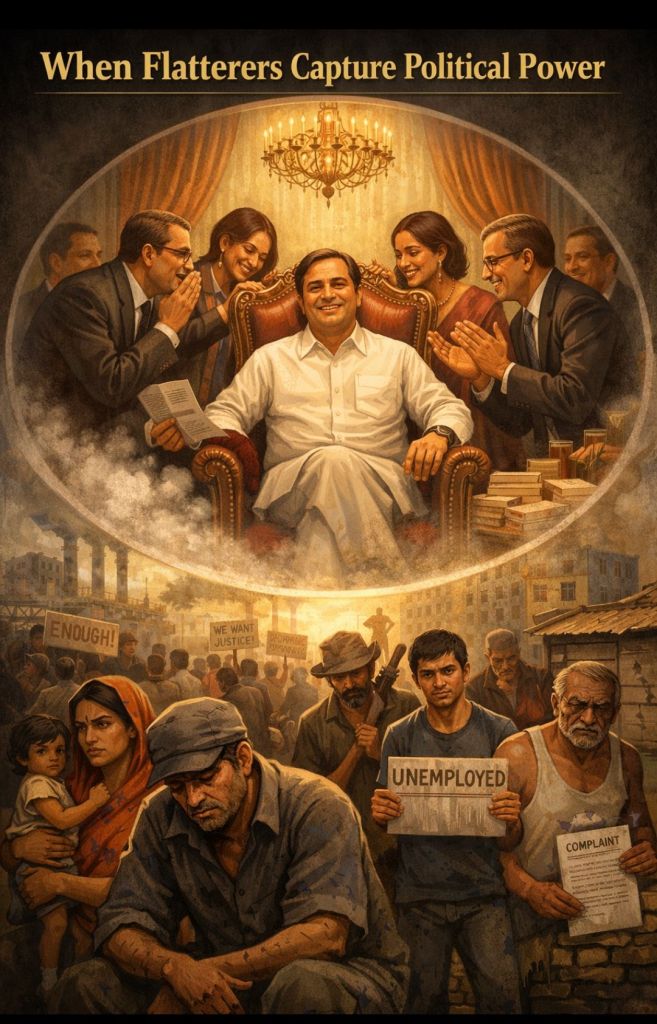
This creates what may be called the political cocoon — a psychologically comforting but electorally fatal environment where controlled narratives replace authentic public sentiment. Within this insulated chamber, leaders gradually lose the ability to distinguish between administrative presentation and emotional legitimacy. Outside the protected zones of power, however, ordinary frustrations continue accumulating. Booth workers remain unpaid. Farmers grow resentful. Youth unemployment deepens. Petty corruption spreads through lower bureaucracy. Citizens experience humiliation inside police stations, municipal offices, revenue departments, and welfare counters. Yet little of this reaches the leadership because the coterie functions like a shock absorber designed to protect rulers from discomfort. Democracies rarely collapse dramatically. They decay quietly through accumulated emotional distance between rulers and citizens.
The most dangerous dimension of coterie politics is not loyalty but competition within loyalty itself. Inner circles constantly engage in what may be called a “war for ears.” Every individual seeks to become the leader’s most trusted interpreter of reality. Information becomes weaponized. Rivalries are intentionally cultivated because insecurity keeps the leadership dependent upon intermediaries for internal management. One group undermines another through whispers, selective leaks, suspicion, and emotional manipulation. Governance energy gets consumed by petty conspiracies instead of public administration. Ministers compete for proximity rather than performance. Bureaucrats quickly learn that pleasing the coterie matters more than solving problems. Governments therefore begin appearing stable publicly while internally corroding through distrust, factionalism, and invisible institutional paralysis.
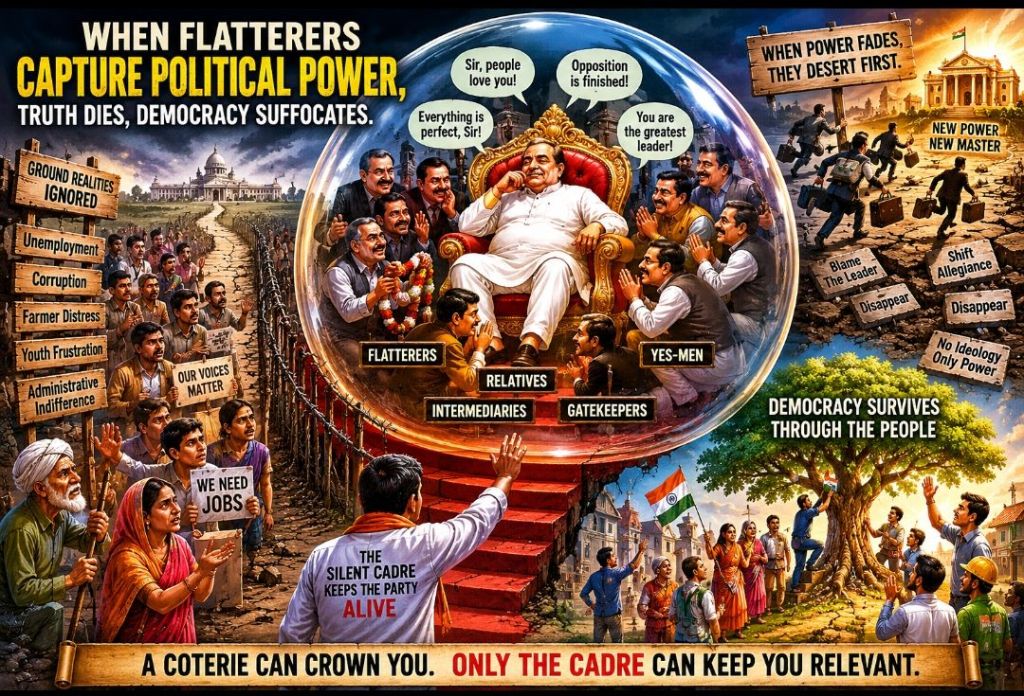
As this one-upmanship intensifies, the ordinary cadre slowly disappears from the leadership’s emotional horizon. The unnoticed worker who pastes posters in the rain, manages polling booths without resources, absorbs public anger during opposition years, and keeps the party alive in hostile territories becomes politically invisible. Talented grassroots leaders lacking coterie patronage are denied growth irrespective of commitment or competence. Organisational structures survive ceremonially but weaken structurally. Ironically, the same coterie that monopolizes access during periods of power often becomes the first to disappear after electoral defeat. Their loyalty was never ideological; it was transactional. Once political decline begins, many quietly migrate toward emerging centres of power. The cadre, however, usually remains. This is the enduring strength of democratic politics: ordinary workers sustain parties not because of contracts or privilege, but because of emotional investment, sacrifice, identity, and conviction.
Modern politics increasingly misunderstands this democratic truth. Governments often measure success through mega-events, skyscrapers, digital campaigns, infrastructure announcements, and televised spectacles. Yet political legitimacy is built not on ceremonial stages but on street-level trust. A farmer receiving compensation on time matters more politically than a publicity-driven summit. A booth worker receiving direct access to leadership matters more than orchestrated rally crowds. A citizen treated respectfully at a mandal office matters more than slogans about governance transformation. Democracies survive because ordinary people feel heard in ordinary spaces. Political collapse begins not when people stop voting, but when they stop believing they matter.
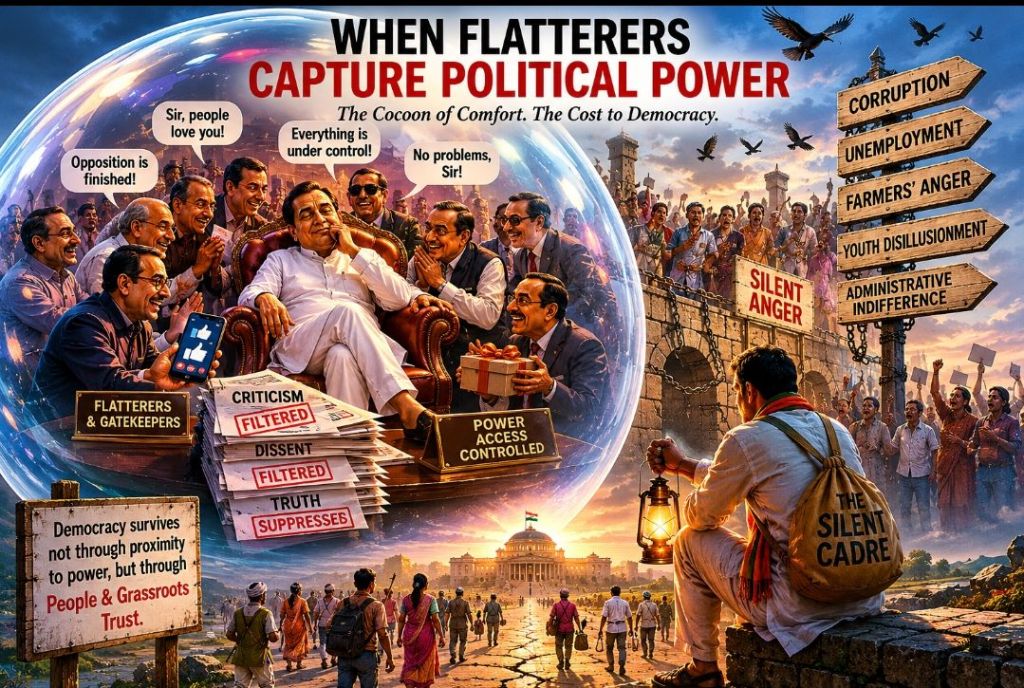
The way forward therefore requires structural humility. Leaders must institutionalize unscripted interactions with grassroots workers free from gatekeeper control. Personal staff and intermediaries should be periodically rotated to prevent monopolies over access. Relatives must not dominate organisational administration. Honest criticism should be protected rather than punished. Feedback systems must become decentralized enough to bypass perception managers. Leaders should consciously spend time in villages, slums, worker households, and public grievance forums without bureaucratic insulation. Political leadership cannot function permanently through sanitized presentations and filtered reports. The healthiest political question is not, “Who praises me most?” but “Who tells me the truth that hurts?”
History across parties, regions, and ideologies repeatedly confirms one enduring pattern: talented leaders surrounded by shrinking circles of flatterers slowly lose touch with the people who once carried their flags. The coterie enjoys the comforts of proximity while the organisation silently erodes beneath them. By the time reality enters the room, the electorate has often already moved on. Political empires rarely collapse because citizens suddenly become irrational. They collapse because leaders stop hearing the silent street beyond the applause chamber.
The ultimate political capital of any democracy is not the relative managing the leader’s calendar, nor the advisor curating social-media perception. It is the unnoticed booth worker travelling on borrowed money, sleeping under leaking roofs, defending the party in hostile territories, and still believing in the movement after defeat. Political systems survive on those invisible shoulders. The day a leader begins believing only the coterie, defeat has already entered the room. The day the leader begins listening again to ordinary citizens, political recovery becomes extraordinarily difficult to stop.
VISIT ARJASRIKANTH.IN FOR MORE INSIGHTS


One response to ““The Velvet Prison of Power: Political Coteries Manufacture Defeat While the Silent Cadre Carries Democracy on Its Back””
Simply a brilliant and cogent analysis
LikeLike