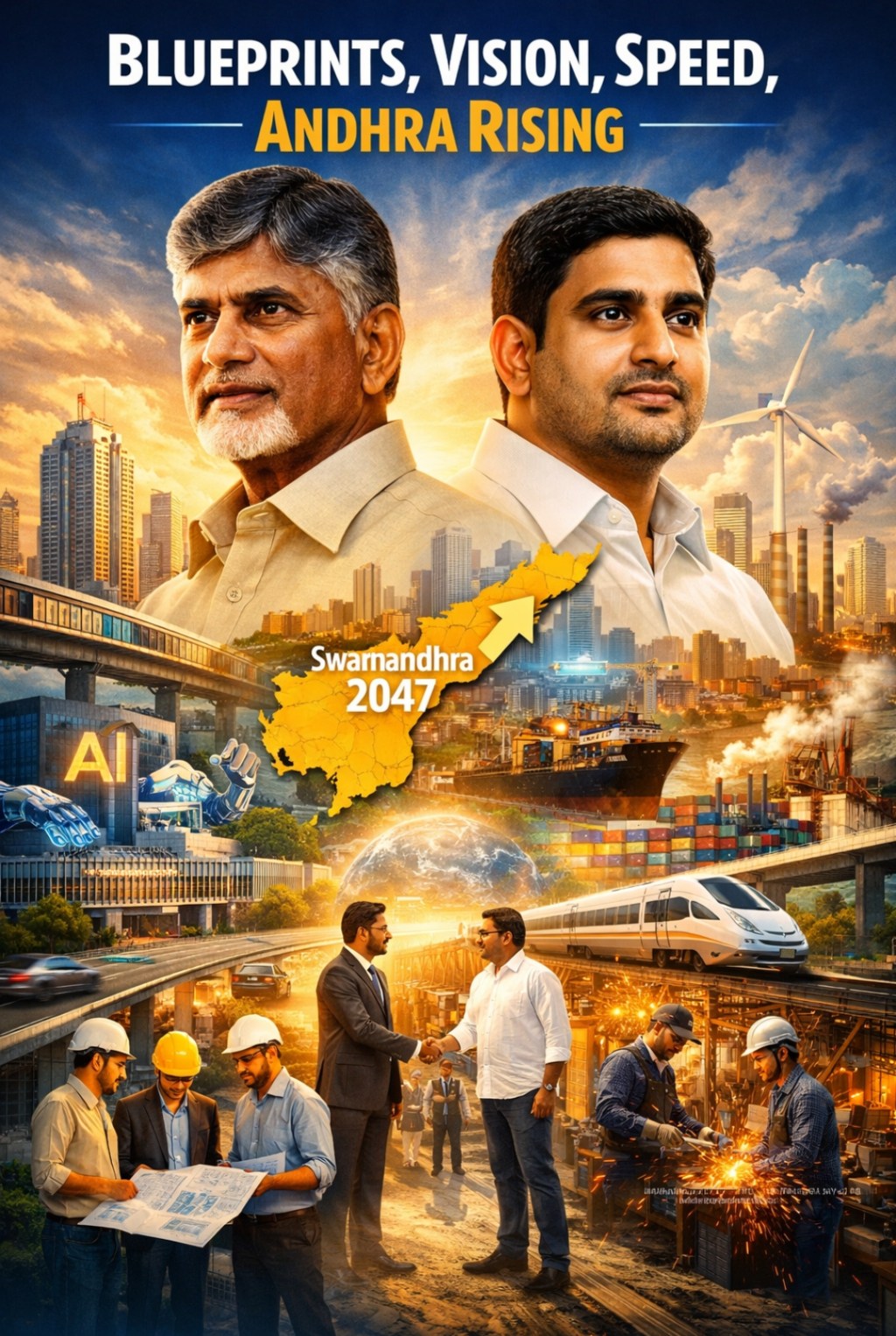
There are leaders who govern states, and then there are leaders who rebuild states after history dismantles them. Andhra Pradesh after bifurcation was not merely a state without Hyderabad—it was a body without its economic brain. Its revenue spine snapped, its institutional confidence weakened, and an entire generation began treating migration as the default career plan. In such moments, governance is no longer about administration; it becomes an act of resurrection. Chandrababu Naidu’s return for a record fourth term is not simply a political comeback—it is the return of an architect to a structure left half-built and exposed to storms. What makes this phase more consequential is that the architect is no longer working alone. Beside him stands Nara Lokesh, not as ceremonial inheritance but as operational horsepower. Andhra Pradesh is witnessing a rare political phenomenon in India: a father-son leadership system functioning like a true double engine—one supplying memory and blueprint, the other delivering speed and execution.

Naidu’s political struggle has never been about power alone. It has been a long battle against India’s most dangerous administrative disease: short-termism. In the early 1990s, when most Indian states were still learning the grammar of liberalisation, Naidu was already writing the vocabulary of the future. His decision to seed nearly 700 engineering colleges was not merely an education reform—it was an industrial wager. He understood that the most decisive infrastructure of a modern economy is not highways, but skills. His push for fibre-optic connectivity was equally futuristic, at a time when governance across India still thought in terms of canals and concrete rather than digital highways. This was the Naidu doctrine: a state must run ahead of the present, not limp behind it. Cyberabad was not an accident—it was the product of policy imagination meeting institutional courage.
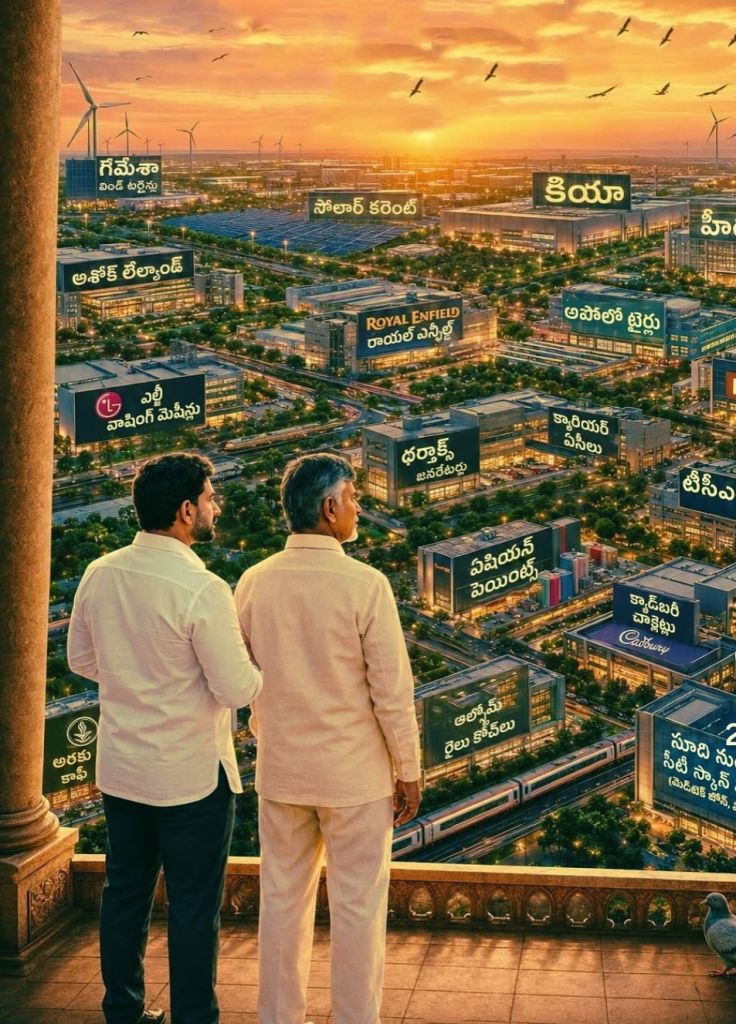
But bifurcation created a harsher test. Unlike Telangana, which inherited Hyderabad, Andhra inherited a vacuum. Amaravati was not a city; it was an idea waiting for cement. Visakhapatnam was not a tech capital; it was a port with unrealised potential. Rayalaseema was not an industrial hub; it was a region historically associated with drought, distress, and departure. The challenge was not to develop a state in the normal sense. It was to prevent a state from slipping into permanent dependency—on remittances, welfare distribution, and political sentiment. Andhra’s greatest enemy was not underdevelopment alone; it was the risk of becoming structurally irrelevant in India’s growth story.
This is why Swarnandhra 2047 is not just a slogan—it is a declaration of reinvention. Naidu has elevated his agenda from state-building to state-reengineering, aiming for a $2.4 trillion economy and a poverty-free Andhra Pradesh. It sounds almost unreal until one observes the early signals: under his current term, Andhra Pradesh has reportedly attracted investments worth nearly 25% of India’s total in under two years. That statistic is not only economic—it is psychological. It suggests Andhra Pradesh is no longer pleading for capital; it is competing for it. The state is repositioning itself not as a claimant for compensation but as a destination for confidence.
Yet vision without execution is merely a speech in a loud hall. That is where Nara Lokesh enters as a political disruptor. Lokesh represents a different leadership energy—one shaped by global corporate language, startup ecosystems, and the impatient logic of digital governance. As Minister for IT, Electronics, and Education, he has operated less like a routine administrator and more like an aggressive market-maker for Andhra Pradesh. His presence on global platforms such as the World Economic Forum at Davos is not cosmetic diplomacy; it is strategic positioning. In the modern world, investment follows narratives before it follows infrastructure. Lokesh is attempting to sell Andhra Pradesh as a future-ready brand, not merely a state with incentives.
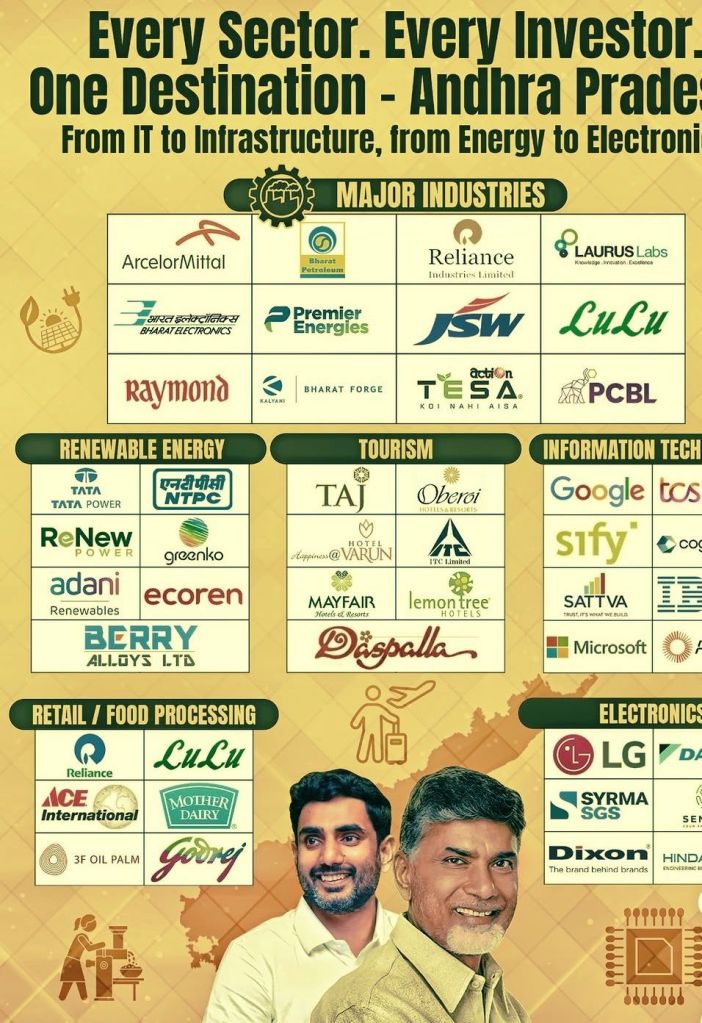
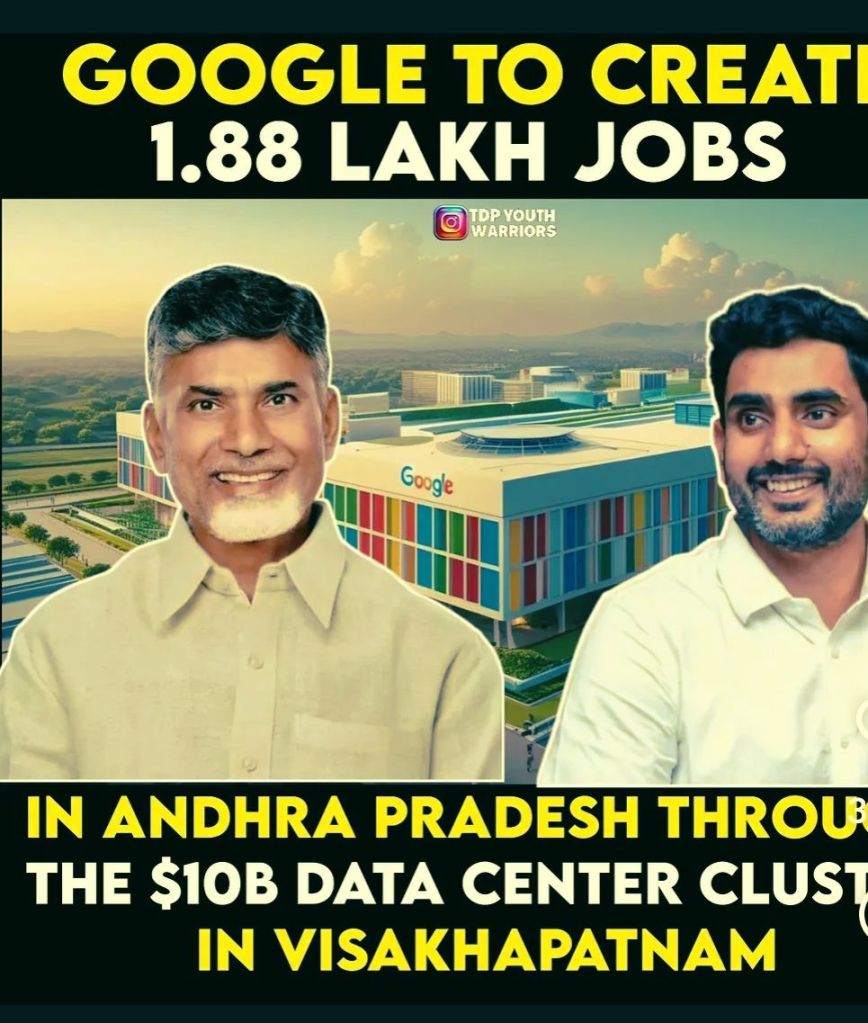
His role is best understood as a translator of ambition into transactions. The $15 billion Google-backed AI hub in Visakhapatnam is not merely a project—it is a signal that Andhra wants a seat inside the global AI supply chain. The projection of two lakh direct and indirect jobs from a single hub is not incremental employment; it is an economic shockwave designed to alter migration patterns. Similarly, agreements worth ₹9.35 lakh crore involving players such as ArcelorMittal, TCS, Cognizant, LG Electronics and others indicate a deliberate attempt to build a multi-sector growth engine rather than a single-city miracle. The objective is unmistakable: generate 20 lakh jobs for youth and convert migration into retention, opportunity into stability, and aspiration into local livelihoods.
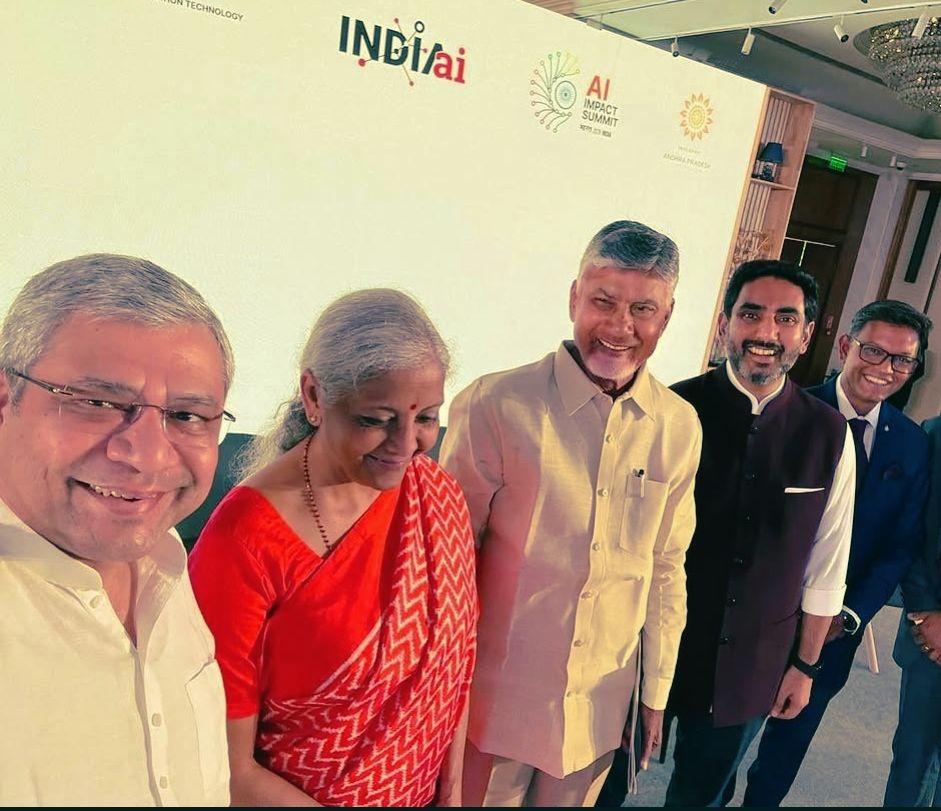
The phrase “double engine governance” is often used in Indian politics as a slogan. In Andhra Pradesh, it is being operationalised as a governance architecture. Naidu argues that alignment with the Centre has enabled rapid implementation of development programmes within 15 months. Lokesh goes further, describing the double-engine framework as guiding Andhra “from darkness to light.” Beneath the poetry lies practical meaning: faster clearances, smoother coordination, stronger investor confidence, and the ability to mobilise national institutions for state ambitions. In India’s federal structure—where even good projects often suffocate under procedural delays—political alignment becomes administrative acceleration. It is not ideology; it is logistics.
Yet the road ahead remains steep. Andhra Pradesh carries fiscal stress, operates under a primary deficit, and faces opposition attacks alleging mismanagement and notional losses of ₹13,667 crore. More worrying is the reported 3.22% decline in State Own Tax Revenue growth in FY26, an indicator that revenue mobilisation and real economic activity must strengthen. Investment announcements cannot remain PowerPoint prosperity; they must translate into factories, payrolls, exports, and tax bases. The political environment is equally combustible. The YSRCP opposition under Jagan Mohan Reddy accuses the government of authoritarianism and misuse of police machinery. Whether these allegations are accepted or rejected, the political heat is undeniable—and governance in such an atmosphere becomes harder because every administrative decision is filtered through suspicion. Naidu and Lokesh are therefore not merely executing projects; they are fighting a parallel narrative war where credibility is as valuable as capital.
Swarnandhra 2047, ultimately, is a wager on transformation at scale: a multi-city industrial ecosystem, a technology-led growth model, and a measurable social mission through Zero Poverty and population management policy. But to make this real, Andhra must borrow ruthlessly from global best practices. It needs Singapore-like strategic focus, choosing high-impact niches such as AI, quantum computing, and advanced manufacturing rather than scattering resources. It needs an Israel-style innovation engine—venture funds, accelerators, regulatory sandboxes, and startup-friendly incentives—so job creation is not hostage only to large corporates.
It needs Gujarat-like plug-and-play infrastructure and single-window clearances that are not symbolic but ruthless. And it must learn from Tamil Nadu’s balanced industrialisation across cities, ensuring that growth does not concentrate in one corridor while other regions remain trapped in stagnation. The Naidu-Lokesh partnership is not merely a family leadership story; it is a governance experiment where experience meets urgency, where Cyberabad’s memory meets Swarnandhra’s ambition. One engine draws the blueprint; the other provides horsepower. If this double engine survives fiscal stress, political confrontation, and execution risks, Andhra Pradesh may achieve something historic: transforming an orphaned post-bifurcation state into India’s next great economic powerhouse.
VISIT ARJASRIKANTH.IN FOR MORE INSIGHTS
 ARJA SOCIAL PERSPECTIVES
One response to ““Two Engines, One Dream: Naidu–Lokesh and Andhra Pradesh’s Swarnandhra Resurrection””
Good morning all
Well noted above content seems to be realistic..
State Govt was missing the development of logistics movements creation of Dry ports and FTW zones fecelity to the trade as on day very few dry ports are available on the state
promote marchidise exim, provide the insetives and
Tax excemptioms to the traders and manifactuers
Andhra Pradesh people were great that they God good politicians who are god send person’s to state
Entire sstate so many rich and industlist are there know one holding FTWZ in our state
In sricity one Gujarathi businessman runs it FTWZ
Govt of AP has to educate our people
As I am having 35 years shipping Cusotms and exim experience why don’t AP Govt can start Airport based FTWZ in AP
so that fecilty will be useful to Aviation industry lot as on day entire in India no state is holding it where as AP has land bank and opportunities are lot
S
LikeLike