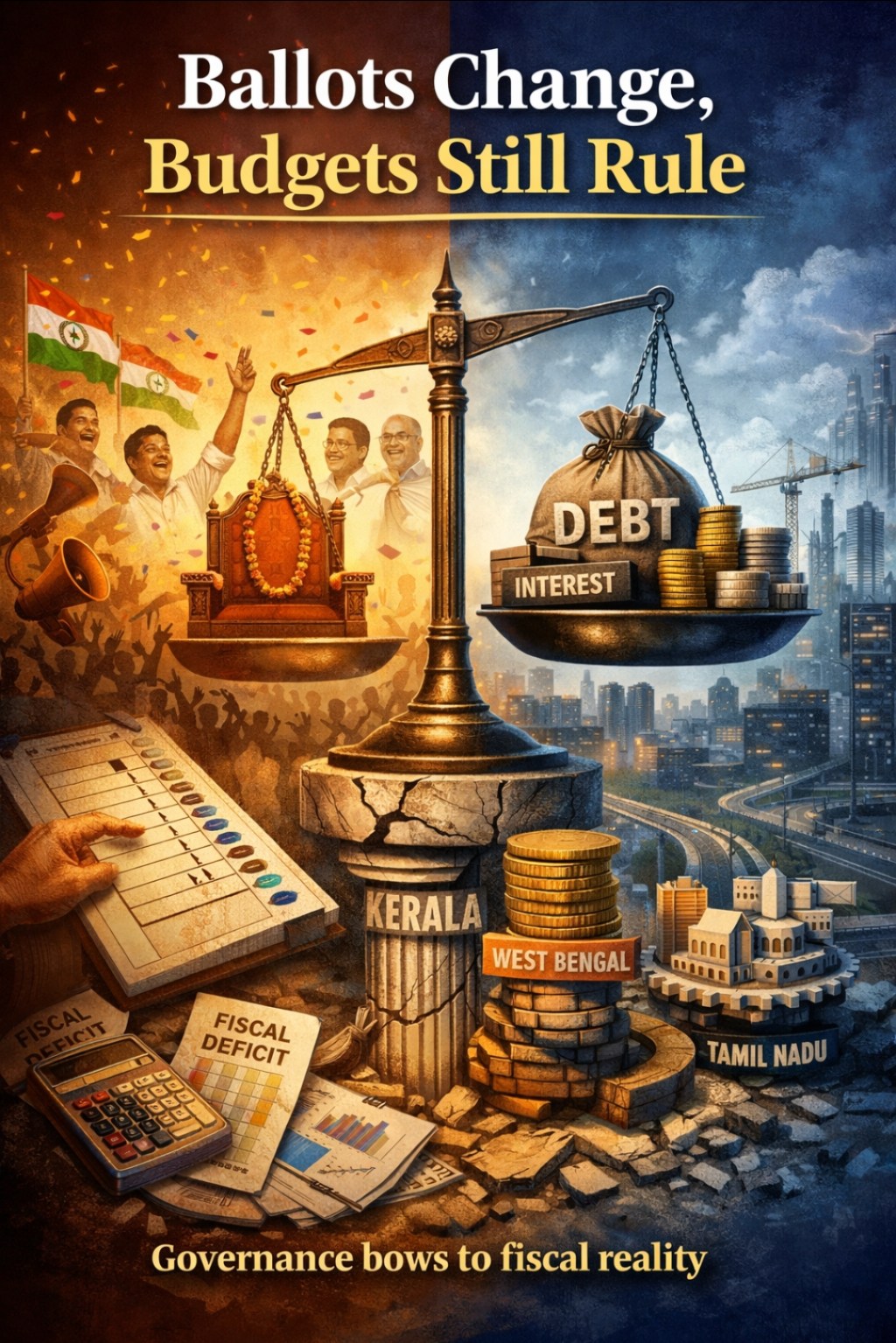
Elections are often narrated like epics of virtue and vengeance. A leader is crowned, a party is buried, a dynasty is “taught a lesson,” an ideology is declared “rejected.” Victory speeches inflate with moral certainty, supporters treat ballot outcomes as divine verdicts, and politics performs its familiar theatre of triumph and humiliation. But when the slogans dissolve into silence and the garlands begin to wilt, governance returns to its most merciless judge: arithmetic.
In West Bengal, Tamil Nadu, and Kerala, three governments have stepped into office through three different political climates. Yet each has inherited the same invisible constitution—debt contracts, interest schedules, pension liabilities, subsidy commitments, and fiscal ceilings that no manifesto can repeal. Democracy changes faces. Fiscal reality changes only deadlines. The ballot may decide who occupies the chair; the balance sheet decides what that chair can actually command.
The first truth these governments must confront is that debt itself is not a sin. Debt is an instrument. The ethical question is not whether a state borrows, but what it borrows for. Borrowing to build productive assets is fundamentally different from borrowing to preserve political comfort. One expands tomorrow’s revenue base; the other simply delays tomorrow’s crisis. In a federal economy like India’s, where states must function simultaneously as welfare providers and growth engines, the distinction between these two forms of borrowing is the difference between development and decline.
A useful lens is long-term prosperity: real per capita income growth over the last fifteen years. Tamil Nadu stands out as the clearest performer. Indexed to 2011–12, its per capita income has nearly doubled, approaching around 210. This is not a statistical coincidence. It is the compounded outcome of industrial clustering, infrastructure discipline, and sustained integration with private investment. Kerala has grown steadily, broadly tracking national momentum, but without extraordinary acceleration. West Bengal, despite beginning from a lower base, reveals the weakest growth trajectory—precisely the opposite of what catch-up growth theory predicts for lagging economies. A state that starts behind should grow faster if structural reforms are unlocking productivity.
Bengal, however, has remained trapped in slow-motion progress.
This divergence is not cosmetic. Per capita income is the long shadow of policy choices. It reflects what a state prioritised, what it financed, and what it failed to build. And that is why the next question is not merely “how much debt,” but what kind of debt architecture has been constructed beneath the surface.
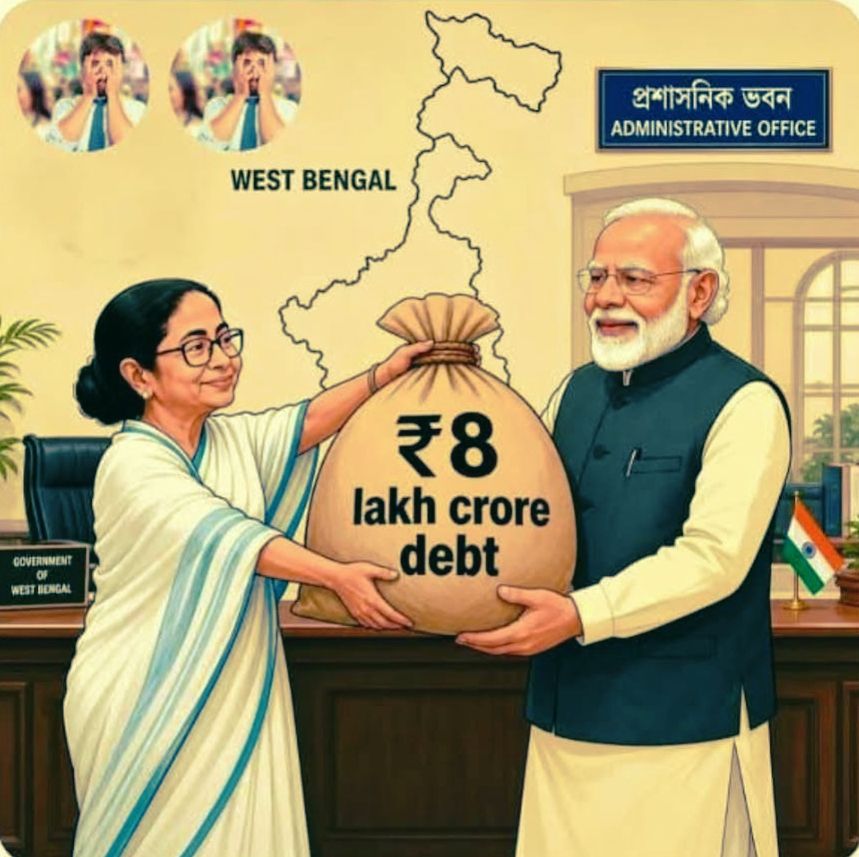
All three states are borrowers. None is fiscally pure. The difference lies in design.
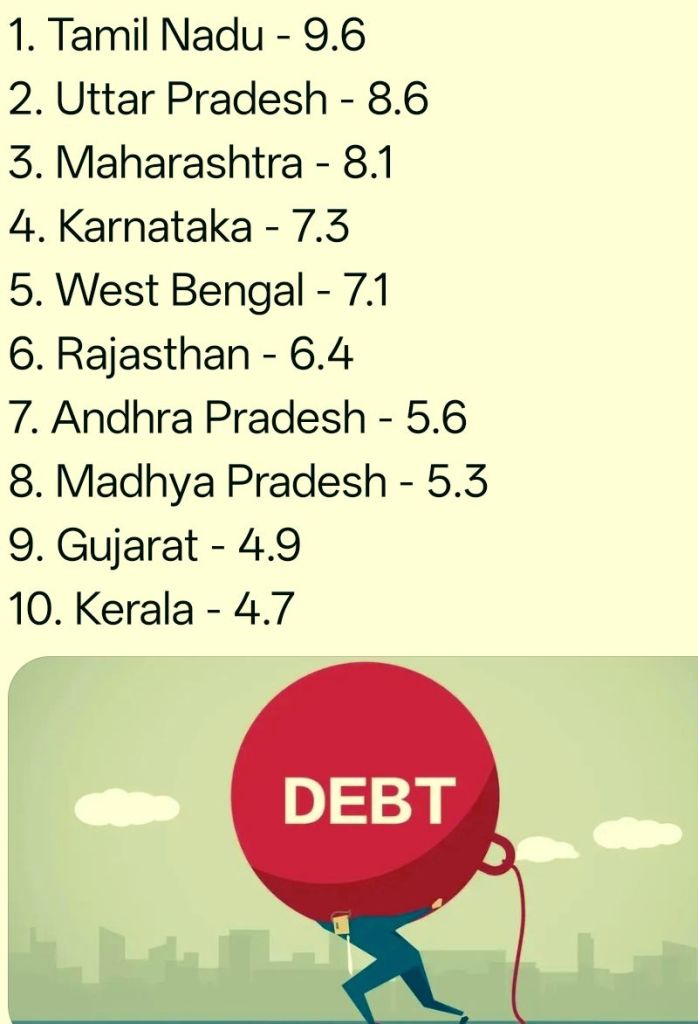
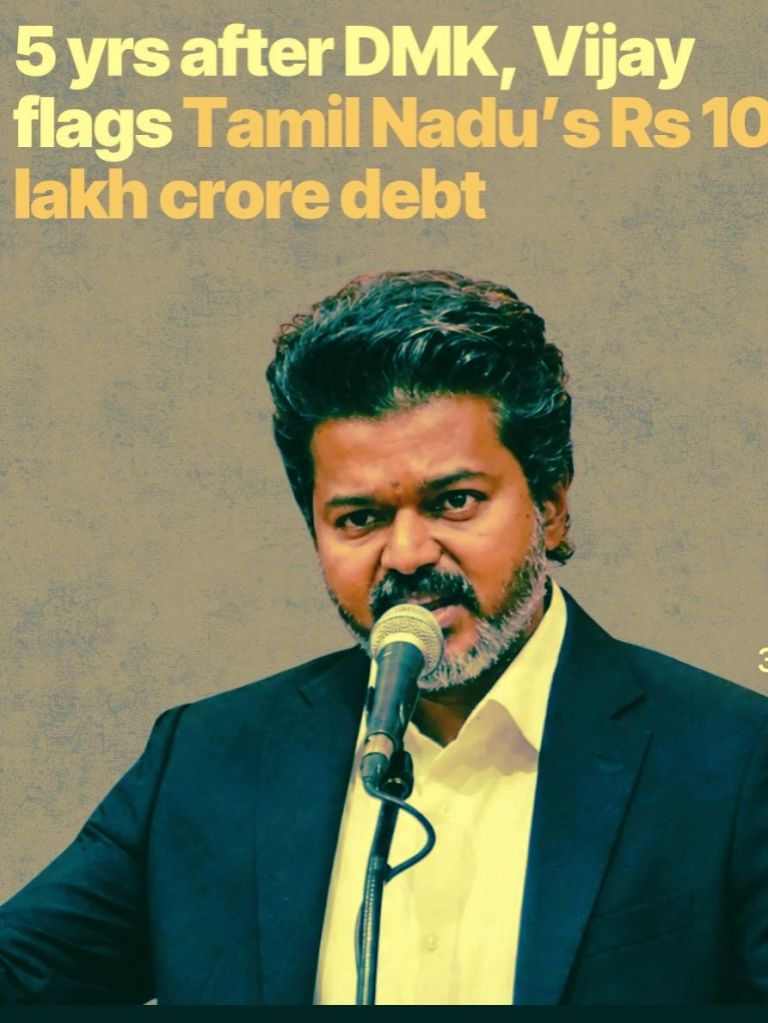
Tamil Nadu’s debt-to-GSDP ratio has risen but stabilised around 29–30 percent—manageable by Indian standards. Yet the more significant feature is that Tamil Nadu’s capital expenditure has expanded in parallel. This parallel rise is the signature of productive borrowing. Roads, ports, industrial corridors, power systems, and urban infrastructure are not decorative trophies for election brochures. They are fiscal investments designed to generate returns through higher growth and a stronger tax base. In Tamil Nadu’s model, debt has behaved more like an engine than a chain. The incoming government inherits not merely a budget, but an economic machine with momentum.
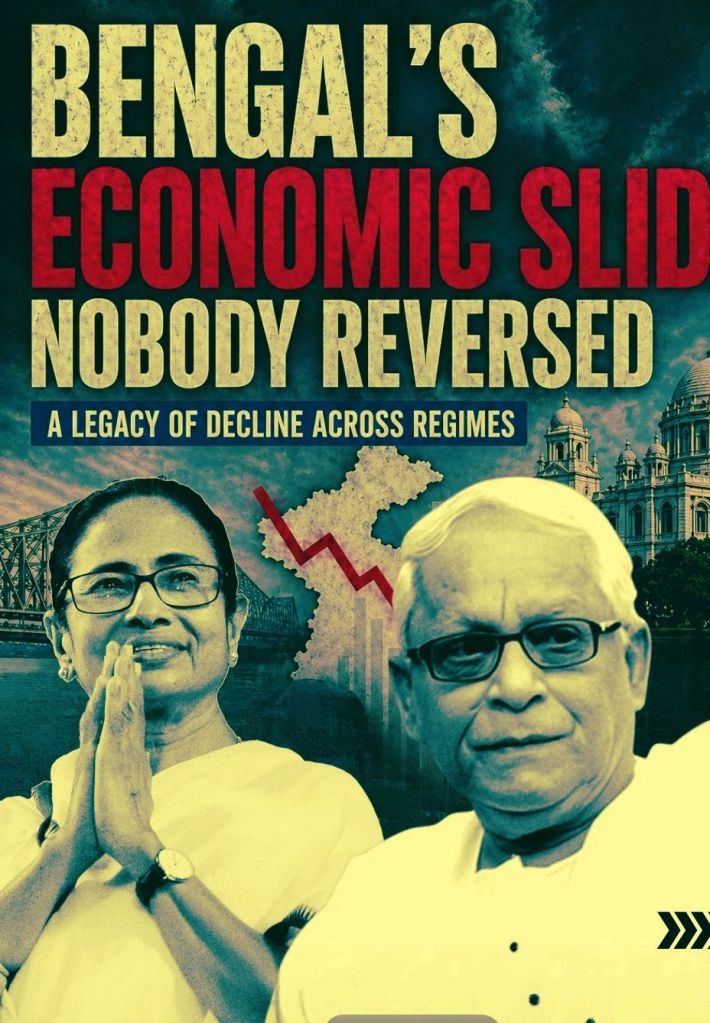
West Bengal entered this period with a heavier burden, once exceeding 40 percent of GSDP—among the highest in India. The state has increased capital expenditure in recent years, which is a positive shift. But the investment base was low to begin with, and the private investment multiplier has not followed with sufficient force. Bengal has started building, but not at a scale large enough to escape its own gravitational pull. Its inheritance is therefore incomplete transformation: the opening chapters of an infrastructure story without the full ecosystem that makes infrastructure profitable. It resembles constructing a railway line without ensuring industries will ever use it.
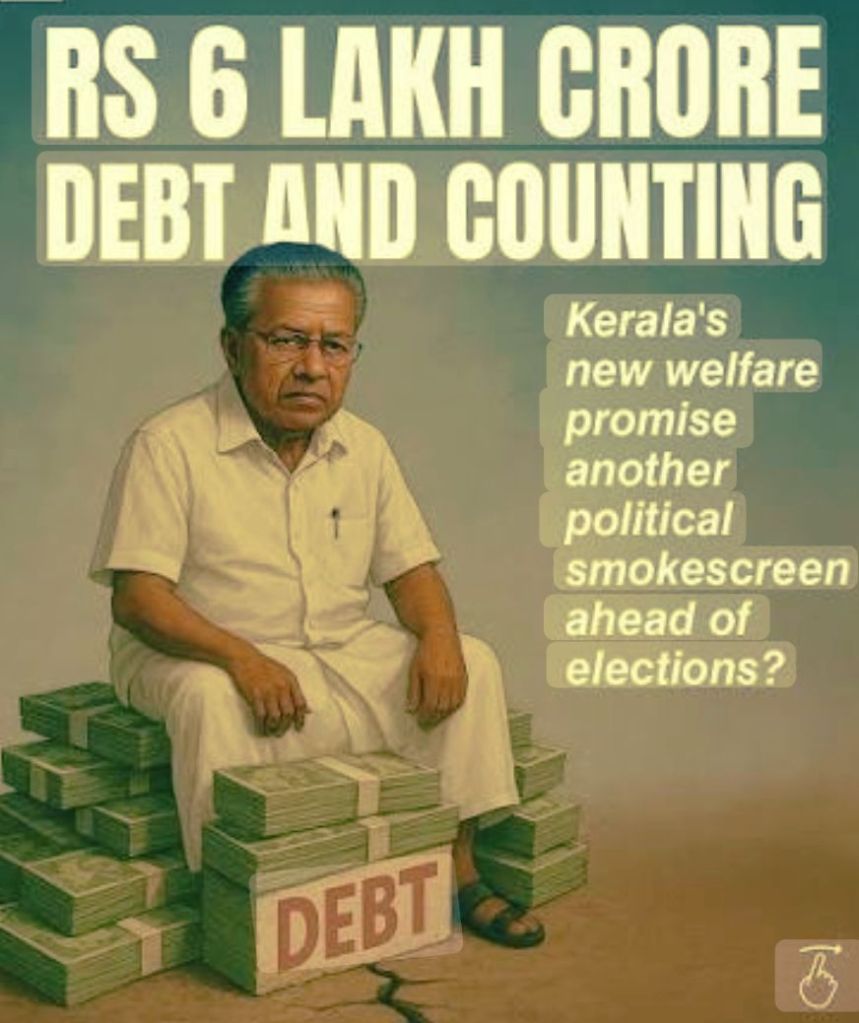
Kerala’s fiscal inheritance is the most structurally alarming. Debt has climbed to nearly 37–38 percent of GSDP, but capital expenditure has not risen proportionately. Borrowing has continued, but asset creation has not kept pace. This is the difference between borrowing to build a bridge and borrowing to fund the daily traffic on an old one. Borrowing to finance salaries, pensions, welfare transfers, and interest payments may be politically stabilising, but it does not expand productive capacity. It expands only future obligations. Kerala increasingly resembles a state consuming its tomorrow to preserve its today.
The most brutal indicator of constraint is not total debt, but the interest burden—how much of revenue receipts is swallowed before the government can even make a single fresh policy decision. Interest payments are the silent tax on ambition. They do not build schools, roads, hospitals, or jobs. They merely pay yesterday’s invoice.
West Bengal once carried an interest burden nearing 28–29 percent of revenue receipts, meaning over a quarter of its income was pre-committed to creditors. Over time, Bengal reduced this burden to levels closer to Tamil Nadu and Kerala. That is a genuine fiscal achievement. But it arrived with an unforgiving trade-off: interest reduction was partly achieved through restrained development spending. Bengal lowered pressure by building less. For a state already behind in infrastructure and industrial competitiveness, this stabilisation came at a developmental cost that now haunts its future.
Kerala has moved in the opposite direction. Since around 2018, interest payments have climbed sharply, remaining above 22 percent of revenue receipts. That number is not a statistic—it is a cage. When interest consumes one-fifth or more of state revenue, fiscal sovereignty begins to evaporate. The government becomes an administrator of old promises rather than an architect of new growth. Tamil Nadu, despite its ambitious borrowing, has kept its interest burden comparatively contained—suggesting that productive borrowing has protected its revenue capacity.
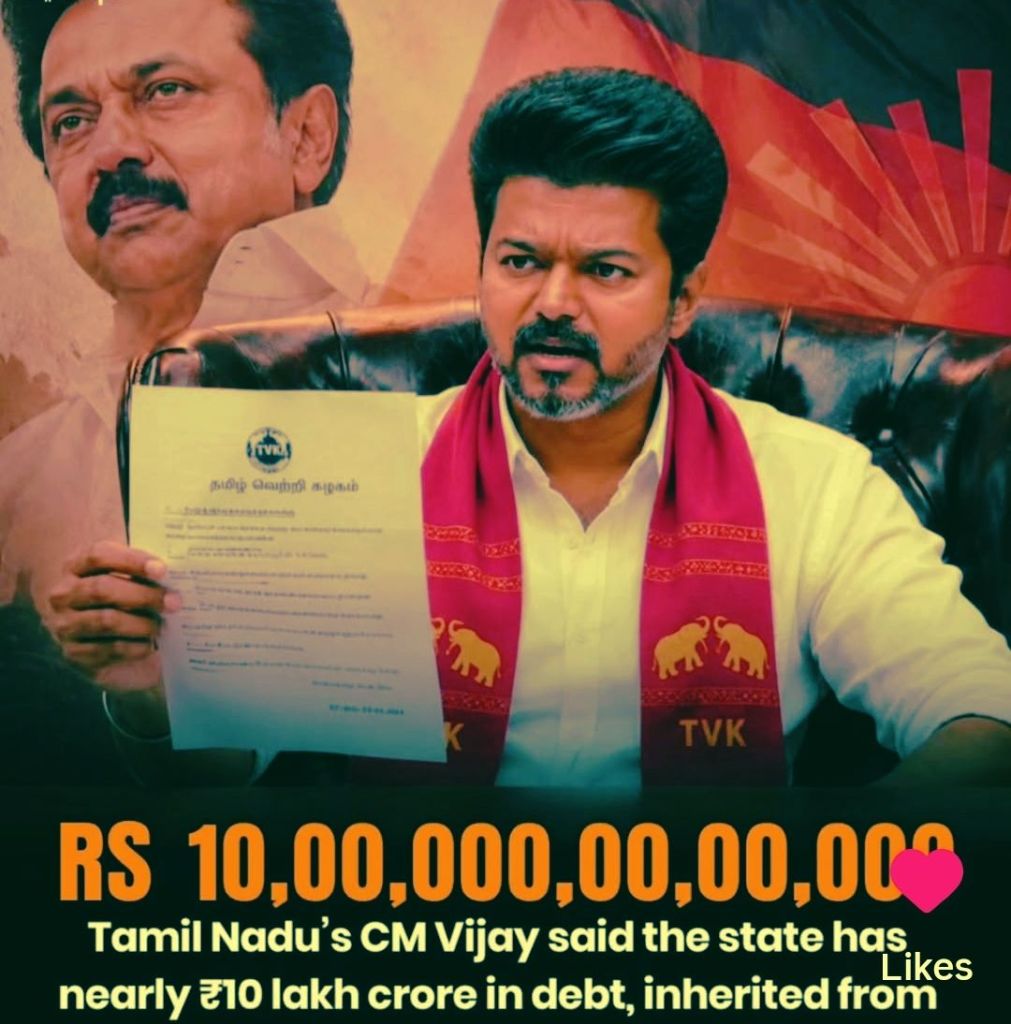
But fiscal health cannot be separated from the structure of the economy itself. The ability to repay debt is not created by speeches. It is created by industries, jobs, exports, and taxable growth.
Tamil Nadu holds a rare Indian advantage: a large services economy anchored to a robust manufacturing base, with manufacturing contributing roughly 22–25 percent of output. This matters because manufacturing produces dense economic linkages—suppliers, logistics, ancillaries, skilled labour markets, export channels. It creates scalable tax revenues and stable employment. Tamil Nadu’s industrial ecosystem is not merely an economic success; it is a fiscal shield. The new government inherits an economy capable of paying for its ambitions.
Kerala’s structure is the opposite: services dominate at over 55 percent, while manufacturing stagnates around 10–12 percent. Kerala’s prosperity has leaned heavily on remittance-supported consumption and public expenditure. Remittances are real, but consumption does not create industrial depth. It does not permanently expand the tax base required to finance a high-welfare state. Kerala’s fiscal stress is therefore not merely a short-term liquidity problem—it is a structural contradiction between welfare ambition and productive capacity.
West Bengal sits between these two worlds. Manufacturing has improved since 2016, reaching around 17–18 percent. That is encouraging, but it has not yet produced the investment ecosystems that generate sustained multipliers. Bengal’s new government inherits not only a budget but the long shadow of industrial decline. Its challenge is existential: can political change reverse economic path dependence, or will it merely administer stagnation with a different face?
Yet even Tamil Nadu, the apparent winner in this comparison, carries a warning label. Subsidies have expanded sharply since 2021–22, nearing ₹60,000 crore, exceeding both Kerala and West Bengal in absolute terms. This reflects India’s new fiscal reality: competitive welfare politics, where every election adds another permanent entitlement—free transport, subsidised electricity, cash transfers. Such measures may be socially meaningful, but they accumulate into structural weight. Tamil Nadu’s advantage is that its industrial base gives it greater capacity to absorb the burden. But even Tamil Nadu faces the central question: will welfare begin to crowd out capital expenditure, slowly weakening the very engine that made it strong?
This is the true inheritance across these three states. Tamil Nadu receives the strongest fiscal architecture, but also the greatest temptation to overextend. Kerala inherits the most dangerous contradiction: rising debt, rising interest burden, and a growth model tilted toward consumption rather than production. West Bengal inherits a fragile industrial foundation and the hard task of proving that political change can become economic transformation.
The deeper lesson is brutally simple: debt is not destiny. What matters is whether debt builds assets that generate returns, or finances consumption that generates only obligations. Elections decide who governs. But the quality of borrowing decides whether governance can deliver at all. And in the end, the harshest election is not held at the ballot box—it is held every year in the budget.
VISIT ARJASRIKANTH.IN FOR MORE INSIGHTS

